

What you'll learn
- What intermolecular forces are, and how they differ from covalent, ionic and metallic bonding.
- How molecular polarity leads to permanent dipole-dipole forces.
- How London forces and hydrogen bonding arise.
- How to explain boiling points, volatility and solubility using intermolecular forces.
The big idea: forces between molecules
A simple molecular substance is made of separate molecules. Within each molecule, atoms are held together by strong covalent bonds. Between neighbouring molecules, there are much weaker attractions called intermolecular forces.
Intermolecular force
An intermolecular force is an attraction between separate molecules. It is not the same as a covalent bond within a molecule.
When a simple molecular substance boils, molecules move away from each other. The covalent bonds inside the molecules usually stay intact; it is the intermolecular forces that are overcome.
Boiling does not break covalent bonds
Saying “the covalent bonds break when water boils” is incorrect for A-Level Chemistry. In boiling water, H₂O molecules separate from each other, but the O–H covalent bonds within each water molecule remain.
Prerequisite: electronegativity and polarity
Electronegativity is the ability of an atom to attract the bonding pair of electrons in a covalent bond.
Polar bond
A polar bond is a covalent bond where the bonding electrons are shared unequally, giving one atom a partial negative charge, δ−, and the other a partial positive charge, δ+.
For example, in H–Cl, chlorine is more electronegative than hydrogen. The bonding pair is pulled closer to Cl, so Cl is δ− and H is δ+.
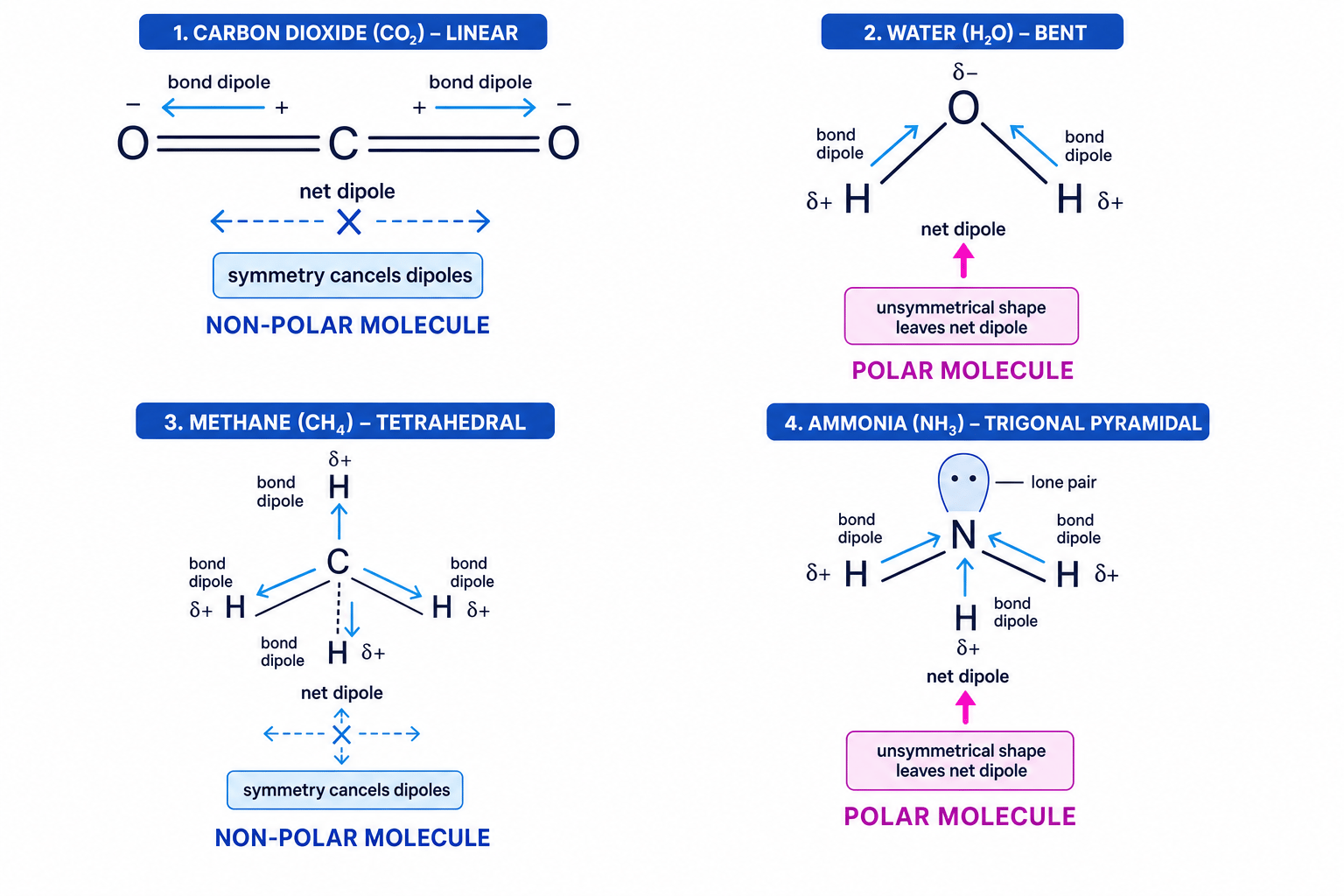
A bond dipole is the separation of partial charges across a polar bond. A molecule is only polar overall if its bond dipoles do not cancel out.
Polarity depends on bonds and shape
To decide whether a molecule is polar, consider both polar bonds and the 3D shape of the molecule. Symmetrical molecules can have polar bonds but no overall dipole.
Deciding whether a molecule is polar
Compare tetrachloromethane, CCl₄, and trichloromethane, CHCl₃.
-
Identify the shapes. Both molecules have four bonding pairs around carbon, so each has a tetrahedral arrangement.
-
Consider the bond dipoles. C–Cl bonds are polar because chlorine is more electronegative than carbon.
-
In CCl₄, all four bonds are the same and arranged symmetrically, so the bond dipoles cancel. CCl₄ is non-polar overall.
-
In CHCl₃, the molecule is not symmetrical because one bond is C–H and three are C–Cl. The dipoles do not cancel, so CHCl₃ is polar overall.
The three main intermolecular forces
For Edexcel A-Level Chemistry, you should be confident with:
| Intermolecular force | Found in | Key idea |
|---|---|---|
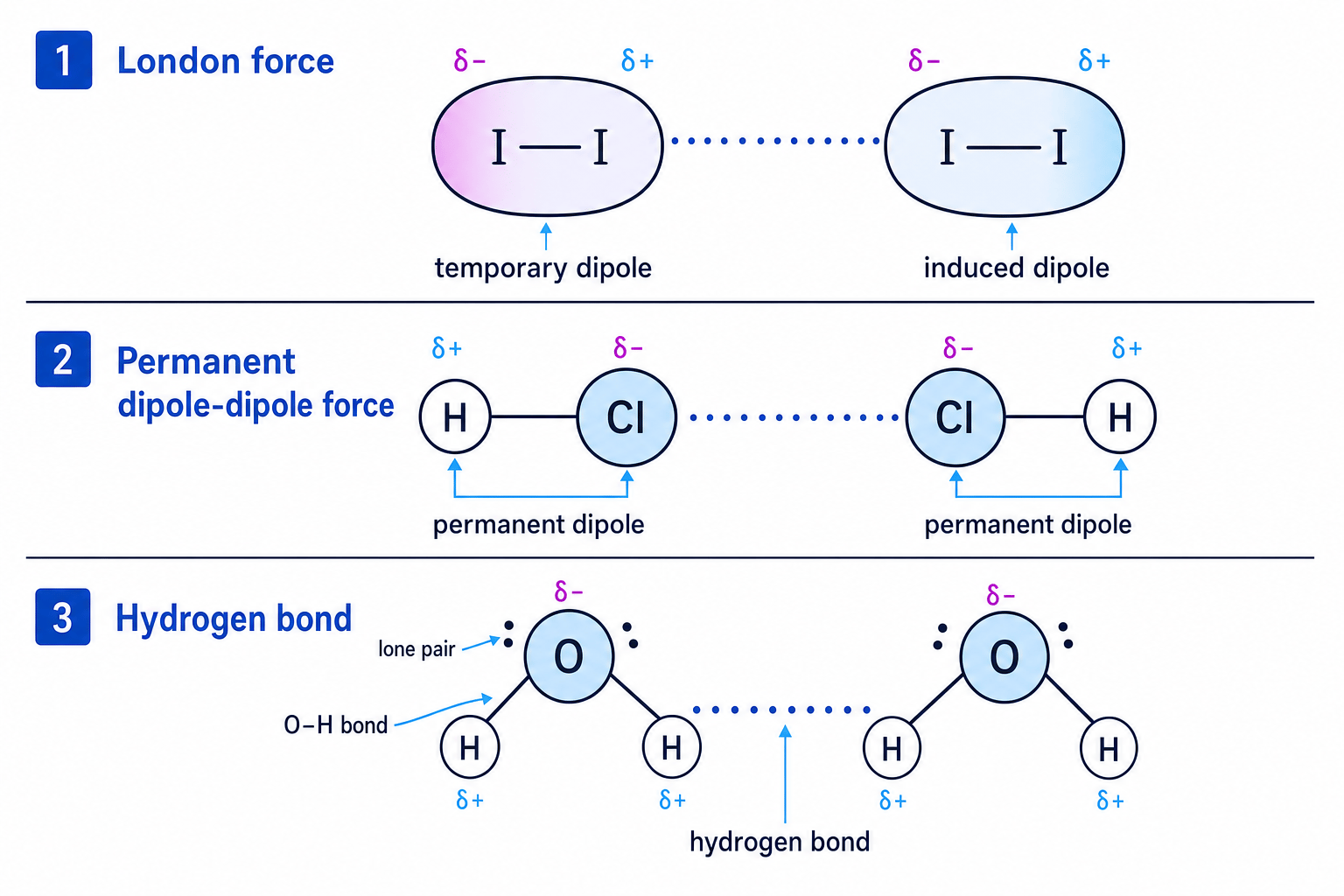
| London forces | All atoms and molecules | Temporary dipoles induce dipoles in neighbours |
| Permanent dipole-dipole forces | Polar molecules | δ+ end of one molecule attracts δ− end of another |
| Hydrogen bonds | Molecules with H directly bonded to N, O or F | Strong attraction to a lone pair on N, O or F |
London forces
London forces are also called instantaneous dipole-induced dipole forces.
Electrons in atoms and molecules are always moving. At any instant, the electron cloud may be unevenly distributed, creating a temporary instantaneous dipole. This dipole can repel or attract electrons in a neighbouring molecule, creating an induced dipole. The two temporary dipoles attract.
London force
A London force is an intermolecular attraction caused by an instantaneous dipole in one particle inducing a dipole in a neighbouring particle.
London forces are present between all atoms and molecules, including non-polar molecules and noble gases.
The strength of London forces increases when:
- the molecule has more electrons;
- the electron cloud is more easily distorted, meaning it is more polarizable;
- molecules have a larger surface area in contact with each other.
Explaining the boiling points of the halogens
Explain why the boiling points increase from fluorine to iodine: F₂, Cl₂, Br₂, I₂.
-
All four molecules are non-polar diatomic molecules, so their main intermolecular forces are London forces.
-
Down the group, the molecules have more electrons and larger electron clouds: I₂ has many more electrons than F₂.
-
Larger electron clouds are more polarizable, so stronger instantaneous and induced dipoles form.
-
Stronger London forces require more energy to overcome, so boiling point increases from F₂ to I₂.
London forces are not always weak overall
A single London force is weak, but large molecules can have many London forces. This is why large non-polar molecules can have surprisingly high boiling points.
Permanent dipole-dipole forces
A permanent dipole exists in a polar molecule because the molecule has a permanent δ+ end and δ− end.
In a liquid or solid, polar molecules can line up so that the δ+ end of one molecule is attracted to the δ− end of another. This is a permanent dipole-dipole force.
Permanent dipole-dipole force
A permanent dipole-dipole force is an attraction between the δ+ end of one polar molecule and the δ− end of another polar molecule.
Permanent dipole-dipole forces are usually stronger than London forces between molecules of similar size, but you must compare the whole molecule, not just the type of force.
Comparing similar-sized molecules
Propanone, CH₃COCH₃, and butane, C₄H₁₀, have similar relative molecular masses. Explain why propanone has the higher boiling point.
-
Since the molecules are similar in size, their London forces are broadly comparable.
-
Butane is non-polar overall, so it only has London forces between its molecules.
-
Propanone has a polar C=O bond and an overall molecular dipole, so it has permanent dipole-dipole forces as well as London forces.
-
More energy is needed to overcome the stronger overall intermolecular forces in propanone, so propanone has the higher boiling point.
Do not rank by force type alone
A small polar molecule does not automatically have a higher boiling point than a much larger non-polar molecule. Size, number of electrons and shape all affect London forces.
Hydrogen bonding
Hydrogen bonding is a particularly strong type of intermolecular attraction.
It happens when hydrogen is covalently bonded to one of the very electronegative atoms nitrogen, oxygen or fluorine. The H atom becomes strongly δ+ and is attracted to a lone pair on N, O or F in a neighbouring molecule.
Hydrogen bond
A hydrogen bond is an attraction between a δ+ hydrogen atom covalently bonded to N, O or F, and a lone pair on N, O or F in a neighbouring molecule.
Common molecules that form hydrogen bonds include water, H₂O, ammonia, NH₃, hydrogen fluoride, HF, alcohols such as ethanol, CH₃CH₂OH, and carboxylic acids such as ethanoic acid, CH₃COOH.
Not every H-containing molecule hydrogen bonds
Hydrogen bonding requires H directly bonded to N, O or F. Methane, CH₄, does not hydrogen bond. Hydrogen chloride, HCl, is treated as having permanent dipole-dipole forces, not hydrogen bonding, at A-Level.
Identifying hydrogen bonding
Decide whether ethanol, CH₃CH₂OH, and methoxymethane, CH₃OCH₃, can form hydrogen bonds between their own molecules.
-
Ethanol contains an O–H bond, so it has a δ+ hydrogen directly bonded to oxygen.
-
Ethanol also has lone pairs on oxygen, so neighbouring ethanol molecules can form O–H···O hydrogen bonds.
-
Methoxymethane has oxygen with lone pairs, but it has no O–H bond because its hydrogens are bonded to carbon.
-
Therefore ethanol can hydrogen bond with itself, but methoxymethane cannot hydrogen bond between its own molecules.
Intermolecular forces and boiling point
Boiling point depends on the energy needed to separate molecules from each other.
Stronger intermolecular forces mean:
- higher boiling point;
- lower volatility;
- higher viscosity, in many liquids;
- higher surface tension, in many liquids.
Volatility
Volatility is how easily a substance evaporates. A more volatile liquid evaporates more easily and usually has a lower boiling point.
Ranking boiling points
Rank propane, CH₃CH₂CH₃, methoxymethane, CH₃OCH₃, and ethanol, CH₃CH₂OH, from lowest to highest boiling point.
-
The molecules have similar relative molecular masses, so comparing the strongest intermolecular forces is useful.
-
Propane is non-polar, so it has London forces only.
-
Methoxymethane is polar due to C–O bonds, so it has London forces and permanent dipole-dipole forces.
-
Ethanol contains an O–H bond, so ethanol molecules form hydrogen bonds as well as London forces.
-
The order of increasing boiling point is: propane < methoxymethane < ethanol.
Boiling point explanation sentence
For a molecular substance: stronger intermolecular forces require more energy to overcome, so the boiling point is higher.
Hydrogen bonding and water
Water has unusually high boiling point for such a small molecule because each H₂O molecule can form hydrogen bonds with neighbouring water molecules.
Hydrogen bonding also explains why ice is less dense than liquid water. In ice, hydrogen bonds hold water molecules in a more open structure. When ice melts, some of this structure collapses, so the molecules pack closer together.
This is why ice floats on water.
Intermolecular forces and solubility
Solubility depends on whether favourable attractions can form between solute particles and solvent molecules.
A useful rule is “like dissolves like”:
- polar substances tend to dissolve in polar solvents, such as water;
- substances that can hydrogen bond often dissolve well in water;
- non-polar substances tend to dissolve better in non-polar solvents.
Explaining alcohol solubility in water
Explain why ethanol is much more soluble in water than hexan-1-ol.
-
Both ethanol and hexan-1-ol contain an O–H group, so both can form hydrogen bonds with water.
-
Ethanol has a short hydrocarbon chain, so the polar O–H group has a large effect on the whole molecule.
-
Hexan-1-ol has a much longer non-polar hydrocarbon chain, which cannot hydrogen bond with water.
-
As the non-polar part becomes larger, water-solubility decreases, so ethanol is much more soluble than hexan-1-ol.
In the exam
-
First decide whether the substance is simple molecular. If it is, discuss intermolecular forces rather than breaking covalent bonds.
-
When comparing boiling points, mention both type of force and molecular size/number of electrons where relevant.
-
For hydrogen bonding, explicitly state “H bonded to N, O or F” and “lone pair on N, O or F”.
Check yourself
- Why is CO₂ non-polar even though each C=O bond is polar?
- Which intermolecular forces are present between HCl molecules?
- Why does ethanol have a higher boiling point than methoxymethane even though they have the same molecular formula?
