

What you'll learn
- How molecular shape is predicted using electron-pair repulsion.
- The main structure types: giant ionic, simple molecular, giant covalent and metallic.
- How to explain melting point, boiling point, brittleness and electrical conductivity from structure.
- How to deduce an unknown structure from physical-property data.
What “structure” means in chemistry
In this topic, you are not just naming a substance — you are explaining how its particles are arranged and why that arrangement gives particular properties.
A particle is the small unit you are talking about: it could be an atom, ion, molecule or electron, depending on the substance.
Structure
A chemical structure is the three-dimensional arrangement of particles and the attractions holding those particles together.
A bond is an attraction between particles. A structure is the wider pattern made by many particles and bonds or forces. In exam answers, you usually need both: what particles are present and what forces act between them.
Molecular shape: electron-pair repulsion
Covalent molecules are not flat drawings in real life. Their bonds point in three-dimensional directions.
The key model is electron-pair repulsion theory, often called VSEPR: valence shell electron pair repulsion. It says that pairs of electrons around a central atom repel each other and arrange themselves as far apart as possible.
Electron domain
An electron domain is a region of electron density around a central atom. A single, double or triple bond counts as one domain, and a lone pair also counts as one domain.
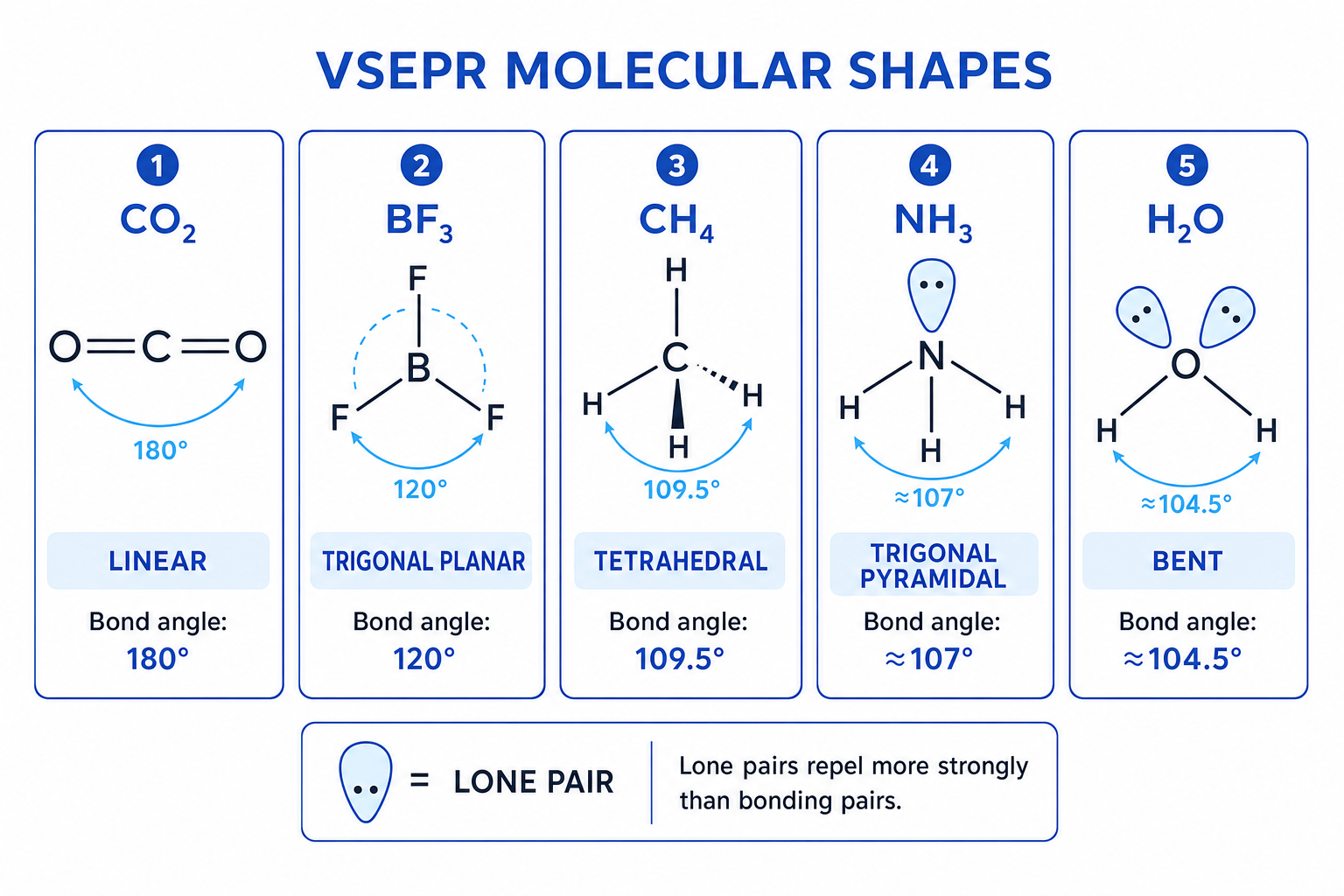
Key shapes you should recognise
- Linear: two bonding domains, 180°, for example CO₂.
- Trigonal planar: three bonding domains, 120°, for example BF₃.
- Tetrahedral: four bonding domains, 109.5°, for example CH₄.
- Trigonal pyramidal: three bonding pairs and one lone pair, about 107°, for example NH₃.
- Bent or non-linear: two bonding pairs and two lone pairs, about 104.5°, for example H₂O.
Lone pairs repel more strongly than bonding pairs. This is why NH₃ and H₂O have bond angles slightly smaller than the perfect tetrahedral angle of 109.5°.
Counting double bonds
For VSEPR, a double bond counts as one electron domain around the central atom, not two. CO₂ has two domains around carbon, so it is linear.
Predicting the shape of ammonia
-
Nitrogen is the central atom in NH₃. It forms three N-H single bonds, so there are three bonding pairs around nitrogen.
-
Nitrogen has five outer-shell electrons. After forming three bonds, one pair remains as a lone pair, giving four electron domains in total.
-
Four electron domains arrange themselves tetrahedrally to minimise repulsion.
-
The shape is named using the positions of the atoms, not the lone pair, so NH₃ is trigonal pyramidal.
-
The lone pair repels more strongly than the bonding pairs, so the H-N-H bond angle is compressed to about 107°.
Solid structures: lattices and networks
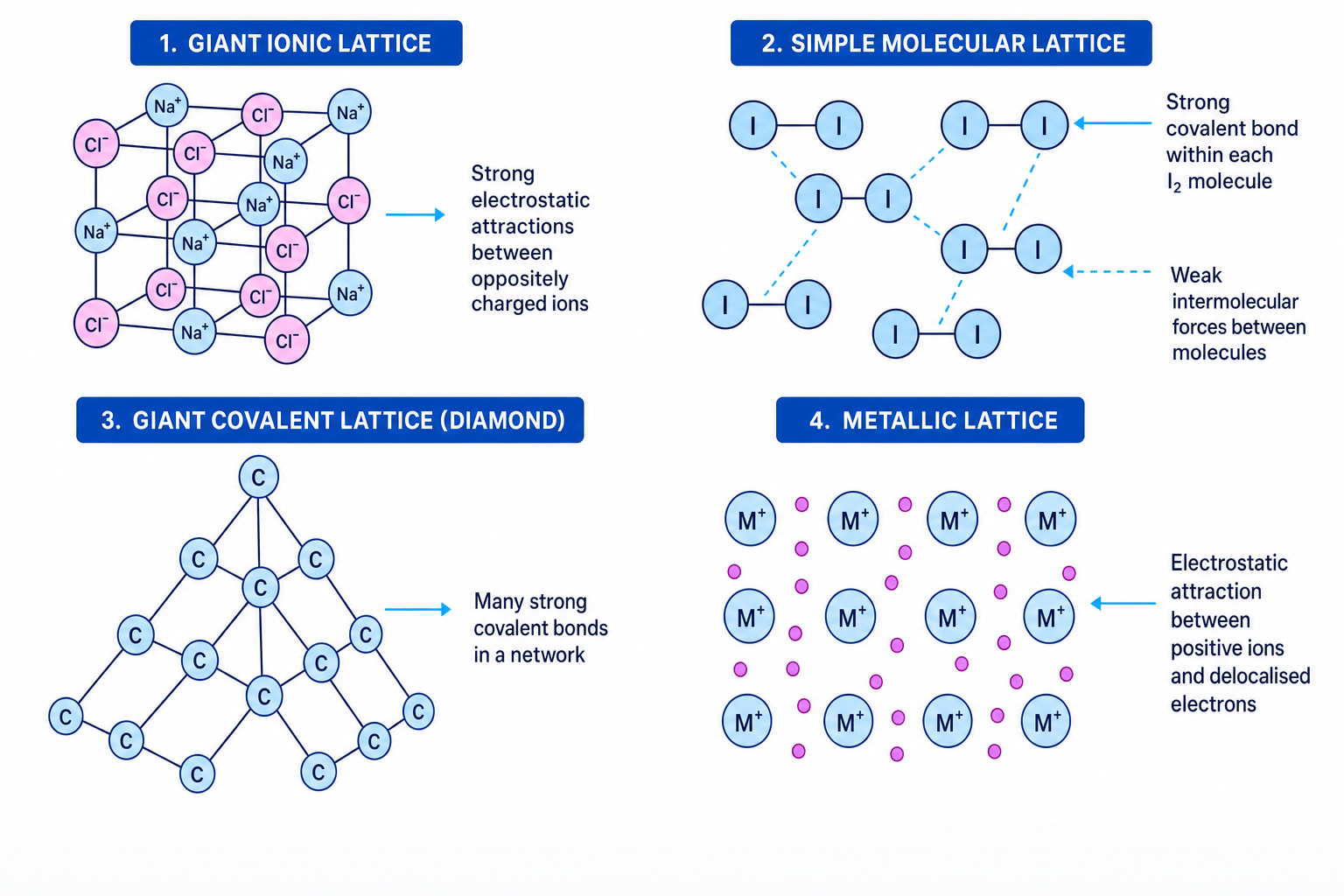
A lattice is a regular repeating arrangement of particles. Many solids have lattice structures, but the particles and forces differ from one structure type to another.
Giant ionic structures
An ionic compound contains positive ions and negative ions. In a giant ionic lattice, oppositely charged ions are arranged in a repeating pattern and held by strong electrostatic attractions in all directions.
Examples include sodium chloride, NaCl, and magnesium oxide, MgO.
Because the attractions are strong and extend throughout the lattice, ionic compounds usually have:
- high melting points and boiling points
- brittle crystals
- no electrical conductivity when solid
- electrical conductivity when molten or in aqueous solution, meaning dissolved in water
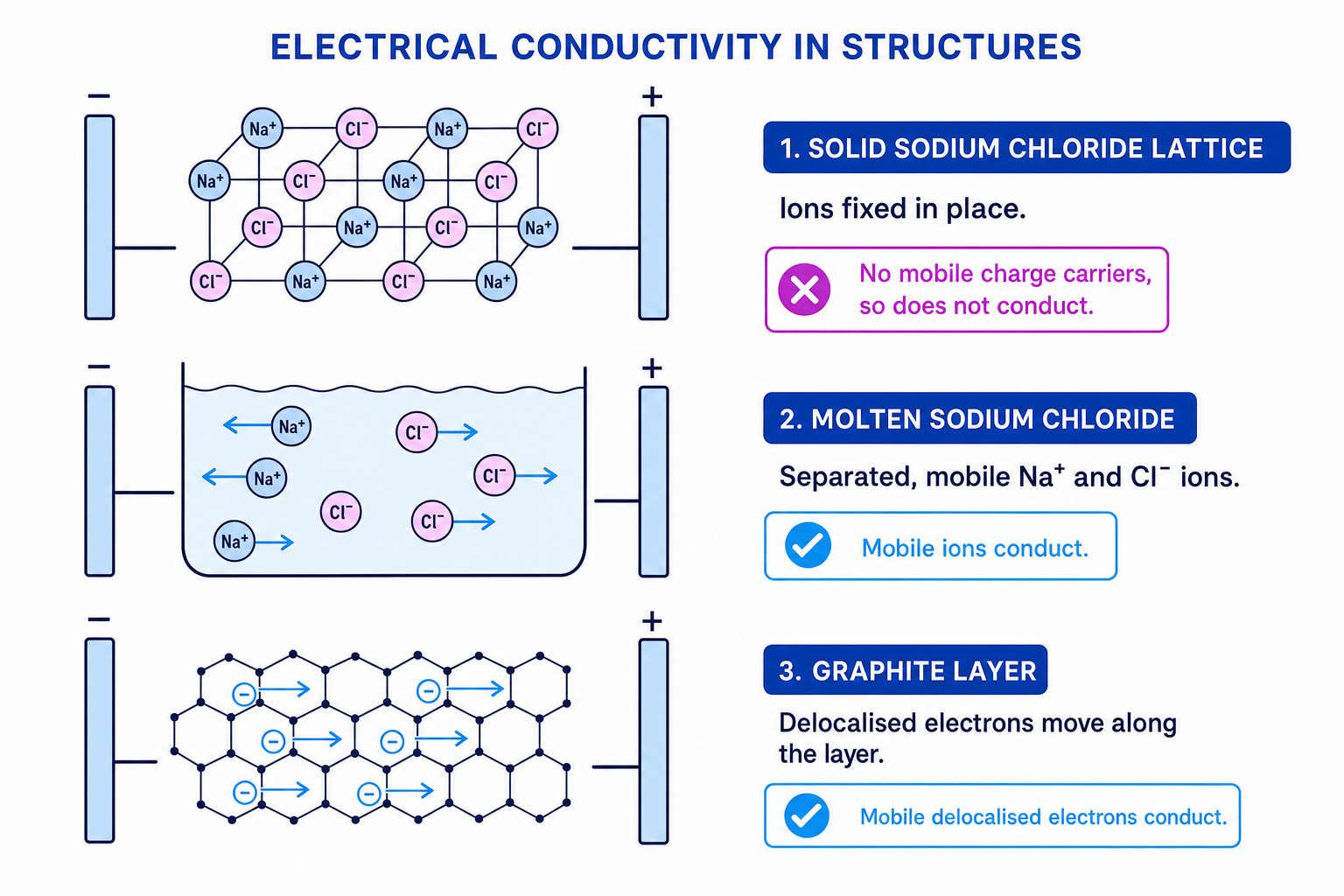
They do not conduct as solids because the ions are fixed in place. They conduct when molten, NaCl(l), or aqueous, NaCl(aq), because the ions are free to move and carry charge.
Simple molecular structures
A simple molecular substance is made of small molecules. The atoms inside each molecule are joined by strong covalent bonds, but the separate molecules are held together by weaker intermolecular forces.
Intermolecular forces
Intermolecular forces are attractions between separate molecules. They are usually much weaker than covalent bonds within molecules.
Examples include iodine, I₂, carbon dioxide, CO₂, oxygen, O₂, and water, H₂O.
Simple molecular substances usually have low melting points and boiling points because only the intermolecular forces need to be overcome when they melt or boil. They usually do not conduct electricity because they have no mobile charged particles.
Boiling simple molecules
Do not say covalent bonds break when iodine boils or water evaporates. The covalent bonds within each molecule remain; the intermolecular forces between molecules are overcome.
Explaining the boiling point trend in the halogens
-
F₂, Cl₂, Br₂ and I₂ are all simple molecular substances. Their molecules are non-polar, so the main intermolecular forces are London forces.
-
Going from F₂ to I₂, the molecules have more electrons and larger electron clouds.
-
Larger electron clouds are more easily distorted, so stronger London forces form between molecules.
-
More energy is needed to overcome these stronger intermolecular forces, so boiling points increase from F₂ to I₂.
Giant covalent structures
A giant covalent structure is a huge network of atoms joined by many strong covalent bonds. These are sometimes called macromolecular structures.
Examples you should know:
- Diamond: each carbon atom forms four covalent bonds to other carbon atoms. It is very hard, has a very high melting point and does not conduct electricity.
- Graphite: each carbon atom forms three covalent bonds in layers. One electron per carbon atom is delocalised, so graphite conducts electricity along the layers.
- Silicon dioxide, SiO₂: a giant covalent network with a high melting point and no mobile charged particles, so it does not conduct.
Delocalised electron
A delocalised electron is not fixed between two particular atoms. It can move through part or all of a structure and may carry charge.
Graphite is a useful exception: it has a high melting point because each layer contains strong covalent bonds, but it is soft and slippery because weak forces act between the layers.
Metallic structures
A metallic structure contains positive metal ions in a regular lattice, surrounded by delocalised electrons.
The attraction between the positive metal ions and delocalised electrons is called metallic bonding.
Metals usually:
- conduct electricity as solids and liquids because delocalised electrons can move
- have high melting points, although this varies between metals
- are malleable and ductile because layers of metal ions can slide while metallic bonding is maintained
Conductivity needs mobile charge carriers
A substance conducts electricity only if it contains charged particles that can move. These are usually mobile ions or mobile electrons.
Deducing structure from properties
A big A-Level skill is working backwards from data. Do not rely on one property alone: high melting point could suggest ionic, giant covalent or metallic structure. Conductivity and mechanical properties help you decide.
Deducing a structure from physical properties
A solid has a high melting point. It is brittle. It does not conduct electricity when solid, but it conducts when molten.
-
A high melting point suggests strong attractions throughout the solid, so a simple molecular structure is unlikely.
-
The solid does not conduct, so it does not contain mobile electrons like a metal or graphite.
-
The molten substance conducts, so it must contain charged particles that become mobile when the lattice breaks down.
-
Brittleness supports an ionic lattice: when layers shift, ions with the same charge line up and repel.
-
The substance is best described as a giant ionic lattice.
Explaining brittleness and malleability
Ionic crystals are brittle. If a layer of ions is displaced, ions with the same charge may become adjacent. Like charges repel, so the crystal splits.
Metals are malleable. When layers of positive ions slide, the delocalised electrons still attract the ions, so the metal changes shape rather than shattering.
Use the structure-property chain
A strong explanation usually follows this chain: particles → arrangement → forces → energy or mobility → property.
In the exam
-
Name the structure type, then identify the particles present: ions, molecules, atoms, metal ions or delocalised electrons.
-
For melting and boiling points, say which forces are overcome and whether they are strong or weak.
-
For conductivity, always state the mobile charge carrier: ions in molten or aqueous ionic compounds, electrons in metals and graphite.
Check yourself
- Why does solid sodium chloride not conduct electricity, but molten sodium chloride does?
- What shape and bond angle would you predict for H₂O, and why is the angle smaller than 109.5°?
- A substance has a low boiling point and does not conduct electricity in any state. What structure type is most likely?
