

What you'll learn
- How to assign oxidation states using a reliable set of rules.
- How to decide what is oxidised and what is reduced.
- How to write balanced redox half-equations and combine them.
- How to recognise disproportionation reactions.
The starting point: charges and electrons
A chemical species is any particle you are discussing: an atom, molecule or ion.
Electrons are negatively charged. If a species loses electrons, it becomes more positive. If a species gains electrons, it becomes more negative. This is the foundation of redox chemistry.
Redox
A redox reaction is a reaction involving electron transfer. Oxidation is loss of electrons, and reduction is gain of electrons.
At A Level, you usually detect electron transfer by tracking oxidation states.
Oxidation states
Oxidation state
An oxidation state, also called an oxidation number, is a book-keeping number assigned to an atom in a species. It is the charge the atom would have if bonding electrons were assigned to the more electronegative atom, where electronegativity means attraction for bonding electrons.
Oxidation states are not always real charges. For example, sulfur in sulfate does not exist as a separate S⁶⁺ ion — the +6 is a formal number used to track redox changes.
Rules for assigning oxidation states
Use these in order:
- An uncombined element has oxidation state zero, e.g. Mg, O₂, Cl₂ and Fe.
- A simple ion has an oxidation state equal to its charge, e.g. Na⁺ is +1 and O²⁻ is −2.
- The sum of oxidation states in a neutral compound is zero.
- The sum of oxidation states in a polyatomic ion equals the overall ion charge.
- Group 1 metals are usually +1; Group 2 metals are usually +2; aluminium is usually +3.
- Fluorine is always −1 in its compounds.
- Oxygen is usually −2, except in peroxides such as H₂O₂ where it is −1, and in OF₂ where it is +2.
- Hydrogen is usually +1 with non-metals, but −1 in metal hydrides such as NaH.
- Halogens are usually −1, unless bonded to oxygen or fluorine.
The Roman numeral in names such as iron(III), sulfate(VI) and manganate(VII) gives the oxidation state of that element.
Charge notation versus oxidation-state notation
Charges are written with the sign after the number, such as Fe³⁺. Oxidation states are written with the sign before the number, such as +3.
Finding oxidation states in ions
-
For SO42−\text{SO}_4^{2-}SO42−, oxygen is normally −2 and the total oxidation states must equal the ion charge, −2: x+4(−2)=−2x + 4(-2) = -2x+4(−2)=−2.
-
Solve the equation: x−8=−2x - 8 = -2x−8=−2, so x=+6x = +6x=+6. Sulfur has oxidation state +6.
-
For ClO−\text{ClO}^-ClO−, oxygen is −2 and the total charge is −1: x+(−2)=−1x + (-2) = -1x+(−2)=−1.
-
Solve: x=+1x = +1x=+1. Chlorine has oxidation state +1, so ClO−\text{ClO}^-ClO− is the chlorate(I) ion.
Oxidation and reduction using oxidation states
Oxidation and reduction can be defined in terms of oxidation-state changes:
Oxidation-state changes
- Oxidation is an increase in oxidation state.
- Reduction is a decrease in oxidation state.
- The species that is oxidised loses electrons.
- The species that is reduced gains electrons.
An oxidising agent causes another species to be oxidised; it is itself reduced. A reducing agent causes another species to be reduced; it is itself oxidised.
OIL RIG plus oxidation states
OIL RIG still works: Oxidation Is Loss, Reduction Is Gain. In oxidation-state questions, also remember: oxidation means the number becomes more positive; reduction means the number becomes less positive.
Identifying oxidation, reduction and agents
For the ionic equation:
Zn(s)+Cu2+(aq)→Zn2+(aq)+Cu(s)\text{Zn(s)} + \text{Cu}^{2+}\text{(aq)} \to \text{Zn}^{2+}\text{(aq)} + \text{Cu(s)}Zn(s)+Cu2+(aq)→Zn2+(aq)+Cu(s)
-
Zinc starts as an element, so Zn has oxidation state zero. It ends as Zn2+\text{Zn}^{2+}Zn2+, so its oxidation state is +2. The oxidation state increases, so zinc is oxidised.
-
Copper starts as Cu2+\text{Cu}^{2+}Cu2+, so its oxidation state is +2. It ends as elemental copper, Cu, with oxidation state zero. The oxidation state decreases, so copper ions are reduced.
-
Zinc causes Cu2+\text{Cu}^{2+}Cu2+ to be reduced, so zinc is the reducing agent. Cu2+\text{Cu}^{2+}Cu2+ causes zinc to be oxidised, so Cu2+\text{Cu}^{2+}Cu2+ is the oxidising agent.
Ionic equations and spectator ions
An ionic equation shows only the species that actually change during a reaction. A spectator ion is present in solution but does not change, so it is left out of the ionic equation.
For example, in the reaction between zinc and copper(II) sulfate, the sulfate ions are spectators. The net ionic equation is the zinc/copper equation above.
Half-equations
Half-equation
A half-equation shows either the oxidation process or the reduction process separately, including the electrons transferred. It must be balanced for both atoms and overall charge.
The flowchart below summarises the half-equation method. It is especially useful for oxygen-containing ions such as manganate(VII), MnO4−\text{MnO}_4^-MnO4−, and dichromate(VI), Cr2O72−\text{Cr}_2\text{O}_7^{2-}Cr2O72−.
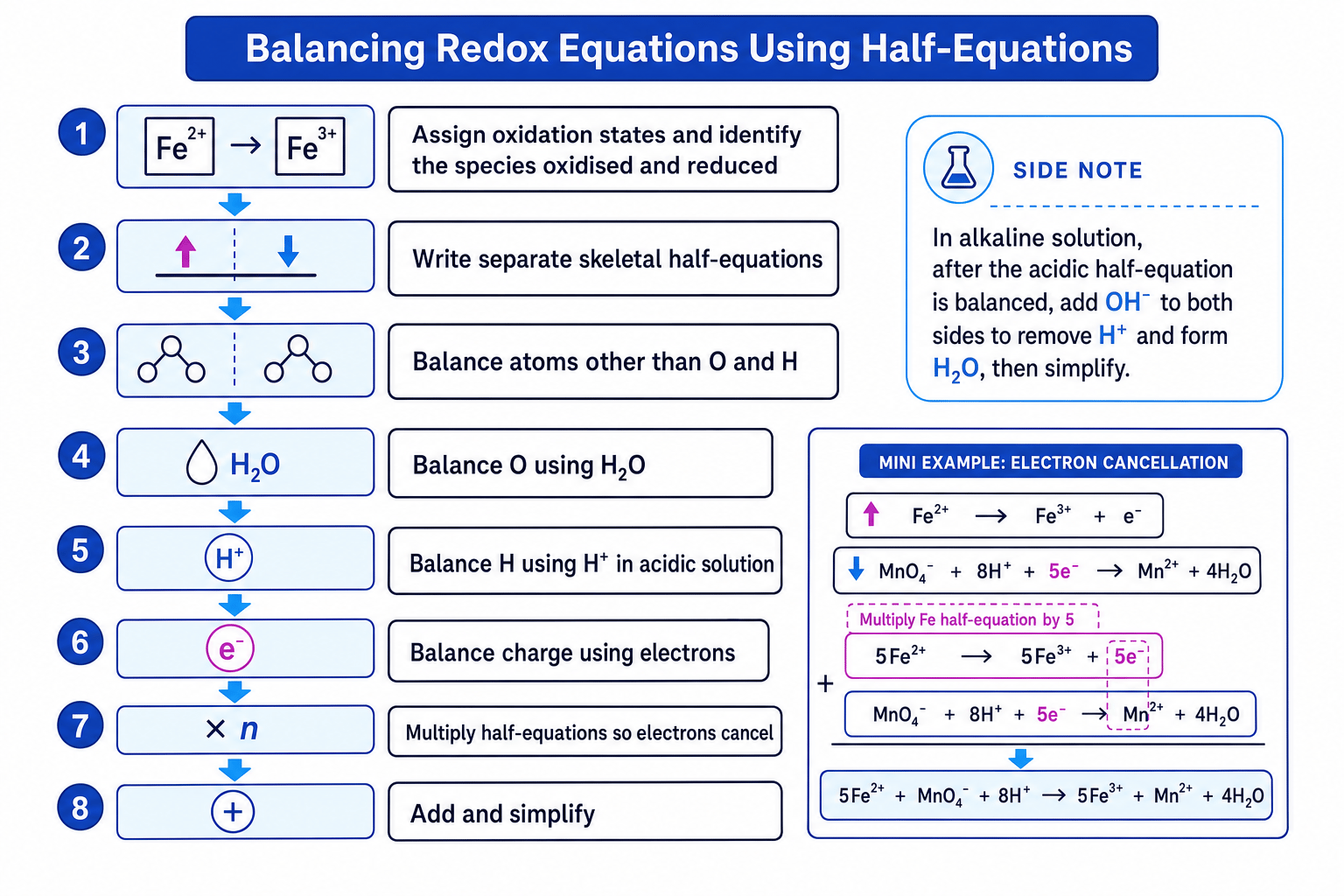
For acidic conditions, balance oxygen using H₂O, balance hydrogen using H⁺, then balance charge using electrons. For alkaline conditions, an efficient method is to balance as if acidic first, then add OH⁻ to both sides to remove any H⁺ by forming H₂O.
Electrons in the final equation
Electrons are only a balancing tool. When you add two half-equations together, the electrons must cancel completely; they should not appear in the final redox equation.
Combining half-equations in acid
Acidified manganate(VII) ions oxidise iron(II) ions to iron(III) ions.
-
Assign oxidation-state changes. Fe goes from +2 in Fe2+\text{Fe}^{2+}Fe2+ to +3 in Fe3+\text{Fe}^{3+}Fe3+, so each Fe²⁺ loses one electron. Mn goes from +7 in MnO4−\text{MnO}_4^-MnO4− to +2 in Mn2+\text{Mn}^{2+}Mn2+, so each Mn gains five electrons.
-
Write the iron half-equation: Fe2+→Fe3++e−\text{Fe}^{2+} \to \text{Fe}^{3+} + e^-Fe2+→Fe3++e−.
-
Build the manganate(VII) half-equation. Balance O with water, H with H⁺, then charge with electrons: MnO4−+8H++5e−→Mn2++4H2O\text{MnO}_4^- + 8\text{H}^+ + 5e^- \to \text{Mn}^{2+} + 4\text{H}_2\text{O}MnO4−+8H++5e−→Mn2++4H2O.
-
Multiply the iron half-equation by 5 so that five electrons are lost and five electrons are gained: 5Fe2+→5Fe3++5e−5\text{Fe}^{2+} \to 5\text{Fe}^{3+} + 5e^-5Fe2+→5Fe3++5e−.
-
Add the half-equations and cancel electrons:
5Fe2+(aq)+MnO4−(aq)+8H+(aq)→5Fe3+(aq)+Mn2+(aq)+4H2O(l)5\text{Fe}^{2+}\text{(aq)} + \text{MnO}_4^-\text{(aq)} + 8\text{H}^+\text{(aq)} \to 5\text{Fe}^{3+}\text{(aq)} + \text{Mn}^{2+}\text{(aq)} + 4\text{H}_2\text{O(l)}5Fe2+(aq)+MnO4−(aq)+8H+(aq)→5Fe3+(aq)+Mn2+(aq)+4H2O(l)
Alkaline half-equations
An alkaline solution contains OH⁻ ions. In alkaline half-equations, OH⁻ and H₂O often appear instead of H⁺.
Balancing a half-equation in alkaline solution
Balance the reduction of manganate(VII), MnO4−\text{MnO}_4^-MnO4−, to manganese(IV) oxide, MnO2\text{MnO}_2MnO2, in alkaline solution.
-
First balance it as if it were acidic: MnO4−+4H++3e−→MnO2+2H2O\text{MnO}_4^- + 4\text{H}^+ + 3e^- \to \text{MnO}_2 + 2\text{H}_2\text{O}MnO4−+4H++3e−→MnO2+2H2O.
-
Add 4OH⁻ to both sides to remove the 4H⁺. On the left, 4H++4OH−=4H2O4\text{H}^+ + 4\text{OH}^- = 4\text{H}_2\text{O}4H++4OH−=4H2O.
-
Cancel 2H₂O from both sides to give the alkaline half-equation: MnO4−+2H2O+3e−→MnO2+4OH−\text{MnO}_4^- + 2\text{H}_2\text{O} + 3e^- \to \text{MnO}_2 + 4\text{OH}^-MnO4−+2H2O+3e−→MnO2+4OH−.
Disproportionation
Disproportionation
Disproportionation is a redox reaction in which the same element is both oxidised and reduced.
A classic example is chlorine reacting with cold, dilute alkali:
Cl2+2OH−→Cl−+ClO−+H2O\text{Cl}_2 + 2\text{OH}^- \to \text{Cl}^- + \text{ClO}^- + \text{H}_2\text{O}Cl2+2OH−→Cl−+ClO−+H2O
Spotting disproportionation in chlorine reactions
-
In Cl2\text{Cl}_2Cl2, chlorine is uncombined, so its oxidation state is zero.
-
In Cl−\text{Cl}^-Cl−, chlorine has oxidation state −1. The oxidation state has decreased, so some chlorine is reduced.
-
In ClO−\text{ClO}^-ClO−, oxygen is −2 and the ion charge is −1, so chlorine is +1. The oxidation state has increased, so some chlorine is oxidised.
-
Chlorine has changed from zero to both −1 and +1, so the reaction is disproportionation.
In the exam
-
Assign oxidation states to the atoms that might change, then identify increases and decreases.
-
For half-equations, balance atoms first, then O with H₂O, H with H⁺, and charge with electrons; convert to alkaline conditions using OH⁻ if needed.
-
Before moving on, check that the final equation balances for atoms and total charge, and that no electrons remain.
Check yourself
- What is the oxidation state of nitrogen in NO3−\text{NO}_3^-NO3−?
- In Fe2+→Fe3++e−\text{Fe}^{2+} \to \text{Fe}^{3+} + e^-Fe2+→Fe3++e−, is iron oxidised or reduced?
- Complete the acidic half-equation for Cr2O72−→Cr3+\text{Cr}_2\text{O}_7^{2-} \to \text{Cr}^{3+}Cr2O72−→Cr3+.
