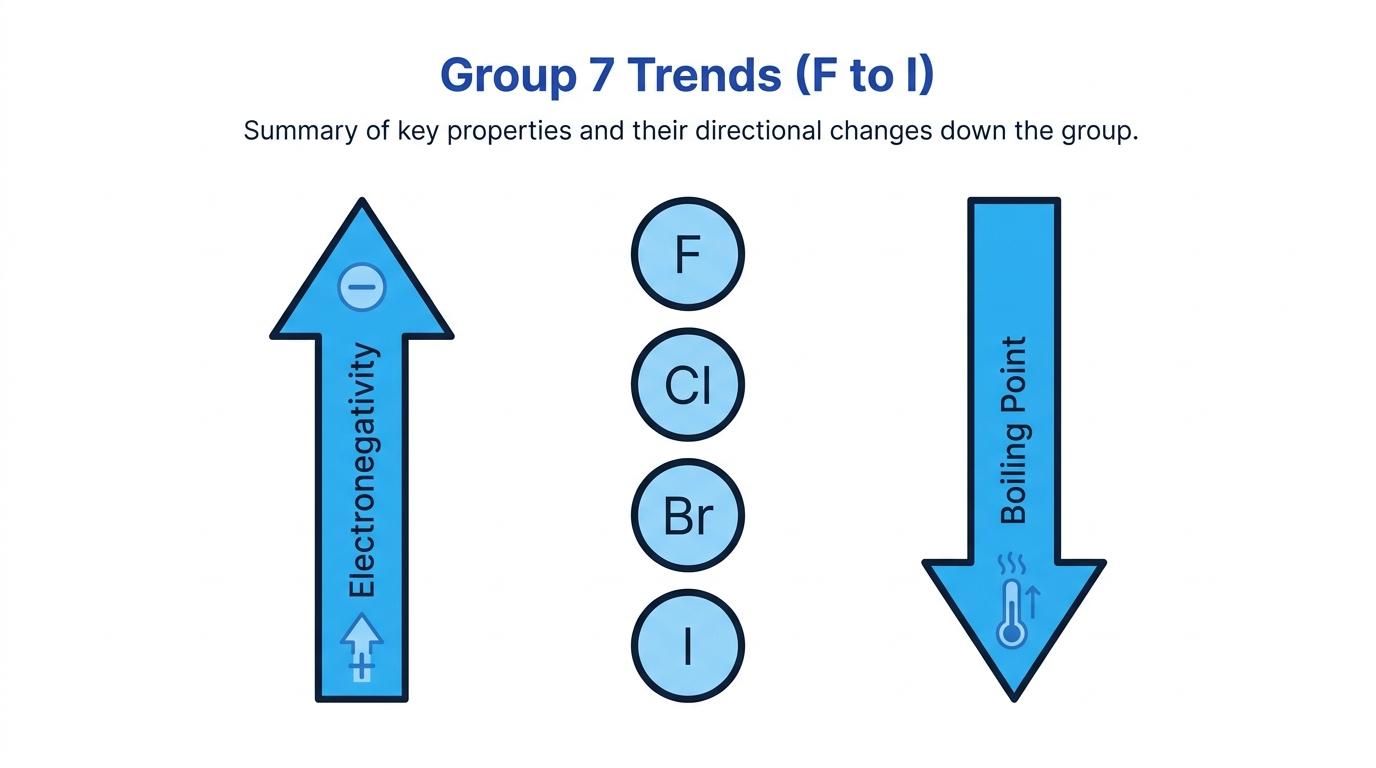
Group 7 elements, the halogens, are highly reactive non-metals. In this topic, we will look at how their physical and chemical properties change as you move down the group from fluorine to iodine.
What you'll learn:
- How atomic radius and shielding affect electronegativity and boiling points down Group 7.
- The contrasting redox trends: why halogens are strong oxidising agents and halide ions are reducing agents.
- How to write and deduce equations for the reactions of solid sodium halides with concentrated sulfuric acid.
- The practical tests to identify chloride, bromide, and iodide ions using acidified silver nitrate and ammonia.
Physical trends down Group 7
Before we look at how the halogens react, we need to understand how their basic physical properties change as the atoms get larger.
Boiling point
The halogens exist as simple covalent diatomic molecules (F2\text{F}_2F2, Cl2\text{Cl}_2Cl2, Br2\text{Br}_2Br2, I2\text{I}_2I2). At room temperature, fluorine and chlorine are gases, bromine is a liquid, and iodine is a solid.
The boiling point increases down the group. To melt or boil a halogen, you are not breaking the strong covalent bond between the two atoms; you are overcoming the intermolecular forces between the molecules.
As you go down the group:
- The atoms get larger, so the diatomic molecules contain more electrons.
- More electrons mean stronger van der Waals forces between the molecules.
- Stronger intermolecular forces require more thermal energy to overcome, resulting in a higher boiling point.
Electronegativity
Electronegativity
Electronegativity is the power of an atom to attract the pair of electrons in a covalent bond towards itself.
The electronegativity decreases as you go down Group 7. Fluorine is the most electronegative element on the periodic table, while iodine is much less electronegative.
Why does this happen? As you move down the group:
- The atomic radius increases.
- The number of inner electron shells increases, which creates more shielding.
- Although the nuclear charge (number of protons) also increases, the increased distance and shielding outweigh it.
- Therefore, the nucleus has a weaker attraction for the shared pair of electrons in a covalent bond.
The halogens as oxidising agents
When elemental halogens (Cl2\text{Cl}_2Cl2, Br2\text{Br}_2Br2, I2\text{I}_2I2) react, they typically gain one electron per atom to achieve a full outer shell, forming a halide ion (X−\text{X}^-X−).
Because they gain electrons (they are reduced), halogens act as oxidising agents (they take electrons from something else).
The oxidising ability decreases down the group (F2>Cl2>Br2>I2\text{F}_2 > \text{Cl}_2 > \text{Br}_2 > \text{I}_2F2>Cl2>Br2>I2). Fluorine is the strongest oxidising agent because it is the smallest atom. Its nucleus is very close to the outer shell with minimal shielding, so it attracts an incoming electron very strongly.
Displacement reactions
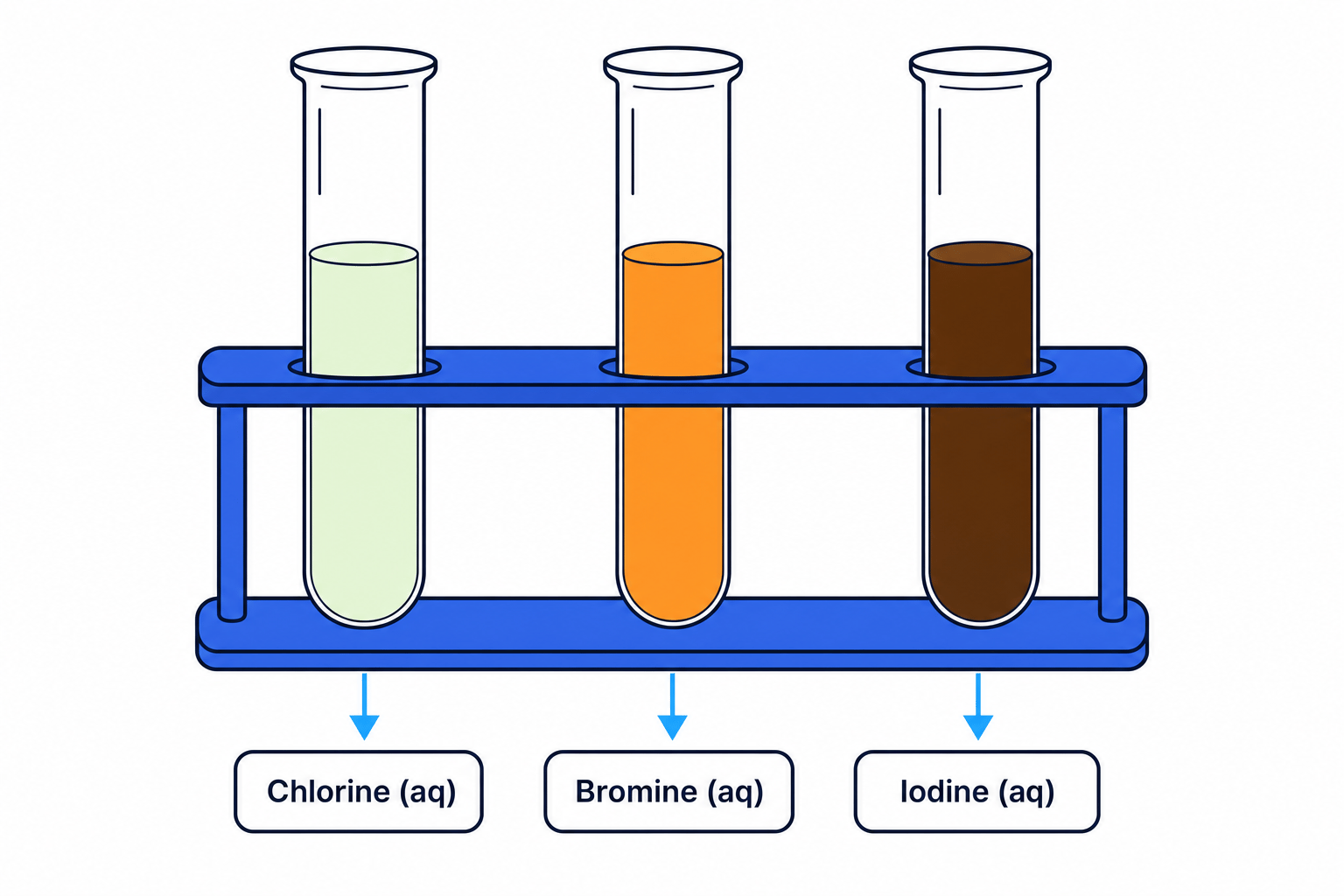
We can prove this trend using displacement reactions. A more reactive halogen (a stronger oxidising agent) will displace a less reactive halide ion from an aqueous solution.
- Chlorine will displace both bromide and iodide ions.
- Bromine will displace iodide ions, but cannot displace chloride ions.
- Iodine cannot displace chloride or bromide ions.
Deducing a displacement reaction
Predict whether a reaction occurs when aqueous chlorine is added to aqueous potassium bromide. If a reaction occurs, write the simplest ionic equation and state the observation.
- Compare the oxidising abilities. Chlorine is higher up Group 7 than bromine, meaning Cl2\text{Cl}_2Cl2 is a stronger oxidising agent than Br2\text{Br}_2Br2. Therefore, chlorine will displace bromide ions from the solution.
- Write the half-equations. Chlorine gains electrons to form chloride ions (reduction):
Bromide ions lose electrons to form bromine (oxidation):
2Br−(aq)→Br2(aq)+2e− 2\text{Br}^-\text{(aq)} \rightarrow \text{Br}_2\text{(aq)} + 2\text{e}^- 2Br−(aq)→Br2(aq)+2e−- Combine to form the full ionic equation. The electrons balance, so just add the reactants and products together:
- Deduce the observation. The potassium bromide solution is initially colourless. As elemental bromine (Br2\text{Br}_2Br2) is produced, the solution will turn orange.
Colour memory
Always look at the product that is a free halogen to determine the final colour of the solution. Cl2(aq)\text{Cl}_2\text{(aq)}Cl2(aq) is very pale green, Br2(aq)\text{Br}_2\text{(aq)}Br2(aq) is orange, and I2(aq)\text{I}_2\text{(aq)}I2(aq) is brown.
The halide ions as reducing agents
When halide ions (Cl−\text{Cl}^-Cl−, Br−\text{Br}^-Br−, I−\text{I}^-I−) react, they lose their extra electron to become a neutral halogen atom.
Because they lose electrons (they are oxidised), halide ions act as reducing agents (they give electrons to something else).
The reducing ability increases down the group (I−>Br−>Cl−>F−\text{I}^- > \text{Br}^- > \text{Cl}^- > \text{F}^-I−>Br−>Cl−>F−). Iodide is the strongest reducing agent because its outer electron is furthest from the nucleus and experiences the most shielding. The attraction between the nucleus and the outer electron is weakest, making it the easiest electron to lose.
Reactions of sodium halides with concentrated sulfuric acid
This trend is dramatically demonstrated by reacting solid sodium halides (NaX\text{NaX}NaX) with concentrated sulfuric acid (H2SO4\text{H}_2\text{SO}_4H2SO4). Sulfuric acid is an oxidising agent. As the halide ions become stronger reducing agents down the group, they can reduce the sulfur in sulfuric acid to lower and lower oxidation states.
1. Sodium chloride (NaCl\text{NaCl}NaCl) Chloride ions are very weak reducing agents. They cannot reduce the sulfur in H2SO4\text{H}_2\text{SO}_4H2SO4 (oxidation state +6+6+6). Instead, only an acid–base reaction occurs:
NaCl(s)+H2SO4(l)→NaHSO4(s)+HCl(g) \text{NaCl}(s) + \text{H}_2\text{SO}_4(l) \rightarrow \text{NaHSO}_4(s) + \text{HCl}(g) NaCl(s)+H2SO4(l)→NaHSO4(s)+HCl(g)Observation: White steamy fumes of hydrogen chloride gas (HCl\text{HCl}HCl).
2. Sodium bromide (NaBr\text{NaBr}NaBr) Bromide ions are slightly stronger reducing agents. The reaction starts with the same acid–base step to produce hydrogen bromide (HBr\text{HBr}HBr):
NaBr(s)+H2SO4(l)→NaHSO4(s)+HBr(g) \text{NaBr}(s) + \text{H}_2\text{SO}_4(l) \rightarrow \text{NaHSO}_4(s) + \text{HBr}(g) NaBr(s)+H2SO4(l)→NaHSO4(s)+HBr(g)Then, the HBr\text{HBr}HBr reduces the sulfuric acid. The sulfur is reduced from +6+6+6 to +4+4+4 in sulfur dioxide (SO2\text{SO}_2SO2):
2HBr(g)+H2SO4(l)→Br2(g)+SO2(g)+2H2O(l) 2\text{HBr}(g) + \text{H}_2\text{SO}_4(l) \rightarrow \text{Br}_2(g) + \text{SO}_2(g) + 2\text{H}_2\text{O}(l) 2HBr(g)+H2SO4(l)→Br2(g)+SO2(g)+2H2O(l)Observations: Steamy fumes of HBr\text{HBr}HBr, orange/brown fumes of Br2\text{Br}_2Br2, and SO2\text{SO}_2SO2 gas (a colourless, choking gas).
3. Sodium iodide (NaI\text{NaI}NaI) Iodide ions are excellent reducing agents. After the initial acid–base formation of hydrogen iodide (HI\text{HI}HI), the HI\text{HI}HI reduces the sulfuric acid continuously. It reduces the sulfur from +6+6+6 down to +4+4+4 (SO2\text{SO}_2SO2), then down to 000 (solid sulfur, S\text{S}S), and finally all the way to −2-2−2 (hydrogen sulfide, H2S\text{H}_2\text{S}H2S):
2HI(g)+H2SO4(l)→I2(g)+SO2(g)+2H2O(l) 2\text{HI}(g) + \text{H}_2\text{SO}_4(l) \rightarrow \text{I}_2(g) + \text{SO}_2(g) + 2\text{H}_2\text{O}(l) 2HI(g)+H2SO4(l)→I2(g)+SO2(g)+2H2O(l) 6HI(g)+H2SO4(l)→3I2(g)+S(s)+4H2O(l) 6\text{HI}(g) + \text{H}_2\text{SO}_4(l) \rightarrow 3\text{I}_2(g) + \text{S}(s) + 4\text{H}_2\text{O}(l) 6HI(g)+H2SO4(l)→3I2(g)+S(s)+4H2O(l) 8HI(g)+H2SO4(l)→4I2(g)+H2S(g)+4H2O(l) 8\text{HI}(g) + \text{H}_2\text{SO}_4(l) \rightarrow 4\text{I}_2(g) + \text{H}_2\text{S}(g) + 4\text{H}_2\text{O}(l) 8HI(g)+H2SO4(l)→4I2(g)+H2S(g)+4H2O(l)Observations: Purple vapour/black solid (I2\text{I}_2I2), yellow solid (sulfur), and a gas smelling of rotten eggs (H2S\text{H}_2\text{S}H2S).
Summary of the sulfuric acid reactions
The distance the reaction goes depends entirely on the reducing power of the halide. Cl−\text{Cl}^-Cl− stops at the acid-base step. Br−\text{Br}^-Br− reduces S\text{S}S to +4+4+4. I−\text{I}^-I− reduces S\text{S}S to +4+4+4, 000, and −2-2−2.
Testing for halide ions in solution
To identify which halide ion is present in an unknown solution, we use acidified silver nitrate (AgNO3\text{AgNO}_3AgNO3). This is a core required practical skill.
The testing sequence
Step 1: Add dilute nitric acid (HNO3\text{HNO}_3HNO3). We acidify the solution to react with and remove any carbonate (CO32−\text{CO}_3^{2-}CO32−) or hydroxide (OH−\text{OH}^-OH−) impurities. If we did not remove them, they would form a false-positive solid precipitate (like silver carbonate) which would mask our true results.
Using the wrong acid
Never use hydrochloric acid (HCl\text{HCl}HCl) or sulfuric acid (H2SO4\text{H}_2\text{SO}_4H2SO4) to acidify the solution. HCl\text{HCl}HCl contains chloride ions, which would give a false positive white precipitate. Sulfuric acid contains sulfate ions, which can form a precipitate with silver. Always use nitric acid.
Step 2: Add aqueous silver nitrate (AgNO3\text{AgNO}_3AgNO3). The silver ions (Ag+\text{Ag}^+Ag+) react with the halide ions to form an insoluble silver halide precipitate:
Ag+(aq)+X−(aq)→AgX(s) \text{Ag}^+\text{(aq)} + \text{X}^-\text{(aq)} \rightarrow \text{AgX(s)} Ag+(aq)+X−(aq)→AgX(s)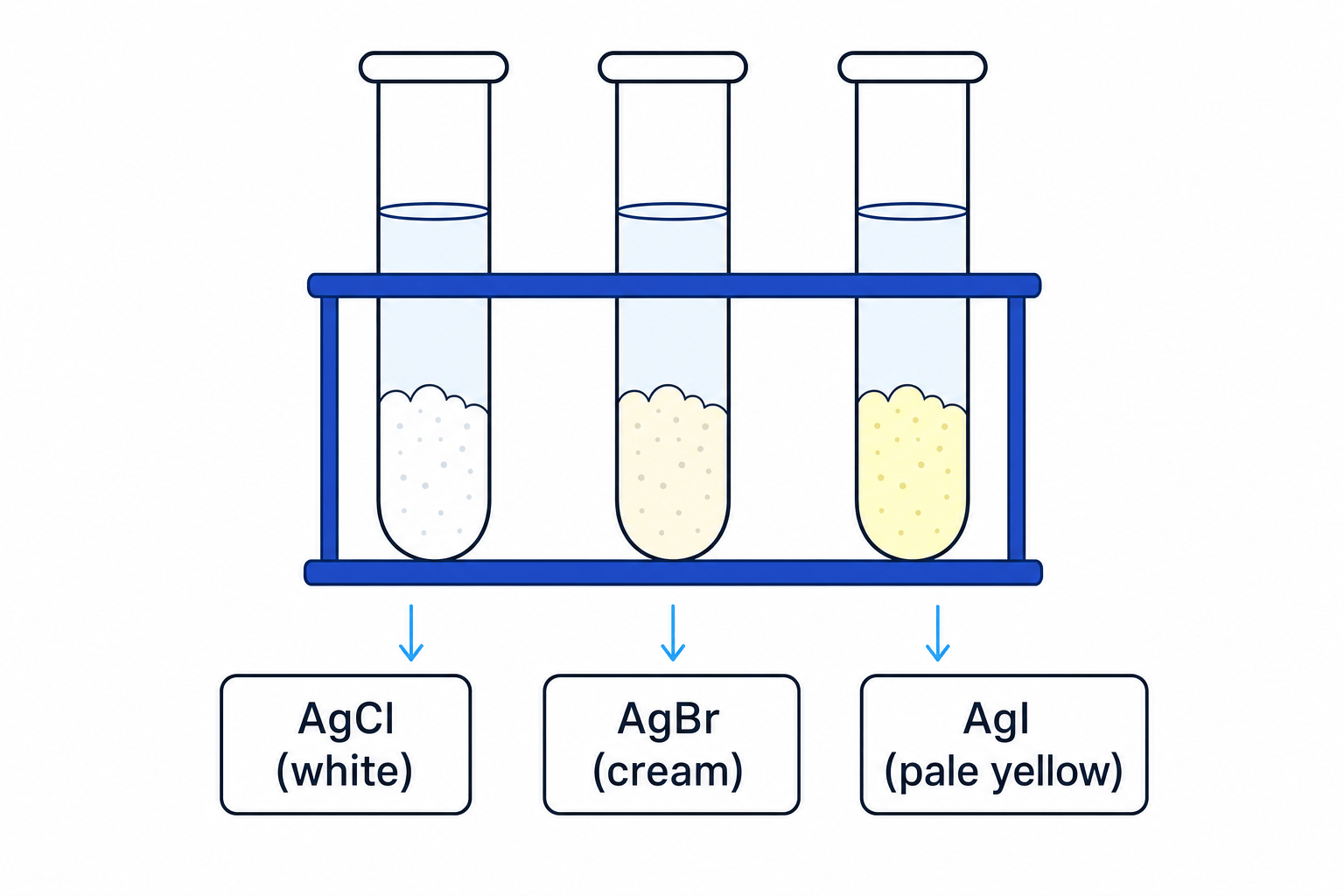
- Cl−\text{Cl}^-Cl− gives a white precipitate of AgCl\text{AgCl}AgCl.
- Br−\text{Br}^-Br− gives a cream precipitate of AgBr\text{AgBr}AgBr.
- I−\text{I}^-I− gives a pale yellow precipitate of AgI\text{AgI}AgI.
Step 3: Add ammonia solution (NH3\text{NH}_3NH3). Because white, cream, and pale yellow can be very hard to tell apart in a busy lab, we add ammonia to confirm the result. The solubility of the silver halides in ammonia decreases down the group.
- AgCl\text{AgCl}AgCl dissolves in dilute ammonia to form a colourless solution.
- AgBr\text{AgBr}AgBr dissolves in concentrated ammonia to form a colourless solution.
- AgI\text{AgI}AgI is insoluble in both dilute and concentrated ammonia.
In the exam
- When asked to explain the boiling point trend, state the molecule type (simple molecular/covalent), state that the size/number of electrons increases, and explicitly name the intermolecular force ("van der Waals forces increase").
- When answering displacement questions, accurately use the terms "oxidising agent" for the halogen (Cl2\text{Cl}_2Cl2) and "reducing agent" for the halide (Br−\text{Br}^-Br−). Confusing the two is heavily penalised.
- For the NaX+H2SO4\text{NaX} + \text{H}_2\text{SO}_4NaX+H2SO4 questions, memorise the exact observations (e.g., "rotten egg smell" for H2S\text{H}_2\text{S}H2S, "yellow solid" for S\text{S}S, "choking gas" for SO2\text{SO}_2SO2). Examiners look for these exact phrases.
- When writing ionic equations for displacement, leave out the spectator ions (e.g., K+\text{K}^+K+ or Na+\text{Na}^+Na+).
Check yourself
- Why does electronegativity decrease down Group 7 despite an increasing nuclear charge?
- What is the simplest ionic equation for the reaction between aqueous chlorine and aqueous potassium iodide?
- Which hydrogen halide produces a yellow solid when reacting with concentrated sulfuric acid?
- Why must you use nitric acid rather than hydrochloric acid before testing for halides with silver nitrate?
- Which silver halide precipitate dissolves in concentrated ammonia but not dilute ammonia?