

What you'll learn
- How chlorine reacts with water (both in the dark and in sunlight) to form different products.
- The ethics, risks, and benefits of adding chlorine to public water supplies.
- How to manufacture bleach by reacting chlorine with cold, dilute sodium hydroxide.
- Required Practical 4: How to carry out simple test-tube reactions to identify unknown cations and anions.
The reaction of chlorine with water
Chlorine is a pale green, toxic gas. Despite its hazards, it is one of the most useful elements in industrial chemistry. When you dissolve chlorine in water, a reversible reaction occurs to produce a mixture of two acids: hydrochloric acid (HCl\mathrm{HCl}HCl) and chloric(I) acid (HClO\mathrm{HClO}HClO).
Cl2(g)+H2O(l)⇌HCl(aq)+HClO(aq) \mathrm{Cl_2(g)} + \mathrm{H_2O(l)} \rightleftharpoons \mathrm{HCl(aq)} + \mathrm{HClO(aq)} Cl2(g)+H2O(l)⇌HCl(aq)+HClO(aq)This reaction is an example of a specific type of redox process called disproportionation.
Disproportionation
Disproportionation is a redox reaction in which the same element is simultaneously both oxidised and reduced to form two different products.
In this reaction, the oxidation state of the chlorine atoms in the elemental Cl2\mathrm{Cl_2}Cl2 molecule is 000. In hydrochloric acid (HCl\mathrm{HCl}HCl), the oxidation state of chlorine decreases to −1-1−1 (reduction). In chloric(I) acid (HClO\mathrm{HClO}HClO), the oxidation state of chlorine increases to +1+1+1 (oxidation).
Chloric(I) acid is also known as hypochlorous acid. It is a weak acid, but it is a powerful oxidising agent and acts as a potent bleach and disinfectant. It kills bacteria, which makes this reaction crucial for water purification.
Chlorine and water in sunlight
The reaction changes if the chlorine and water are exposed to bright sunlight (or any strong source of ultraviolet radiation). The UV light breaks down the chloric(I) acid, causing a different overall reaction to take place:
2Cl2(g)+2H2O(l)→4HCl(aq)+O2(g) 2\mathrm{Cl_2(g)} + 2\mathrm{H_2O(l)} \to 4\mathrm{HCl(aq)} + \mathrm{O_2(g)} 2Cl2(g)+2H2O(l)→4HCl(aq)+O2(g)Notice that in sunlight, no chlorate(I) is formed. Instead, the water is oxidised to oxygen gas, and the pale green colour of the chlorine gas fades as it is entirely converted into colourless hydrochloric acid and oxygen. This is why outdoor swimming pools require frequent additions of chlorine—the sunlight constantly degrades the active disinfectant.
Treating public water supplies
Chlorine is routinely added to public drinking water supplies and swimming pools to kill disease-causing microorganisms, such as those that cause cholera and typhoid.
However, adding chemicals to public water supplies is sometimes controversial. Society has to weigh the advantages against the disadvantages:
The benefits:
- Chlorine effectively destroys pathogenic bacteria.
- It prevents outbreaks of severe waterborne diseases.
- It leaves a residual amount in the water, which prevents reinfection further down the supply network.
The risks:
- Chlorine gas is highly toxic and acts as a severe respiratory irritant.
- Chlorine can react with natural organic compounds (like decaying leaves) in the water to form chlorinated hydrocarbons. Some of these compounds are suspected carcinogens (cancer-causing).
Weighing the balance
In the UK and most of the world, society has decided that the massive, proven benefits to public health (preventing fatal epidemics) completely outweigh the toxic effects of chlorine and the minor risks of forming trace chlorinated hydrocarbons.
Making bleach (Reaction with cold, dilute NaOH)
Instead of water, you can react chlorine with cold, dilute, aqueous sodium hydroxide. This reaction is also a disproportionation, but it goes to completion and produces sodium chlorate(I) (NaClO\mathrm{NaClO}NaClO), which is the active ingredient in everyday household bleach.
Cl2(g)+2NaOH(aq)→NaClO(aq)+NaCl(aq)+H2O(l) \mathrm{Cl_2(g)} + 2\mathrm{NaOH(aq)} \to \mathrm{NaClO(aq)} + \mathrm{NaCl(aq)} + \mathrm{H_2O(l)} Cl2(g)+2NaOH(aq)→NaClO(aq)+NaCl(aq)+H2O(l)The solution formed is a mixture of sodium chloride and sodium chlorate(I). It is widely used in cleaning, removing stains, and as an industrial disinfectant.
Proving bleach formation is a disproportionation reaction
We can use oxidation states to prove that the reaction between Cl2\mathrm{Cl_2}Cl2 and NaOH\mathrm{NaOH}NaOH is a disproportionation.
- State the initial oxidation state of chlorine. Because Cl2\mathrm{Cl_2}Cl2 is an element, its oxidation state is 000.
- Calculate the oxidation state of chlorine in NaClO\mathrm{NaClO}NaClO. Sodium is an alkali metal, so Na=+1\mathrm{Na} = +1Na=+1. Oxygen is almost always O=−2\mathrm{O} = -2O=−2. For the compound to be neutral, the sum of oxidation states must be zero. Therefore: 1+Cl+(−2)=0⇒Cl=+11 + \mathrm{Cl} + (-2) = 0 \Rightarrow \mathrm{Cl} = +11+Cl+(−2)=0⇒Cl=+1.
- Calculate the oxidation state of chlorine in NaCl\mathrm{NaCl}NaCl. Sodium is +1+1+1, so chlorine must be −1-1−1.
- Compare the changes. The oxidation state of chlorine has increased from 000 to +1+1+1 (oxidation) and decreased from 000 to −1-1−1 (reduction). Because the same element was both oxidised and reduced, the reaction is a disproportionation.
Required Practical 4: Test-tube reactions for ions
As a chemist, you must be able to identify unknown ions in a solution. Required Practical 4 covers a specific set of qualitative tests for anions (negative ions) and cations (positive ions).
Testing for Anions
When testing for anions, you must carry out the tests in a strict sequence to prevent false positive results:
- Carbonate test (CO32−\mathrm{CO_3^{2-}}CO32−)
- Sulfate test (SO42−\mathrm{SO_4^{2-}}SO42−)
- Halide test (Cl−\mathrm{Cl^-}Cl−, Br−\mathrm{Br^-}Br−, I−\mathrm{I^-}I−)
Why this order? Because barium ions (used in the sulfate test) will also form a white precipitate with carbonates. Silver ions (used in the halide test) will form precipitates with both sulfates and carbonates. By testing for (and removing) carbonates first, then sulfates, you guarantee that your halide test is accurate.
1. The Carbonate Test Add dilute nitric acid (or hydrochloric acid) to the unknown solution. If carbonate ions are present, you will see effervescence (fizzing) as carbon dioxide gas is evolved.
CO32−(aq)+2H+(aq)→CO2(g)+H2O(l) \mathrm{CO_3^{2-}(aq)} + 2\mathrm{H^+(aq)} \to \mathrm{CO_2(g)} + \mathrm{H_2O(l)} CO32−(aq)+2H+(aq)→CO2(g)+H2O(l)2. The Sulfate Test Add acidified barium chloride (BaCl2\mathrm{BaCl_2}BaCl2) solution. (We acidify it first with HCl\mathrm{HCl}HCl to react with any rogue carbonate impurities that might give a false positive). If sulfate ions are present, a thick white precipitate of barium sulfate forms.
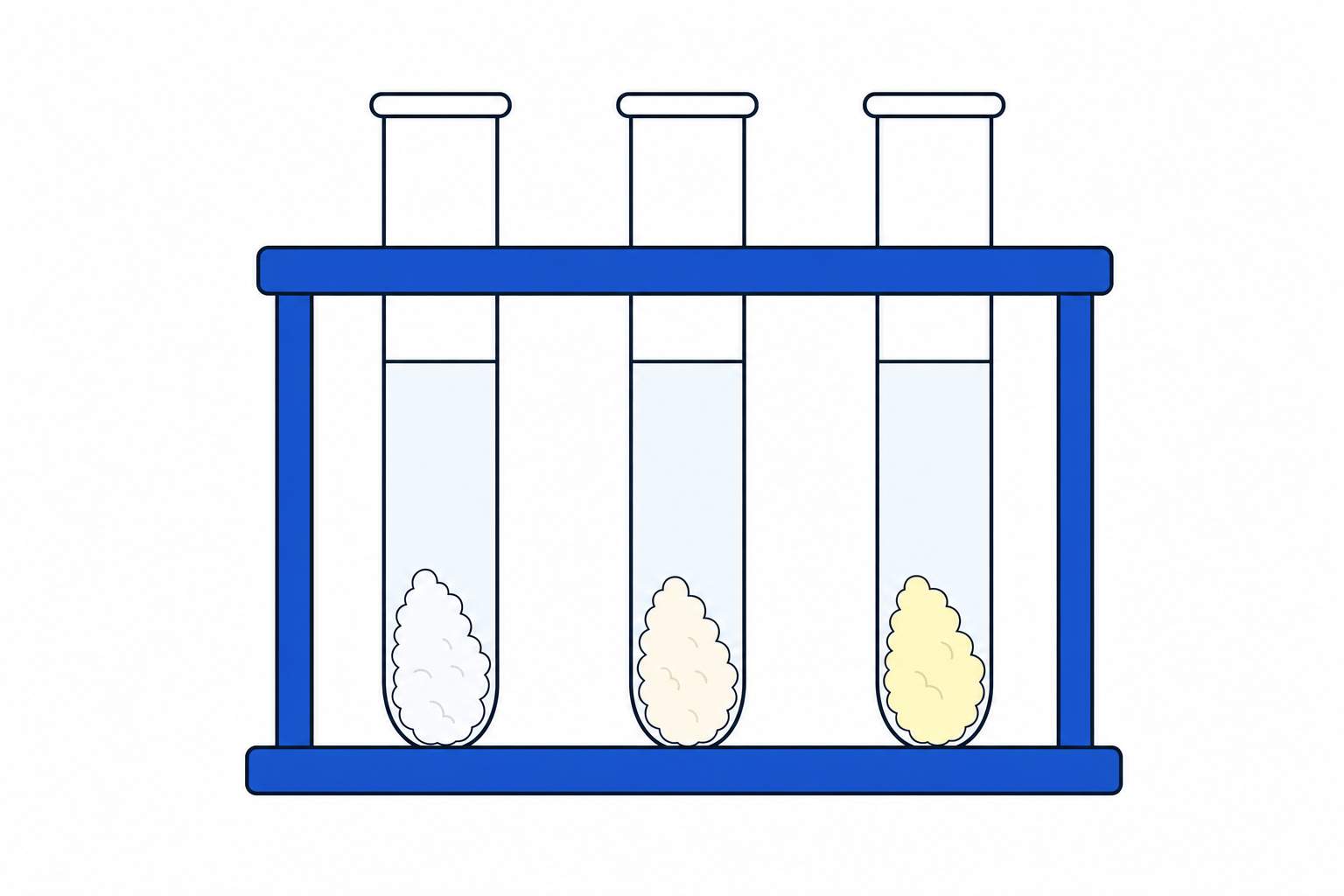
Ba2+(aq)+SO42−(aq)→BaSO4(s) \mathrm{Ba^{2+}(aq)} + \mathrm{SO_4^{2-}(aq)} \to \mathrm{BaSO_4(s)} Ba2+(aq)+SO42−(aq)→BaSO4(s)3. The Halide Test Add dilute nitric acid (HNO3\mathrm{HNO_3}HNO3) to remove impurities, followed by silver nitrate solution (AgNO3\mathrm{AgNO_3}AgNO3). The halide ions form silver halide precipitates with distinct colours:
- Chloride (Cl−\mathrm{Cl^-}Cl−): White precipitate (AgCl\mathrm{AgCl}AgCl)
- Bromide (Br−\mathrm{Br^-}Br−): Cream precipitate (AgBr\mathrm{AgBr}AgBr)
- Iodide (I−\mathrm{I^-}I−): Pale yellow precipitate (AgI\mathrm{AgI}AgI)
Confirming the halides
The colours of the silver halides can be hard to tell apart in poor lab lighting. To confirm, add dilute ammonia solution: the white AgCl\mathrm{AgCl}AgCl dissolves, but the others do not. Then add concentrated ammonia: the cream AgBr\mathrm{AgBr}AgBr dissolves, but the yellow AgI\mathrm{AgI}AgI remains completely insoluble.
4. The Hydroxide Test (OH−\mathrm{OH^-}OH−) Hydroxide ions make a solution alkaline. You can test for them simply by dipping red litmus paper into the solution; it will turn blue. Alternatively, universal indicator will turn blue or purple.
Testing for Cations
1. Group 2 Metal Ions Group 2 ions can be distinguished by observing how their solubility trends change when you add either sodium hydroxide (NaOH\mathrm{NaOH}NaOH) or dilute sulfuric acid (H2SO4\mathrm{H_2SO_4}H2SO4).
- Adding NaOH\mathrm{NaOH}NaOH: Tests for the formation of the metal hydroxide. Magnesium forms a thick white precipitate of Mg(OH)2\mathrm{Mg(OH)_2}Mg(OH)2 because it is highly insoluble. Barium hydroxide is soluble, so no precipitate forms.
- Adding H2SO4\mathrm{H_2SO_4}H2SO4: Tests for the formation of the metal sulfate. Barium forms a thick white precipitate of BaSO4\mathrm{BaSO_4}BaSO4 because it is highly insoluble. Magnesium sulfate is soluble, so no precipitate forms.
2. Ammonium Ions (NH4+\mathrm{NH_4^+}NH4+) Add dilute sodium hydroxide solution to the unknown sample and warm it gently in a water bath. If ammonium ions are present, ammonia gas (NH3\mathrm{NH_3}NH3) is released.
NH4+(aq)+OH−(aq)→NH3(g)+H2O(l) \mathrm{NH_4^+(aq)} + \mathrm{OH^-(aq)} \to \mathrm{NH_3(g)} + \mathrm{H_2O(l)} NH4+(aq)+OH−(aq)→NH3(g)+H2O(l)Holding the litmus paper
Ammonia is an alkaline gas. To test for it, hold a piece of damp red litmus paper over the mouth of the test tube. The common mistake is using dry litmus paper—the gas must dissolve in the water on the paper to release the OH−\mathrm{OH^-}OH− ions that cause the paper to turn blue.
In the exam
- When asked for the equation of chlorine reacting with water, read carefully to see if it specifies "in sunlight". If it doesn't, give the disproportionation equation producing HCl\mathrm{HCl}HCl and HClO\mathrm{HClO}HClO.
- If asked to justify the use of chlorine in water treatment despite its toxicity, explicitly state that "the health benefits of killing bacteria outweigh the risks of toxicity". Examiners look for that exact balancing statement.
- For ion tests, always name the reagent used (e.g., acidified silver nitrate) and state the observation clearly (e.g., white precipitate). Just saying "it goes white" will not score the mark.
Check yourself
- Write the full balanced equation for the reaction used to manufacture household bleach.
- What is the oxidation state of chlorine in chloric(I) acid?
- Why must you add dilute nitric acid before testing for halide ions with silver nitrate?
- Which of the silver halide precipitates will dissolve in dilute aqueous ammonia?
