

What you'll learn:
- Which specific metal-aqua ions are formed by iron, copper, and aluminium in solution.
- Why 3+3+3+ metal-aqua ions are more acidic than 2+2+2+ ions, using the concept of charge density.
- How to predict and write equations for the test-tube reactions of these ions with OH−\text{OH}^-OH−, NH3\text{NH}_3NH3, and CO32−\text{CO}_3^{2-}CO32−.
- How to describe the amphoteric nature of aluminium hydroxide.
Metal-Aqua Ions
When you dissolve salts of transition metals (and some main-group metals like aluminium) in water, the positive metal ions don't just float around naked. They become surrounded by water molecules, which act as ligands.
Metal-aqua ion
A complex ion formed when water molecules bond to a central metal ion via coordinate (dative covalent) bonds.
The oxygen atom in each water molecule has lone pairs of electrons. It donates one lone pair into an empty orbital on the central metal ion. For the metals in this specification, six water molecules surround the central ion, resulting in an octahedral shape.
You need to know the formulas and colours of four specific metal-aqua ions in aqueous solution:
- Copper(II): [Cu(H2O)6]2+[\text{Cu}(\text{H}_2\text{O})_6]^{2+}[Cu(H2O)6]2+ is a blue solution.
- Iron(II): [Cu(H2O)6]2+[\text{Cu}(\text{H}_2\text{O})_6]^{2+}[Cu(H2O)6]2+ is a green solution.
- Iron(III): [Fe(H2O)6]3+[\text{Fe}(\text{H}_2\text{O})_6]^{3+}[Fe(H2O)6]3+ is a pale violet solution (though often looks yellow-brown in the lab due to slight hydrolysis).
- Aluminium(III): [Al(H2O)6]3+[\text{Al}(\text{H}_2\text{O})_6]^{3+}[Al(H2O)6]3+ is a colourless solution.
(Note: Aluminium is a Group 3 metal, not a transition metal, but its highly charged ion behaves similarly in these reactions).
The Acidity of Metal-Aqua Ions
Metal-aqua ions are acidic in solution. They undergo hydrolysis reactions where the complex acts as a Brønsted-Lowry acid, donating a proton (H+\text{H}^+H+) to surrounding free water molecules.
For example, a generic 3+3+3+ ion reacts like this:
[M(H2O)6]3++H2O⇌[M(H2O)5(OH)]2++H3O+ [\text{M}(\text{H}_2\text{O})_6]^{3+} + \text{H}_2\text{O} \rightleftharpoons [\text{M}(\text{H}_2\text{O})_5(\text{OH})]^{2+} + \text{H}_3\text{O}^+ [M(H2O)6]3++H2O⇌[M(H2O)5(OH)]2++H3O+Because H3O+\text{H}_3\text{O}^+H3O+ ions are produced, the resulting solution is acidic. However, not all metal-aqua ions are equally acidic. The acidity of [M(H2O)6]3+[\text{M}(\text{H}_2\text{O})_6]^{3+}[M(H2O)6]3+ is noticeably greater than that of [M(H2O)6]2+[\text{M}(\text{H}_2\text{O})_6]^{2+}[M(H2O)6]2+.
Explaining the difference: Charge Density
The reason for this difference comes down to the charge and size of the central metal ion.
- A 3+3+3+ ion has a higher charge and a smaller ionic radius than a 2+2+2+ ion.
- Therefore, a 3+3+3+ ion has a much higher charge density.
- This high charge density strongly attracts the electrons in the coordinate bond from the oxygen of the water ligand.
- This pulling effect (polarising power) extends to the O−H\text{O}-\text{H}O−H bonds within the water molecule, pulling electron density away from the hydrogen atoms.
- The O−H\text{O}-\text{H}O−H bond is severely weakened, making it much easier for the water ligand to release an H+\text{H}^+H+ ion.
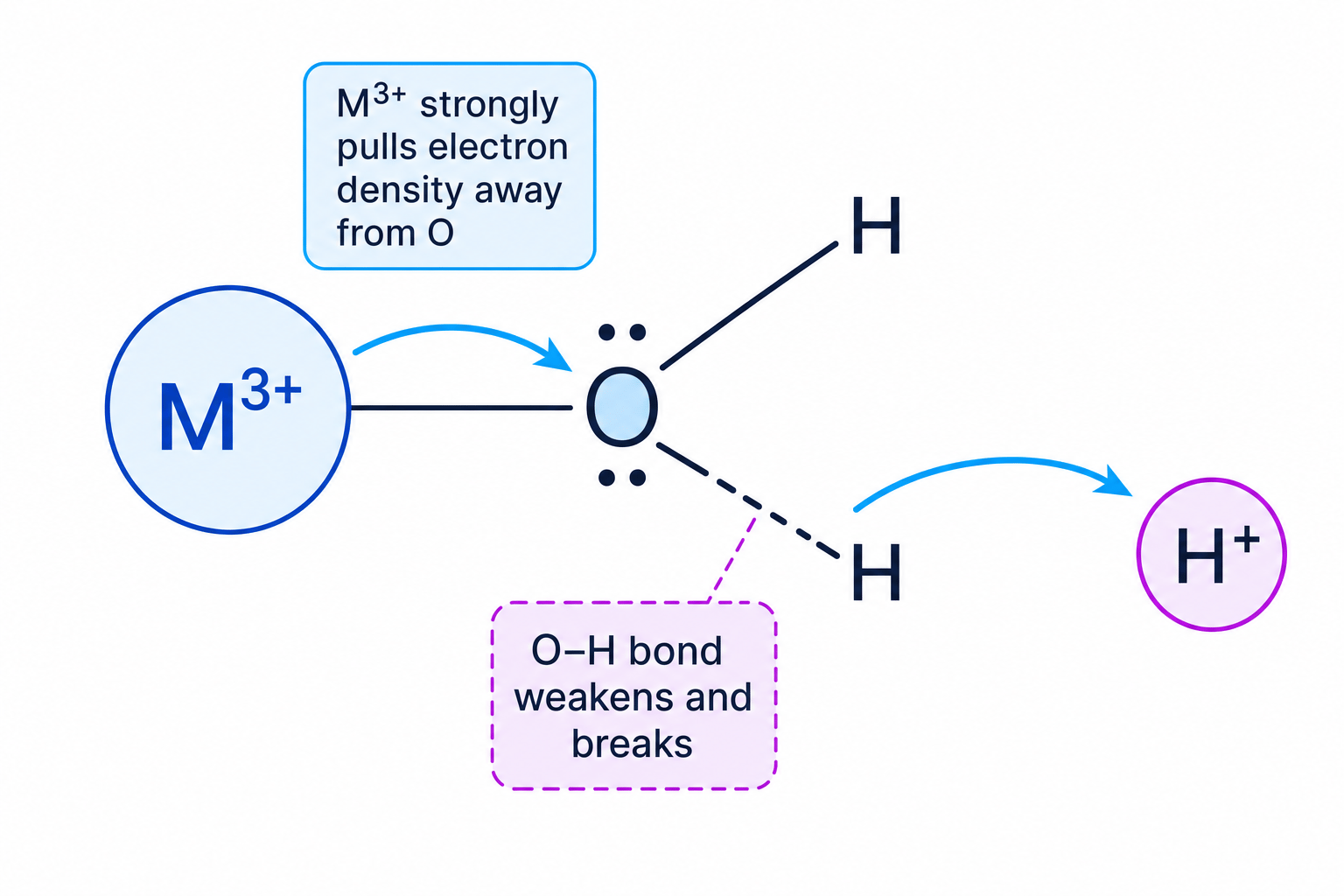
Charge density controls acidity
The higher the charge density of the central metal ion, the more it polarises the water ligands, weakening the O−H\text{O}-\text{H}O−H bonds and making the complex more acidic.
Reactions with Sodium Hydroxide (OH−\text{OH}^-OH−) and Ammonia (NH3\text{NH}_3NH3)
Both hydroxide ions (OH−\text{OH}^-OH−) and ammonia (NH3\text{NH}_3NH3) act as Brønsted-Lowry bases. When you add them dropwise to solutions of metal-aqua ions, they strip protons off the water ligands.
As protons are removed, the overall charge on the complex drops. Once the complex becomes neutral (having zero overall charge), it is no longer soluble in water and falls out of solution as a solid precipitate.
The Dropwise Reactions
For 2+2+2+ ions, two protons are removed. You form a precipitate with the general formula M(OH)2(H2O)4\text{M}(\text{OH})_2(\text{H}_2\text{O})_4M(OH)2(H2O)4.
[M(H2O)6]2++2OH−→M(OH)2(H2O)4+2H2O [\text{M}(\text{H}_2\text{O})_6]^{2+} + 2\text{OH}^- \rightarrow \text{M}(\text{OH})_2(\text{H}_2\text{O})_4 + 2\text{H}_2\text{O} [M(H2O)6]2++2OH−→M(OH)2(H2O)4+2H2O [M(H2O)6]2++2NH3→M(OH)2(H2O)4+2NH4+ [\text{M}(\text{H}_2\text{O})_6]^{2+} + 2\text{NH}_3 \rightarrow \text{M}(\text{OH})_2(\text{H}_2\text{O})_4 + 2\text{NH}_4^+ [M(H2O)6]2++2NH3→M(OH)2(H2O)4+2NH4+For 3+3+3+ ions, three protons are removed. You form a precipitate with the general formula M(OH)3(H2O)3\text{M}(\text{OH})_3(\text{H}_2\text{O})_3M(OH)3(H2O)3.
[M(H2O)6]3++3OH−→M(OH)3(H2O)3+3H2O [\text{M}(\text{H}_2\text{O})_6]^{3+} + 3\text{OH}^- \rightarrow \text{M}(\text{OH})_3(\text{H}_2\text{O})_3 + 3\text{H}_2\text{O} [M(H2O)6]3++3OH−→M(OH)3(H2O)3+3H2O [M(H2O)6]3++3NH3→M(OH)3(H2O)3+3NH4+ [\text{M}(\text{H}_2\text{O})_6]^{3+} + 3\text{NH}_3 \rightarrow \text{M}(\text{OH})_3(\text{H}_2\text{O})_3 + 3\text{NH}_4^+ [M(H2O)6]3++3NH3→M(OH)3(H2O)3+3NH4+Forgetting the water ligands in precipitates
When writing the formula for the solid precipitate, students often write just Cu(OH)2\text{Cu}(\text{OH})_2Cu(OH)2 or Fe(OH)3\text{Fe}(\text{OH})_3Fe(OH)3. While sometimes accepted as shorthand, the strictly correct A-level formula includes the remaining water ligands to maintain the coordination number of 6: Cu(OH)2(H2O)4\text{Cu}(\text{OH})_2(\text{H}_2\text{O})_4Cu(OH)2(H2O)4 or Fe(OH)3(H2O)3\text{Fe}(\text{OH})_3(\text{H}_2\text{O})_3Fe(OH)3(H2O)3.
Colours of the Precipitates
Memorising these distinct colours is vital for Required Practical 11, where you will carry out these exact test-tube reactions to identify unknowns.
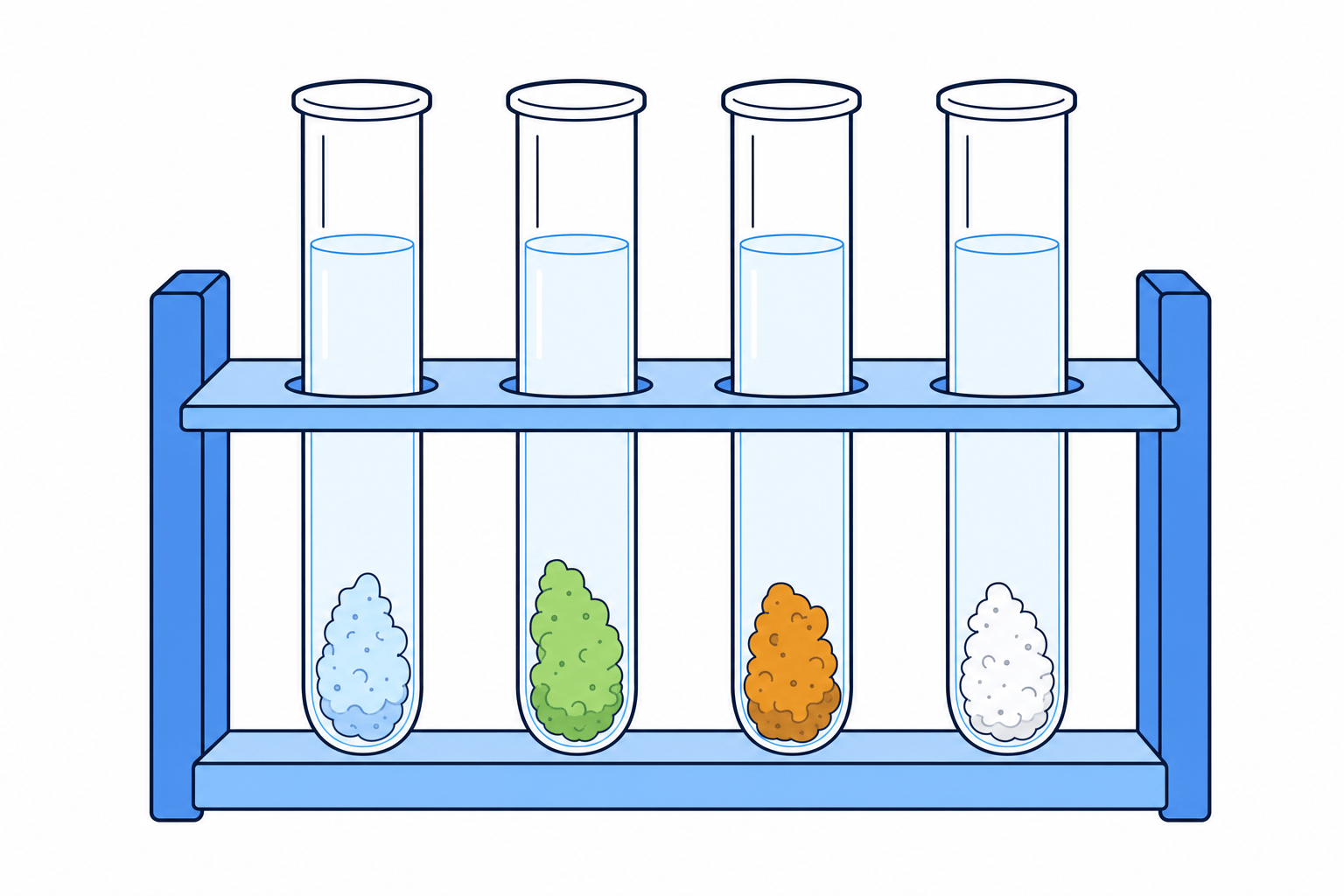
- Copper(II): [Cu(H2O)6]2+[\text{Cu}(\text{H}_2\text{O})_6]^{2+}[Cu(H2O)6]2+ reacts to form a pale blue precipitate.
- Iron(II): [Fe(H2O)6]2+[\text{Fe}(\text{H}_2\text{O})_6]^{2+}[Fe(H2O)6]2+ reacts to form a green precipitate (which slowly turns brown at the surface as it oxidises in air to Iron(III)).
- Iron(III): [Fe(H2O)6]3+[\text{Fe}(\text{H}_2\text{O})_6]^{3+}[Fe(H2O)6]3+ reacts to form a brown precipitate (often described as orange-brown or rust-coloured).
- Aluminium(III): [Al(H2O)6]3+[\text{Al}(\text{H}_2\text{O})_6]^{3+}[Al(H2O)6]3+ reacts to form a white precipitate.
Adding Excess Reagent
What happens if you keep adding the base past the point of precipitation?
Excess NaOH\text{NaOH}NaOH and Aluminium's Amphoteric Character: If you add excess NaOH\text{NaOH}NaOH to the white aluminium precipitate, it redissolves to form a colourless solution.
Amphoteric
A substance that can act as both an acid and a base.
Aluminium hydroxide is amphoteric. It dissolves in acid (acting as a base to form [Al(H2O)6]3+[\text{Al}(\text{H}_2\text{O})_6]^{3+}[Al(H2O)6]3+ again) and dissolves in excess base (acting as an acid, donating a further proton).
Al(OH)3(H2O)3+OH−→[Al(OH)4(H2O)2]−+H2O \text{Al}(\text{OH})_3(\text{H}_2\text{O})_3 + \text{OH}^- \rightarrow [\text{Al}(\text{OH})_4(\text{H}_2\text{O})_2]^- + \text{H}_2\text{O} Al(OH)3(H2O)3+OH−→[Al(OH)4(H2O)2]−+H2OThe resulting negatively charged complex is soluble, so the solid vanishes. (None of the other metals in this spec redissolve in excess NaOH\text{NaOH}NaOH).
Excess NH3\text{NH}_3NH3 and Copper: If you add excess ammonia to the pale blue copper precipitate, ammonia stops acting as a base and starts acting as a ligand. A ligand substitution reaction occurs, replacing water and hydroxide ligands to form a deep blue solution.
Cu(OH)2(H2O)4+4NH3→[Cu(NH3)4(H2O)2]2++2H2O+2OH− \text{Cu}(\text{OH})_2(\text{H}_2\text{O})_4 + 4\text{NH}_3 \rightarrow [\text{Cu}(\text{NH}_3)_4(\text{H}_2\text{O})_2]^{2+} + 2\text{H}_2\text{O} + 2\text{OH}^- Cu(OH)2(H2O)4+4NH3→[Cu(NH3)4(H2O)2]2++2H2O+2OH−Reactions with Sodium Carbonate (CO32−\text{CO}_3^{2-}CO32−)
The reaction with the carbonate ion perfectly demonstrates the difference in acidity between 2+2+2+ and 3+3+3+ metal-aqua ions.
The 2+2+2+ Ions (Copper and Iron(II))
Because the 2+2+2+ complexes are relatively weakly acidic, the carbonate ion doesn't strip protons from them. Instead, a simple precipitation reaction occurs, where the carbonate ion replaces the entire complex to form an insoluble metal carbonate.
[M(H2O)6]2++CO32−→MCO3+6H2O [\text{M}(\text{H}_2\text{O})_6]^{2+} + \text{CO}_3^{2-} \rightarrow \text{MCO}_3 + 6\text{H}_2\text{O} [M(H2O)6]2++CO32−→MCO3+6H2O- Copper(II): Forms CuCO3\text{CuCO}_3CuCO3, a blue-green precipitate.
- Iron(II): Forms FeCO3\text{FeCO}_3FeCO3, a green precipitate.
The 3+3+3+ Ions (Iron(III) and Aluminium)
The 3+3+3+ complexes are highly acidic. They are so eager to donate protons that the carbonate ion acts as a base, stripping protons from the water ligands rather than forming a carbonate salt.
The carbonate ion (CO32−\text{CO}_3^{2-}CO32−) gains protons to form carbonic acid (H2CO3\text{H}_2\text{CO}_3H2CO3), which immediately breaks down into water and carbon dioxide gas. The metal complex turns into the neutral hydroxide precipitate.
2[M(H2O)6]3++3CO32−→2M(OH)3(H2O)3+3CO2+3H2O 2[\text{M}(\text{H}_2\text{O})_6]^{3+} + 3\text{CO}_3^{2-} \rightarrow 2\text{M}(\text{OH})_3(\text{H}_2\text{O})_3 + 3\text{CO}_2 + 3\text{H}_2\text{O} 2[M(H2O)6]3++3CO32−→2M(OH)3(H2O)3+3CO2+3H2OIf you add Na2CO3\text{Na}_2\text{CO}_3Na2CO3 to Iron(III) or Aluminium(III) solutions, you will observe effervescence (bubbling of CO2\text{CO}_2CO2) alongside the formation of the normal hydroxide precipitate (brown for Fe, white for Al).
How to tell the difference?
If a question asks how to distinguish between Fe2+\text{Fe}^{2+}Fe2+ and Fe3+\text{Fe}^{3+}Fe3+ using aqueous sodium carbonate, looking for the presence of bubbles is a perfect discriminator. Fe2+\text{Fe}^{2+}Fe2+ will only form a precipitate; Fe3+\text{Fe}^{3+}Fe3+ will form a precipitate and fizz.
Applying the Rules (Required Practical 11)
Deducing an unknown transition metal ion
An unknown metal chloride salt dissolves in water to form a solution, X. When a few drops of aqueous ammonia are added to a sample of X, a white precipitate forms. When excess aqueous sodium hydroxide is added to a fresh sample of X, a white precipitate forms which then completely dissolves to leave a colourless solution. Identify the metal ion in X and write an equation for the reaction with excess sodium hydroxide.
- Analyse the first observation: Addition of dropwise ammonia forms a white precipitate. From the spec, the only ion that forms a white precipitate is the Aluminium(III) ion, [Al(H2O)6]3+[\text{Al}(\text{H}_2\text{O})_6]^{3+}[Al(H2O)6]3+, which forms Al(OH)3(H2O)3\text{Al}(\text{OH})_3(\text{H}_2\text{O})_3Al(OH)3(H2O)3.
- Confirm with the second observation: Addition of excess sodium hydroxide causes the initial white precipitate to redissolve into a colourless solution. This confirms amphoteric behaviour, which is the hallmark of Aluminium(III) among the ions you study.
- Write the equation: Start with the solid hydroxide precipitate and react it with OH−\text{OH}^-OH− to form the soluble complex.
(Note: AQA also accepts the simplified form: Al(OH)3+OH−→[Al(OH)4]−\text{Al}(\text{OH})_3 + \text{OH}^- \rightarrow [\text{Al}(\text{OH})_4]^-Al(OH)3+OH−→[Al(OH)4]−)
In the exam
- Look out for the word "excess" in the question text. The examiner will try to catch you out by describing the formation of a precipitate that then reacts further (like Cu with excess NH3\text{NH}_3NH3, or Al with excess OH−\text{OH}^-OH−).
- When asked for observations, always state both the colour AND the state (e.g., "blue solution", "green precipitate"). Just writing "blue" won't earn the mark.
- If an equation asks for a reaction with aqueous sodium carbonate, check the charge on the metal. If it's a 3+3+3+ metal, you must include CO2\text{CO}_2CO2 and H2O\text{H}_2\text{O}H2O as products. If it's a 2+2+2+ metal, just make the solid metal carbonate.
Check yourself
- Why is an aqueous solution of Iron(III) nitrate more acidic than an aqueous solution of Iron(II) nitrate?
- What are the observations when you add dropwise aqueous sodium carbonate to a solution containing [Fe(H2O)6]3+[\text{Fe}(\text{H}_2\text{O})_6]^{3+}[Fe(H2O)6]3+?
- Write the balanced equation for the reaction of [Cu(H2O)6]2+[\text{Cu}(\text{H}_2\text{O})_6]^{2+}[Cu(H2O)6]2+ with excess aqueous ammonia.
