What you'll learn
- What a mass spectrum shows, especially the molecular ion peak.
- Why high-resolution mass spectrometry uses precise atomic masses.
- How to compare calculated precise masses with a measured precise molecular mass.
- How to combine an empirical formula with mass spectrometry to find a molecular formula.
The starting point: formulae and masses
Mass spectrometry is an analytical technique: it helps you find out what a substance is. In this part of organic analysis, you use it mainly to determine the molecular formula of an organic compound.
Molecular formula
The molecular formula gives the actual number of atoms of each element in one molecule, for example C3H6O\text{C}_3\text{H}_6\text{O}C3H6O.
The empirical formula is different: it gives the simplest whole-number ratio of atoms. For example, C6H12O6\text{C}_6\text{H}_{12}\text{O}_6C6H12O6 has empirical formula CH2O\text{CH}_2\text{O}CH2O.
The relative molecular mass, MrM_rMr, is the mass of a molecule relative to one-twelfth of the mass of a carbon-12 atom. It has no units. The molar mass has the same numerical value but is written in g mol⁻¹.
Precise atomic masses
In simpler calculations, you often use rounded masses such as C = 12, H = 1 and O = 16. In high-resolution mass spectrometry, those rounded values are not accurate enough.
A precise atomic mass is a more accurate mass for a particular isotope. Common values you may be given include:
- carbon-12: 12.0000
- hydrogen-1: 1.0078
- nitrogen-14: 14.0031
- oxygen-16: 15.9949
- chlorine-35: 34.9689
- bromine-79: 78.9183
Why precision matters
Different molecular formulae can have the same rounded, or nominal, mass but different precise masses. High-resolution mass spectrometry can distinguish between them.
What a mass spectrometer does
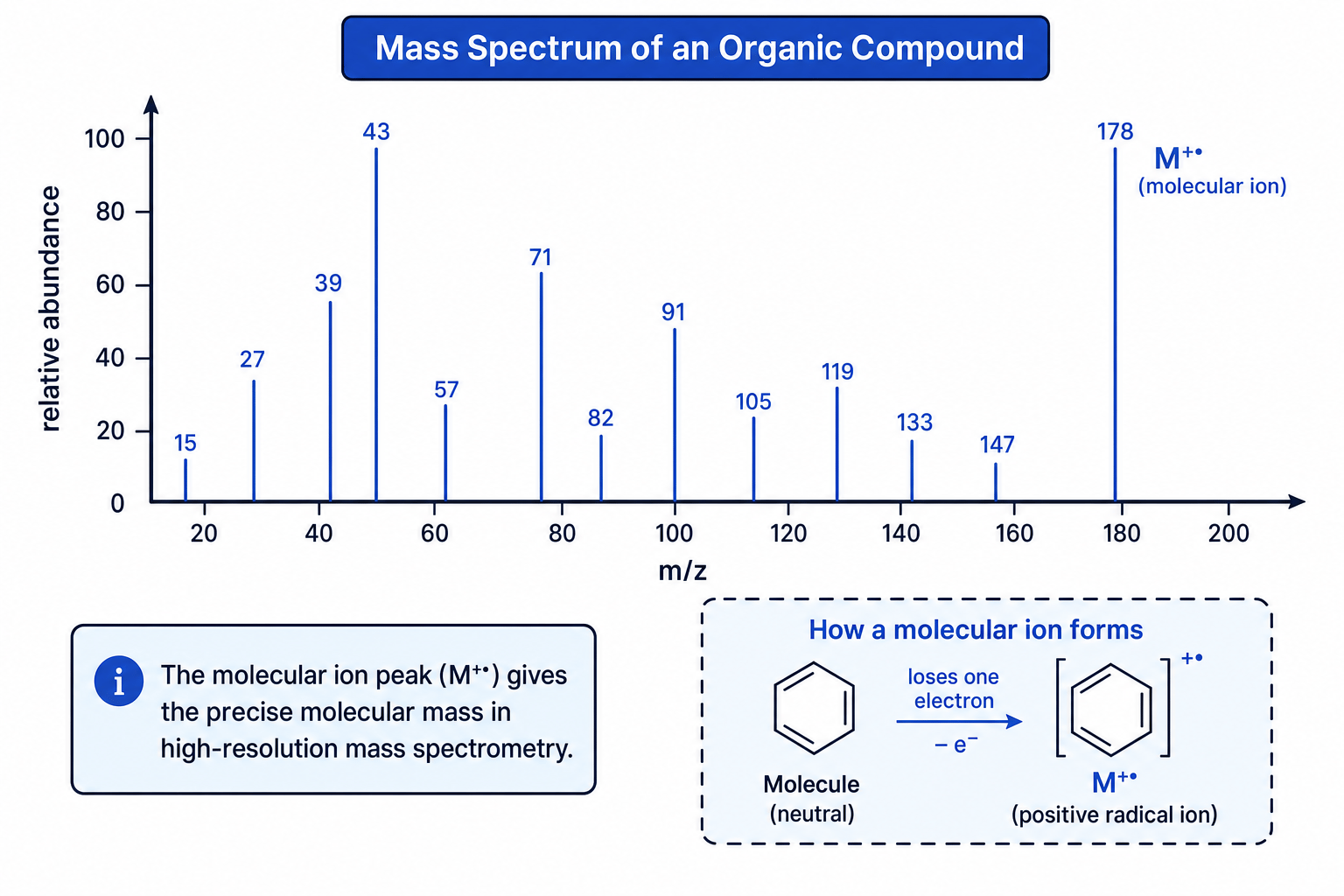
A mass spectrometer turns molecules into ions, separates those ions by their mass-to-charge ratio, and records a mass spectrum.
In a common ionisation method, a molecule loses one electron and forms a positive ion. If the whole molecule remains intact after losing the electron, it is called the molecular ion, often written as M+•. It has almost the same mass as the original molecule; at A-Level, the mass of the lost electron is ignored.
Some molecular ions break apart into smaller fragment ions. These give peaks at lower mass-to-charge values.
Mass-to-charge ratio
The mass-to-charge ratio, written m/zm/zm/z, compares the mass of an ion with its charge. For most organic ions you meet at A-Level, the charge is +1, so m/zm/zm/z is numerically the same as the ion’s relative mass.
The molecular ion peak
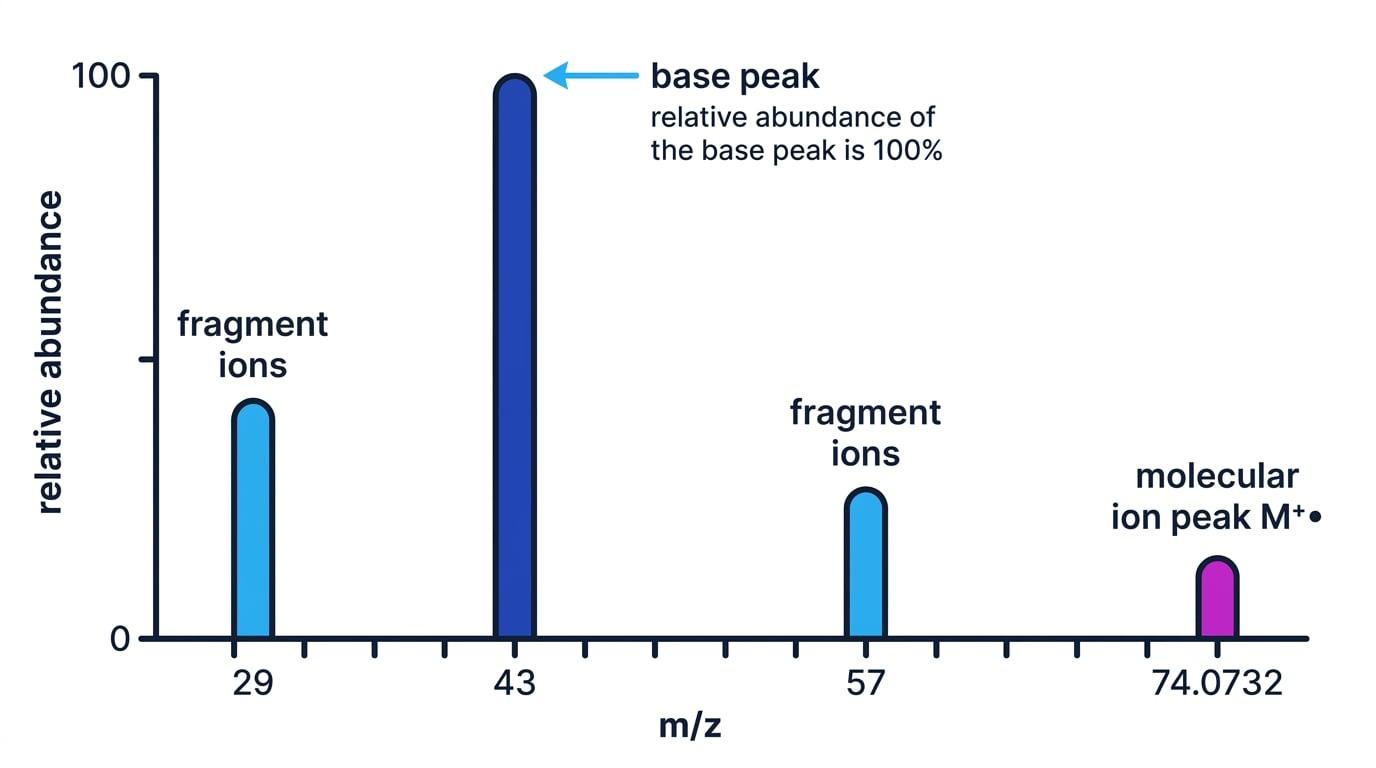
A mass spectrum plots relative abundance on the vertical axis against m/zm/zm/z on the horizontal axis. The tallest peak is called the base peak and is assigned a relative abundance of 100%.
The molecular ion peak is the peak due to the intact molecule after ionisation. In high-resolution mass spectrometry, its precise m/zm/zm/z value gives the precise molecular mass of the compound.
Base peak ≠ molecular ion
The base peak is the most abundant ion, not necessarily the molecular ion. A fragment ion can easily give the tallest peak.
Reading the molecular ion peak
A spectrum has a base peak at m/z=43m/z = 43m/z=43 and a smaller peak identified as the molecular ion at m/z=74.0732m/z = 74.0732m/z=74.0732.
- The peak at 43 is the base peak, so it is the most abundant ion, but it could be a fragment.
- The peak identified as the molecular ion represents the intact molecule after losing one electron.
- The molecular ion has charge +1, so the precise molecular mass is 74.0732; the corresponding molar mass is 74.0732 g mol⁻¹.
Using high-resolution mass spectrometry to find a molecular formula
A low-resolution mass spectrum usually gives whole-number m/zm/zm/z values. A high-resolution mass spectrum gives more decimal places, so you can compare the measured precise molecular mass with calculated precise masses.
The method is:
- Write down the possible molecular formulae, or use the formulae given in the question.
- Calculate the precise molecular mass of each formula using the precise atomic masses supplied.
- Compare your calculated values with the measured precise molecular mass.
- Choose the formula with the closest match.
Choosing between formulae with the same nominal mass
A compound has a high-resolution molecular ion peak at m/z=60.0573m/z = 60.0573m/z=60.0573. Possible formulae are C3H8O\text{C}_3\text{H}_8\text{O}C3H8O, C2H4O2\text{C}_2\text{H}_4\text{O}_2C2H4O2 and CH4N2O\text{CH}_4\text{N}_2\text{O}CH4N2O. Use C = 12.0000, H = 1.0078, N = 14.0031 and O = 15.9949.
- All three possible formulae have a nominal mass of about 60, so rounded masses alone cannot identify the formula.
- Calculate C3H8O\text{C}_3\text{H}_8\text{O}C3H8O: 3(12.0000)+8(1.0078)+15.9949=60.05733(12.0000) + 8(1.0078) + 15.9949 = 60.05733(12.0000)+8(1.0078)+15.9949=60.0573.
- Calculate the other candidates: C2H4O2=2(12.0000)+4(1.0078)+2(15.9949)=60.0210\text{C}_2\text{H}_4\text{O}_2 = 2(12.0000) + 4(1.0078) + 2(15.9949) = 60.0210C2H4O2=2(12.0000)+4(1.0078)+2(15.9949)=60.0210, and CH4N2O=12.0000+4(1.0078)+2(14.0031)+15.9949=60.0323\text{CH}_4\text{N}_2\text{O} = 12.0000 + 4(1.0078) + 2(14.0031) + 15.9949 = 60.0323CH4N2O=12.0000+4(1.0078)+2(14.0031)+15.9949=60.0323.
- The measured value, 60.0573, matches C3H8O\text{C}_3\text{H}_8\text{O}C3H8O, so the molecular formula is C3H8O\text{C}_3\text{H}_8\text{O}C3H8O.
Do not round too early
Keep the calculated precise masses to the same number of decimal places as the data in the question. Rounding to whole numbers destroys the evidence high-resolution mass spectrometry gives you.
Combining empirical formula and precise molecular mass
Sometimes another analysis, such as combustion analysis, gives you the empirical formula. Mass spectrometry then gives the molecular mass, allowing you to scale up the empirical formula.
Use:
n=precise molecular massempirical formula massn = \frac{\text{precise molecular mass}}{\text{empirical formula mass}}n=empirical formula massprecise molecular massThen multiply every subscript in the empirical formula by nnn.
Finding a molecular formula from an empirical formula
A compound has empirical formula CH2O\text{CH}_2\text{O}CH2O. Its high-resolution mass spectrum gives a precise molecular mass of 90.0315. Find the molecular formula using C = 12.0000, H = 1.0078 and O = 15.9949.
- Calculate the empirical formula mass: 12.0000+2(1.0078)+15.9949=30.0105 g mol−112.0000 + 2(1.0078) + 15.9949 = 30.0105\ \text{g mol}^{-1}12.0000+2(1.0078)+15.9949=30.0105 g mol−1.
- Find the multiplier: n=90.031530.0105=3.000n = \frac{90.0315}{30.0105} = 3.000n=30.010590.0315=3.000.
- Multiply every subscript in CH2O\text{CH}_2\text{O}CH2O by 3, giving C3H6O3\text{C}_3\text{H}_6\text{O}_3C3H6O3.
Isotope peaks and sensible limits
Real mass spectra can also contain isotope peaks. For example, molecules containing carbon may show an M+1 peak due to a small amount of carbon-13. Compounds containing chlorine or bromine often show distinctive M and M+2 patterns.
For this specification point, focus on the precise molecular mass of the molecular ion and the precise atomic masses given.
Exact mass still needs chemical context
A precise mass is most useful when the question gives possible elements, candidate formulae, or an empirical formula. Without sensible chemical limits, there may be more than one formula close to the same mass.
In the exam
- Decide whether you are reading a molecular ion peak, comparing candidate formulae, or scaling up an empirical formula.
- Use the precise atomic masses supplied in the question and compare values before rounding.
- Do not use the base peak or a fragment peak as the molecular mass; use the peak or value identified as the molecular ion or precise molecular mass.
Check yourself
- Why can two different molecular formulae have the same nominal mass but different precise masses?
- A spectrum has a base peak at m/z=43m/z = 43m/z=43 and a molecular ion at m/z=88.0888m/z = 88.0888m/z=88.0888. Which value gives the molecular mass?
- If the empirical formula is CH2\text{CH}_2CH2 and the precise molecular mass is about 56, what multiplier would you expect?