What you'll learn
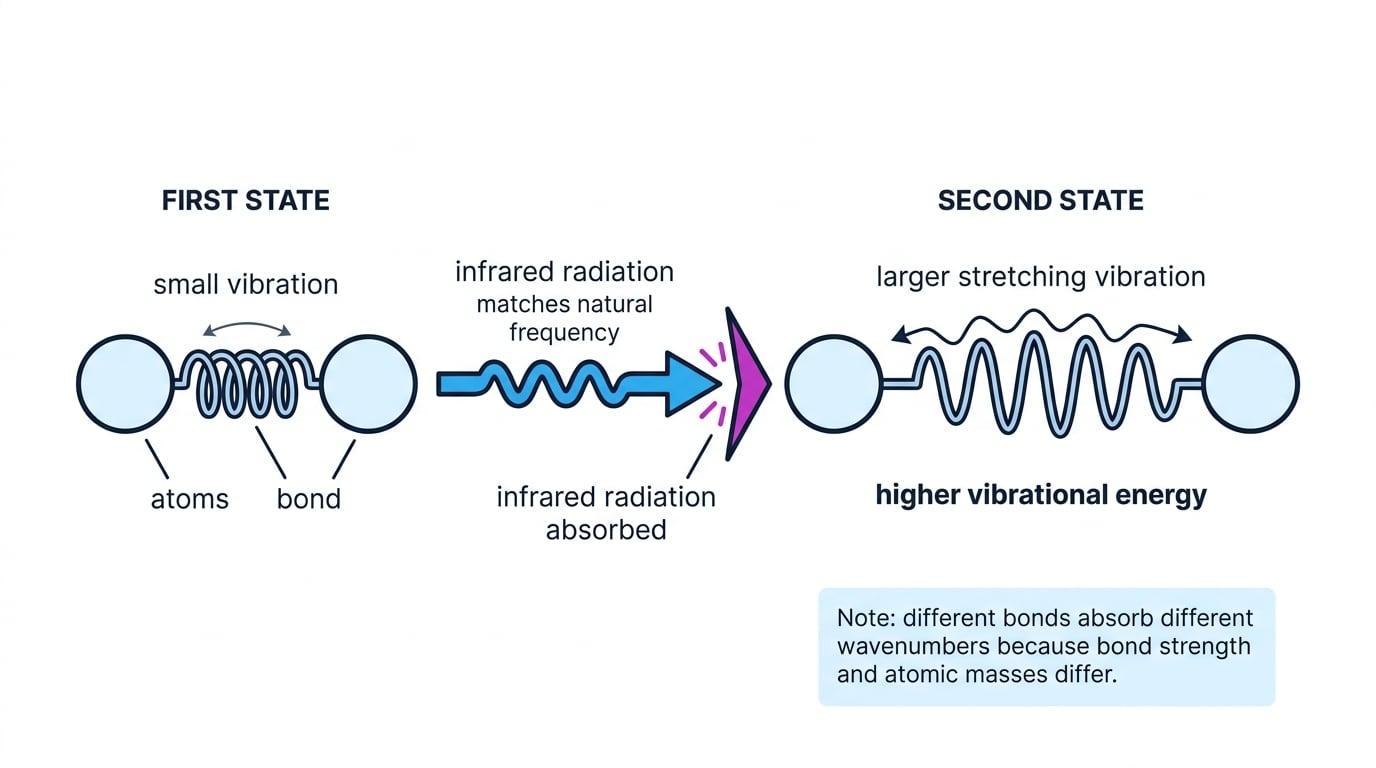
- How covalent bonds absorb infrared radiation and behave like tiny springs.
- How to read an infrared (IR) spectrum to identify functional groups like alcohols, carboxylic acids, and carbonyls.
- How to use the "fingerprint region" to identify exact molecules and spot impurities.
- Why gases like carbon dioxide and methane cause global warming.
Bonds as tiny springs
Covalent bonds aren't rigid sticks holding atoms together; they are constantly moving. You can think of them as tiny springs that bend and stretch.
At room temperature, bonds vibrate at specific frequencies. If you shine infrared (IR) radiation on a molecule, bonds will absorb the energy only if the frequency of the radiation exactly matches the natural frequency of the bond's vibration. When the bond absorbs this energy, it jumps to a higher vibrational energy level (it stretches further or bends more vigorously).
Different bonds (like C=O, O-H, or C-H) have different masses of atoms and different bond strengths. Therefore, they act like different types of springs and absorb entirely different frequencies of IR radiation.
Reading an IR spectrum
An IR spectrometer passes a range of infrared frequencies through a sample and measures what comes out the other side. The result is an infrared spectrum, which is a graph showing which frequencies were absorbed.
Wavenumber
A measure of frequency used in IR spectroscopy. It is the reciprocal of wavelength and is measured in cm⁻¹. Higher wavenumbers correspond to shorter wavelengths and higher energy.
When you look at an IR spectrum, the axes can seem a bit backwards at first:
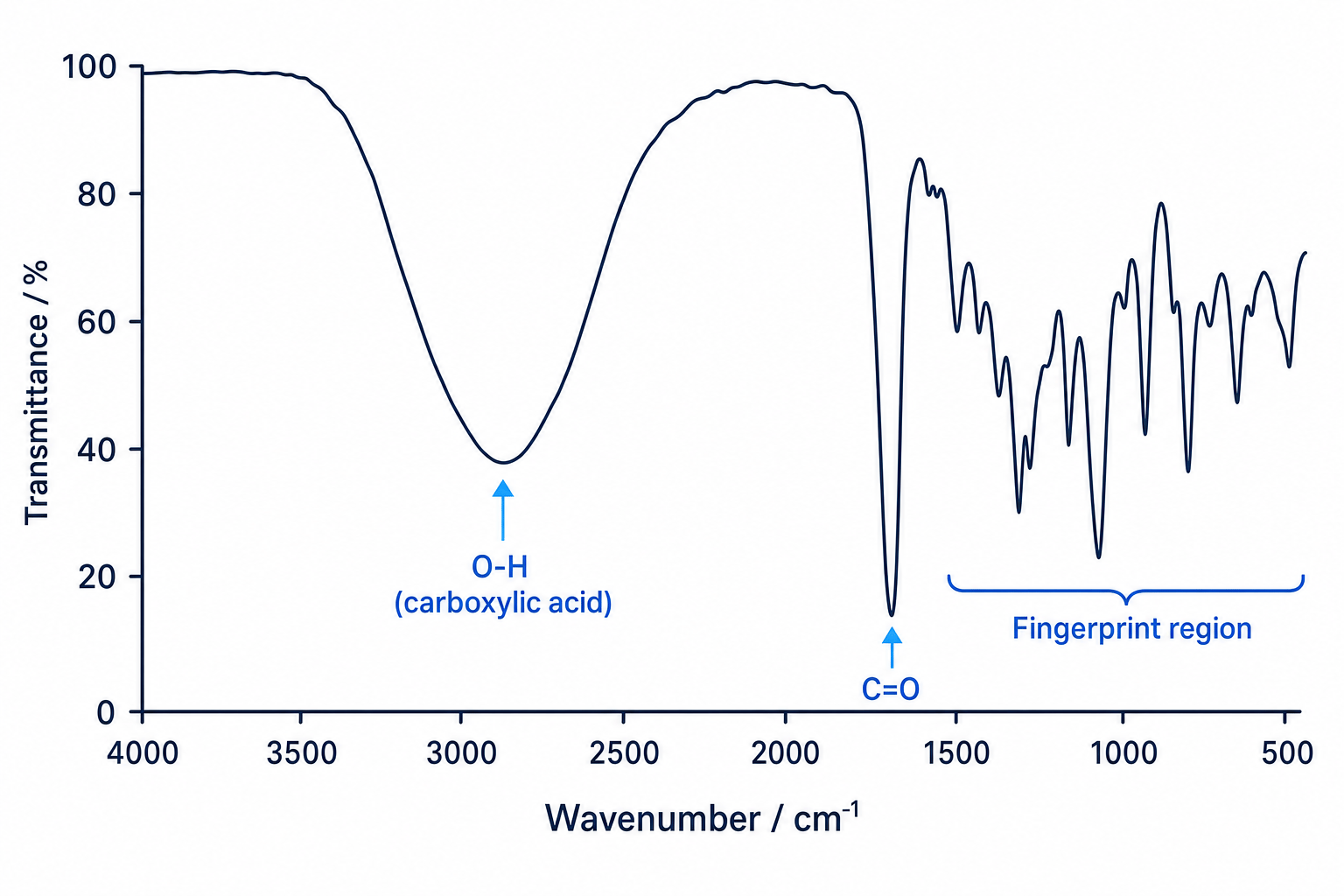
- x-axis (Wavenumber / cm⁻¹): This runs backwards, usually starting at 4000 cm⁻¹ on the left and decreasing to 400 cm⁻¹ on the right.
- y-axis (Transmittance / %): This shows how much radiation passed through the sample. 100% means all radiation was transmitted (none absorbed).
Because the y-axis is transmittance, absorptions appear as "troughs" or deep dips that point downwards. Chemists confusingly call these downward dips peaks.
Spotting functional groups
The left-hand side of the spectrum (above 1500 cm⁻¹) is where we look to identify functional groups. You don't need to memorise the exact wavenumbers; you will be given a table in your Chemistry Data Booklet. However, you should learn to recognise the shape of the most important peaks:
- The C=O bond: Absorbs strongly around 1680–1750 cm⁻¹. It produces a very sharp, deep, needle-like peak. If you see this, your molecule has a carbonyl group (it could be an aldehyde, ketone, carboxylic acid, ester, or amide).
- The O-H bond (alcohols): Absorbs roughly between 3230–3550 cm⁻¹. It forms a broad, smooth, U-shaped curve.
- The O-H bond (carboxylic acids): Absorbs roughly between 2500–3000 cm⁻¹. It forms a very broad, "hairy" or jagged peak that often overlaps with the C-H bond absorptions. Note that if you have a carboxylic acid, you will also see the sharp C=O peak at ~1700 cm⁻¹.
Check the Data Booklet
Always check your Data Booklet in the exam. An O-H peak in an alcohol is at a slightly different wavenumber range than an O-H peak in an acid. Quoting the exact range from your booklet will secure the marks.
Deducing a structure from IR data
You are given an unknown liquid with the molecular formula C3H6O\text{C}_3\text{H}_6\text{O}C3H6O. Its IR spectrum shows a sharp absorption at 1715 cm⁻¹, but no absorptions above 3000 cm⁻¹. Identify the molecule.
- Analyse the formula: The formula C3H6O\text{C}_3\text{H}_6\text{O}C3H6O fits the general formula CnH2nO\text{C}_n\text{H}_{2n}\text{O}CnH2nO. This means it must contain one double bond or one ring. Given the single oxygen atom, it could be an aldehyde, a ketone, an alcohol with a double bond, or a cyclic ether.
- Identify functional groups from the IR data: The sharp peak at 1715 cm⁻¹ falls within the C=O absorption range. This confirms the molecule contains a carbonyl group.
- Rule out other functional groups: The absence of any peaks above 3000 cm⁻¹ means there is no O-H bond present. We can confidently rule out any alcohols or carboxylic acids.
- Determine the structure: The molecule must be a ketone or an aldehyde. Since it has 3 carbon atoms, the only possible structures are propanal (CH3CH2CHO\text{CH}_3\text{CH}_2\text{CHO}CH3CH2CHO) or propanone (CH3COCH3\text{CH}_3\text{COCH}_3CH3COCH3). In an exam, you might need extra chemical tests (like Tollens' reagent) or the fingerprint region to distinguish between these two, but IR alone has narrowed it down perfectly to the carbonyl family.
The fingerprint region
The region of the spectrum on the far right, below 1500 cm⁻¹, is usually highly complex. It is packed full of overlapping peaks caused by complex bending vibrations of the entire molecule.
The fingerprint region is unique
The pattern of peaks below 1500 cm⁻¹ is unique to every specific molecule, much like a human fingerprint.
Even if two molecules have the exact same functional groups (like propan-1-ol and propan-2-ol), their spectra will look almost identical above 1500 cm⁻¹, but their fingerprint regions will be entirely different.
Chemists use this region in two main ways:
- Identification: A computer can compare the fingerprint region of an unknown sample against a database of known spectra. If the pattern is a perfect match, the molecule is identified with certainty.
- Checking purity: If a compound is completely pure, its spectrum will exactly match the database. If there are extra peaks in the fingerprint region (or elsewhere), the sample contains impurities.
Ignoring impurities
Students often assume that an extra, unexpected peak means they have misidentified the molecule. If the main functional group peaks match, but there's a small rogue peak (like a faint O-H stretch in what should be a pure ketone), it is usually just an impurity (like unreacted alcohol from a synthesis).
IR spectroscopy and global warming
IR spectroscopy isn't just a lab technique; it's happening in our atmosphere right now.
The Sun emits mostly ultraviolet (UV) and visible light, which passes easily through the Earth's atmosphere and warms the ground. The warm Earth then radiates heat back outwards. However, the Earth is much cooler than the Sun, so it emits radiation at a lower energy — specifically, infrared radiation.
Gases in the atmosphere such as carbon dioxide (CO2\text{CO}_2CO2), methane (CH4\text{CH}_4CH4), and water vapour (H2O\text{H}_2\text{O}H2O) contain bonds that absorb this outgoing infrared radiation.
- The bonds in these gases absorb the specific frequencies of IR radiation emitted by the Earth.
- The molecules gain vibrational energy and vibrate more vigorously.
- These vibrating molecules collide with other molecules in the air (like N2\text{N}_2N2 and O2\text{O}_2O2), transferring this energy as kinetic energy.
- An increase in the average kinetic energy of the atmospheric gases means the temperature of the atmosphere rises.
This process traps heat that would otherwise escape into space, leading to the greenhouse effect and global warming.
In the exam
- Always state the bond: When identifying a peak, never just write the functional group. Write the bond and the group (e.g. write "O-H bond in an alcohol", not just "alcohol").
- Quote the range: Always quote the exact wavenumber range from your Data Sheet to back up your claim (e.g. "Peak at 1710 cm⁻¹ is in the 1680–1750 cm⁻¹ range for C=O").
- Check the y-axis: Remember that absorptions go downwards. A "strong peak" reaches close to 0% transmittance at the bottom of the graph.
Check yourself
- How does the fingerprint region help distinguish between two positional isomers (like pentan-2-one and pentan-3-one)?
- Which bonds in atmospheric carbon dioxide are responsible for absorbing IR radiation?
- If an IR spectrum of oxidised ethanol shows a very broad peak around 2900 cm⁻¹ and a sharp peak at 1710 cm⁻¹, what functional group has been formed?