What you'll learn
- How to carry out the core test-tube reactions for organic analysis (Required Practical 6).
- The correct reagents, conditions, and observations for identifying alkenes, carboxylic acids, alcohols, and aldehydes.
- How to deduce an unknown organic structure by piecing together multiple test results.
What makes a good chemical test?
Chemists often need to identify an unknown liquid or check if a reaction has successfully produced a new functional group. To do this, we rely on qualitative tests.
Qualitative test
A chemical procedure that determines the presence or absence of a specific substance or functional group, rather than measuring its exact concentration.
For a test to be useful in a test tube, the result must be blindingly obvious to the naked eye. We are looking for:
- A distinct colour change.
- The formation of a solid precipitate.
- Effervescence (fizzing or bubbling).
In Required Practical 6, you are expected to confidently test for four functional groups: alkenes, carboxylic acids, alcohols, and aldehydes.
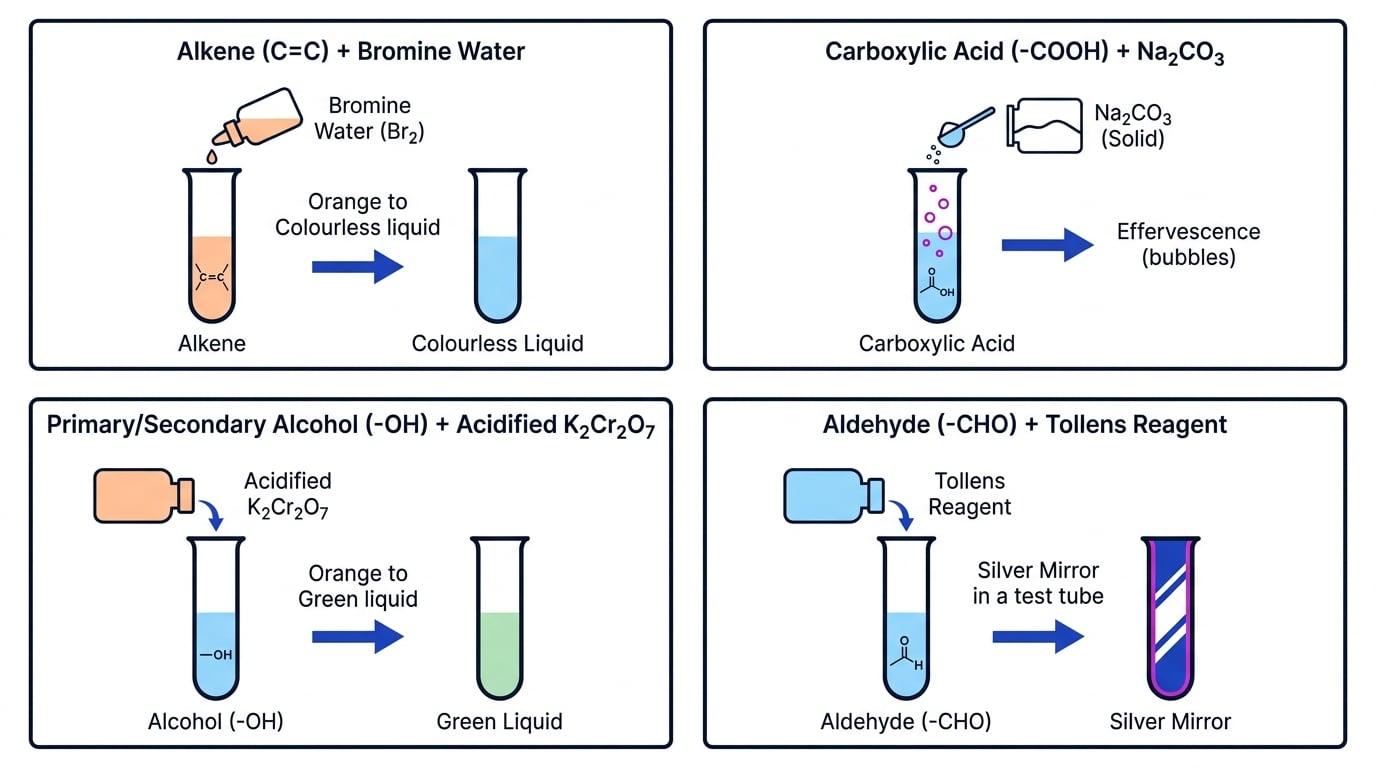
1. Testing for Alkenes
Alkenes contain a carbon–carbon double bond (C=CC=CC=C). Because this double bond is electron-rich, it readily undergoes electrophilic addition reactions.
The Bromine Water Test
- Reagent: Bromine water, Br2(aq)Br_2\text{(aq)}Br2(aq).
- Procedure: Add a few drops of bromine water to the unknown sample and shake the test tube gently.
- Observation if positive: The solution changes from orange to colourless.
- Explanation: The bromine adds across the double bond to form a dihalogenoalkane. As the Br2Br_2Br2 molecules are consumed, their characteristic orange colour disappears.
Clear vs Colourless
Never describe the positive bromine water result as "going clear". Water is clear and colourless, but apple juice is clear and brown. The correct term for the disappearance of colour is colourless.
2. Testing for Carboxylic Acids
Carboxylic acids contain the −COOH-COOH−COOH functional group. They are weak acids, but they are still acidic enough to react with carbonates to produce carbon dioxide gas.
The Carbonate Test
- Reagent: Aqueous sodium carbonate, Na2CO3(aq)Na_2CO_3\text{(aq)}Na2CO3(aq), or solid sodium hydrogencarbonate, NaHCO3(s)NaHCO_3\text{(s)}NaHCO3(s).
- Procedure: Add a small spatula measure of sodium hydrogencarbonate (or a few cm3cm^3cm3 of sodium carbonate solution) to your sample.
- Observation if positive: Vigorous effervescence (fizzing) as carbon dioxide gas is evolved.
- Confirmation: To be absolutely certain the gas is CO2CO_2CO2, you can bubble it through limewater. The limewater will turn cloudy.
Safety check
Most other organic functional groups you meet at A-Level (alcohols, aldehydes, ketones, alkanes, alkenes) are not acidic enough to react with carbonates. This makes the carbonate test highly specific and reliable for carboxylic acids.
3. Testing for Alcohols
Alcohols contain the hydroxyl group (−OH-OH−OH). We classify them as primary (1∘1^\circ1∘), secondary (2∘2^\circ2∘), or tertiary (3∘3^\circ3∘) depending on how many carbon atoms are attached to the carbon holding the −OH-OH−OH group.
We can identify primary and secondary alcohols because they can be oxidised. Tertiary alcohols cannot be easily oxidised.
The Potassium Dichromate(VI) Test
- Reagent: Acidified potassium dichromate(VI) solution, written as K2Cr2O7/H+K_2Cr_2O_7 / H^+K2Cr2O7/H+. (Usually acidified with dilute sulfuric acid, H2SO4H_2SO_4H2SO4).
- Procedure: Add the sample to the acidified dichromate solution and warm gently in a hot water bath.
- Observation if positive: The solution turns from orange to green.
- Explanation: Primary and secondary alcohols reduce the orange dichromate(VI) ions (Cr2O72−Cr_2O_7^{2-}Cr2O72−) to green chromium(III) ions (Cr3+Cr^{3+}Cr3+).
Primary alcohols are oxidised first to aldehydes, and then to carboxylic acids. Secondary alcohols are oxidised to ketones. Tertiary alcohols will show no visible change (the solution stays orange) because they have no hydrogen atom on the carbon bearing the −OH-OH−OH group to be removed during oxidation.
4. Distinguishing Aldehydes from Ketones
Aldehydes and ketones both contain the carbonyl group (C=OC=OC=O). However, aldehydes have a hydrogen atom attached to the carbonyl carbon, meaning they can be oxidised further to form carboxylic acids. Ketones cannot be oxidised further under mild conditions.
We exploit this difference using mild oxidising agents.
Tollens' Reagent (The Silver Mirror Test)
- Reagent: Ammoniacal silver nitrate (made by adding aqueous ammonia to silver nitrate until the initial brown precipitate just dissolves).
- Procedure: Add a few drops of the unknown sample to Tollens' reagent in a clean test tube and warm gently in a hot water bath.
- Observation if positive: A metallic silver mirror forms on the inside of the test tube.
- Explanation: The aldehyde is oxidised to a carboxylic acid. At the same time, the colourless silver(I) complex ions, [Ag(NH3)2]+[Ag(NH_3)_2]^+[Ag(NH3)2]+, are reduced to solid silver atoms (AgAgAg). Ketones cause no change.
Fehling's Solution
- Reagent: A blue solution containing copper(II) ions (Cu2+Cu^{2+}Cu2+) in an alkaline environment.
- Procedure: Add the unknown to Fehling's solution and warm in a hot water bath.
- Observation if positive: The blue solution produces a brick-red precipitate.
- Explanation: The aldehyde is oxidised, reducing the blue copper(II) ions to copper(I) oxide (Cu2OCu_2OCu2O), which is an insoluble brick-red solid. Ketones cause no change.
Summary of mild oxidation tests
If a substance gives a positive result with Tollens' (silver mirror) or Fehling's (brick-red precipitate), it is an aldehyde. If an organic compound contains a carbonyl group but fails these tests, it is a ketone.
Putting it all together
In exams, you are rarely asked about just one test in isolation. You will usually be given molecular formulas and a sequence of test results, and asked to deduce the identity of the molecule.
Deducing an unknown structure from test results
Compound Y has the molecular formula C4H10OC_4H_{10}OC4H10O. When Y is warmed with acidified potassium dichromate(VI), the solution turns from orange to green, and a new organic product, Z, is distilled off.
When product Z is warmed with Tollens' reagent, a silver mirror is formed. Deduce the structures of Y and Z, explaining your reasoning.
- Analyse the molecular formula: Compound Y is C4H10OC_4H_{10}OC4H10O. This fits the general formula for a saturated aliphatic alcohol or ether (CnH2n+2OC_n H_{2n+2} OCnH2n+2O).
- Analyse the first test (acidified K2Cr2O7K_2Cr_2O_7K2Cr2O7): The orange to green colour change means oxidation has occurred. Therefore, Y must be a primary or secondary alcohol. (A tertiary alcohol would cause no colour change, and ethers do not oxidise).
- Analyse the second test (Tollens' reagent): The oxidation product Z forms a silver mirror with Tollens' reagent. This tells us Z is an aldehyde.
- Combine the evidence: Since Z is an aldehyde, it must have been produced by the mild oxidation of a primary alcohol. (If Y had been a secondary alcohol, Z would be a ketone, which would fail the Tollens' test).
- State the final structures: Compound Y is a straight-chain primary alcohol with 4 carbons: butan-1-ol (CH3CH2CH2CH2OHCH_3CH_2CH_2CH_2OHCH3CH2CH2CH2OH). Product Z is the corresponding aldehyde: butanal (CH3CH2CH2CHOCH_3CH_2CH_2CHOCH3CH2CH2CHO). Note: 2-methylpropan-1-ol is also a valid primary alcohol for C4H10OC_4H_{10}OC4H10O and would also be an acceptable answer unless further branching info was given.
In the exam
- State the reagent fully: Don't just write "dichromate" or "silver nitrate". Write "acidified potassium dichromate(VI)" and "Tollens' reagent" (or ammoniacal silver nitrate).
- Describe both the before and after colours: Examiners want to see that you know the starting state. Write "orange to green" instead of just "turns green". Write "orange to colourless" instead of "decolourises".
- Check the conditions: Remember that oxidation tests (dichromate, Tollens', Fehling's) require gentle heating. Always specify "warm in a water bath" when describing these procedures.
Check yourself
- Which functional group will cause aqueous sodium carbonate to effervesce?
- What visible observation occurs when propene is mixed with bromine water?
- Why do we warm Tollens' reagent in a hot water bath rather than over a direct Bunsen flame? (Hint: think about the flammability of organic liquids).
- A liquid with formula C3H8OC_3H_8OC3H8O resists oxidation when boiled with acidified K2Cr2O7K_2Cr_2O_7K2Cr2O7. What is its IUPAC name?