

What you'll learn
- Why enthalpy change alone cannot predict whether a reaction will happen.
- What entropy is and how to calculate the entropy change of a system.
- How to use the Gibbs free-energy equation, ΔG=ΔH−TΔS\Delta G = \Delta H - T\Delta SΔG=ΔH−TΔS, to find out if a reaction is feasible.
- How to interpret a graph of ΔG\Delta GΔG against temperature to find entropy and enthalpy changes.
The limits of enthalpy
At AS-level, you learned that exothermic reactions (where ΔH\Delta HΔH is negative) are generally favourable because they release energy, making the products more stable than the reactants.
However, enthalpy doesn't tell the whole story. If a negative ΔH\Delta HΔH was the only requirement for a reaction to happen, endothermic reactions (where ΔH\Delta HΔH is positive) would be impossible. Yet, everyday endothermic processes happen spontaneously—for example, ice melting at room temperature, or ammonium nitrate dissolving in water to make an instant cold pack.
Clearly, another driving force is at work in nature. That force is entropy.
What is entropy?
Entropy is a measure of disorder or randomness in a system. Nature naturally trends towards chaos. If a chemical or physical change increases the disorder of a system, that change is energetically favourable.
Entropy,
A measure of the disorder or randomness of a system. The more disordered a system, the higher its entropy. It is measured in J K−1mol−1\text{J K}^{-1} \text{mol}^{-1}J K−1mol−1.
You can often predict whether entropy increases or decreases just by looking at a chemical equation or a physical state change:
- Physical changes: A gas is highly chaotic (particles moving rapidly in all directions), while a solid is highly ordered (particles vibrating in a fixed lattice). Therefore, melting (solid →\to→ liquid) and boiling (liquid →\to→ gas) result in a massive increase in entropy.
- Chemical changes: If a reaction produces more moles of gas than it consumes, the system has become more disordered, so the entropy change (ΔS\Delta SΔS) is positive.
Calculating entropy change
Just like you can calculate standard enthalpy changes, you can calculate the standard entropy change of a reaction, ΔS\Delta SΔS, using standard absolute entropy values for the reactants and products.
ΔS=∑S⊖(products)−∑S⊖(reactants) \Delta S = \sum S^{\ominus}(\text{products}) - \sum S^{\ominus}(\text{reactants}) ΔS=∑S⊖(products)−∑S⊖(reactants)Calculating standard entropy change
Calculate the entropy change for the Haber process: N2(g)+3H2(g)→2NH3(g)\text{N}_2(\text{g}) + 3\text{H}_2(\text{g}) \to 2\text{NH}_3(\text{g})N2(g)+3H2(g)→2NH3(g) Given the standard entropies (S⊖S^{\ominus}S⊖): N2=191.6\text{N}_2 = 191.6N2=191.6, H2=130.6\text{H}_2 = 130.6H2=130.6, NH3=192.3 J K−1mol−1\text{NH}_3 = 192.3 \text{ J K}^{-1} \text{mol}^{-1}NH3=192.3 J K−1mol−1.
- Sum the total standard entropy of the products: 2×192.3=384.6 J K−1mol−12 \times 192.3 = 384.6 \text{ J K}^{-1} \text{mol}^{-1}2×192.3=384.6 J K−1mol−1
- Sum the total standard entropy of the reactants: 191.6+(3×130.6)=583.4 J K−1mol−1191.6 + (3 \times 130.6) = 583.4 \text{ J K}^{-1} \text{mol}^{-1}191.6+(3×130.6)=583.4 J K−1mol−1
- Subtract the reactants from the products to find ΔS\Delta SΔS: ΔS=384.6−583.4=−198.8 J K−1mol−1\Delta S = 384.6 - 583.4 = -198.8 \text{ J K}^{-1} \text{mol}^{-1}ΔS=384.6−583.4=−198.8 J K−1mol−1
(Notice how ΔS\Delta SΔS is negative. This makes sense: 4 moles of gas are reacting to form only 2 moles of gas, so the system is becoming more ordered!)
Gibbs free-energy change, ΔG\Delta GΔG
We now have two driving forces for a chemical reaction:
- A drive towards lower enthalpy (exothermic, −ΔH-\Delta H−ΔH).
- A drive towards higher entropy (more disorder, +ΔS+\Delta S+ΔS).
We combine these two factors into a single master equation called the Gibbs free-energy change, ΔG\Delta GΔG.
Gibbs free-energy change,
The overall energy change of a reaction that determines its feasibility, balancing both enthalpy and entropy changes at a specific temperature.
ΔG=ΔH−TΔS \Delta G = \Delta H - T\Delta S ΔG=ΔH−TΔSWhere TTT is the temperature in Kelvin (K\text{K}K).
The rule of feasibility
For a reaction to be chemically feasible (meaning it can happen spontaneously without continuous energy being added), the value of ΔG\Delta GΔG must be zero or negative (ΔG≤0\Delta G \le 0ΔG≤0).
Mismatched units: The most common trap
The Gibbs equation is mathematically straightforward, but examiners love to catch you out on the units.
Forgetting to convert entropy units
Standard enthalpy changes (ΔH\Delta HΔH) are almost always given in kJ mol−1\text{kJ mol}^{-1}kJ mol−1. Standard entropy changes (ΔS\Delta SΔS) are almost always given in J K−1mol−1\text{J K}^{-1} \text{mol}^{-1}J K−1mol−1. Before putting them into ΔG=ΔH−TΔS\Delta G = \Delta H - T\Delta SΔG=ΔH−TΔS, you must divide ΔS\Delta SΔS by 100010001000 to convert it into kJ K−1mol−1\text{kJ K}^{-1} \text{mol}^{-1}kJ K−1mol−1. If you don't, your ΔG\Delta GΔG will be wildly incorrect.
Finding the temperature when a reaction becomes feasible
Sometimes, a reaction is not feasible at room temperature but becomes feasible if you heat it up (or cool it down). You will frequently be asked to calculate the exact temperature at which a reaction just becomes feasible.
A reaction becomes feasible the moment ΔG\Delta GΔG hits 000.
Calculating the feasibility temperature
Using the Haber process reaction from earlier, we know ΔS=−198.8 J K−1mol−1\Delta S = -198.8 \text{ J K}^{-1} \text{mol}^{-1}ΔS=−198.8 J K−1mol−1. The enthalpy change for this reaction is ΔH=−92.2 kJ mol−1\Delta H = -92.2 \text{ kJ mol}^{-1}ΔH=−92.2 kJ mol−1. Calculate the maximum temperature at which this reaction remains feasible.
- State the condition for the reaction just becoming feasible: ΔG=0\Delta G = 0ΔG=0
- Set up the Gibbs equation to solve for TTT:
- Convert ΔS\Delta SΔS into kJ K−1mol−1\text{kJ K}^{-1} \text{mol}^{-1}kJ K−1mol−1 by dividing by 1000: ΔS=−0.1988 kJ K−1mol−1\Delta S = -0.1988 \text{ kJ K}^{-1} \text{mol}^{-1}ΔS=−0.1988 kJ K−1mol−1
- Substitute the values to find TTT:
Because both ΔH\Delta HΔH and ΔS\Delta SΔS are negative, increasing the temperature makes the −TΔS-T\Delta S−TΔS term more positive, eventually making ΔG\Delta GΔG positive. Therefore, the reaction is only feasible below 463.8 K463.8 \text{ K}463.8 K.
Graphical analysis of Gibbs free energy
A very common A-level question asks you to interpret a graph of ΔG\Delta GΔG plotted against temperature TTT. You can extract both the entropy change and the enthalpy change straight from this graph by matching the Gibbs equation to the equation of a straight line, y=mx+cy = mx + cy=mx+c.
ΔG=−ΔS(T)+ΔHy=m(x)+c\begin{aligned} \Delta G &= -\Delta S(T) + \Delta H \\ y &= m(x) + c \end{aligned}ΔGy=−ΔS(T)+ΔH=m(x)+cBy aligning the two equations, we can see:
- The y-axis is ΔG\Delta GΔG.
- The x-axis is TTT.
- The gradient (mmm) of the line is −ΔS-\Delta S−ΔS.
- The y-intercept (ccc) is ΔH\Delta HΔH.
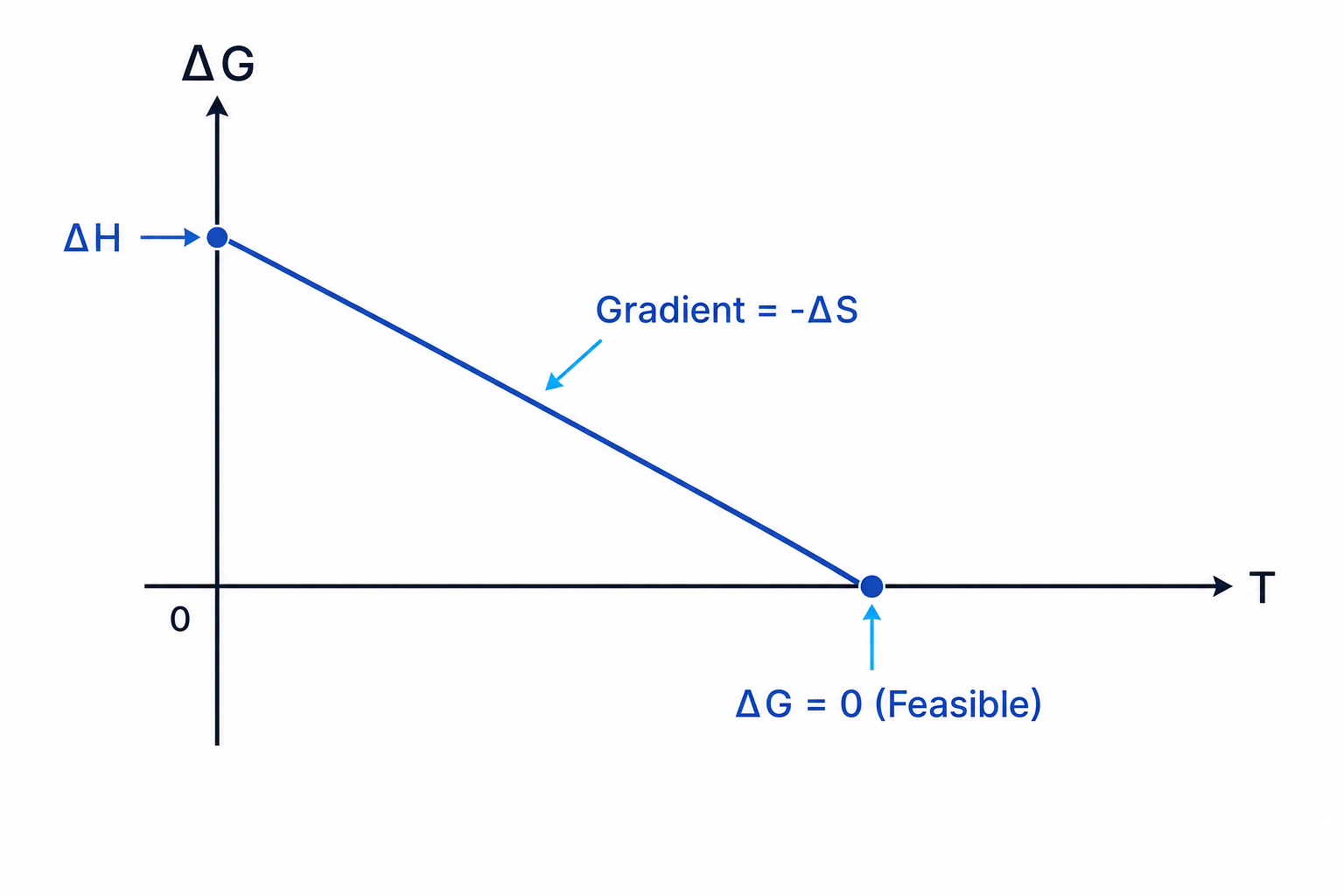
When you look at this graph, you can instantly read the system's thermodynamics:
- The y-intercept (ΔH\Delta HΔH): Gives you the enthalpy change. In the graph above, the intercept is positive, meaning the reaction is endothermic.
- The gradient (−ΔS-\Delta S−ΔS): The line slopes downwards, meaning the gradient is negative. Since m=−ΔSm = -\Delta Sm=−ΔS, a negative gradient means ΔS\Delta SΔS must be positive (entropy is increasing).
- The x-intercept: This is the exact point where ΔG=0\Delta G = 0ΔG=0. The temperature at this point is T=ΔHΔST = \frac{\Delta H}{\Delta S}T=ΔSΔH. Any temperature to the right of this point (where the line dips below the x-axis) represents conditions where the reaction is feasible.
Sign-flipping the gradient
Always remember that the gradient of the graph is −ΔS-\Delta S−ΔS, not ΔS\Delta SΔS. If you calculate a negative gradient from the graph, the actual entropy change of the reaction is positive!
In the exam
- Watch your temperatures: Temperatures in thermodynamics calculations must always be in Kelvin. If given a value in ∘C^\circ\text{C}∘C, immediately add 273273273 to convert it to K\text{K}K.
- Check your units for ΔS\Delta SΔS: Always look at the units of ΔS\Delta SΔS given in the question. If it's in Joules (J), divide by 100010001000 before putting it into the Gibbs equation alongside a ΔH\Delta HΔH that is in kilojoules (kJ).
- "Feasible" doesn't mean "fast": If ΔG\Delta GΔG is negative, the reaction is thermodynamically feasible. However, it might still have a massive activation energy (EaE_aEa), meaning its rate is so slow it appears not to happen at all (e.g. carbon spontaneously turning into diamond). Do not confuse thermodynamic feasibility with chemical kinetics.
Check yourself
- Why does the freezing of water have a negative entropy change?
- What are the units of ΔG\Delta GΔG when ΔH\Delta HΔH is in kJ mol−1\text{kJ mol}^{-1}kJ mol−1 and ΔS\Delta SΔS has been converted to kJ K−1mol−1\text{kJ K}^{-1} \text{mol}^{-1}kJ K−1mol−1?
- If a reaction is exothermic (ΔH<0\Delta H < 0ΔH<0) and produces more disorder (ΔS>0\Delta S > 0ΔS>0), at what temperatures will it be feasible?
- How do you use the gradient of a ΔG\Delta GΔG vs TTT graph to find the entropy change?
