What you'll learn
- How a rate equation links reaction rate to reactant concentrations.
- How to deduce orders of reaction from initial-rate data.
- How to calculate the rate constant, including its units.
- How temperature affects kkk using the Arrhenius equation.
Starting point: rate and concentration
The rate of reaction tells you how quickly reactants are used up or products are formed. In rate-equation questions, rate is usually measured in mol dm⁻³ s⁻¹.
Square brackets mean concentration. For example, [A][\text{A}][A] means the concentration of A, usually in mol dm⁻³.
Initial rate
The initial rate is the rate right at the start of the reaction, before the concentrations have changed significantly.
Initial rates are useful because you know the starting concentrations accurately, so you can compare how changing one concentration affects the rate.
The rate equation
For a reaction involving reactants A and B, the rate equation has the form:
rate=k[A]m[B]n\text{rate}=k[\text{A}]^m[\text{B}]^nrate=k[A]m[B]nThis is A-level-only kinetics: unlike simpler rate ideas, the powers in the rate equation come from experimental data, not just from the balanced chemical equation.
Order of reaction
The order of reaction with respect to a reactant is the power to which that reactant’s concentration is raised in the experimentally determined rate equation.
Rate constant
The rate constant, kkk, is the proportionality constant in the rate equation for a particular reaction at a fixed temperature.
On this specification, the individual orders mmm and nnn are restricted to 0, 1 and 2.
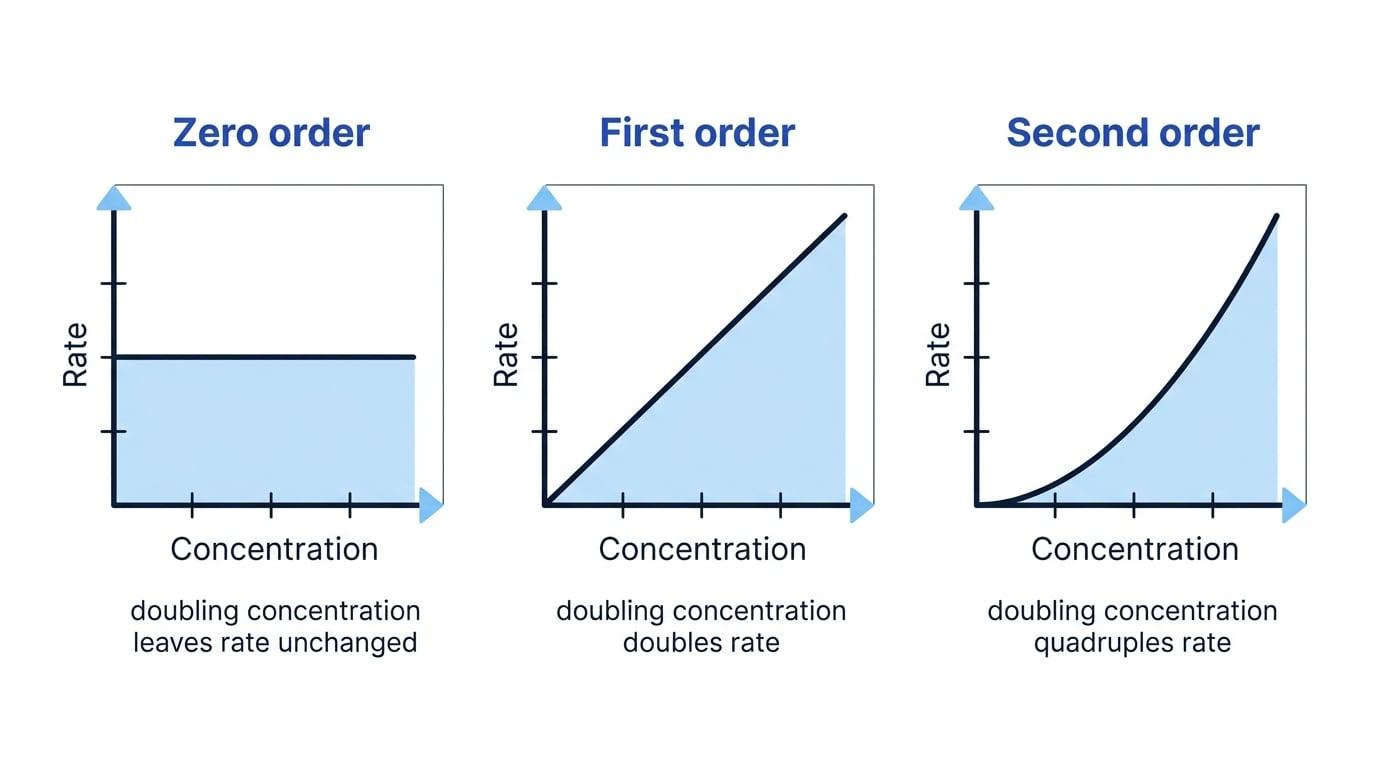
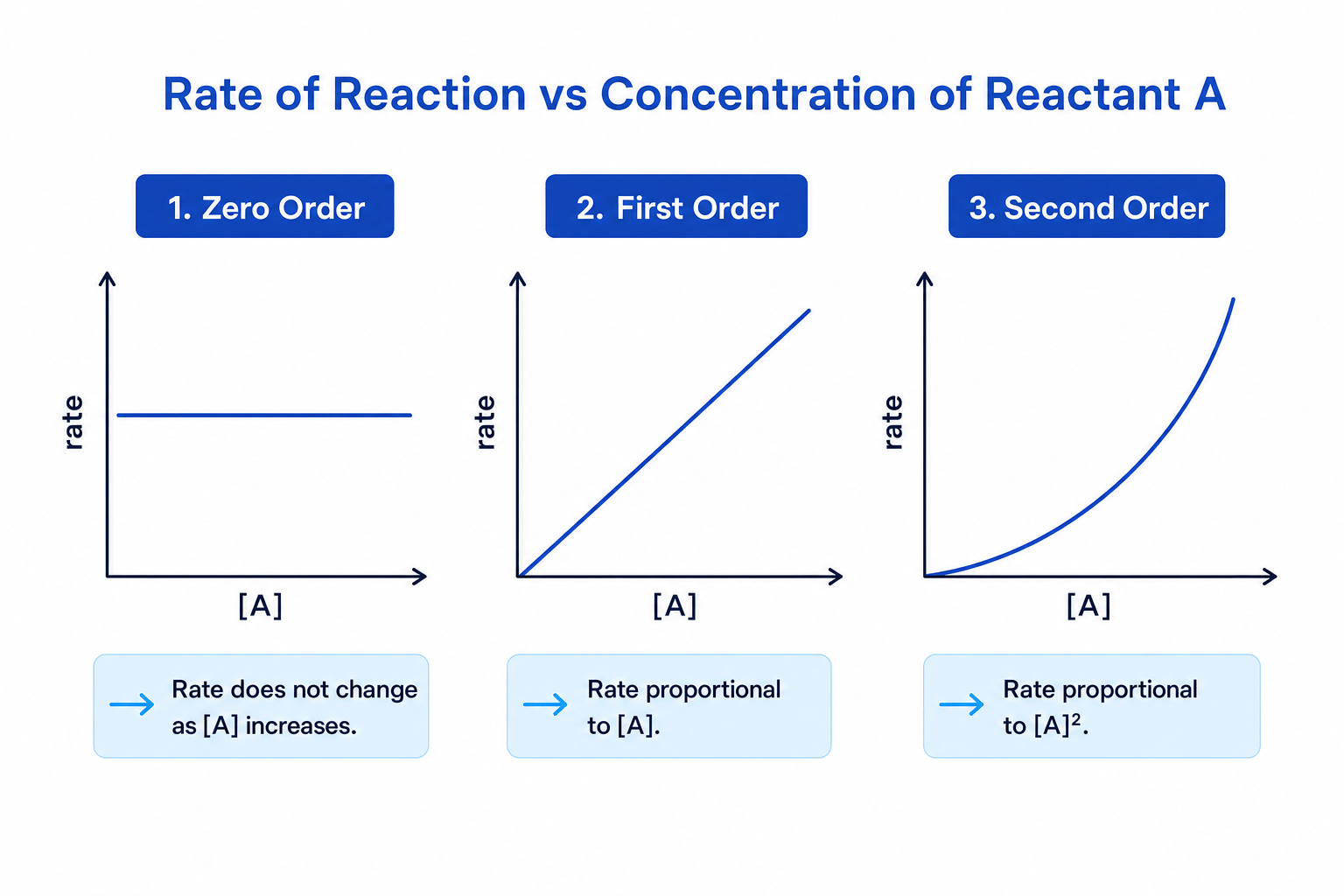
The three common concentration effects look like this:
What the orders mean
- Zero order: changing that reactant’s concentration has no effect on rate.
- First order: doubling that reactant’s concentration doubles the rate.
- Second order: doubling that reactant’s concentration makes the rate four times bigger.
The overall order is the sum of the individual orders. For rate=k[A]2[B]\text{rate}=k[\text{A}]^2[\text{B}]rate=k[A]2[B], the overall order is 3.
Orders are experimental
Do not assume the orders from the balanced equation. They are found by comparing rate data from experiments.
Using a known rate equation
A reaction has rate=k[A]2[B]\text{rate}=k[\text{A}]^2[\text{B}]rate=k[A]2[B]. At a particular temperature, k=0.480k=0.480k=0.480 dm⁶ mol⁻² s⁻¹, [A]=0.100[\text{A}]=0.100[A]=0.100 mol dm⁻³ and [B]=0.200[\text{B}]=0.200[B]=0.200 mol dm⁻³.
-
Use the powers in the rate equation: A is squared, while B is first order.
-
Substitute the values: rate=0.480×(0.100)2×0.200\text{rate}=0.480 \times (0.100)^2 \times 0.200rate=0.480×(0.100)2×0.200.
-
Calculate the value: rate=9.60×10⁻⁴\text{rate}=9.60 \times 10^{-4}rate=9.60×10⁻⁴ mol dm⁻³ s⁻¹.
Deducing orders from initial-rate data
The usual method is to compare two experiments where only one reactant concentration changes.
If concentration changes by a factor and the rate changes by another factor, match the change to the order:
- Concentration changes but rate does not change → zero order.
- Concentration doubles and rate doubles → first order.
- Concentration doubles and rate quadruples → second order.
Factor method
When one reactant changes and the others are constant, use: concentration factor raised to the order equals rate factor.
Deducing a rate equation
Initial-rate data are collected at the same temperature:
- Experiment 1: [A]=0.100[\text{A}]=0.100[A]=0.100 mol dm⁻³, [B]=0.100[\text{B}]=0.100[B]=0.100 mol dm⁻³, rate = 2.00×10−42.00 \times 10^{-4}2.00×10⁻⁴ mol dm⁻³ s⁻¹
- Experiment 2: [A]=0.200[\text{A}]=0.200[A]=0.200 mol dm⁻³, [B]=0.100[\text{B}]=0.100[B]=0.100 mol dm⁻³, rate = 8.00×10−48.00 \times 10^{-4}8.00×10⁻⁴ mol dm⁻³ s⁻¹
- Experiment 3: [A]=0.200[\text{A}]=0.200[A]=0.200 mol dm⁻³, [B]=0.300[\text{B}]=0.300[B]=0.300 mol dm⁻³, rate = 2.40×10−32.40 \times 10^{-3}2.40×10⁻³ mol dm⁻³ s⁻¹
-
Compare experiments 1 and 2: [B][\text{B}][B] is constant, [A][\text{A}][A] doubles, and the rate becomes four times larger. Since 22=42^2=422=4, the order with respect to A is 2.
-
Compare experiments 2 and 3: [A][\text{A}][A] is constant, [B][\text{B}][B] triples, and the rate triples. Since 31=33^1=331=3, the order with respect to B is 1.
-
Write the rate equation using those powers: rate=k[A]2[B]\text{rate}=k[\text{A}]^2[\text{B}]rate=k[A]2[B].
Using equation coefficients as orders
The balanced equation might suggest possible reactants, but it does not usually tell you the orders. Use the rate data.
Calculating the rate constant and its units
Once you know the rate equation, rearrange it to find kkk.
For example, if:
rate=k[A]2[B]\text{rate}=k[\text{A}]^2[\text{B}]rate=k[A]2[B]then:
k=rate[A]2[B]k=\frac{\text{rate}}{[\text{A}]^2[\text{B}]}k=[A]2[B]rateThe units of kkk depend on the overall order:
- Overall order 0: units of kkk are mol dm⁻³ s⁻¹.
- Overall order 1: units of kkk are s⁻¹.
- Overall order 2: units of kkk are dm³ mol⁻¹ s⁻¹.
- Overall order 3: units of kkk are dm⁶ mol⁻² s⁻¹.
Finding k and its units
Using experiment 1 from the previous example, the rate equation is rate=k[A]2[B]\text{rate}=k[\text{A}]^2[\text{B}]rate=k[A]2[B].
-
Rearrange for kkk: k=rate[A]2[B]k=\frac{\text{rate}}{[\text{A}]^2[\text{B}]}k=[A]2[B]rate.
-
Substitute the data: k=2.00×10⁻⁴(0.100)2×0.100=0.200k=\frac{2.00 \times 10^{-4}}{(0.100)^2 \times 0.100}=0.200k=(0.100)2×0.1002.00×10−4=0.200.
-
The reaction is third order overall, so the units are dm⁶ mol⁻² s⁻¹. Therefore, k=0.200k=0.200k=0.200 dm⁶ mol⁻² s⁻¹.
Forgetting the units of k
The rate constant does not always have units of mol dm⁻³ s⁻¹. Its units change with the overall order of the reaction.
Zero-order reactions from concentration–time graphs
For a zero-order reaction, the rate does not depend on the concentration of that reactant. If you plot concentration against time, the graph is a straight line with a constant negative gradient.
For the disappearance of a reactant in a simple 1:1 situation:
k=magnitude of the gradientk=\text{magnitude of the gradient}k=magnitude of the gradientFinding k from a zero-order graph
A zero-order reactant decreases from 0.160 mol dm⁻³ to 0.040 mol dm⁻³ in 300 s.
-
Calculate the gradient of the concentration–time graph: 0.040−0.160300−0=−4.00×10⁻⁴\frac{0.040-0.160}{300-0}=-4.00 \times 10^{-4}300−00.040−0.160=−4.00×10⁻⁴ mol dm⁻³ s⁻¹.
-
The gradient is negative because the reactant concentration is decreasing.
-
For the rate constant, take the magnitude: k=4.00×10⁻⁴k=4.00 \times 10^{-4}k=4.00×10⁻⁴ mol dm⁻³ s⁻¹.
Temperature and the rate constant
Increasing temperature increases the rate constant kkk. This means the reaction is faster at the same concentrations.
The reason is that a higher temperature gives particles more kinetic energy, so a greater proportion of collisions have energy at least equal to the activation energy, EaE_aEa.
Temperature changes k
Changing concentration changes the rate through the concentration terms. Changing temperature changes the value of kkk.
The Arrhenius equation
The relationship between kkk and temperature is given by:
k=Ae−Ea/RTk=Ae^{-E_a/RT}k=Ae−Ea/RTwhere:
- AAA is the Arrhenius constant.
- EaE_aEa is the activation energy.
- RRR is the gas constant, usually 8.31 J K⁻¹ mol⁻¹.
- TTT is the temperature in K.
You will normally be given the equation and the value of RRR when needed.
Units in Arrhenius calculations
Use temperature in K, not °C. If RRR is in J K⁻¹ mol⁻¹, then EaE_aEa must be in J mol⁻¹, not kJ mol⁻¹.
Calculating k using the Arrhenius equation
For a reaction, A=1.20×10¹²A=1.20 \times 10^{12}A=1.20×10¹² s⁻¹, Ea=75.0E_a=75.0Ea=75.0 kJ mol⁻¹ and T=298T=298T=298 K.
-
Convert the activation energy: 75.0 kJ mol⁻¹ = 75000 J mol⁻¹.
-
Substitute into the exponent: −EaRT=−750008.31×298=−30.3-\frac{E_a}{RT}=-\frac{75000}{8.31 \times 298}=-30.3−RTEa=−8.31×29875000=−30.3.
-
Calculate kkk: k=1.20×10¹²×e−30.3=8.3×10⁻²k=1.20 \times 10^{12} \times e^{-30.3}=8.3 \times 10^{-2}k=1.20×10¹²×e−30.3=8.3×10⁻² s⁻¹.
The Arrhenius plot
The Arrhenius equation can be rearranged into a straight-line form:
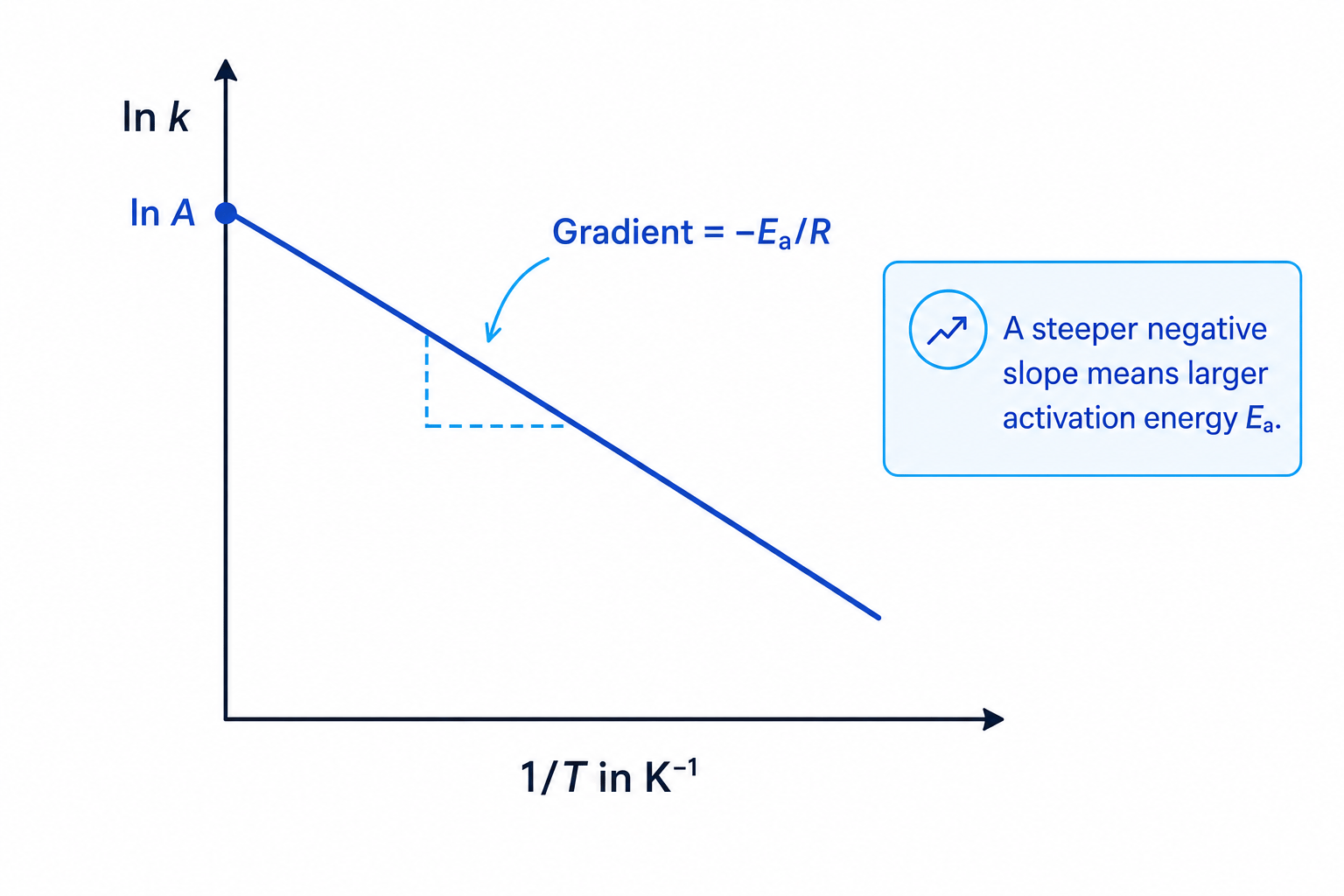
lnk=−EaRT+lnA\ln k=-\frac{E_a}{RT}+\ln Alnk=−RTEa+lnAThis can also be written as:
lnk=−EaR(1T)+lnA\ln k=-\frac{E_a}{R}\left(\frac{1}{T}\right)+\ln Alnk=−REa(T1)+lnASo a graph of lnk\ln klnk against 1T\frac{1}{T}T1 is a straight line with gradient −EaR-\frac{E_a}{R}−REa and intercept lnA\ln AlnA.
Finding activation energy from a gradient
An Arrhenius plot of lnk\ln klnk against 1T\frac{1}{T}T1 has a gradient of -7250 K.
-
Use the gradient relationship: gradient=−EaR\text{gradient}=-\frac{E_a}{R}gradient=−REa.
-
Substitute the gradient: −7250=−Ea8.31-7250=-\frac{E_a}{8.31}−7250=−8.31Ea, so Ea=7250×8.31=6.02×10⁴E_a=7250 \times 8.31=6.02 \times 10^4Ea=7250×8.31=6.02×10⁴ J mol⁻¹.
-
Convert to kJ mol⁻¹: Ea=60.2E_a=60.2Ea=60.2 kJ mol⁻¹.
In the exam
- Compare experiments where only one concentration changes; use factor changes to find the order.
- Never assume orders from the balanced equation unless the question explicitly gives the rate equation.
- For kkk, derive the units from the rate equation; for Arrhenius work, use K for temperature and J mol⁻¹ for activation energy.
Check yourself
- If doubling [A][\text{A}][A] leaves the rate unchanged, what is the order with respect to A?
- For rate=k[A][B]2\text{rate}=k[\text{A}][\text{B}]^2rate=k[A][B]2, how would you find the units of kkk?
- On a graph of lnk\ln klnk against 1T\frac{1}{T}T1, how is EaE_aEa found from the gradient?