

Building on the foundation of Hess's Law you learned at AS, we are now going to look at the energetics of ionic compounds. You cannot directly measure the energy released when a lattice forms from gaseous ions. Instead, we have to calculate it indirectly using a specific type of energy cycle called a Born–Haber cycle.
What you'll learn
- How to define the energy changes involved in forming an ionic lattice.
- How to construct and calculate values from a Born–Haber cycle.
- What the difference between theoretical and experimental lattice enthalpies tells us about covalent character.
- How to use energy cycles to calculate the enthalpy of solution.
1. Lattice Enthalpy
Ionic lattices are held together by the strong electrostatic attraction between oppositely charged ions. Lattice enthalpy is a measure of the strength of this ionic bonding. The AQA specification requires you to know it from two different perspectives: formation and dissociation.
Lattice formation and dissociation
- Enthalpy of lattice formation (ΔLEH⊖\Delta_{\text{LE}}H^{\ominus}ΔLEH⊖): The standard enthalpy change when one mole of a solid ionic compound is formed from its gaseous ions. This is an exothermic process (values are negative).
- Enthalpy of lattice dissociation: The standard enthalpy change when one mole of a solid ionic compound is completely dissociated into its gaseous ions. This is an endothermic process (values are positive, and exactly equal in magnitude to formation).
Unless specified otherwise, when a question asks you to "calculate the lattice enthalpy", they usually mean lattice formation. We will focus on lattice formation in our main Born–Haber cycle.
2. The Building Blocks of the Cycle
A Born–Haber cycle breaks down the formation of an ionic lattice from its elements into a series of hypothetical steps. To build the cycle, you need to know the definitions of several enthalpy changes.
From standard states to gaseous atoms
Before atoms can become ions, they must be separated and turned into a gas.
- Enthalpy of formation (ΔfH⊖\Delta_{\text{f}}H^{\ominus}ΔfH⊖): The enthalpy change when one mole of a compound is formed from its elements in their standard states under standard conditions.
- Enthalpy of atomisation (ΔatH⊖\Delta_{\text{at}}H^{\ominus}ΔatH⊖): The enthalpy change when one mole of gaseous atoms is formed from the element in its standard state. For solid sodium, this is Na(s)→Na(g)\text{Na(s)} \to \text{Na(g)}Na(s)→Na(g).
- Bond enthalpy: The enthalpy change required to break one mole of a specific covalent bond in the gas phase.
Atomisation vs Bond Enthalpy
For a diatomic molecule like chlorine (Cl2\text{Cl}_2Cl2), making one mole of gaseous atoms means breaking exactly half a mole of Cl−Cl\text{Cl}-\text{Cl}Cl−Cl bonds. Therefore, the enthalpy of atomisation of chlorine is exactly half the bond enthalpy of Cl−Cl\text{Cl}-\text{Cl}Cl−Cl.
From gaseous atoms to gaseous ions
Once we have gaseous atoms, we need to turn the metals into positive ions and the non-metals into negative ions.
- First Ionisation Energy (ΔieH⊖\Delta_{\text{ie}}H^{\ominus}ΔieH⊖): The enthalpy change when one mole of electrons is removed from one mole of gaseous atoms to form one mole of gaseous 1+1+1+ ions.
- First Electron Affinity (ΔeaH⊖\Delta_{\text{ea}}H^{\ominus}ΔeaH⊖): The enthalpy change when one mole of electrons is added to one mole of gaseous atoms to form one mole of gaseous 1−1-1− ions.
Signs of Electron Affinities
The first electron affinity is always exothermic (negative) because the nucleus attracts the incoming electron. However, if you are making a 2−2-2− ion (like O2−\text{O}^{2-}O2−), the second electron affinity is endothermic (positive) because you are forcing a negative electron onto an already negative ion, which requires energy to overcome the repulsion.
3. Constructing a Born–Haber Cycle
A Born–Haber cycle is essentially an energy level diagram.
- We start at a "zero" line with the elements in their standard states.
- We point an arrow downwards to the solid ionic lattice. This is the enthalpy of formation.
- We point arrows upwards, atomising and then ionising the elements, until we reach the highest energy point: purely gaseous ions.
- We point a large arrow downwards from the gaseous ions to the solid lattice. This is the lattice formation enthalpy.
Here is what a complete Born–Haber cycle looks like for sodium chloride (NaCl\text{NaCl}NaCl):
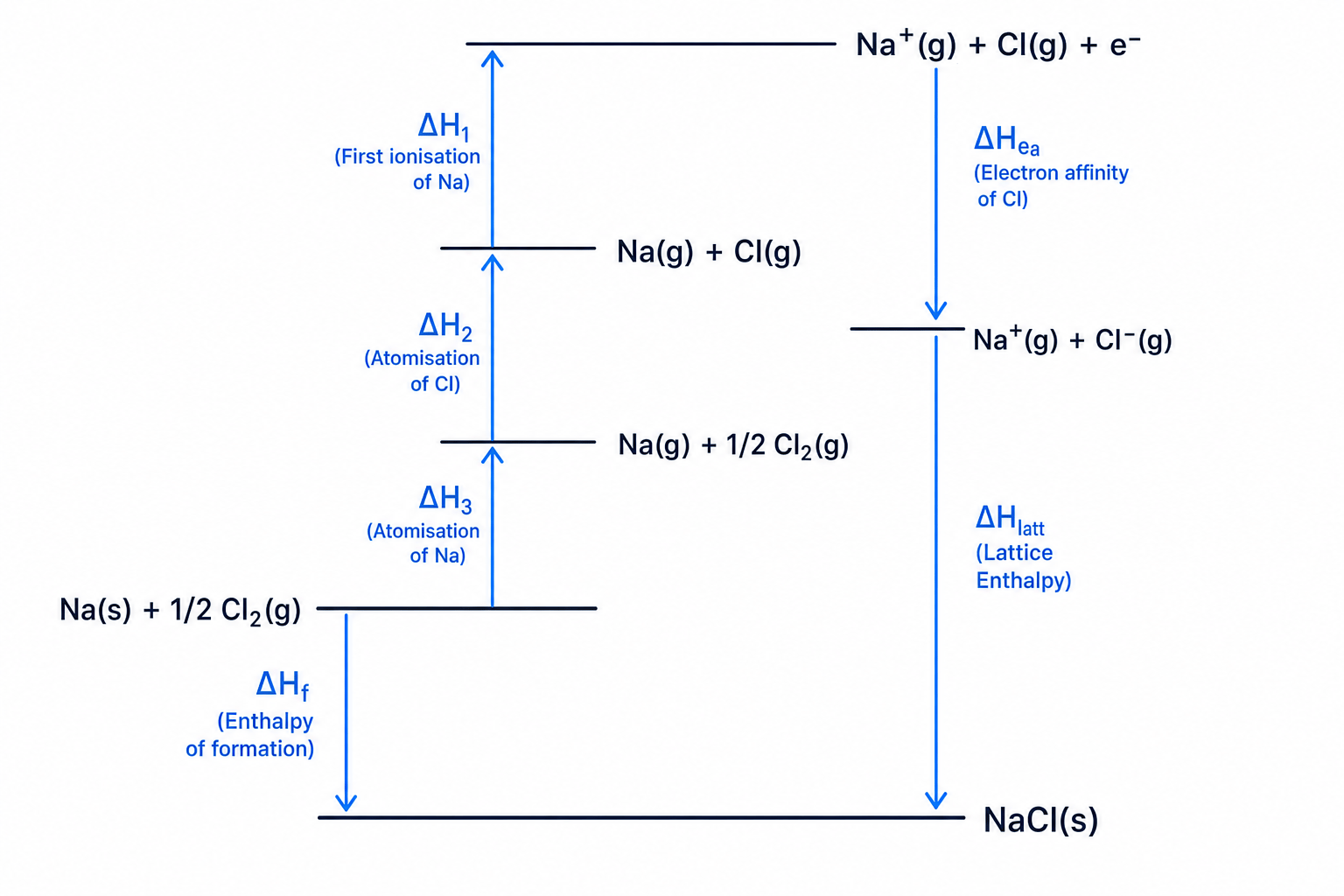
Because energy is conserved (Hess's Law), the direct route (Enthalpy of formation) must equal the sum of the indirect route (all the upward atomisation and ionisation steps + the downward electron affinity and lattice formation steps).
Let's put this into practice with a slightly more complex molecule, MgCl2\text{MgCl}_2MgCl2.
Calculating lattice formation enthalpy for magnesium chloride
Use the following data to calculate the enthalpy of lattice formation for MgCl2\text{MgCl}_2MgCl2. All values are in kJ mol−1\text{kJ mol}^{-1}kJ mol−1.
- Enthalpy of formation of MgCl2\text{MgCl}_2MgCl2: −642-642−642
- Enthalpy of atomisation of Mg\text{Mg}Mg: +148+148+148
- First ionisation energy of Mg\text{Mg}Mg: +738+738+738
- Second ionisation energy of Mg\text{Mg}Mg: +1451+1451+1451
- Enthalpy of atomisation of Cl\text{Cl}Cl: +121+121+121
- First electron affinity of Cl\text{Cl}Cl: −349-349−349
- Write out the Hess's Law equation The direct route (formation) equals the indirect route (everything else added together).
- Substitute the data, taking care with stoichiometry Because MgCl2\text{MgCl}_2MgCl2 contains two chloride ions, we must multiply the atomisation and electron affinity of chlorine by 222. We also need both the 1st and 2nd ionisation energies of Magnesium to reach Mg2+\text{Mg}^{2+}Mg2+.
- Simplify the calculation Combine the numbers for the indirect route to find the total energy of the purely gaseous ions relative to the elements:
- Solve for Lattice Enthalpy Rearrange to make ΔLEH\Delta_{\text{LE}}HΔLEH the subject.
(The large negative value makes sense, as lattice formation is highly exothermic).
4. The Perfect Ionic Model vs Covalent Character
Once we have calculated a lattice enthalpy using a Born–Haber cycle (the experimental value), we can compare it to a purely theoretical calculation based on physics.
The Perfect Ionic Model calculates theoretical lattice enthalpy by assuming that ions are perfectly spherical point charges and that the bonding is 100% ionic, with no covalent character at all.
When we compare the two values, two things can happen:
- They are almost identical (e.g. NaCl\text{NaCl}NaCl). This tells us the perfect ionic model is a very good representation of the compound. The bonding is almost purely ionic.
- The Born–Haber (experimental) value is much more exothermic than the theoretical value (e.g. AgI\text{AgI}AgI or MgCl2\text{MgCl}_2MgCl2).
Evidence for Covalent Character
If the experimental lattice enthalpy from a Born–Haber cycle is more exothermic (more negative) than the theoretical value from the perfect ionic model, it proves the compound has covalent character.
This extra covalent character happens because the positive cation distorts (polarises) the electron cloud of the negative anion. This means the electrons are shared slightly between the ions, making the bonds stronger than the perfect ionic model predicts.
5. Enthalpies of Solution and Hydration
We can use a different type of energy cycle to figure out what happens when an ionic lattice dissolves in water.
Solution and Hydration
- Enthalpy of solution (ΔsolH⊖\Delta_{\text{sol}}H^{\ominus}ΔsolH⊖): The enthalpy change when one mole of an ionic solid completely dissolves in water under standard conditions.
- Enthalpy of hydration (ΔhydH⊖\Delta_{\text{hyd}}H^{\ominus}ΔhydH⊖): The enthalpy change when one mole of gaseous ions is completely dissolved in water to form one mole of aqueous ions.
Dissolving an ionic lattice is a two-step process in terms of energy:
- First, you must break apart the lattice into gaseous ions. This is the lattice dissociation enthalpy (endothermic).
- Second, water molecules surround the gaseous ions, releasing energy. This is the enthalpy of hydration (exothermic).
We can map this onto an energy cycle:
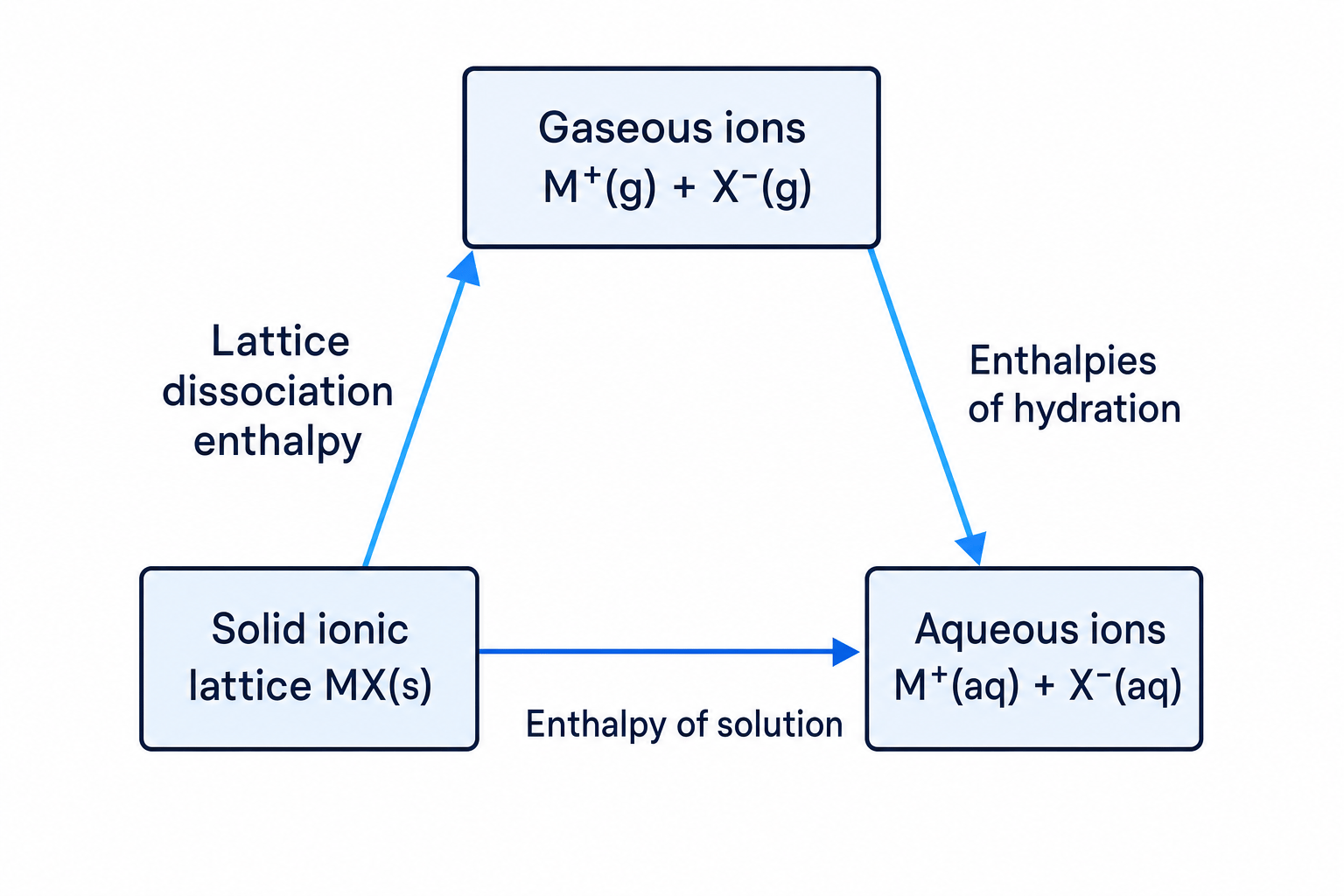
The equation derived from this cycle is:
ΔsolH=ΔL.dissH+∑ΔhydH \Delta_{\text{sol}}H = \Delta_{\text{L.diss}}H + \sum \Delta_{\text{hyd}}H ΔsolH=ΔL.dissH+∑ΔhydHCalculating enthalpy of solution
Calculate the enthalpy of solution for potassium chloride (KCl\text{KCl}KCl) given the following data:
- Lattice dissociation enthalpy of KCl=+715 kJ mol−1\text{KCl} = +715 \text{ kJ mol}^{-1}KCl=+715 kJ mol−1
- Enthalpy of hydration of K+=−322 kJ mol−1\text{K}^+ = -322 \text{ kJ mol}^{-1}K+=−322 kJ mol−1
- Enthalpy of hydration of Cl−=−364 kJ mol−1\text{Cl}^- = -364 \text{ kJ mol}^{-1}Cl−=−364 kJ mol−1
- State the Hess cycle relationship To find the enthalpy of solution, add the lattice dissociation enthalpy to the sum of the hydration enthalpies.
- Substitute the values
- Calculate the final answer
(A positive value means the solution cools down as the salt dissolves, which is true for KCl\text{KCl}KCl.)
Watch your lattice enthalpies
The formula above uses Lattice Dissociation (which is positive). If the data table gives you Lattice Formation (which is negative), you must reverse the sign to turn it into dissociation before you plug it into ΔsolH=ΔL.dissH+∑ΔhydH\Delta_{\text{sol}}H = \Delta_{\text{L.diss}}H + \sum \Delta_{\text{hyd}}HΔsolH=ΔL.dissH+∑ΔhydH.
In the exam
- Look out for stoichiometry traps: If the lattice contains two of the same ion (e.g. the F−\text{F}^-F− in CaF2\text{CaF}_2CaF2), you must multiply both the atomisation energy and the electron affinity of fluorine by 222.
- Check whether it's formation or dissociation: Exams love to mix up lattice formation and lattice dissociation data. Check the sign carefully. Formation is always negative; dissociation is always positive.
- Remember the diatomic elements: Sometimes a question will give you the bond enthalpy of Cl2\text{Cl}_2Cl2 instead of the enthalpy of atomisation of Cl\text{Cl}Cl. You will need to halve the bond enthalpy to find the atomisation energy of one mole of Cl\text{Cl}Cl atoms.
- Be explicit about covalent character: When comparing experimental and theoretical lattice enthalpies, use the exact phrasing "the compound has partial covalent character" and specify that it makes the experimental value "more exothermic".
Check yourself
- What is the difference between the enthalpy of lattice formation and the enthalpy of lattice dissociation?
- Why is the second electron affinity of oxygen an endothermic process, while the first is exothermic?
- How do you construct an equation to find the enthalpy of solution using lattice dissociation and hydration enthalpies?
- If the perfect ionic model gives a lattice enthalpy of −780 kJ mol−1-780 \text{ kJ mol}^{-1}−780 kJ mol−1 but the Born–Haber cycle gives −910 kJ mol−1-910 \text{ kJ mol}^{-1}−910 kJ mol−1, what does this tell you about the bonding in the lattice?
