What you'll learn
- How to distinguish exothermic and endothermic reactions.
- What enthalpy change, ΔH\Delta HΔH, means at constant pressure.
- What standard conditions and standard states mean.
- How to define ΔcH⊖\Delta_c H^\ominusΔcH⊖ and ΔfH⊖\Delta_f H^\ominusΔfH⊖ accurately.
The basic idea: energy moves between the reaction and the surroundings
In energetics, we usually focus on a chemical reaction as the system. Everything outside it — the solution, container, thermometer and air nearby — is the surroundings.
When a reaction happens, energy may be transferred between the system and the surroundings, often as heat.
System and surroundings
The system is the chemical reaction being studied. The surroundings are everything outside the reaction that can gain or lose energy.
At A-Level, you need to be very comfortable describing the direction of heat transfer: from the reaction to the surroundings, or from the surroundings into the reaction.
Exothermic reactions
An exothermic reaction transfers heat energy to the surroundings. The surroundings usually get warmer, so a thermometer placed in the reaction mixture often shows a temperature rise.
Exothermic reaction
An exothermic reaction is a reaction that releases heat energy to the surroundings. Its enthalpy change is negative: ΔH<0\Delta H < 0ΔH<0.
The products have less enthalpy than the reactants. The “missing” energy has been transferred to the surroundings.
Endothermic reactions
An endothermic reaction takes in heat energy from the surroundings. The surroundings usually get cooler, so a thermometer often shows a temperature fall.
Endothermic reaction
An endothermic reaction is a reaction that absorbs heat energy from the surroundings. Its enthalpy change is positive: ΔH>0\Delta H > 0ΔH>0.
The products have more enthalpy than the reactants. Energy has been absorbed from the surroundings and stored in the products.
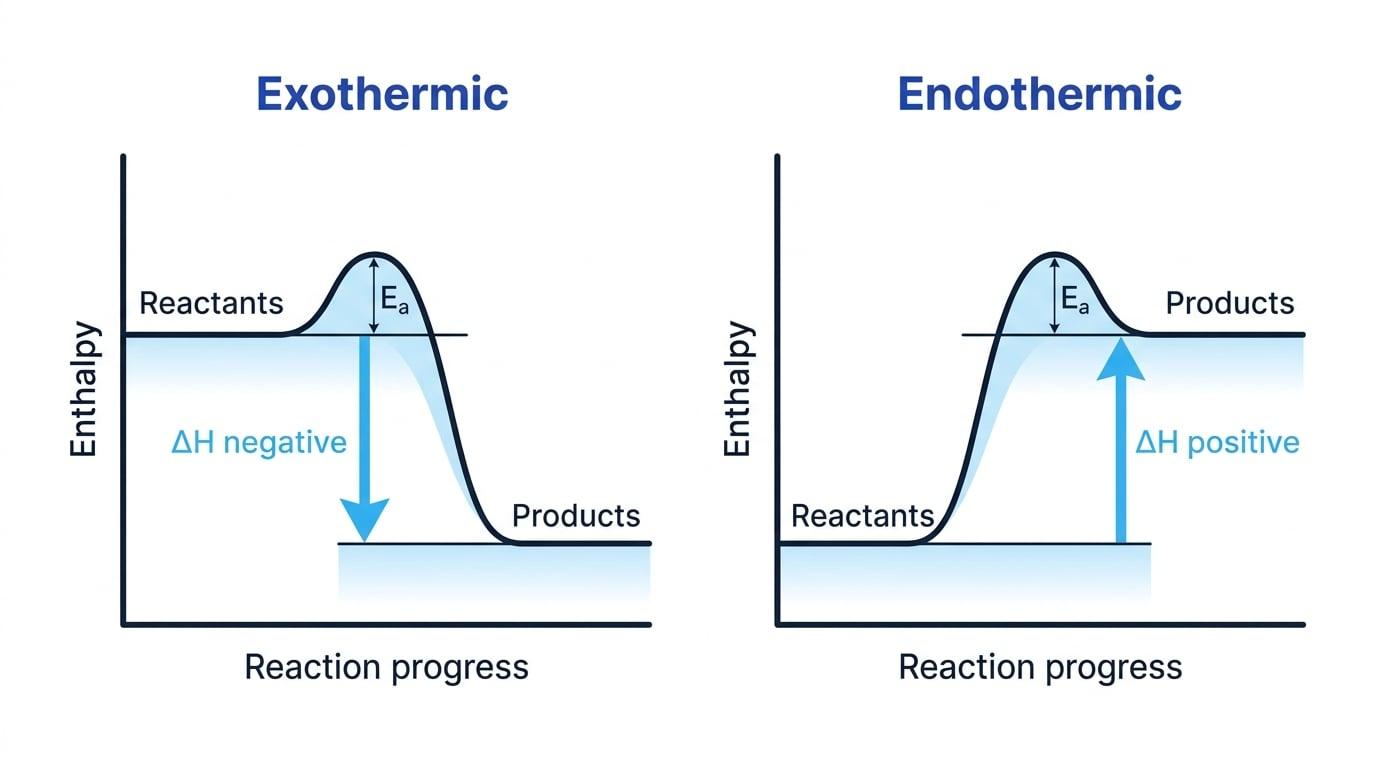
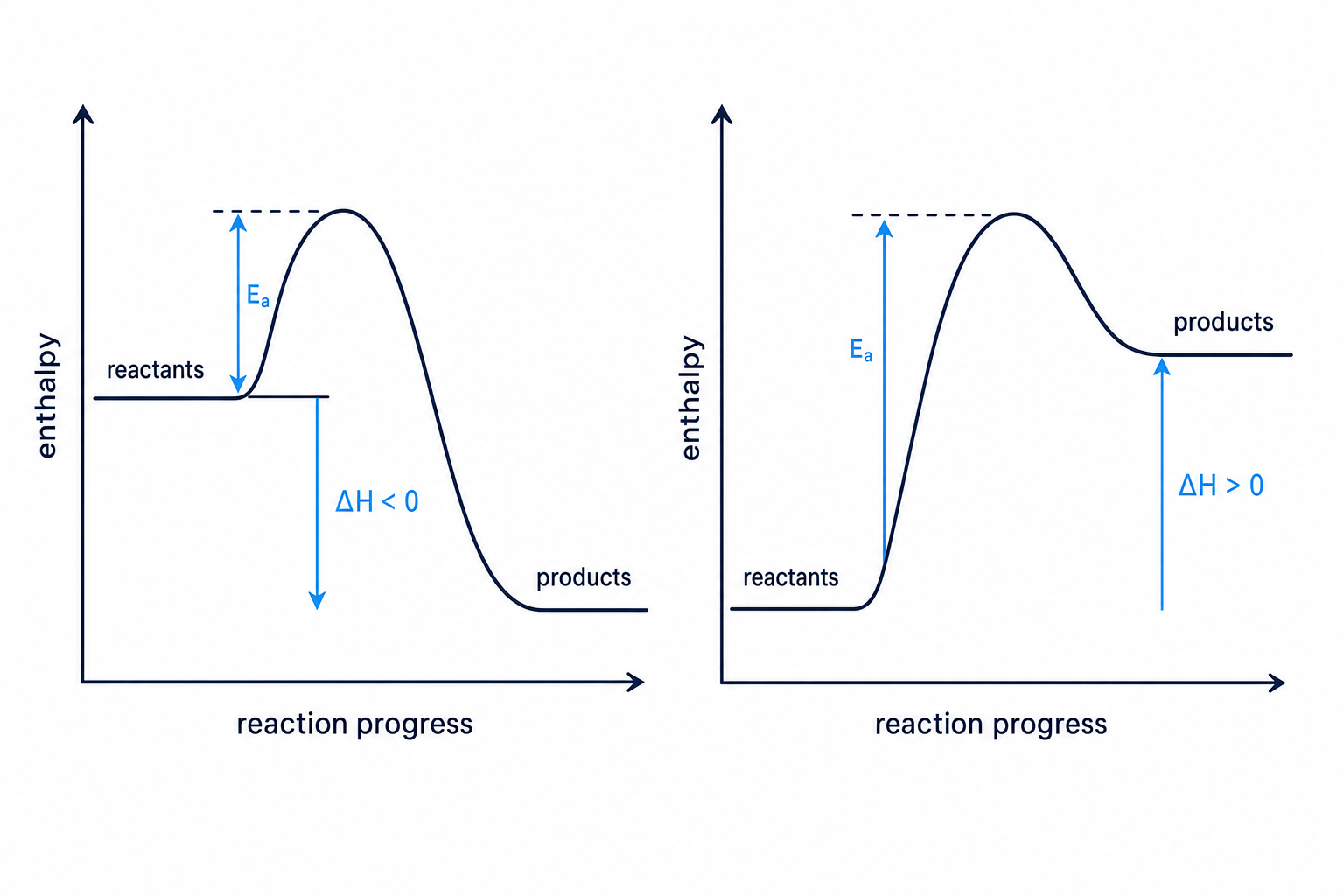
The reaction profile diagrams below show the sign of ΔH\Delta HΔH for exothermic and endothermic reactions.
Sign of ΔH
For exothermic reactions, products are lower in enthalpy than reactants, so ΔH\Delta HΔH is negative. For endothermic reactions, products are higher in enthalpy than reactants, so ΔH\Delta HΔH is positive.
Deciding whether a reaction is exothermic or endothermic
A reaction mixture starts at 21.0 °C and reaches 34.5 °C. Decide whether the reaction is exothermic or endothermic, and state the sign of ΔH\Delta HΔH.
- Compare the initial and final temperatures: the temperature increases from 21.0 °C to 34.5 °C, so the surroundings have gained heat energy.
- If the surroundings gain heat energy, the reaction must have transferred heat energy to the surroundings.
- Therefore the reaction is exothermic, so its enthalpy change is negative: ΔH<0\Delta H < 0ΔH<0.
Mixing up temperature change and ΔH sign
A temperature rise means the surroundings gained energy, so the reaction lost energy. That is why a temperature rise usually means ΔH\Delta HΔH is negative.
What enthalpy change means
Enthalpy is a measure of the heat energy content of a system at constant pressure. You do not need to measure the absolute enthalpy of a substance; in chemistry, we measure changes in enthalpy.
Enthalpy change
The enthalpy change, ΔH\Delta HΔH, is the heat energy change measured under conditions of constant pressure.
The symbol Δ\DeltaΔ means “change in”. So ΔH\Delta HΔH means:
ΔH=Hproducts−Hreactants\Delta H = H_{\text{products}} - H_{\text{reactants}}ΔH=Hproducts−HreactantsThis explains the sign convention:
- If products have lower enthalpy than reactants, Hproducts−HreactantsH_{\text{products}} - H_{\text{reactants}}Hproducts−Hreactants is negative.
- If products have higher enthalpy than reactants, Hproducts−HreactantsH_{\text{products}} - H_{\text{reactants}}Hproducts−Hreactants is positive.
Enthalpy changes are usually given in kJ mol⁻¹. The “per mole” part depends on the balanced equation being used.
Finding ΔH from enthalpy levels
A reaction has reactants at an enthalpy level of 250 kJ mol⁻¹ and products at 90 kJ mol⁻¹. Calculate ΔH\Delta HΔH and classify the reaction.
-
Use the definition of enthalpy change:
ΔH=Hproducts−Hreactants\Delta H = H_{\text{products}} - H_{\text{reactants}}ΔH=Hproducts−Hreactants -
Substitute the enthalpy levels, keeping the units:
ΔH=90−250=−160 kJ mol−1\Delta H = 90 - 250 = -160\ \text{kJ mol}^{-1}ΔH=90−250=−160 kJ mol−1 -
Since ΔH\Delta HΔH is negative, the reaction is exothermic.
Quick sign check
Think “products lower means negative”. On an energy-level diagram, a downward arrow for ΔH\Delta HΔH means an exothermic reaction.
Standard enthalpy changes
Enthalpy changes depend on conditions such as pressure, temperature and physical state. For example, forming liquid water and forming steam are not the same enthalpy change.
To make values comparable, chemists use standard enthalpy changes.
Standard conditions
Standard conditions for enthalpy changes are a pressure of 100 kPa and a stated temperature, often 298 K.
You may see a standard enthalpy change written with the symbol ⊖\ominus⊖, for example ΔH⊖\Delta H^\ominusΔH⊖ or ΔH298⊖\Delta H_{298}^\ominusΔH298⊖.
The 298 tells you the temperature is 298 K. If the temperature is different, it should be stated.
Standard states
A standard state is the physical state of a substance under the stated standard conditions. For example, at 100 kPa and 298 K:
- hydrogen is H₂(g)
- oxygen is O₂(g)
- water is H₂O(l)
- carbon is C(s, graphite), not diamond
For solutions, a standard concentration of 1.00 mol dm⁻³ is commonly used.
Standard enthalpy change
A standard enthalpy change is an enthalpy change measured under standard conditions, with substances in their standard states.
Forgetting the state symbols
Definitions of standard enthalpy changes rely on substances being in their standard states, so equations should include state symbols such as (s), (l), (g) and (aq).
Standard enthalpy of combustion
Combustion means burning in oxygen. For the AQA definition, you must include one mole, complete combustion, oxygen, and standard conditions.
Standard enthalpy of combustion
The standard enthalpy of combustion, ΔcH⊖\Delta_c H^\ominusΔcH⊖, is the enthalpy change when one mole of a substance is completely burned in oxygen under standard conditions, with all substances in their standard states.
Combustion reactions are usually exothermic, so values of ΔcH⊖\Delta_c H^\ominusΔcH⊖ are usually negative.
For example, the standard enthalpy of combustion of methane refers to:
CH4(g)+2O2(g)→CO2(g)+2H2O(l)\text{CH}_4(g) + 2\text{O}_2(g) \to \text{CO}_2(g) + 2\text{H}_2\text{O}(l)CH4(g)+2O2(g)→CO2(g)+2H2O(l)This equation shows one mole of methane being completely burned in oxygen.
Writing a combustion equation for ΔcH⦵
Write the equation that represents the standard enthalpy of combustion of ethanol, C₂H₅OH(l).
-
Start with exactly one mole of the substance being burned:
C2H5OH(l)+O2(g)→\text{C}_2\text{H}_5\text{OH}(l) + \text{O}_2(g) \toC2H5OH(l)+O2(g)→ -
Complete combustion of a compound containing carbon and hydrogen forms carbon dioxide and water:
C2H5OH(l)+O2(g)→2CO2(g)+3H2O(l)\text{C}_2\text{H}_5\text{OH}(l) + \text{O}_2(g) \to 2\text{CO}_2(g) + 3\text{H}_2\text{O}(l)C2H5OH(l)+O2(g)→2CO2(g)+3H2O(l) -
Balance oxygen atoms. The products contain 7 oxygen atoms in total. Ethanol already contains 1 oxygen atom, so 6 more are needed from oxygen gas, requiring 3 molecules of O₂:
C2H5OH(l)+3O2(g)→2CO2(g)+3H2O(l)\text{C}_2\text{H}_5\text{OH}(l) + 3\text{O}_2(g) \to 2\text{CO}_2(g) + 3\text{H}_2\text{O}(l)C2H5OH(l)+3O2(g)→2CO2(g)+3H2O(l)
Standard enthalpy of formation
Formation means making a compound from its elements. For the AQA definition, you must include one mole of compound, formed from its elements, standard conditions, and standard states.
Standard enthalpy of formation
The standard enthalpy of formation, ΔfH⊖\Delta_f H^\ominusΔfH⊖, is the enthalpy change when one mole of a compound is formed from its constituent elements under standard conditions, with all substances in their standard states.
For example, the standard enthalpy of formation of carbon dioxide is represented by:
C(s, graphite)+O2(g)→CO2(g)\text{C}(s,\text{ graphite}) + \text{O}_2(g) \to \text{CO}_2(g)C(s, graphite)+O2(g)→CO2(g)This forms exactly one mole of CO₂ from carbon and oxygen in their standard states.
Elements have zero ΔfH⦵
The standard enthalpy of formation of an element in its standard state is zero, because no formation reaction is needed to make it from itself.
So:
- ΔfH⊖\Delta_f H^\ominusΔfH⊖ for O₂(g) is zero.
- ΔfH⊖\Delta_f H^\ominusΔfH⊖ for H₂(g) is zero.
- ΔfH⊖\Delta_f H^\ominusΔfH⊖ for C(s, graphite) is zero.
- ΔfH⊖\Delta_f H^\ominusΔfH⊖ for C(s, diamond) is not zero, because diamond is not carbon’s standard state at 298 K and 100 kPa.
Writing a formation equation for ΔfH⦵
Write the equation that represents the standard enthalpy of formation of liquid water, H₂O(l).
-
Formation must make exactly one mole of the compound, so put one H₂O(l) on the product side:
→H2O(l)\to \text{H}_2\text{O}(l)→H2O(l) -
Use the elements in their standard states as reactants: hydrogen is H₂(g) and oxygen is O₂(g).
H2(g)+O2(g)→H2O(l)\text{H}_2(g) + \text{O}_2(g) \to \text{H}_2\text{O}(l)H2(g)+O2(g)→H2O(l) -
Balance the equation while keeping one mole of water as the product:
H2(g)+12O2(g)→H2O(l)\text{H}_2(g) + \frac{1}{2}\text{O}_2(g) \to \text{H}_2\text{O}(l)H2(g)+21O2(g)→H2O(l)
Fractions are allowed in formation equations
Formation equations often contain fractions, such as 12O2(g)\frac{1}{2}\text{O}_2(g)21O2(g). That is fine because the definition requires exactly one mole of compound to be formed.
Comparing combustion and formation
These two definitions are easy to mix up, but they focus on different substances.
For combustion, the “one mole” is the substance being burned. Oxygen is a reactant, and complete combustion products are formed.
For formation, the “one mole” is the compound being made. The reactants must be elements in their standard states.
Spot the definition quickly
Combustion: one mole burned in oxygen. Formation: one mole made from elements.
Choosing the correct enthalpy definition
Consider this equation:
C(s, graphite)+2H2(g)→CH4(g)\text{C}(s,\text{ graphite}) + 2\text{H}_2(g) \to \text{CH}_4(g)C(s, graphite)+2H2(g)→CH4(g)Decide whether it represents a standard enthalpy of combustion or formation.
- Check what is happening to the substance: methane is being made, not burned.
- Check the reactants: carbon and hydrogen are elements in their standard states.
- Check the amount of product: exactly one mole of CH₄(g) is formed, so the equation represents the standard enthalpy of formation of methane, ΔfH⊖\Delta_f H^\ominusΔfH⊖.
In the exam
- For exothermic/endothermic questions, link the sign of ΔH\Delta HΔH to the direction of heat transfer and the relative enthalpy of reactants and products.
- In definitions, include the crucial phrases: one mole, standard conditions, and standard states where needed.
- When writing equations for ΔcH⊖\Delta_c H^\ominusΔcH⊖ or ΔfH⊖\Delta_f H^\ominusΔfH⊖, include state symbols and make sure the equation forms or burns exactly one mole of the named substance.
Check yourself
- Why is ΔH\Delta HΔH negative for an exothermic reaction?
- What conditions are meant by “standard conditions” for enthalpy changes?
- Write the equation for the standard enthalpy of formation of MgO(s).