Forces between molecules
What you'll learn:
- The difference between bonds inside molecules and forces between molecules.
- The three types of intermolecular forces: induced dipole–dipole, permanent dipole–dipole, and hydrogen bonding.
- How to predict the relative melting and boiling points of different substances.
- Why water behaves strangely, including why ice floats and why water's boiling point is unusually high.
Intramolecular vs Intermolecular Forces
Before we look at how molecules interact with each other, we need to draw a strict line between two very different types of attraction.
Intramolecular forces are the strong bonds holding atoms together within a molecule. These are your covalent bonds. Intermolecular forces are the much weaker attractive forces between neighboring molecules.
Intermolecular forces
The weak forces of attraction that act between separate molecules. They are responsible for the physical properties of a substance, such as its melting and boiling points.
Breaking bonds vs breaking forces
When you boil water, you are turning liquid H2O\text{H}_2\text{O}H2O into gaseous H2O\text{H}_2\text{O}H2O. The molecules spread apart, but they remain intact as H2O\text{H}_2\text{O}H2O. You are breaking the weak intermolecular forces between the molecules, not the strong covalent bonds between the hydrogen and oxygen atoms. Never say "covalent bonds break" when explaining melting or boiling points of simple molecular substances!
There are three types of intermolecular forces you need to know, and they vary in strength. Let's build them up from the weakest to the strongest.
1. Induced dipole–dipole forces (van der Waals)
These are the weakest type of intermolecular force, but they are incredibly important because they exist between all atoms and molecules.
How they form
Imagine a perfectly symmetrical, non-polar molecule, like a halogen molecule (I2\text{I}_2I2) or a noble gas atom (Ar\text{Ar}Ar). The electrons are moving around constantly in an electron cloud. Because electrons move randomly, at any given split second, there might be more electrons on one side of the molecule than the other. This creates a temporary, instantaneous dipole. One end of the molecule becomes slightly negative (δ−\delta-δ−) and the other becomes slightly positive (δ+\delta+δ+).
This instantaneous dipole will then push or pull on the electron clouds of neighboring molecules, causing them to develop an induced dipole. The δ+\delta+δ+ end of one molecule attracts the δ−\delta-δ− end of the next, creating a weak electrostatic attraction. This process happens continuously, creating fleeting attractions across the whole substance.
Naming these forces
The exam board accepts several names for these forces: induced dipole–dipole forces, van der Waals forces, London forces, or dispersion forces. "Van der Waals forces" is very common, but describing them as "instantaneous dipole – induced dipole interactions" is the clearest way to explain how they work.
What affects the strength of van der Waals forces?
The strength of van der Waals forces depends on two things:
- The size of the molecule (number of electrons): Larger molecules have larger electron clouds. These larger clouds are more "polarisable" — meaning it is easier for the electrons to shift and form instantaneous dipoles. Therefore, the more electrons a molecule has, the stronger its van der Waals forces. This is why the boiling points of the halogens increase down Group 7 (from fluorine to iodine).
- The shape of the molecule: Molecules that are straight chains can pack closely together, leading to a larger surface area of contact between them. This allows stronger van der Waals forces to form. Branched molecules cannot pack as closely, so the distance between molecules is greater, resulting in weaker forces and lower boiling points.
2. Permanent dipole–dipole forces
Some molecules don't have to wait for random electron movement to create a dipole — they have a permanent one.
A permanent dipole exists if a molecule has polar bonds (due to a difference in electronegativity between the bonded atoms) AND an asymmetrical shape, meaning the dipoles don't cancel out. Good examples are hydrogen chloride (HCl\text{HCl}HCl) and trichloromethane (CHCl3\text{CHCl}_3CHCl3).
When these molecules are near each other, the permanently δ+\delta+δ+ end of one molecule is attracted to the permanently δ−\delta-δ− end of a neighboring molecule.
Combining forces
Permanent dipole–dipole forces act in addition to van der Waals forces. If you have two molecules of a similar size, but one is polar and the other is non-polar, the polar molecule will have a higher boiling point because it has both van der Waals forces AND permanent dipole-dipole forces holding it together.
3. Hydrogen bonding
Hydrogen bonding is the strongest type of intermolecular force. It is a very specific, super-charged version of a permanent dipole-dipole interaction.
For hydrogen bonding to happen, two strict conditions must be met:
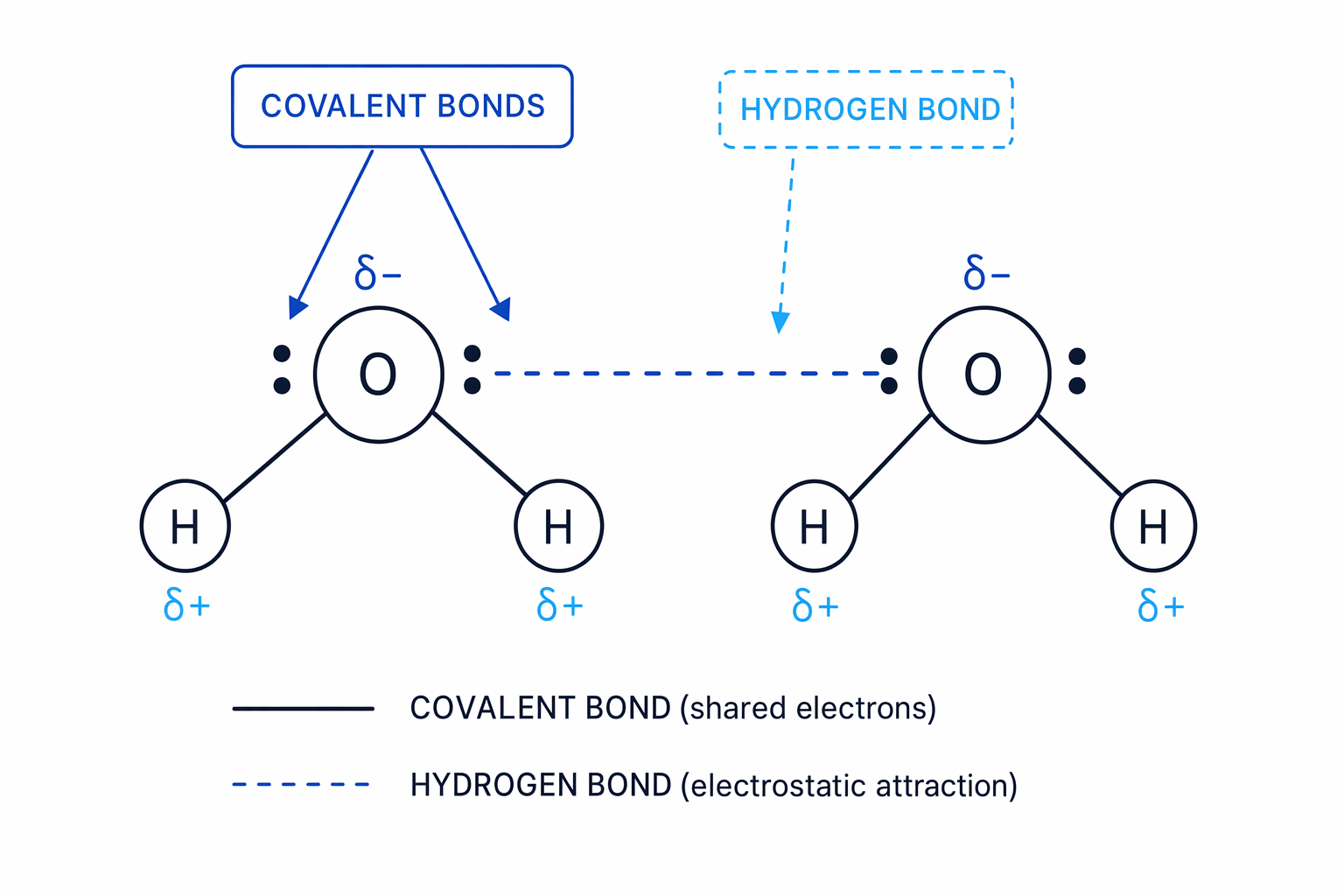
- You need a hydrogen atom covalently bonded to a very electronegative atom: specifically Nitrogen (N), Oxygen (O), or Fluorine (F). Because N, O, and F are so electronegative, they pull the bonding electrons far away from the hydrogen atom. The hydrogen is left as an exposed, highly concentrated δ+\delta+δ+ nucleus.
- You need a lone pair of electrons on a Nitrogen, Oxygen, or Fluorine atom in a neighboring molecule.
The exposed δ+\delta+δ+ hydrogen is intensely attracted to the lone pair on the neighboring N, O, or F.
The N, O, F rule
Students often see a molecule with hydrogen and a highly electronegative atom (like chlorine) and assume it hydrogen bonds. It doesn't. Chlorine is large, so its charge is too spread out. Hydrogen bonding only occurs when hydrogen is directly bonded to N, O, or F.
The anomalous properties of water
Because hydrogen bonds are so strong relative to other intermolecular forces, they dramatically alter the physical properties of the substances that have them. Water (H2O\text{H}_2\text{O}H2O) is the classic example, possessing two major "anomalies".
1. Ice is less dense than liquid water Usually, solid structures are denser than liquids because the molecules pack tightly together. However, when water freezes, the hydrogen bonds lock the molecules into a rigid, open, 3D lattice. To maintain the most stable hydrogen bond angles, the molecules are actually forced slightly further apart than they are in the liquid state. More space between the molecules means a larger volume, which means a lower density. This is why ice floats on water!
2. Anomalous high boiling points If we look at the boiling points of the hydrides in Group 6 (compounds of Group 6 elements with hydrogen), we would expect a steady increase as the molecules get larger, due to the increasing strength of van der Waals forces.
However, water (H2O\text{H}_2\text{O}H2O) completely breaks the trend.
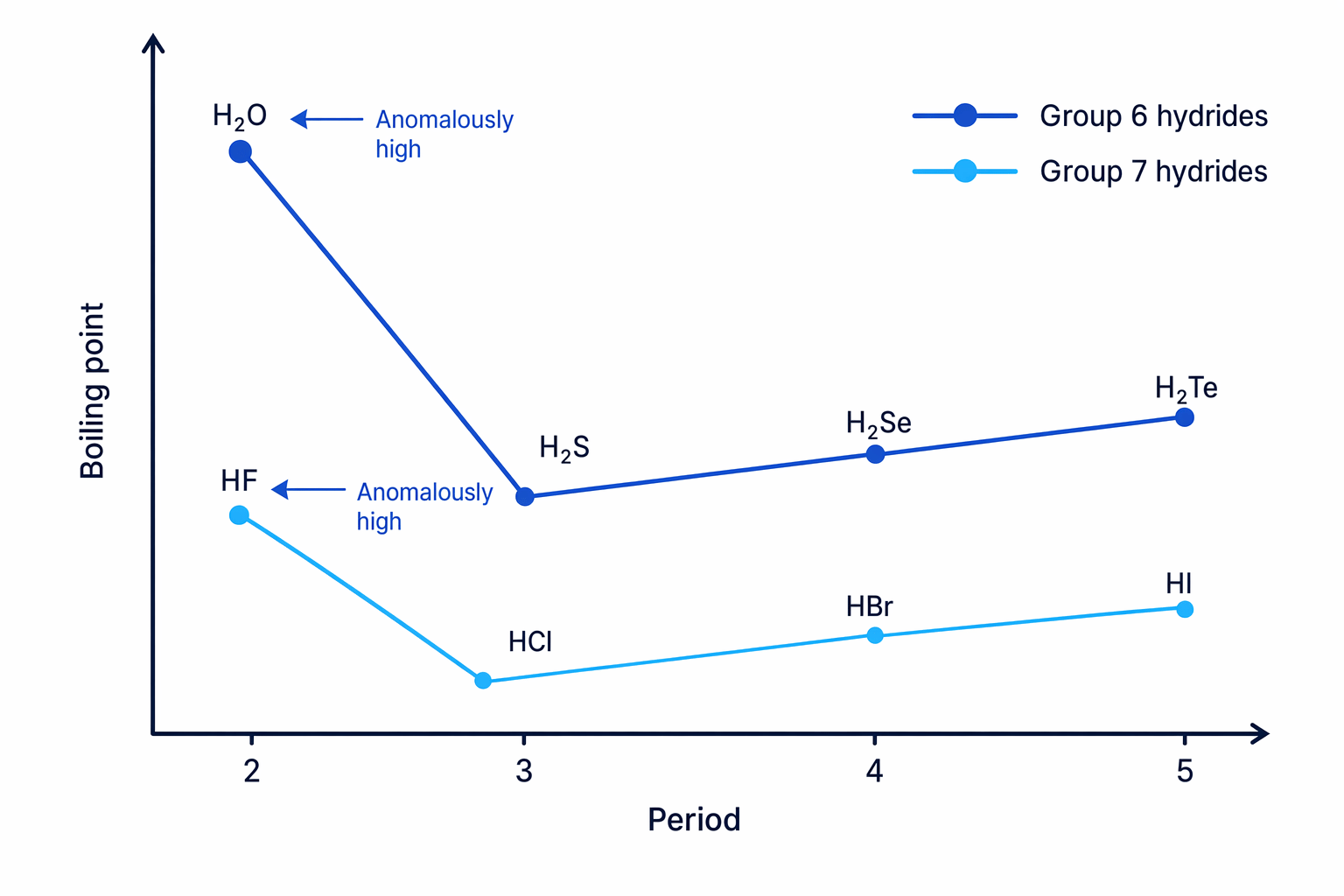
As the graph shows, water has a massively higher boiling point than hydrogen sulfide (H2S\text{H}_2\text{S}H2S). This is because water molecules form strong hydrogen bonds with each other, whereas hydrogen sulfide molecules only form weaker van der Waals and permanent dipole-dipole forces. The same pattern is seen in Group 7 with hydrogen fluoride (HF\text{HF}HF) compared to the rest of the hydrogen halides.
Comparing the boiling points of unfamiliar molecules
Put the following three substances in order of increasing boiling point, and explain your reasoning.
- Butane (CH3CH2CH2CH3\text{CH}_3\text{CH}_2\text{CH}_2\text{CH}_3CH3CH2CH2CH3)
- Propanone (CH3COCH3\text{CH}_3\text{COCH}_3CH3COCH3)
- Propan-1-ol (CH3CH2CH2OH\text{CH}_3\text{CH}_2\text{CH}_2\text{OH}CH3CH2CH2OH)
- Identify the strongest intermolecular force in Butane. It is a pure hydrocarbon and is entirely non-polar. It only has van der Waals forces between its molecules.
- Identify the strongest intermolecular force in Propanone. It has a polar C=O\text{C=O}C=O bond and the molecule is asymmetrical, so it has a permanent dipole. It will form permanent dipole-dipole forces (as well as van der Waals forces).
- Identify the strongest intermolecular force in Propan-1-ol. It contains an O-H\text{O-H}O-H bond. The hydrogen is directly bonded to an oxygen, which has lone pairs. It can therefore form hydrogen bonds.
- Rank the forces from weakest to strongest. Van der Waals forces are the weakest, permanent dipole-dipole forces are stronger, and hydrogen bonds are the strongest.
- Conclude the order. Therefore, the order of increasing boiling point is: Butane < Propanone < Propan-1-ol. (More energy is required to overcome the stronger intermolecular forces).
In the exam
- When asked to draw a hydrogen bond, you must include four things to get full marks: the δ+\delta+δ+ and δ−\delta-δ− partial charges, the lone pair on the N, O, or F, a dashed line representing the hydrogen bond, and an explicit label showing that the bond angle between the covalent bond and the hydrogen bond (X-H⋯Y\text{X-H} \cdots \text{Y}X-H⋯Y) is exactly 180∘180^\circ180∘.
- In explanations of melting/boiling point trends, state explicitly that "intermolecular forces are overcome". Do not just say "bonds are broken".
- When comparing the strength of van der Waals forces, don't just say "bigger mass". Say "more electrons, so stronger van der Waals forces between molecules".
- If asked about a practical method to test for polar molecules, remember that a jet of polar liquid from a burette will be deflected towards an electrostatically charged rod (because the permanent dipoles align and are attracted to the charge), whereas a non-polar liquid will fall straight down.
Check yourself
- What type of intermolecular force would exist between two molecules of methane (CH4\text{CH}_4CH4)?
- Why does boiling point increase as you go down the noble gas group from Helium to Radon?
- Why does pentane have a higher boiling point than its branched isomer, 2,2-dimethylpropane?
- Which of the following can form hydrogen bonds between its molecules: CH3F\text{CH}_3\text{F}CH3F, NH3\text{NH}_3NH3, or H2S\text{H}_2\text{S}H2S?