What you'll learn
- How q=mcΔTq=mc\Delta Tq=mcΔT links a temperature change to heat transfer.
- How to convert heat energy into a molar enthalpy change, ΔH\Delta HΔH.
- How to carry out Required Practical 2: measuring an enthalpy change.
- How to avoid the common unit, sign and “wrong mass” traps.
The big idea: measuring heat indirectly
In energetics, you often want to know how much energy a reaction releases or absorbs. You cannot usually “see” that energy directly, so you measure a temperature change instead.
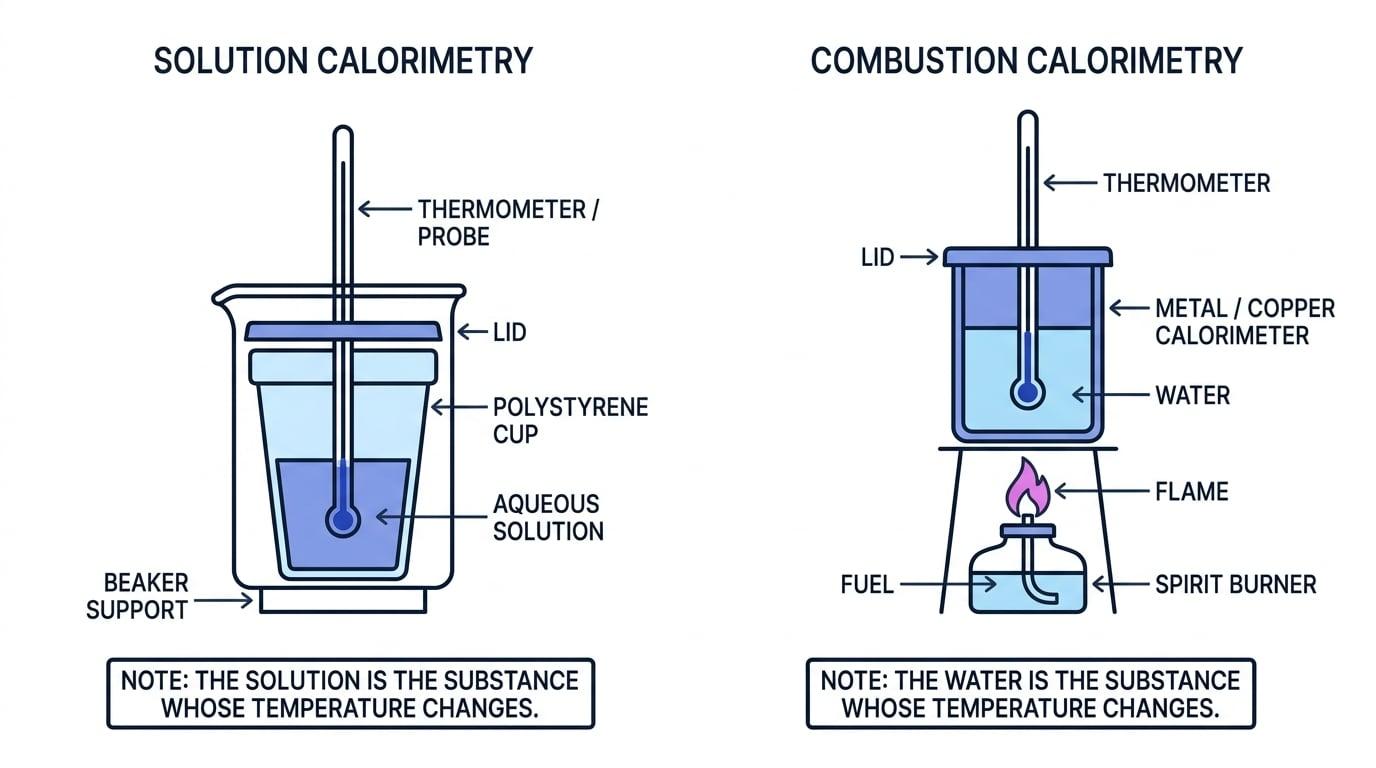
A calorimeter is apparatus used to measure heat changes. In A-Level practical work this is often a polystyrene cup for reactions in solution, or a metal calorimeter containing water for combustion experiments.
Calorimetry
Calorimetry is the measurement of heat energy transferred during a chemical or physical change by measuring the temperature change of a substance.
If a reaction warms the surroundings, it has released energy. If it cools the surroundings, it has absorbed energy.
Exothermic and endothermic changes
Exothermic and endothermic
An exothermic change transfers heat energy to the surroundings, so the measured temperature usually rises and ΔH\Delta HΔH is negative. An endothermic change takes in heat energy from the surroundings, so the measured temperature usually falls and ΔH\Delta HΔH is positive.
The key word is surroundings. In a cup calorimeter, the surroundings you measure are usually the solution. In combustion calorimetry, the surroundings you measure are usually the water being heated.
Temperature change and sign
A temperature rise in the measured substance means the reaction released heat, so the reaction enthalpy change is negative. A temperature fall means the reaction absorbed heat, so the reaction enthalpy change is positive.
The equation q=mcΔTq=mc\Delta Tq=mcΔT
The heat change, qqq, is calculated using:
q=mcΔTq=mc\Delta Tq=mcΔTwhere:
- qqq is the heat energy transferred, usually in J
- mmm is the mass of the substance whose temperature changes
- ccc is the specific heat capacity of that substance
- ΔT\Delta TΔT is the temperature change
Specific heat capacity
Specific heat capacity, ccc, is the energy needed to raise the temperature of 1 g or 1 kg of a substance by 1 K. The units must match the mass unit you use.
At A-Level, if mmm is in g, ccc is usually in J g⁻¹ K⁻¹. If mmm is in kg, ccc must be in J kg⁻¹ K⁻¹. AQA will give you the value of ccc when you need it; you are not expected to recall it.
A temperature change has the same numerical size in °C and K, so a rise from 20.0 °C to 26.5 °C is ΔT=6.5 K\Delta T=6.5\text{ K}ΔT=6.5 K.
Calculating heat transferred to water
A sample of 200.0 g of water is heated from 18.2 °C to 24.7 °C. The specific heat capacity of water is 4.18 J g−1 K−14.18\text{ J g}^{-1}\text{ K}^{-1}4.18 J g−1 K−1. Calculate the heat transferred to the water.
-
Find the temperature change:
ΔT=24.7−18.2=6.5 K\Delta T=24.7-18.2=6.5\text{ K}ΔT=24.7−18.2=6.5 K -
Substitute into q=mcΔTq=mc\Delta Tq=mcΔT:
q=200.0 g×4.18 J g−1 K−1×6.5 Kq=200.0\text{ g} \times 4.18\text{ J g}^{-1}\text{ K}^{-1} \times 6.5\text{ K}q=200.0 g×4.18 J g−1 K−1×6.5 K -
Calculate and convert if useful:
q=5434 J=5.43 kJq=5434\text{ J}=5.43\text{ kJ}q=5434 J=5.43 kJ
Using the wrong mass
In q=mcΔTq=mc\Delta Tq=mcΔT, mmm is the mass of the substance that changes temperature, not automatically the mass of the reactant. For combustion, mmm is the mass of water heated. The fuel mass is used later to calculate moles of fuel burned.
From heat energy to molar enthalpy change
An enthalpy change, ΔH\Delta HΔH, is the heat energy transferred at constant pressure. In school calorimetry, reactions are usually done open to the air, so the pressure is effectively constant.
Molar enthalpy change
A molar enthalpy change is the enthalpy change per mole of substance reacting, dissolving, being neutralised, or being burned. Its units are kJ mol⁻¹.
The general idea is:
ΔH=qreactionn\Delta H=\frac{q_{\text{reaction}}}{n}ΔH=nqreactionwhere nnn is the amount in moles. Since q=mcΔTq=mc\Delta Tq=mcΔT usually gives the heat gained or lost by the measured surroundings, you often need the opposite sign for the reaction:
qreaction=−qsurroundingsq_{\text{reaction}}=-q_{\text{surroundings}}qreaction=−qsurroundingsIn practice, many exam answers do this in two stages:
- Calculate the size of the heat change using q=mcΔTq=mc\Delta Tq=mcΔT.
- Decide the sign of ΔH\Delta HΔH from whether the temperature rose or fell.
Calculating molar enthalpy change for neutralisation
25.0 cm³ of 1.00 mol dm⁻³ HCl is mixed with 25.0 cm³ of 1.00 mol dm⁻³ NaOH in a polystyrene cup. The temperature rises by 6.8 K. Assume the final solution has density 1.00 g cm⁻³ and c=4.18 J g−1 K−1c=4.18\text{ J g}^{-1}\text{ K}^{-1}c=4.18 J g−1 K−1. Calculate ΔH\Delta HΔH for the neutralisation.
-
Work out the mass of solution that changed temperature. The total volume is 50.0 cm³, so the mass is 50.0 g.
-
Calculate the heat gained by the solution:
qsolution=50.0 g×4.18 J g−1 K−1×6.8 K=1421 J=1.421 kJq_{\text{solution}}=50.0\text{ g} \times 4.18\text{ J g}^{-1}\text{ K}^{-1} \times 6.8\text{ K}=1421\text{ J}=1.421\text{ kJ}qsolution=50.0 g×4.18 J g−1 K−1×6.8 K=1421 J=1.421 kJ -
Calculate the amount of acid and alkali reacting. For each solution:
n=cV=1.00 mol dm−3×0.0250 dm3=0.0250 moln=cV=1.00\text{ mol dm}^{-3} \times 0.0250\text{ dm}^3=0.0250\text{ mol}n=cV=1.00 mol dm−3×0.0250 dm3=0.0250 mol -
Divide by the amount reacting and apply the sign. The solution warmed, so the reaction is exothermic:
ΔH=−1.421 kJ0.0250 mol=−56.8 kJ mol−1\Delta H=-\frac{1.421\text{ kJ}}{0.0250\text{ mol}}=-56.8\text{ kJ mol}^{-1}ΔH=−0.0250 mol1.421 kJ=−56.8 kJ mol−1
Volume units in mole calculations
Use dm³, not cm³, in n=cVn=cVn=cV. So 25.0 cm³ becomes 0.0250 dm³ before multiplying by concentration in mol dm⁻³.
Required Practical 2: measuring an enthalpy change
You need to be able to describe how to measure an enthalpy change by calorimetry, and how to process the results.
Two common setups are shown below. The important point is to identify what is being heated or cooled.
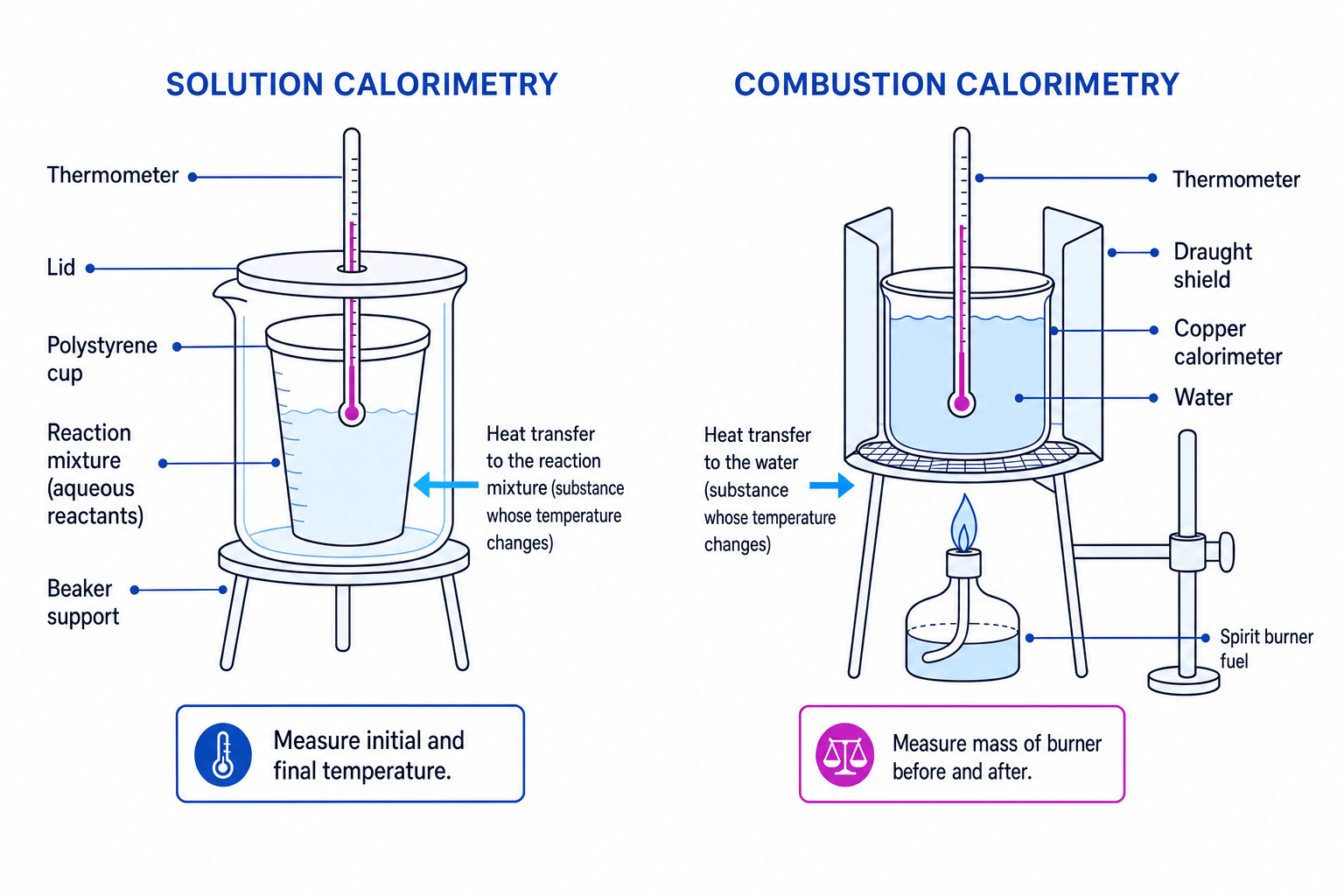
Solution calorimetry
This is used for reactions such as:
- dissolving a salt, such as potassium chloride
- neutralising NaOH with HCl
- displacement reactions, such as zinc reacting with copper(II) sulfate solution
A typical method:
- Measure known volumes or masses of reactants.
- Place the solution in a polystyrene cup supported in a beaker.
- Use a lid and thermometer or temperature probe.
- Record the initial temperature.
- Add the second reactant, stir, and record the maximum or minimum temperature.
- Calculate ΔT\Delta TΔT, then use q=mcΔTq=mc\Delta Tq=mcΔT.
- Divide by the relevant amount in moles to find ΔH\Delta HΔH.
For dilute aqueous solutions, exams often tell you to assume the density is 1.00 g cm⁻³ and the specific heat capacity is the same as water.
Combustion calorimetry
This is used to estimate enthalpies of combustion, for example burning alcohols.
A typical method:
- Add a known mass or volume of water to a copper calorimeter.
- Measure the initial temperature of the water.
- Weigh the spirit burner with its fuel.
- Burn the fuel to heat the water, stirring gently.
- Measure the final temperature of the water.
- Reweigh the spirit burner to find the mass of fuel burned.
- Use the water’s temperature change to calculate qqq, then use the fuel burned to calculate moles.
Calculating enthalpy of combustion
A spirit burner containing ethanol heats 100.0 g of water from 21.0 °C to 48.5 °C. The burner loses 0.460 g of mass. The molar mass of ethanol is 46.0 g mol⁻¹ and c=4.18 J g−1 K−1c=4.18\text{ J g}^{-1}\text{ K}^{-1}c=4.18 J g−1 K−1. Calculate the experimental enthalpy of combustion of ethanol.
-
Choose the correct mass for q=mcΔTq=mc\Delta Tq=mcΔT. The water changes temperature, so m=100.0 gm=100.0\text{ g}m=100.0 g and ΔT=48.5−21.0=27.5 K\Delta T=48.5-21.0=27.5\text{ K}ΔT=48.5−21.0=27.5 K.
-
Calculate heat gained by the water:
qwater=100.0 g×4.18 J g−1 K−1×27.5 K=11495 J=11.5 kJq_{\text{water}}=100.0\text{ g} \times 4.18\text{ J g}^{-1}\text{ K}^{-1} \times 27.5\text{ K}=11495\text{ J}=11.5\text{ kJ}qwater=100.0 g×4.18 J g−1 K−1×27.5 K=11495 J=11.5 kJ -
Calculate moles of ethanol burned:
n=0.460 g46.0 g mol−1=0.0100 moln=\frac{0.460\text{ g}}{46.0\text{ g mol}^{-1}}=0.0100\text{ mol}n=46.0 g mol−10.460 g=0.0100 mol -
Divide heat released by moles burned and apply the exothermic sign:
ΔHc=−11.5 kJ0.0100 mol=−1150 kJ mol−1\Delta H_c=-\frac{11.5\text{ kJ}}{0.0100\text{ mol}}=-1150\text{ kJ mol}^{-1}ΔHc=−0.0100 mol11.5 kJ=−1150 kJ mol−1
Heat loss and improving the measurement
Simple calorimetry is never perfect. Some heat is transferred to the cup, air, thermometer or surroundings instead of only to the substance you are measuring.
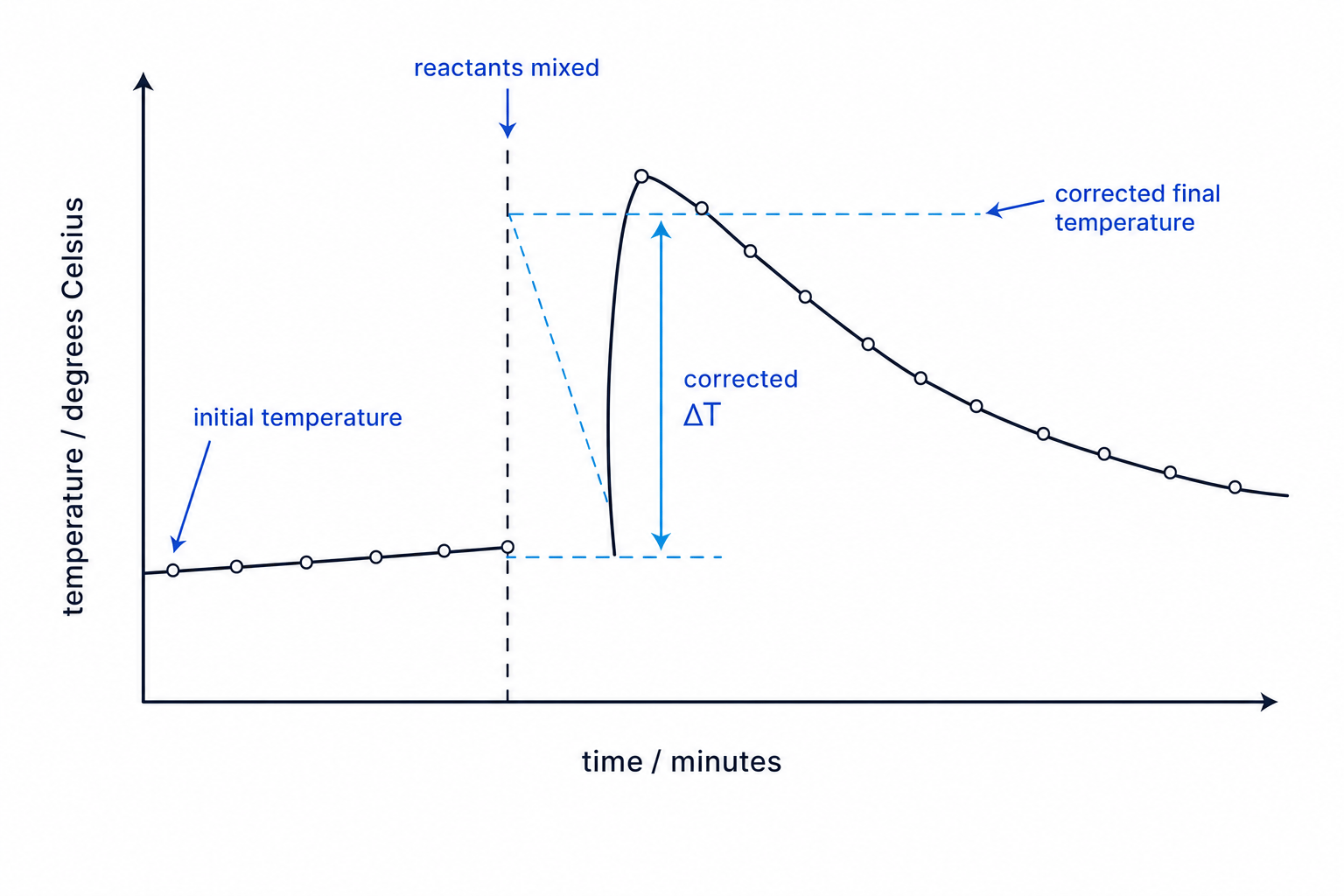
For solution calorimetry, you can reduce heat exchange by using a polystyrene cup, a lid, stirring, and recording temperatures regularly. A more accurate method is to plot a temperature-time graph and extrapolate back to the mixing time.
For combustion calorimetry, the main errors are heat loss to the air, incomplete combustion, evaporation of fuel, and heat absorbed by the metal calorimeter. These usually make the measured enthalpy of combustion less exothermic than the accepted value.
Significant figures
Report your final ΔH\Delta HΔH to a sensible number of significant figures based on the least precise measurements. If a temperature change is only given as 6.8 K, an answer like -57 kJ mol⁻¹ is usually more appropriate than -56.813 kJ mol⁻¹.
In the exam
- Identify the substance whose temperature changes before choosing mmm in q=mcΔTq=mc\Delta Tq=mcΔT.
- Keep units consistent: cm³ to dm³ for n=cVn=cVn=cV, J to kJ before giving ΔH\Delta HΔH in kJ mol⁻¹.
- Decide the sign from the temperature change: rise means exothermic and negative; fall means endothermic and positive.
Check yourself
- In a combustion experiment, why is the mass of water used in q=mcΔTq=mc\Delta Tq=mcΔT rather than the mass of fuel?
- A reaction mixture cools down during a dissolving experiment. What sign should ΔH\Delta HΔH have?
- Why does heat loss usually make an experimental enthalpy of combustion less negative than the true value?