What you'll learn
- How electrons are arranged in shells, sub-shells and orbitals.
- How to write electron configurations for atoms and ions up to Z=36Z = 36Z=36.
- How to define and write equations for first and successive ionisation energies.
- How ionisation energy patterns give evidence for shells and sub-shells.
Starting point: atomic number and electrons
The atomic number, ZZZ, is the number of protons in the nucleus of an atom.
For a neutral atom, the number of electrons is also equal to ZZZ, because the positive charge from the protons is balanced by the negative charge from the electrons.
So:
- sodium has Z=11Z = 11Z=11, so a neutral sodium atom has 11 electrons
- argon has Z=18Z = 18Z=18, so a neutral argon atom has 18 electrons
- bromine has Z=35Z = 35Z=35, so a neutral bromine atom has 35 electrons
For ions, you adjust the number of electrons:
- a positive ion has lost electrons
- a negative ion has gained electrons
For example, Mg2+\text{Mg}^{2+}Mg2+ has 12 protons but only 10 electrons.
Shells, sub-shells and orbitals
Electrons do not just sit randomly around the nucleus. They occupy energy levels.
Shell, sub-shell and orbital
- A shell is a main energy level, labelled by a principal quantum number such as n=1n = 1n=1, n=2n = 2n=2 or n=3n = 3n=3.
- A sub-shell is a division within a shell, labelled s, p or d at A-Level.
- An orbital is a region of space that can hold up to two electrons.
The sub-shells have different numbers of orbitals:
- an s sub-shell has 1 orbital, so it holds 2 electrons
- a p sub-shell has 3 orbitals, so it holds 6 electrons
- a d sub-shell has 5 orbitals, so it holds 10 electrons
Sub-shell capacities
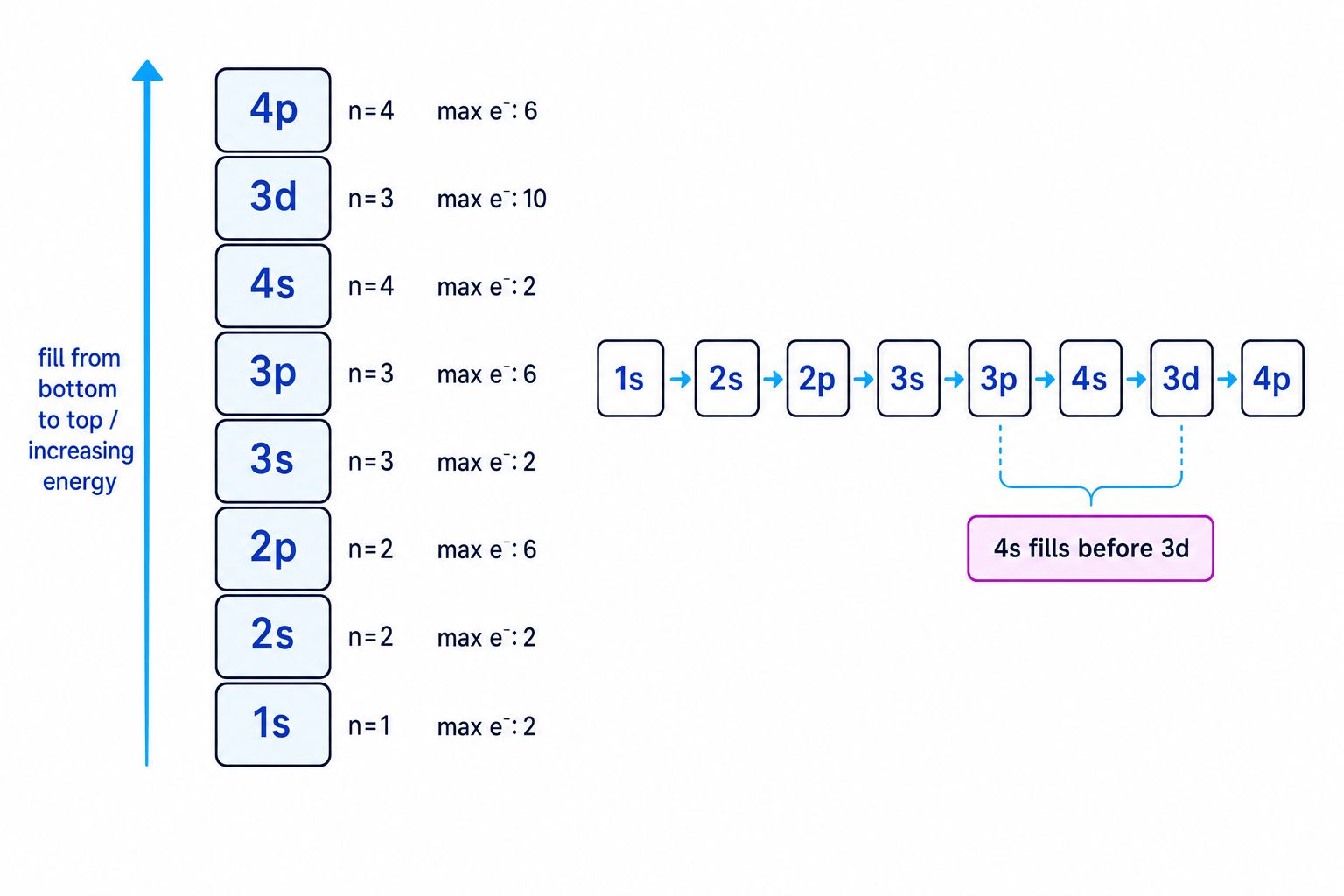
The maximum numbers of electrons are: s holds 2, p holds 6, and d holds 10.
The filling order up to Z=36Z = 36Z=36
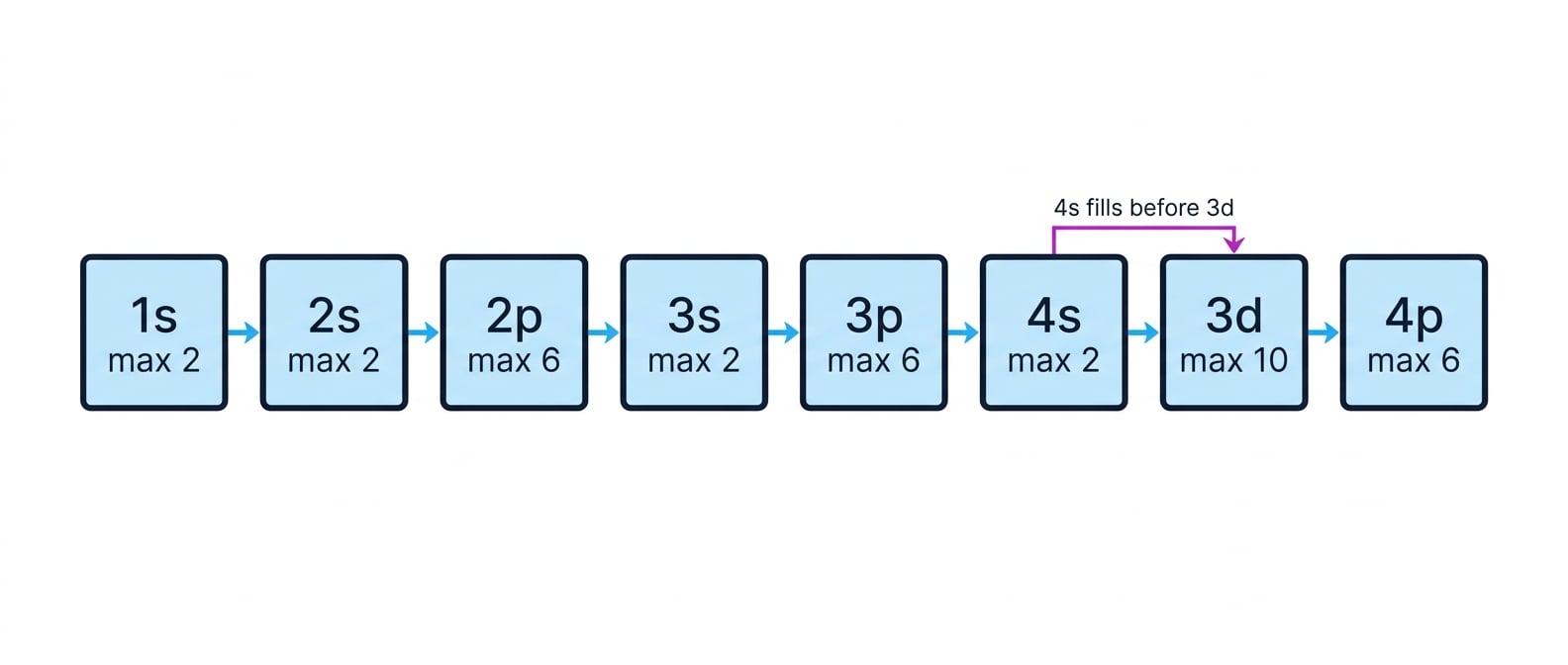
Electrons fill the lowest available energy sub-shells first. For atoms up to krypton, Z=36Z = 36Z=36, the order you need is:
1s→2s→2p→3s→3p→4s→3d→4p1s \to 2s \to 2p \to 3s \to 3p \to 4s \to 3d \to 4p1s→2s→2p→3s→3p→4s→3d→4pThe slightly surprising bit is that 4s fills before 3d.
Writing electron configurations
An electron configuration shows how many electrons are in each occupied sub-shell.
For example:
Na: 1s2 2s2 2p6 3s1\text{Na: } 1s^2\,2s^2\,2p^6\,3s^1Na: 1s22s22p63s1This means:
- 2 electrons in 1s
- 2 electrons in 2s
- 6 electrons in 2p
- 1 electron in 3s
Total = 11 electrons, so this is sodium.
Writing the electron configuration of sulfur
Write the electron configuration of sulfur, Z=16Z = 16Z=16.
-
Work out the number of electrons. Sulfur is neutral and has Z=16Z = 16Z=16, so it has 16 electrons.
-
Fill the sub-shells in order, using their maximum capacities:
1s2 2s2 2p6 3s21s^2\,2s^2\,2p^6\,3s^21s22s22p63s2This accounts for 2+2+6+2=122 + 2 + 6 + 2 = 122+2+6+2=12 electrons.
-
Put the remaining 4 electrons into the next sub-shell, 3p:
S: 1s2 2s2 2p6 3s2 3p4\text{S: } 1s^2\,2s^2\,2p^6\,3s^2\,3p^4S: 1s22s22p63s23p4
Using noble gas shorthand
For longer configurations, you can use the previous noble gas in square brackets.
For example, calcium has Z=20Z = 20Z=20:
Ca: 1s2 2s2 2p6 3s2 3p6 4s2\text{Ca: } 1s^2\,2s^2\,2p^6\,3s^2\,3p^6\,4s^2Ca: 1s22s22p63s23p64s2The first 18 electrons are the same as argon, so you can write:
Ca: [Ar] 4s2\text{Ca: } [\text{Ar}]\,4s^2Ca: [Ar]4s2This is quicker and often clearer.
Counting check
The superscripts must add up to the total number of electrons in the atom or ion. This is the easiest way to catch mistakes.
Electron configurations of ions
For non-transition-metal ions, the rule is usually simple:
- negative ions gain electrons into the next available sub-shell
- positive ions lose electrons from the outer shell
For example, chlorine is:
Cl: [Ne] 3s2 3p5\text{Cl: } [\text{Ne}]\,3s^2\,3p^5Cl: [Ne]3s23p5A chloride ion gains 1 electron:
Cl−:[Ne] 3s2 3p6\text{Cl}^-: [\text{Ne}]\,3s^2\,3p^6Cl−:[Ne]3s23p6That is the same electron configuration as argon.
Ions involving 4s and 3d
Although 4s fills before 3d, electrons are removed from 4s before 3d when transition metal ions form.
4s electrons are lost first
For transition metal ions, remove electrons from 4s before removing electrons from 3d. So iron loses its 4s electrons before its 3d electrons.
Writing the electron configuration of an iron ion
Write the electron configuration of Fe2+\text{Fe}^{2+}Fe2+. Iron has Z=26Z = 26Z=26.
-
Write the neutral atom configuration. Iron has 26 electrons:
Fe: [Ar] 4s2 3d6\text{Fe: } [\text{Ar}]\,4s^2\,3d^6Fe: [Ar]4s23d6 -
Adjust for the ion charge. Fe2+\text{Fe}^{2+}Fe2+ has lost 2 electrons, so it has 24 electrons.
-
Remove electrons from 4s first:
Fe2+:[Ar] 3d6\text{Fe}^{2+}: [\text{Ar}]\,3d^6Fe2+:[Ar]3d6
Removing 3d before 4s
A common error is to write Fe2+\text{Fe}^{2+}Fe2+ as [Ar] 4s2 3d4[\text{Ar}]\,4s^2\,3d^4[Ar]4s23d4. This is wrong because the 4s electrons are removed first.
Two important exceptions: chromium and copper
Most atoms follow the filling order exactly, but chromium and copper are common exceptions.
Instead of:
Cr: [Ar] 4s2 3d4\text{Cr: } [\text{Ar}]\,4s^2\,3d^4Cr: [Ar]4s23d4chromium is:
Cr: [Ar] 4s1 3d5\text{Cr: } [\text{Ar}]\,4s^1\,3d^5Cr: [Ar]4s13d5Instead of:
Cu: [Ar] 4s2 3d9\text{Cu: } [\text{Ar}]\,4s^2\,3d^9Cu: [Ar]4s23d9copper is:
Cu: [Ar] 4s1 3d10\text{Cu: } [\text{Ar}]\,4s^1\,3d^{10}Cu: [Ar]4s13d10This happens because half-filled and fully filled d sub-shells are especially stable.
Ionisation energy
Ionisation energy is about how much energy is needed to remove electrons.
First ionisation energy
The first ionisation energy is the energy required to remove one electron from each atom in one mole of gaseous atoms to form one mole of gaseous 1+ ions.
The equation is:
X(g)→X+(g)+e−\text{X(g)} \to \text{X}^+\text{(g)} + e^-X(g)→X+(g)+e−Ionisation energies are measured in kJ mol⁻¹.
The state symbol (g) is essential: first ionisation energy always refers to gaseous atoms.
Successive ionisation energies
Successive ionisation energies remove electrons one at a time from the same element.
For example, for magnesium:
First ionisation energy:
Mg(g)→Mg+(g)+e−\text{Mg(g)} \to \text{Mg}^+\text{(g)} + e^-Mg(g)→Mg+(g)+e−Second ionisation energy:
Mg+(g)→Mg2+(g)+e−\text{Mg}^+\text{(g)} \to \text{Mg}^{2+}\text{(g)} + e^-Mg+(g)→Mg2+(g)+e−In general:
X(n−1)+(g)→Xn+(g)+e−\text{X}^{(n-1)+}\text{(g)} \to \text{X}^{n+}\text{(g)} + e^-X(n−1)+(g)→Xn+(g)+e−Writing a successive ionisation equation
Write the equation for the third ionisation energy of aluminium.
-
Third ionisation energy means removing the third electron, so the starting ion has already lost 2 electrons: Al2+\text{Al}^{2+}Al2+.
-
Removing one more electron forms Al3+\text{Al}^{3+}Al3+.
-
Include gaseous state symbols and the electron:
Al2+(g)→Al3+(g)+e−\text{Al}^{2+}\text{(g)} \to \text{Al}^{3+}\text{(g)} + e^-Al2+(g)→Al3+(g)+e−
What affects ionisation energy?
Ionisation energy depends mainly on three factors.
Nuclear charge
A greater number of protons means a stronger attraction between the nucleus and the electron being removed.
So, higher nuclear charge usually increases ionisation energy.
Distance from the nucleus
An electron further from the nucleus is less strongly attracted, so it is easier to remove.
So, larger atomic radius usually decreases ionisation energy.
Shielding
Inner shell electrons repel outer shell electrons. This reduces the attraction between the nucleus and the outer electron.
This effect is called shielding.
Shielding
Shielding is the reduction in attraction between the nucleus and an outer electron due to repulsion from electrons in inner shells.
Evidence from Period 3 ionisation energies
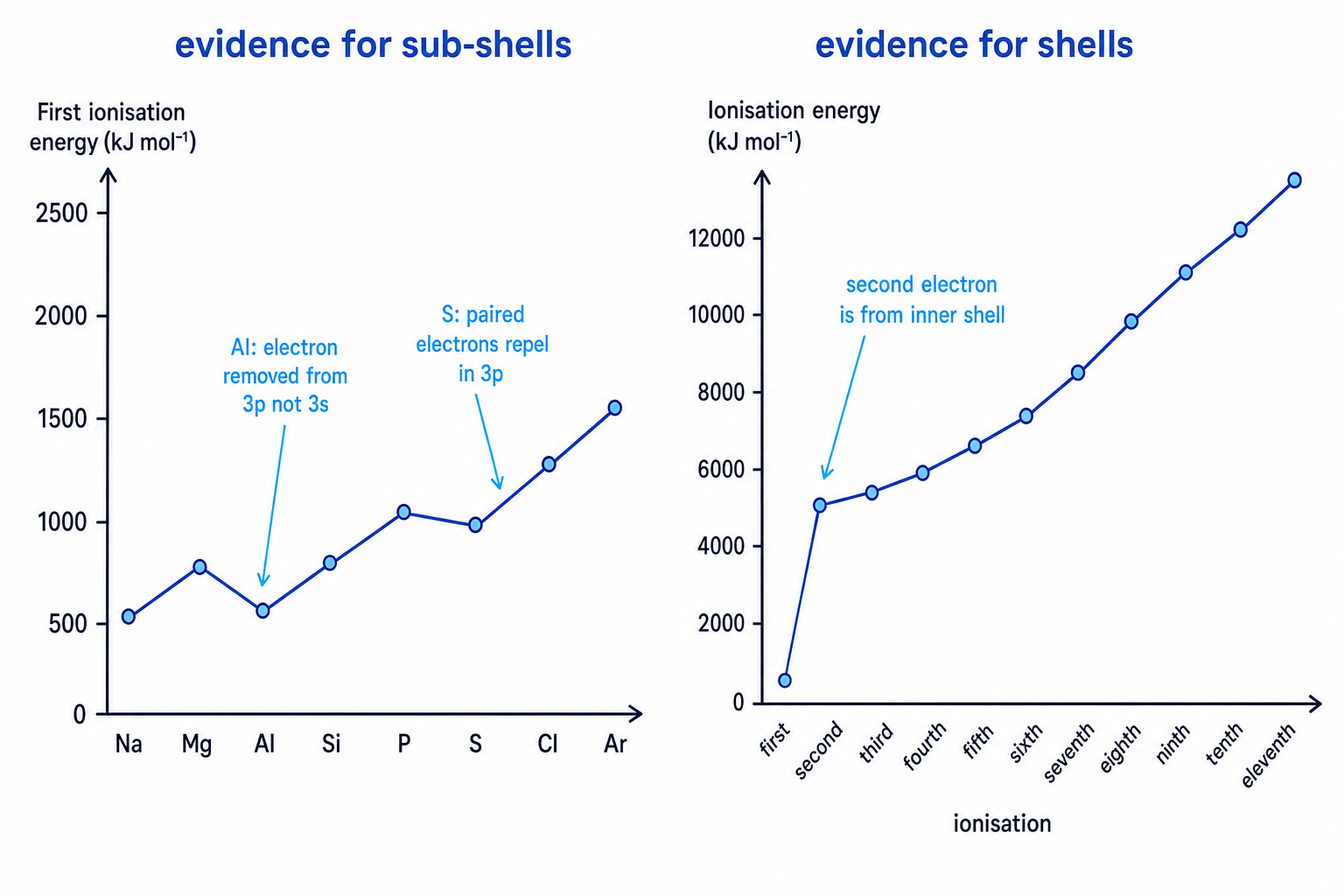
Across Period 3, from sodium to argon, first ionisation energy generally increases.
This is because:
- nuclear charge increases
- electrons are added to the same main shell
- shielding is similar
- atomic radius decreases
- the outer electron is more strongly attracted to the nucleus
However, the graph is not perfectly smooth. There are dips from Mg to Al and from P to S.
The dip from Mg to Al
Magnesium ends in 3s:
Mg: [Ne] 3s2\text{Mg: } [\text{Ne}]\,3s^2Mg: [Ne]3s2Aluminium ends in 3p:
Al: [Ne] 3s2 3p1\text{Al: } [\text{Ne}]\,3s^2\,3p^1Al: [Ne]3s23p1The electron removed from aluminium is in a 3p sub-shell, which is slightly higher in energy than 3s and is easier to remove.
This provides evidence that the third shell is split into sub-shells.
The dip from P to S
Phosphorus ends in:
P: [Ne] 3s2 3p3\text{P: } [\text{Ne}]\,3s^2\,3p^3P: [Ne]3s23p3Sulfur ends in:
S: [Ne] 3s2 3p4\text{S: } [\text{Ne}]\,3s^2\,3p^4S: [Ne]3s23p4In phosphorus, the three 3p electrons occupy separate p orbitals. In sulfur, one 3p orbital contains a pair of electrons. The paired electrons repel each other, so one is easier to remove.
This provides evidence for orbitals within sub-shells.
Period 3 evidence
The general increase shows increasing nuclear attraction across the period. The dips show that electrons occupy different sub-shells and orbitals.
Evidence from Group 2 ionisation energies
Down Group 2, from beryllium to barium, first ionisation energy decreases.
This is because each element has its outer electrons in a shell further from the nucleus:
- Be has outer electrons in the second shell
- Mg has outer electrons in the third shell
- Ca has outer electrons in the fourth shell
Although nuclear charge increases down the group, the effect of increased distance and shielding is more important.
So the outer electron is less strongly attracted and is easier to remove.
Successive ionisation energies and shells
Successive ionisation energies show large jumps when the next electron is removed from an inner shell.
For example, sodium has one outer electron:
Na: 1s2 2s2 2p6 3s1\text{Na: } 1s^2\,2s^2\,2p^6\,3s^1Na: 1s22s22p63s1The first electron is removed from 3s. The second electron would have to be removed from the second shell, which is closer to the nucleus and much less shielded. So the second ionisation energy is much larger.
Identifying the group from successive ionisation energies
An element has successive ionisation energies with a large jump between the second and third ionisations. Deduce its group.
-
A large jump after the second ionisation means the first 2 electrons were relatively easy to remove.
-
The third electron is much harder to remove, so it must come from an inner shell.
-
Therefore, the atom had 2 outer-shell electrons. It is in Group 2.
Large jump rule
If the big jump is after the nth ionisation energy, the atom has n outer-shell electrons.
Pulling it together
Electron configurations and ionisation energies support each other.
Electron configurations predict which electrons are outermost and easiest to remove. Ionisation energy data then gives experimental evidence for:
- shells
- sub-shells
- orbitals
- the number of outer-shell electrons
In the exam
- For electron configurations, count electrons carefully first, then fill sub-shells in the order 1s→2s→2p→3s→3p→4s→3d→4p1s \to 2s \to 2p \to 3s \to 3p \to 4s \to 3d \to 4p1s→2s→2p→3s→3p→4s→3d→4p.
- For ions, adjust the electron count for the charge, and remember that 4s electrons are removed before 3d electrons.
- For ionisation energy explanations, always link the trend to attraction between the nucleus and the electron being removed: nuclear charge, distance and shielding.
Check yourself
- What is the full electron configuration of selenium, Z=34Z = 34Z=34?
- Why is the first ionisation energy of aluminium lower than that of magnesium?
- An element has a large jump between its third and fourth successive ionisation energies. What does this tell you about its outer-shell electrons?