What you'll learn
- What atomic number and mass number tell you about an atom.
- How to count protons, neutrons and electrons in atoms and ions.
- Why atoms of the same element can have different masses.
- How isotope abundance data gives the mass value shown on the periodic table.
1. Atoms and the particles inside them
An atom is the smallest particle of an element that keeps the chemical identity of that element. In this topic, the key idea is that atoms are made from a tiny central nucleus with electrons around it.
The nucleus is the small, dense centre of the atom. It contains protons and neutrons. Electrons are found outside the nucleus in energy levels or shells.
Fundamental particles
In this topic, the fundamental particles of atoms are protons, neutrons and electrons.
You should know these basic features:
- Protons are in the nucleus, have relative charge +1, and relative mass about 1.
- Neutrons are in the nucleus, have relative charge 0, and relative mass about 1.
- Electrons are outside the nucleus, have relative charge -1, and a much smaller relative mass.
An ion is a particle with an overall charge because it has lost or gained electrons. Positive ions have lost electrons. Negative ions have gained electrons.
2. Atomic number and mass number
Atomic number and mass number
- The atomic number, ZZZ, is the number of protons in the nucleus of an atom.
- The mass number, AAA, is the total number of protons and neutrons in the nucleus.
The atomic number identifies the element. For example, every atom with 6 protons is carbon. If the number of protons changes, the element changes.
The mass number tells you which version of the atom you have, because it includes both types of particle in the nucleus. Protons and neutrons are sometimes called nucleons, meaning particles in the nucleus.
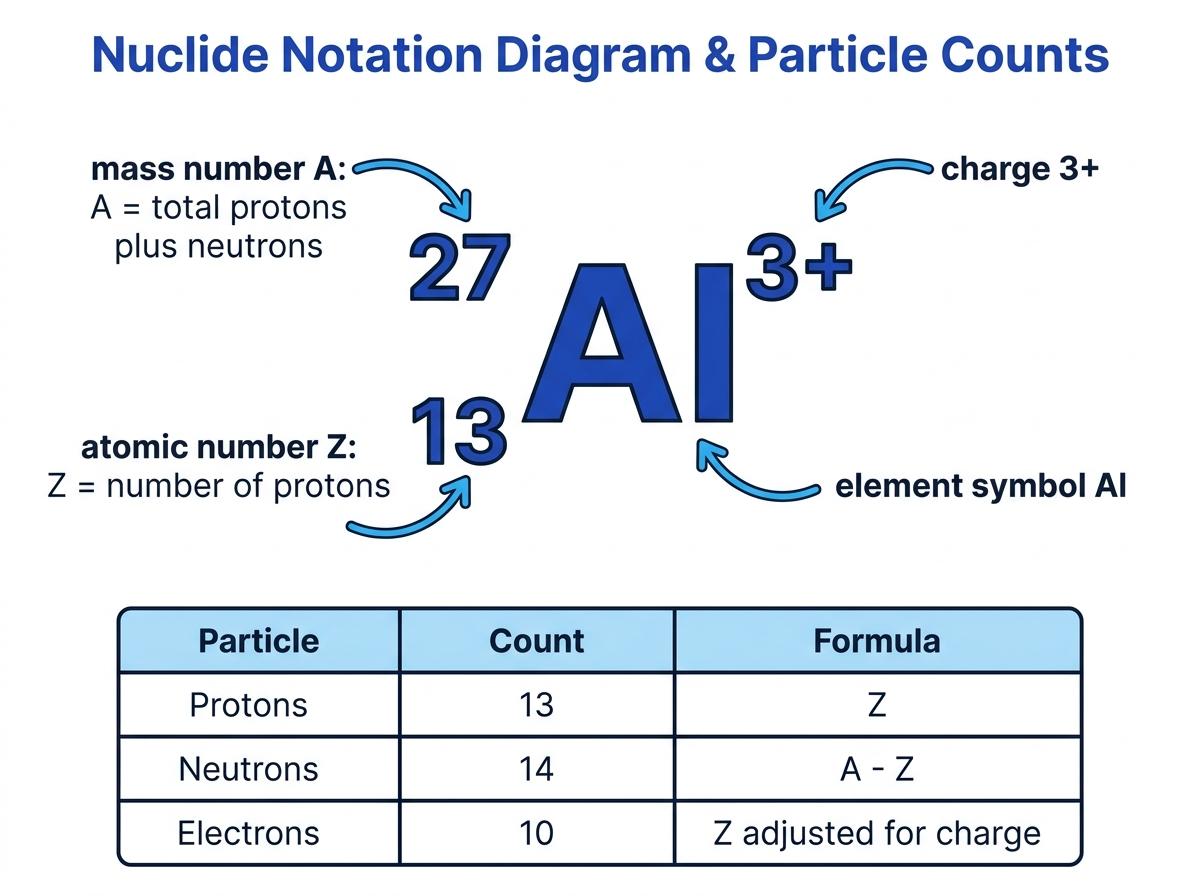
The notation and particle-counting rules are summarised in this diagram.
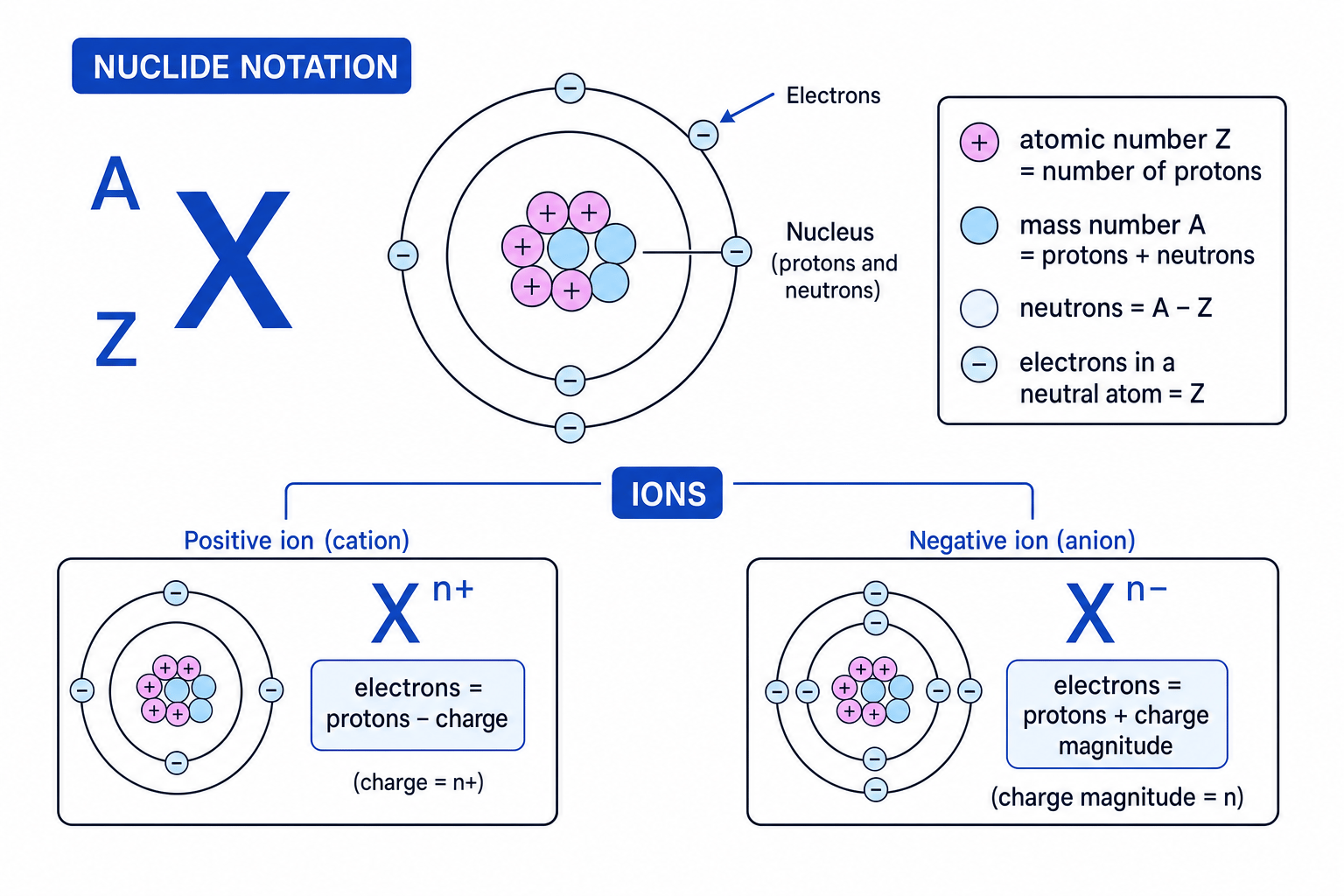
A nuclide can be written as ZAX^{A}_{Z}\text{X}ZAX, where X\text{X}X is the element symbol. If it is an ion, the charge is written at the top right, for example 1327Al3+^{27}_{13}\text{Al}^{3+}1327Al3+.
Counting particles
Use the same order every time:
- Protons = atomic number, ZZZ.
- Neutrons = mass number minus atomic number, A−ZA - ZA−Z.
- Electrons = protons, then adjust for charge.
For electrons:
- A neutral atom has the same number of electrons as protons.
- A positive ion has fewer electrons than protons.
- A negative ion has more electrons than protons.
Charge changes electrons, not the nucleus
When an atom becomes an ion, it gains or loses electrons. Its protons and neutrons do not change, so AAA and ZZZ stay the same.
Counting particles in an aluminium ion
For 1327Al3+^{27}_{13}\text{Al}^{3+}1327Al3+:
-
Use Z=13Z=13Z=13, so the ion has 13 protons. This also tells you the element is aluminium.
-
Use A=27A=27A=27, so the number of neutrons is 27−13=1427 - 13 = 1427−13=14.
-
A charge of 3+ means the atom has lost 3 electrons, so the number of electrons is 13−3=1013 - 3 = 1013−3=10.
3. Isotopes
Isotopes
Isotopes are atoms of the same element with the same number of protons but different numbers of neutrons.
Because isotopes have the same number of protons, they have the same atomic number, ZZZ. Because they have different numbers of neutrons, they have different mass numbers, AAA.
This explains why isotopes exist: atoms of one element can have the same nuclear charge but different numbers of neutrons in the nucleus.
Neutral atoms of isotopes have the same number of electrons and the same electron arrangement. This means they have very similar chemical properties. Their physical properties, such as mass and density, can differ slightly because their masses are different.
The isotope test
Same element means same number of protons. Isotopes must have the same ZZZ but different numbers of neutrons.
Recognising isotopes
Decide whether 1735Cl^{35}_{17}\text{Cl}1735Cl and 1737Cl^{37}_{17}\text{Cl}1737Cl are isotopes.
-
Compare the atomic numbers: both have Z=17Z=17Z=17, so they are atoms of the same element, chlorine.
-
Calculate the neutrons: 1735Cl^{35}_{17}\text{Cl}1735Cl has 35−17=1835 - 17 = 1835−17=18 neutrons, while 1737Cl^{37}_{17}\text{Cl}1737Cl has 37−17=2037 - 17 = 2037−17=20 neutrons.
-
They have the same number of protons but different numbers of neutrons, so they are isotopes.
Same mass number does not mean isotopes
1840Ar^{40}_{18}\text{Ar}1840Ar and 2040Ca^{40}_{20}\text{Ca}2040Ca both have mass number 40, but they have different atomic numbers. They are different elements, not isotopes.
4. Time of flight mass spectrometry
A time of flight mass spectrometer, often shortened to TOF mass spectrometer, is an instrument used to measure masses and abundances of ions. The time of flight is the time taken for an ion to travel through the flight tube to the detector.
Mass spectrometer and mass spectrum
- A mass spectrometer converts particles into ions and separates them by mass-to-charge ratio, m/zm/zm/z.
- A mass spectrum is the output graph. It shows relative abundance, meaning the amount of each ion compared with the others, against m/zm/zm/z.
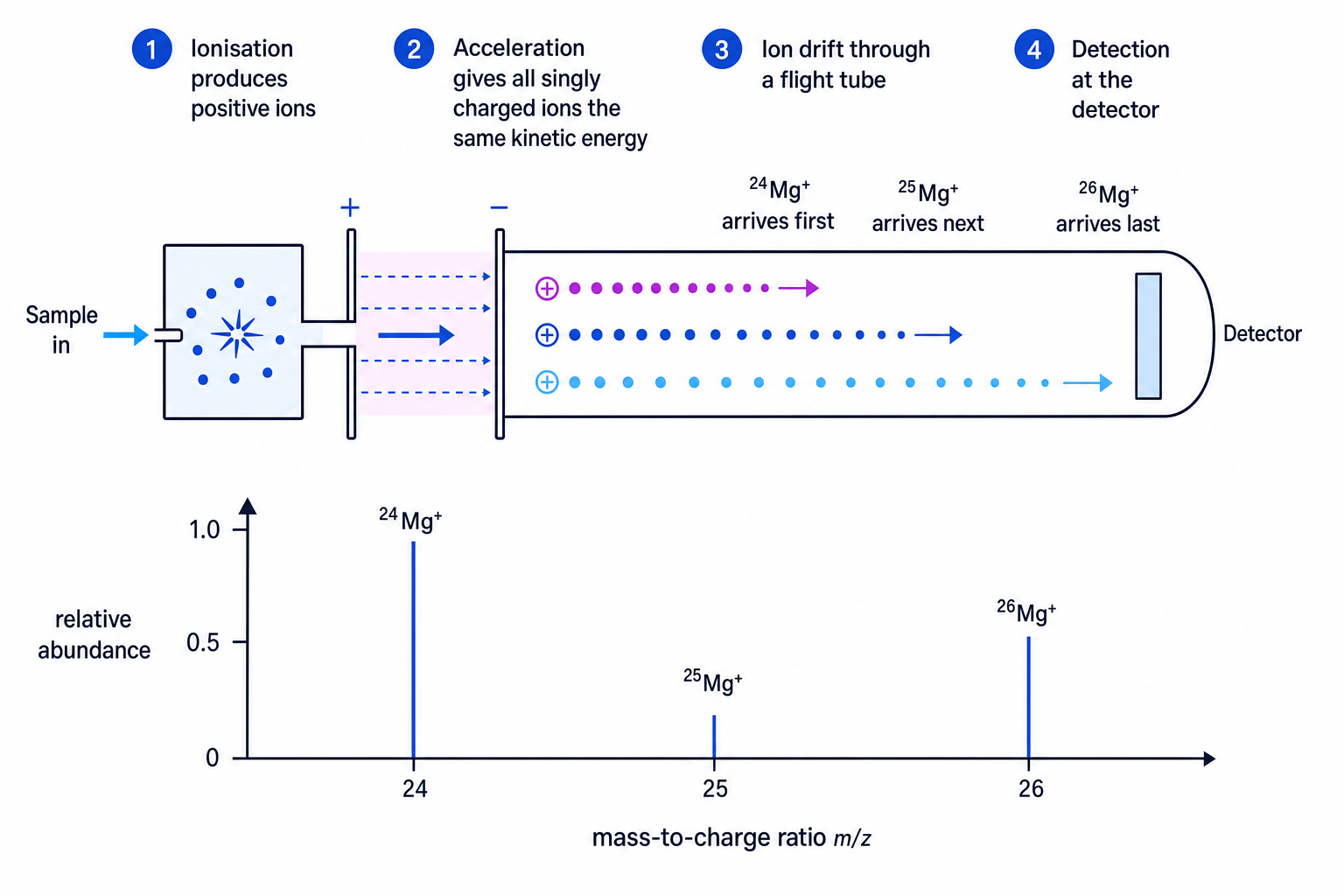
The main stages of a simple TOF mass spectrometer are shown below.
The four main stages
-
Ionisation: atoms or molecules are turned into positive ions. For an atom, this can be represented as X(g)→X+(g)+e−\text{X}(g) \to \text{X}^+(g) + e^-X(g)→X+(g)+e−.
-
Acceleration: the positive ions are accelerated by an electric field. In the simplified model, singly charged ions are given the same kinetic energy, where kinetic energy is energy due to motion.
-
Ion drift: the ions travel through a flight tube. There is no accelerating field in the drift region, so ions move at constant speed. Lighter ions travel faster than heavier ions if they have the same charge and kinetic energy.
-
Detection: ions hit the detector. The detector produces an electrical signal, allowing the instrument to record arrival time and abundance.
The key relationship for the drift stage is:
Ek=12mv2E_k = \frac{1}{2}mv^2Ek=21mv2If ions have the same kinetic energy, a smaller mass means a larger speed, so the ion reaches the detector sooner.
Predicting order of arrival in TOF
Compare the singly charged ions 24Mg+^{24}\text{Mg}^+24Mg+, 25Mg+^{25}\text{Mg}^+25Mg+ and 26Mg+^{26}\text{Mg}^+26Mg+.
-
They are all singly charged, so compare their masses directly.
-
They are given the same kinetic energy. From Ek=12mv2E_k = \frac{1}{2}mv^2Ek=21mv2, the ion with the smaller mass must have the larger speed.
-
The order of arrival is 24Mg+^{24}\text{Mg}^+24Mg+ first, then 25Mg+^{25}\text{Mg}^+25Mg+, then 26Mg+^{26}\text{Mg}^+26Mg+.
5. Reading simple mass spectra of elements
For an element, a simple mass spectrum has peaks for its isotopes. The position of each peak gives the mass-to-charge ratio, m/zm/zm/z. The height or area of each peak gives the relative abundance.
A mononuclear ion is an ion containing one atom only, such as 24Mg+^{24}\text{Mg}^+24Mg+. In this topic, calculations of relative atomic mass are limited to mononuclear ions.
Reading isotope peaks
For singly charged mononuclear ions, the m/zm/zm/z value gives the isotope’s relative mass, and the peak height or area gives how common that isotope is.
Mass spectrometry can be used to identify elements because each element has a characteristic pattern of isotope peaks. For example, magnesium has peaks at m/z=24m/z=24m/z=24, m/z=25m/z=25m/z=25 and m/z=26m/z=26m/z=26, with a distinctive abundance pattern.
Mass spectrometry can also be used to determine relative molecular mass, MrM_\text{r}Mr. The relative molecular mass is the relative mass of a molecule. If the molecular ion is singly charged, the m/zm/zm/z value of the molecular ion peak gives MrM_\text{r}Mr.
When m/z is not just the mass
The simple link between m/zm/zm/z and isotope mass assumes a singly charged ion. A 2+ ion has a different m/zm/zm/z value, so always use the charge information given in the question.
6. Relative isotopic mass and relative atomic mass
Relative isotopic mass and relative atomic mass
- The relative isotopic mass is the mass of an atom of an isotope relative to one twelfth of the mass of a carbon-12 atom.
- The relative atomic mass, ArA_\text{r}Ar, is the weighted mean mass of the atoms of an element relative to one twelfth of the mass of a carbon-12 atom.
A weighted mean means that more abundant isotopes contribute more to the final value. This is why relative atomic masses on the periodic table are often decimals rather than whole numbers.
Use:
Ar=∑(isotopic mass×relative abundance)∑(relative abundance)A_\text{r} = \frac{\sum(\text{isotopic mass} \times \text{relative abundance})}{\sum(\text{relative abundance})}Ar=∑(relative abundance)∑(isotopic mass×relative abundance)If the abundances are percentages, the denominator is usually 100. If the data are given as peak heights, add the peak heights for the denominator.
Mass number is not relative atomic mass
AAA is a whole-number count for one atom. ArA_\text{r}Ar is a weighted mean for a natural sample, so it can be a decimal, such as chlorine at about 35.5.
Calculating relative atomic mass from isotope abundances
Chlorine has two isotope peaks: relative isotopic mass 35.0 with abundance 75.8%, and relative isotopic mass 37.0 with abundance 24.2%.
-
Use a weighted mean because the two isotopes are not equally abundant.
-
Substitute the masses and abundances: Ar=(35.0×75.8)+(37.0×24.2)75.8+24.2=35.484A_\text{r} = \frac{(35.0 \times 75.8) + (37.0 \times 24.2)}{75.8 + 24.2} = 35.484Ar=75.8+24.2(35.0×75.8)+(37.0×24.2)=35.484.
-
Round sensibly using the precision of the data: Ar=35.5A_\text{r} = 35.5Ar=35.5. Relative atomic mass has no unit.
Sanity check for Ar
Your ArA_\text{r}Ar should lie between the lightest and heaviest isotope masses, and it should be closer to the more abundant isotope.
In the exam
-
For particle counts, start with protons = ZZZ, then neutrons = A−ZA - ZA−Z, then adjust electrons for the charge.
-
On spectra, read m/zm/zm/z values as isotope masses only when the ions are mononuclear and singly charged.
-
For ArA_\text{r}Ar calculations, use a weighted mean, include all isotopes, and round to an appropriate number of significant figures.
Check yourself
- How many protons, neutrons and electrons are in 2656Fe2+^{56}_{26}\text{Fe}^{2+}2656Fe2+?
- Why are 12C^{12}\text{C}12C and 14C^{14}\text{C}14C isotopes of the same element?
- A mass spectrum has peaks at m/z=10m/z=10m/z=10 and m/z=11m/z=11m/z=11 with abundances 20% and 80%. What calculation would you use to find ArA_\text{r}Ar?