

What you'll learn
- What oxidation, reduction, oxidising agents and reducing agents mean.
- How to assign oxidation states from a formula or ion.
- How to use oxidation state changes to identify what has been oxidised or reduced.
- How to write and combine half-equations into an overall redox equation.
1. The big idea: redox is electron transfer
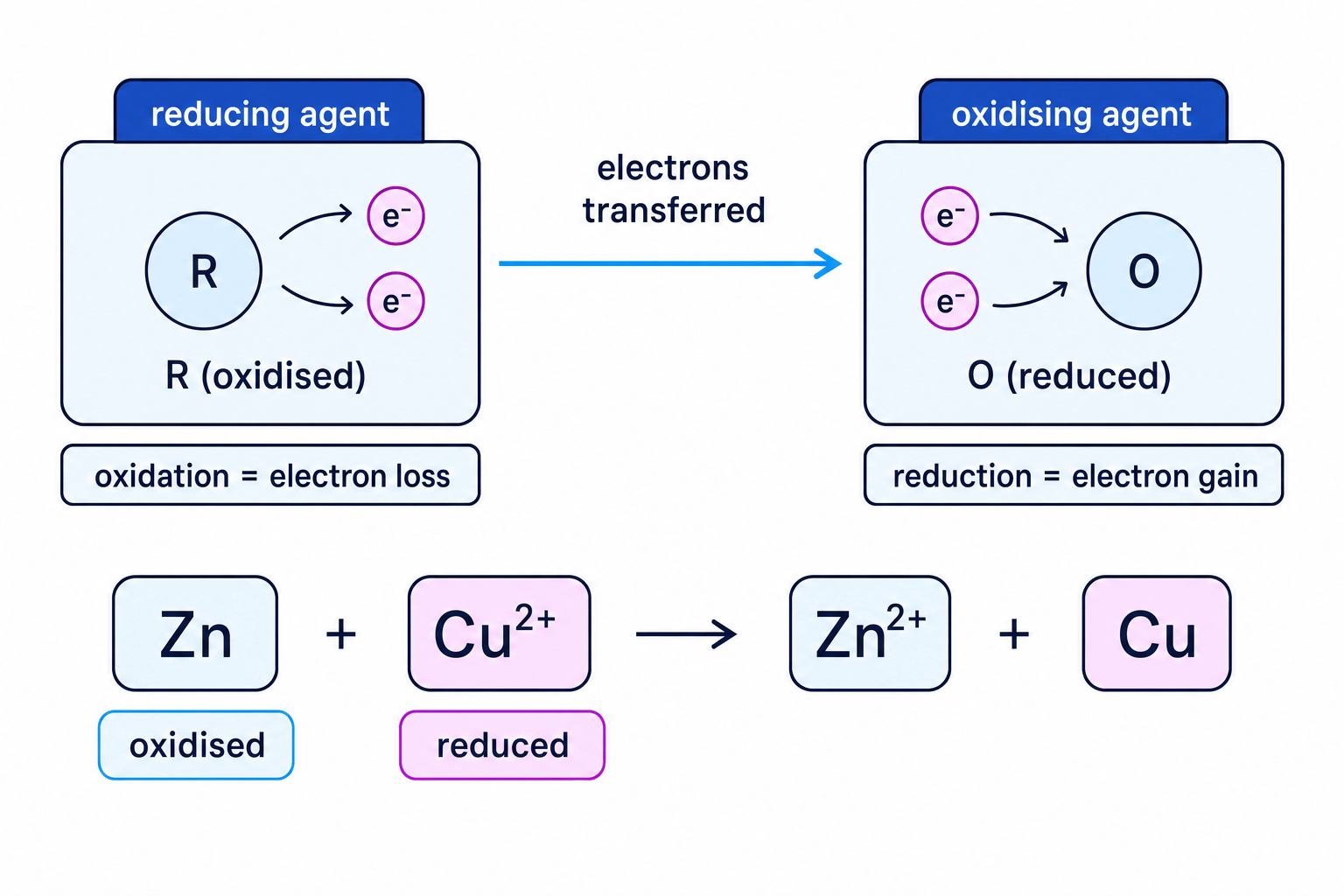
A redox reaction is a reaction where electrons are transferred. One species loses electrons, and another species gains those electrons. These two processes always happen together: you cannot have electron loss without electron gain somewhere else.
Oxidation and reduction
Oxidation is the loss of electrons.
Reduction is the gain of electrons.
A helpful memory aid is OIL RIG: Oxidation Is Loss, Reduction Is Gain.
Oxidising and reducing agents
An oxidising agent accepts electrons and is itself reduced.
A reducing agent donates electrons and is itself oxidised.
Who transfers electrons?
In a redox reaction, electrons are transferred from the reducing agent to the oxidising agent.
Identifying electron donor and acceptor
For the reaction:
Zn+Cu2+→Zn2++Cu\text{Zn} + \text{Cu}^{2+} \to \text{Zn}^{2+} + \text{Cu}Zn+Cu2+→Zn2++Cu- Compare zinc before and after the reaction: Zn becomes Zn²⁺, so it has lost two electrons.
- Compare copper before and after the reaction: Cu²⁺ becomes Cu, so it has gained two electrons.
- Zinc donates electrons, so zinc is the reducing agent and is oxidised. Cu²⁺ accepts electrons, so Cu²⁺ is the oxidising agent and is reduced.
2. Oxidation states
In many reactions, electrons are not shown directly. Instead, chemists use oxidation states to track redox changes.
Oxidation state
An oxidation state is a number assigned to an atom in a substance, showing the charge it would have if the bonding were treated as completely ionic.
Oxidation states are a bookkeeping tool. They are not always real charges, especially in covalent compounds, but they are extremely useful for spotting redox.
Core rules for assigning oxidation states
Use these rules in order when needed:
- An element in its uncombined form has oxidation state zero. Examples: Mg, O₂, Cl₂, Fe.
- A monatomic ion has an oxidation state equal to its charge. For example, Na⁺ is +1 and O²⁻ is -2.
- The sum of oxidation states in a neutral compound is zero.
- The sum of oxidation states in an ion equals the charge on the ion.
- Group 1 metals are usually +1.
- Group 2 metals are usually +2.
- Aluminium is usually +3.
- Fluorine is always -1 in compounds.
- Oxygen is usually -2, except in peroxides where it is -1, and in OF₂ where oxygen is +2.
- Hydrogen is usually +1, except in metal hydrides such as NaH, where it is -1.
- Chlorine, bromine and iodine are usually -1, unless bonded to oxygen or a more electronegative halogen.
The sum rule is your anchor
For most A-Level questions, the key move is: assign the oxidation states you know, call the unknown one xxx, then make the total equal to the overall charge.
Finding an oxidation state
Find the oxidation state of chromium in Cr₂O₇²⁻.
-
Let the oxidation state of chromium be xxx. Oxygen is usually -2.
-
There are two chromium atoms and seven oxygen atoms. The ion has an overall charge of -2, so:
- Solve the equation:
So chromium has oxidation state +6 in Cr₂O₇²⁻.
Forgetting the charge on an ion
In an ion, the oxidation states add up to the ionic charge, not zero. For SO₄²⁻, the total must be -2; for NH₄⁺, the total must be +1.
3. Using oxidation states to identify redox
Once you can assign oxidation states, redox becomes much easier to spot.
Oxidation state changes
If an element’s oxidation state increases, it has been oxidised.
If an element’s oxidation state decreases, it has been reduced.
This links to electrons: losing negatively charged electrons makes the oxidation state increase; gaining electrons makes it decrease.
Identifying oxidation and reduction
Chlorine reacts with iodide ions:
Cl2+2I−→2Cl−+I2\text{Cl}_2 + 2\text{I}^- \to 2\text{Cl}^- + \text{I}_2Cl2+2I−→2Cl−+I2-
Assign oxidation states. Cl₂ is an element, so chlorine is 0. I⁻ is -1. Cl⁻ is -1. I₂ is an element, so iodine is 0.
-
Iodine changes from -1 in I⁻ to 0 in I₂. Its oxidation state increases, so iodide ions have been oxidised.
-
Chlorine changes from 0 in Cl₂ to -1 in Cl⁻. Its oxidation state decreases, so chlorine has been reduced.
-
I⁻ is oxidised, so I⁻ is the reducing agent. Cl₂ is reduced, so Cl₂ is the oxidising agent.
Oxidation state is not always a real charge
In CO₂, carbon has oxidation state +4, but there is no actual C⁴⁺ ion present. Oxidation states are formal numbers used to track electron movement.
4. Half-equations
A half-equation shows either the oxidation process or the reduction process on its own. It includes electrons so that charge is balanced.
Half-equation
A half-equation is an equation for one half of a redox reaction, showing either electron loss or electron gain.
Simple half-equations
For simple ions, use two checks:
- Atoms must balance.
- Total charge must balance.
Writing simple half-equations
Write half-equations for Fe²⁺ forming Fe³⁺ and Cl₂ forming Cl⁻.
- For iron, the atom is already balanced. The charge changes from +2 to +3, so one electron must be lost:
- For chlorine, first balance the chlorine atoms:
- The right-hand side has total charge -2, so add two electrons to the left-hand side:
- The iron half-equation shows oxidation because electrons are produced. The chlorine half-equation shows reduction because electrons are gained.
Putting electrons on the wrong side
Electrons on the right mean oxidation, because electrons are being lost. Electrons on the left mean reduction, because electrons are being gained.
5. Half-equations involving oxygen and hydrogen
For aqueous redox reactions, especially in acidic solution, you may need to balance O and H as well as charge.
Method for acidic conditions
- Balance the atom being oxidised or reduced.
- Balance oxygen atoms using H₂O.
- Balance hydrogen atoms using H⁺.
- Balance charge using electrons.
- Check atoms and charge.
Writing a half-equation in acid
Write the reduction half-equation for MnO₄⁻ forming Mn²⁺ in acidic solution.
- Balance manganese. There is one Mn atom on each side, so no coefficient is needed:
- Balance oxygen by adding four H₂O molecules to the right:
- Balance hydrogen by adding eight H⁺ ions to the left:
- Balance charge. The left-hand side has charge +7 overall, and the right-hand side has charge +2. Add five electrons to the left to reduce the charge from +7 to +2:
- Check the oxidation state: manganese goes from +7 in MnO₄⁻ to +2 in Mn²⁺, so this is reduction, consistent with electrons being on the left.
Acidic versus alkaline conditions
If a question says acidified, H⁺ is allowed in your half-equation. If it says alkaline, you may need to remove H⁺ by adding OH⁻ to both sides, forming H₂O and then cancelling waters.
6. Combining half-equations
To get the overall redox equation, add the oxidation and reduction half-equations together. The electrons must cancel, because electrons are transferred internally and should not appear in the final equation.
Equalise electrons before adding
Multiply one or both half-equations so that the number of electrons lost equals the number of electrons gained.
Combining half-equations
Combine these half-equations for acidified manganate(VII) ions reacting with Fe²⁺ ions:
MnO4−+8H++5e−→Mn2++4H2O\text{MnO}_4^- + 8\text{H}^+ + 5\text{e}^- \to \text{Mn}^{2+} + 4\text{H}_2\text{O}MnO4−+8H++5e−→Mn2++4H2O Fe2+→Fe3++e−\text{Fe}^{2+} \to \text{Fe}^{3+} + \text{e}^-Fe2+→Fe3++e−- The manganese half-equation uses five electrons, but the iron half-equation produces one electron. Multiply the iron half-equation by 5:
- Add the two half-equations:
- Cancel the five electrons from both sides:
- Check charge. Left: -1 + 8 + 10 = +17. Right: +2 + 15 = +17. The charges balance, so the overall ionic equation is correct.
Leaving electrons in the final equation
Electrons should appear in half-equations, but they should cancel out when you combine them. If electrons remain in your final overall equation, something has gone wrong.
7. Quick summary
- Oxidation is electron loss; reduction is electron gain.
- Oxidising agents accept electrons and are reduced.
- Reducing agents donate electrons and are oxidised.
- Oxidation states help you identify which element has been oxidised or reduced.
- Half-equations show electron transfer explicitly.
- Overall redox equations are made by combining half-equations and cancelling electrons.
In the exam
- Assign oxidation states carefully, especially in ions: the total must equal the ionic charge.
- When writing half-equations, balance atoms first, then balance charge using electrons.
- Before finalising an overall redox equation, check that atoms, charge and electrons all balance.
Check yourself
- What is the difference between an oxidising agent and a reducing agent?
- What is the oxidation state of nitrogen in NO₃⁻?
- How would you combine two half-equations if one contains two electrons and the other contains three electrons?
