What you'll learn
- Why chemists use the logarithmic pH scale rather than standard concentrations.
- How to convert the concentration of hydrogen ions, [H+][\text{H}^+][H+], into pH.
- How to reverse the process to find [H+][\text{H}^+][H+] from a given pH.
- How to calculate the pH of a strong acid using its concentration.
This topic marks the start of the A-Level only Acids and Bases section. The math you learn here will be the foundation for everything else you do with weak acids, buffers, and titration curves.
The problem with hydrogen ions
Acidity is caused by hydrogen ions, H+\text{H}^+H+, dissolved in water. To compare the acidity of different solutions, we could simply state their hydrogen ion concentrations in mol dm⁻³.
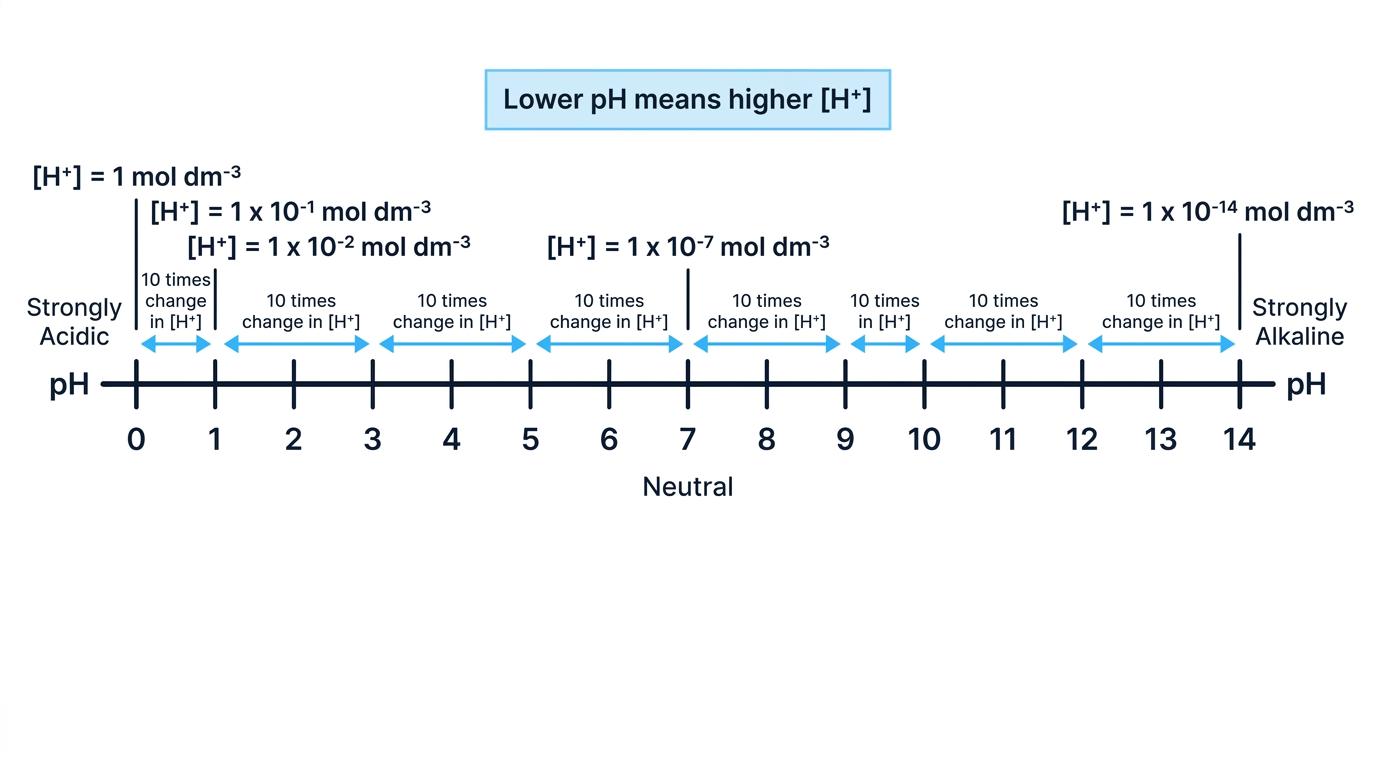
However, the concentration of hydrogen ions in aqueous solution covers a shockingly wide range. A highly concentrated acid might have a [H+][\text{H}^+][H+] of 1.01.01.0 mol dm⁻³, while a strong alkali might have a [H+][\text{H}^+][H+] of 0.000000000000010.000000000000010.00000000000001 mol dm⁻³ (or 1.0×10−141.0 \times 10^{-14}1.0×10⁻¹⁴ mol dm⁻³).
Using standard form for everyday lab work is clunky. To solve this, a Danish chemist named Sørensen introduced a logarithmic scale called the pH scale. By taking the logarithm of these tiny numbers, we convert that massive, awkward range into a neat, manageable scale typically running from 0 to 14.
pH
The pH of a solution is defined mathematically as the negative base-10 logarithm of the hydrogen ion concentration.
pH=−log10[H+] \text{pH} = -\log_{10}[\text{H}^+] pH=−log10[H+]Understanding the logarithmic scale
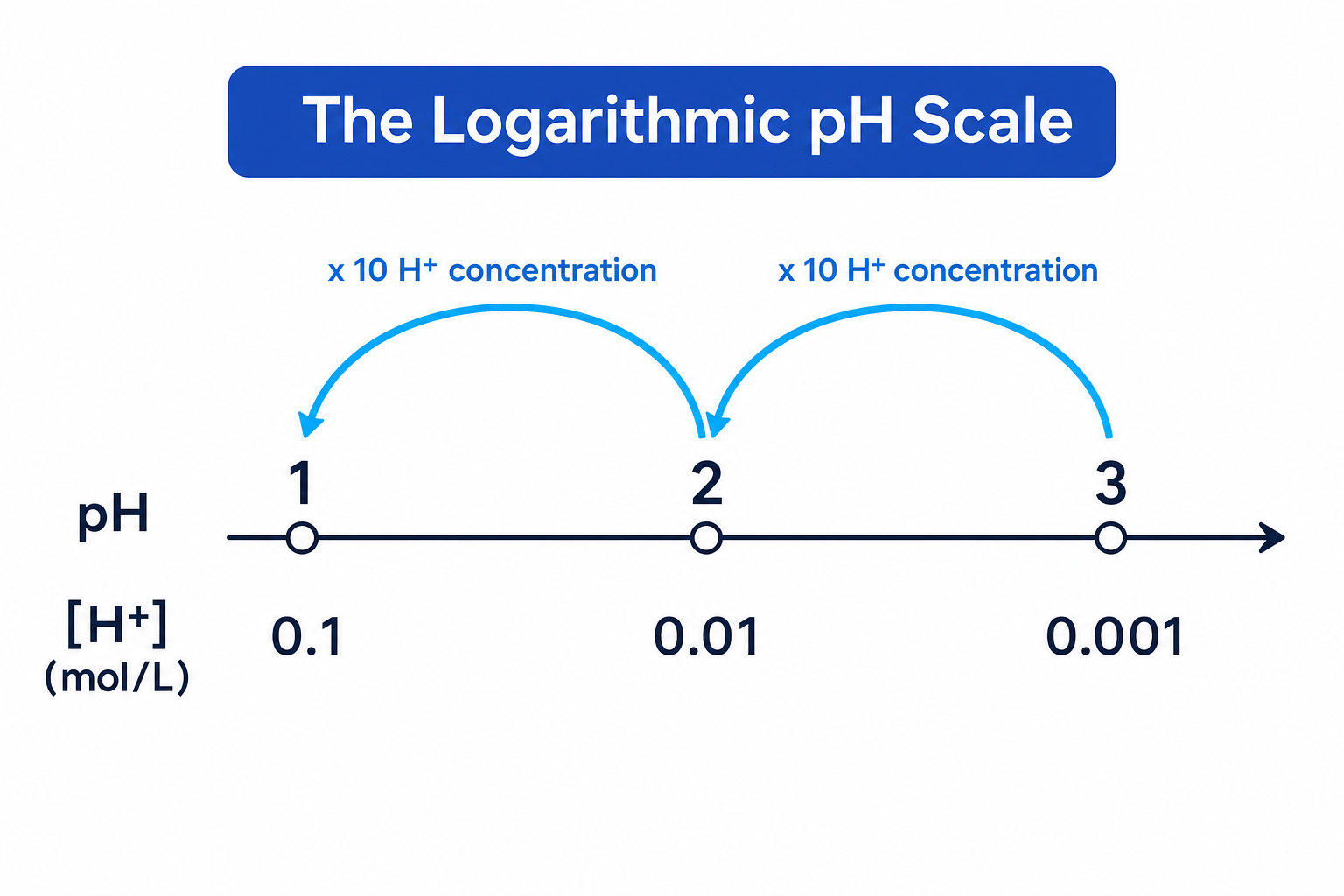
Because the pH scale is logarithmic (base 10), a change of one pH unit means the hydrogen ion concentration has changed by a factor of ten.
If you decrease the pH by 1 (making the solution more acidic), the [H+][\text{H}^+][H+] is multiplied by 10. If you decrease the pH by 2, the [H+][\text{H}^+][H+] is multiplied by 100.
Inverse relationship
The negative sign in the equation means that pH and [H+][\text{H}^+][H+] move in opposite directions. The higher the concentration of hydrogen ions, the lower the pH.
Converting hydrogen ion concentration to pH
To find the pH of a solution when you know its [H+][\text{H}^+][H+], you simply plug the concentration into the definition equation.
Calculating pH from hydrogen ion concentration
Find the pH of a solution that has a hydrogen ion concentration of 4.5×10−34.5 \times 10^{-3}4.5×10⁻³ mol dm⁻³. Give your answer to 2 decimal places.
- State the equation for pH.
- Substitute the given hydrogen ion concentration into the equation.
- Evaluate the expression using your calculator (make sure you use the
logorlog10button, notln).
- Round the final answer to the requested precision (2 decimal places).
Decimal places for pH
Unless an exam question explicitly tells you otherwise, always quote your calculated pH values to 2 decimal places. This is standard chemical practice.
Converting pH back to hydrogen ion concentration
You also need to be able to work backwards. If you measure the pH of a solution with a pH meter, you must be able to calculate the actual concentration of hydrogen ions present.
To rearrange the equation pH=−log10[H+]\text{pH} = -\log_{10}[\text{H}^+]pH=−log10[H+] to make [H+][\text{H}^+][H+] the subject, we first move the negative sign, and then take the inverse logarithm (which means raising 10 to the power of the value).
[H+]=10−pH [\text{H}^+] = 10^{-\text{pH}} [H+]=10−pHCalculating hydrogen ion concentration from pH
A sample of rainwater has a measured pH of 5.30. Calculate the concentration of hydrogen ions in the rainwater.
- State the rearranged pH equation.
- Substitute the given pH value into the power.
- Evaluate using the inverse log button (often
SHIFT+logon your calculator).
- Round your answer to an appropriate number of significant figures (usually 2 or 3, matching the data provided) and state the units.
Forgetting the negative sign
When calculating [H+][\text{H}^+][H+] from pH, the most common error is typing 10pH10^{\text{pH}}10pH instead of 10−pH10^{-\text{pH}}10−pH into the calculator. If your pH is 3.00, your concentration should be a small decimal (0.0010.0010.001), not a massive number like 100010001000. Always pause and ask: "Does this concentration make physical sense?"
Calculating the pH of strong acids
A strong acid is defined as an acid that completely dissociates (ionises) into its ions when dissolved in water.
Typical strong acids you need to know are hydrochloric acid (HCl\text{HCl}HCl), nitric acid (HNO3\text{HNO}_3HNO3), and sulfuric acid (H2SO4\text{H}_2\text{SO}_4H2SO4).
Because a strong acid fully dissociates, we can directly link the starting concentration of the acid to the concentration of hydrogen ions it produces.
For a monoprotic strong acid (an acid that releases one proton per molecule, like HCl\text{HCl}HCl or HNO3\text{HNO}_3HNO3):
HCl→H++Cl− \text{HCl} \to \text{H}^+ + \text{Cl}^- HCl→H++Cl−The ratio of acid to hydrogen ions is 1:1. Therefore, the hydrogen ion concentration is exactly equal to the original concentration of the acid.
[H+]=[HA] [\text{H}^+] = [\text{HA}] [H+]=[HA]Calculating the pH of a strong monoprotic acid
Calculate the pH of a 0.0250.0250.025 mol dm⁻³ solution of nitric acid (HNO3\text{HNO}_3HNO3).
- Deduce the hydrogen ion concentration. Nitric acid is a strong monoprotic acid, so it completely dissociates (HNO3→H++NO3−\text{HNO}_3 \to \text{H}^+ + \text{NO}_3^-HNO3→H++NO3−). Therefore, [H+]=[HNO3][\text{H}^+] = [\text{HNO}_3][H+]=[HNO3].
- State the pH equation.
- Substitute the concentration into the equation.
- Evaluate and round to 2 decimal places.
Diprotic acids
Sulfuric acid (H2SO4\text{H}_2\text{SO}_4H2SO4) is a diprotic strong acid. Each molecule can release two protons. For calculation purposes at A-Level (unless the question gives you specific dissociation data for the second proton), assume it fully dissociates both protons: [H+]=2×[H2SO4][\text{H}^+] = 2 \times [\text{H}_2\text{SO}_4][H+]=2×[H2SO4]. For example, a 0.100.100.10 mol dm⁻³ solution of H2SO4\text{H}_2\text{SO}_4H2SO4 would give a [H+][\text{H}^+][H+] of 0.200.200.20 mol dm⁻³.
In the exam
- Always explicitly write down pH=−log10[H+]\text{pH} = -\log_{10}[\text{H}^+]pH=−log10[H+] before you substitute any numbers. This often secures the first method mark in calculation questions, even if you mess up the calculator work later.
- Check whether the acid given is monoprotic (like HCl\text{HCl}HCl) or diprotic (like H2SO4\text{H}_2\text{SO}_4H2SO4). If it is diprotic, remember to multiply the acid concentration by 2 to find your [H+][\text{H}^+][H+].
- Give all final pH answers to 2 decimal places, unless the specific question tells you otherwise.
- When calculating [H+][\text{H}^+][H+] from pH, ensure your answer is given in standard form to an appropriate number of significant figures (usually 3 sig figs).
Check yourself
- What is the mathematical definition of pH?
- Without using a calculator, if the pH drops from 4.00 to 2.00, by what factor has the hydrogen ion concentration increased?
- What is the expected [H+][\text{H}^+][H+] in a solution of hydrochloric acid with a concentration of 0.150.150.15 mol dm⁻³?
- How would you arrange the calculation to find the pH of 0.0500.0500.050 mol dm⁻³ sulfuric acid?