

Welcome to A-Level acid–base chemistry! At GCSE, you learned that acids release H+\text{H}^+H+ ions in water and alkalis release OH−\text{OH}^-OH− ions. While this is true, it is a slightly limited view of how chemical reactions actually work. In this topic, we will look at a much more powerful way to understand acids and bases.
What you'll learn:
- The Brønsted–Lowry definitions of acids and bases.
- Why an H+\text{H}^+H+ ion is simply referred to as a "proton".
- How acid–base reactions in solution form dynamic equilibria.
- How to identify conjugate acid–base pairs in a chemical equation.
The Brønsted–Lowry definitions
In 1923, two chemists—Johannes Nicolaus Brønsted and Thomas Martin Lowry—independently proposed a new way to define acids and bases. Instead of just looking at what substances release into water, they looked at how molecules interact with each other during a reaction.
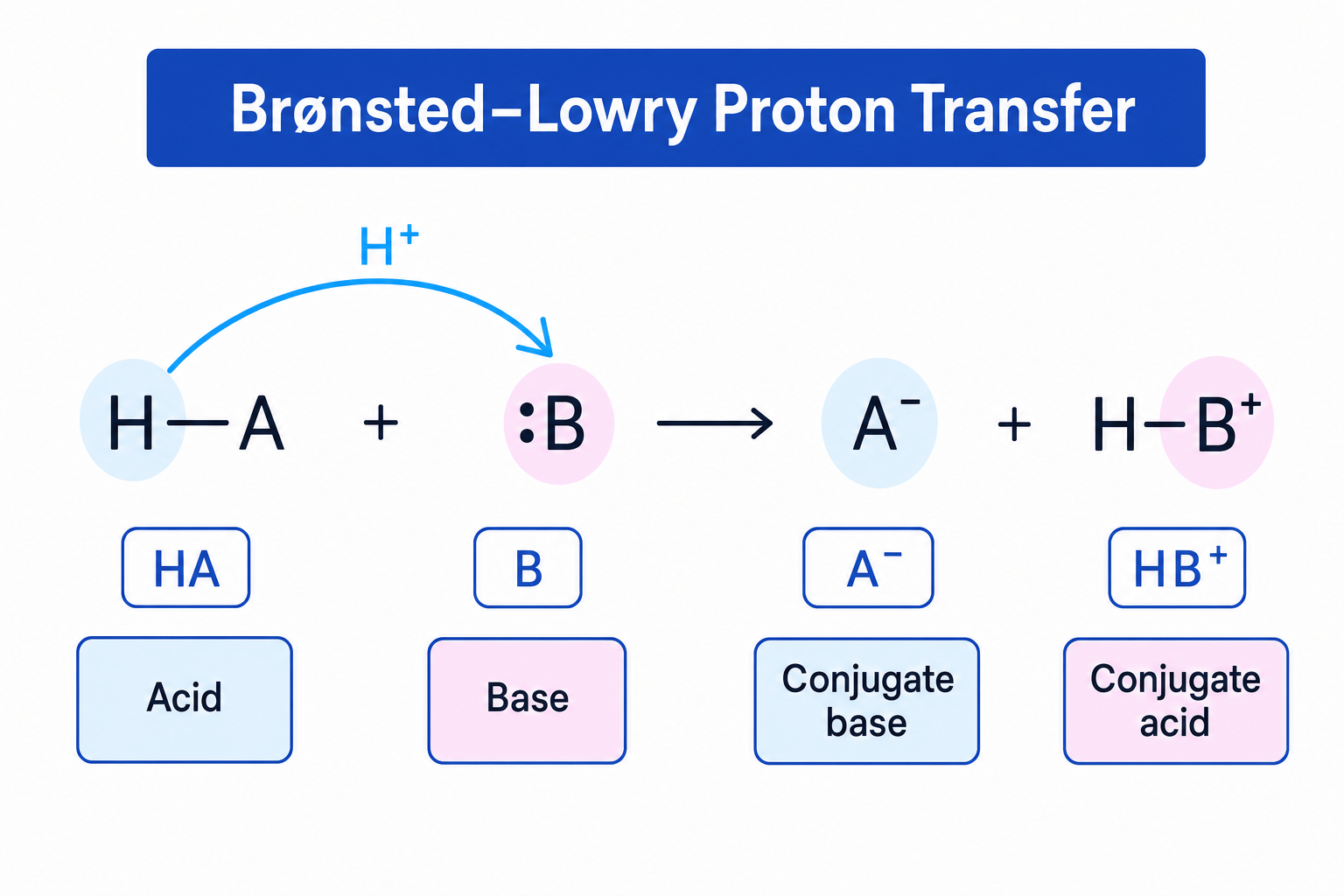
They realised that acid–base chemistry is entirely about the transfer of H+\text{H}^+H+ ions from one species to another.
Brønsted–Lowry definitions
- A Brønsted–Lowry acid is a proton (H+\text{H}^+H+) donor.
- A Brønsted–Lowry base is a proton (H+\text{H}^+H+) acceptor.
Why do we call the H+\text{H}^+H+ ion a "proton"? Think about a neutral hydrogen atom. It consists of exactly one proton in the nucleus and one electron orbiting it. If that hydrogen atom loses its only electron to become an H+\text{H}^+H+ ion, there is nothing left but the bare proton. Therefore, in chemistry, donating an H+\text{H}^+H+ ion is exactly the same as donating a proton.
The essential requirement for a base
Because a Brønsted–Lowry base must accept a proton, it must have a lone pair of electrons to form a dative covalent (coordinate) bond with the incoming H+\text{H}^+H+ ion. Ammonia (NH3\text{NH}_3NH3) and water (H2O\text{H}_2\text{O}H2O) are excellent examples of molecules with lone pairs that can act as bases.
Proton transfer in aqueous solution
Protons are highly reactive—they have a very high charge density and do not just float around on their own in aqueous solutions. When an acid donates a proton, there must be a base ready to accept it immediately.
Let's look at what happens when hydrogen chloride (HCl\text{HCl}HCl) gas dissolves in water:
HCl(g)+H2O(l)→H3O+(aq)+Cl−(aq) \text{HCl(g)} + \text{H}_2\text{O(l)} \to \text{H}_3\text{O}^+\text{(aq)} + \text{Cl}^-\text{(aq)} HCl(g)+H2O(l)→H3O+(aq)+Cl−(aq)In this reaction:
- HCl\text{HCl}HCl donates a proton to water. Therefore, HCl\text{HCl}HCl is the acid.
- H2O\text{H}_2\text{O}H2O accepts the proton using one of the lone pairs on its oxygen atom. Therefore, water is acting as the base.
The resulting H3O+\text{H}_3\text{O}^+H3O+ ion is called the oxonium ion (sometimes called the hydronium ion). Whenever we write H+(aq)\text{H}^+\text{(aq)}H+(aq) in a chemical equation, it is actually a shorthand for H3O+(aq)\text{H}_3\text{O}^+\text{(aq)}H3O+(aq).
Acid–base equilibria and conjugate pairs
Many acid–base reactions do not go to completion. Weak acids and weak bases only partially dissociate in water, establishing a dynamic equilibrium.
Because these reactions are reversible, proton transfer happens in both directions. Let's examine the equilibrium established when ethanoic acid (CH3COOH\text{CH}_3\text{COOH}CH3COOH) is dissolved in water:
CH3COOH(aq)+H2O(l)⇌CH3COO−(aq)+H3O+(aq) \text{CH}_3\text{COOH(aq)} + \text{H}_2\text{O(l)} \rightleftharpoons \text{CH}_3\text{COO}^-\text{(aq)} + \text{H}_3\text{O}^+\text{(aq)} CH3COOH(aq)+H2O(l)⇌CH3COO−(aq)+H3O+(aq)Let's break down the two directions:
- The forward reaction: CH3COOH\text{CH}_3\text{COOH}CH3COOH donates a proton to H2O\text{H}_2\text{O}H2O. So, CH3COOH\text{CH}_3\text{COOH}CH3COOH is an acid, and H2O\text{H}_2\text{O}H2O is a base.
- The reverse reaction: H3O+\text{H}_3\text{O}^+H3O+ donates a proton back to the ethanoate ion (CH3COO−\text{CH}_3\text{COO}^-CH3COO−). Therefore, H3O+\text{H}_3\text{O}^+H3O+ is acting as an acid, and CH3COO−\text{CH}_3\text{COO}^-CH3COO− is acting as a base.
Notice how the ethanoic acid (CH3COOH\text{CH}_3\text{COOH}CH3COOH) turns into the ethanoate ion (CH3COO−\text{CH}_3\text{COO}^-CH3COO−) by losing a proton. These two species are intimately linked and are known as a conjugate acid–base pair.
Conjugate acid–base pair
A pair of chemical species that differ by only one proton (H+\text{H}^+H+). When the acid donates its proton, it transforms into its conjugate base. When the base accepts a proton, it transforms into its conjugate acid.
In any acid–base equilibrium, there will always be two conjugate pairs.
Identifying conjugate acid–base pairs
Given the equilibrium established when ammonia is dissolved in water, identify the two conjugate acid–base pairs:
NH3(aq)+H2O(l)⇌NH4+(aq)+OH−(aq) \text{NH}_3\text{(aq)} + \text{H}_2\text{O(l)} \rightleftharpoons \text{NH}_4^+\text{(aq)} + \text{OH}^-\text{(aq)} NH3(aq)+H2O(l)⇌NH4+(aq)+OH−(aq)- Compare the reactants to the products to see where the proton has moved in the forward reaction. H2O\text{H}_2\text{O}H2O has become OH−\text{OH}^-OH− (it lost a proton), meaning H2O\text{H}_2\text{O}H2O is the acid. NH3\text{NH}_3NH3 has become NH4+\text{NH}_4^+NH4+ (it gained a proton), meaning NH3\text{NH}_3NH3 is the base.
- Link the acid on the left to the species it becomes on the right to form the first pair. The acid H2O\text{H}_2\text{O}H2O loses a proton to become its conjugate base, OH−\text{OH}^-OH−. Pair 1: H2O\text{H}_2\text{O}H2O and OH−\text{OH}^-OH−.
- Link the base on the left to the species it becomes on the right to form the second pair. The base NH3\text{NH}_3NH3 gains a proton to become its conjugate acid, NH4+\text{NH}_4^+NH4+. Pair 2: NH3\text{NH}_3NH3 and NH4+\text{NH}_4^+NH4+.
Missing the charges
When writing conjugate bases or acids, students often forget to adjust the charge. Removing an H+\text{H}^+H+ decreases the overall charge by 1. Adding an H+\text{H}^+H+ increases the overall charge by 1. For example, the conjugate base of HSO4−\text{HSO}_4^-HSO4− is SO42−\text{SO}_4^{2-}SO42− (not SO4−\text{SO}_4^-SO4−).
The amphoteric nature of water
You might have noticed something interesting in the examples above.
- When reacting with HCl\text{HCl}HCl or ethanoic acid, water accepted a proton (acted as a base).
- When reacting with ammonia, water donated a proton (acted as an acid).
Species that can behave as either an acid or a base depending on what they are reacting with are described as amphoteric (specifically, amphiprotic, since they can either donate or accept a proton).
The fundamental rule of acid–base equilibria
Every acid–base reaction is simply a competition for protons. The position of the equilibrium depends on how strongly the acids want to donate protons compared to how strongly the bases want to accept them.
In the exam
- When asked to define a Brønsted–Lowry acid or base, always use the word "proton". Do not write "hydrogen ion" if you want to guarantee the mark.
- If an exam question asks you to identify the conjugate base of a complex molecule, simply remove one H\text{H}H atom from the formula and subtract 1 from the charge.
- If asked to write an acid–base equilibrium equation, ensure you use the reversible arrows (⇌\rightleftharpoons⇌) to show it is a dynamic equilibrium.
Check yourself
- What is the Brønsted–Lowry definition of a base?
- What is the conjugate acid of H2O\text{H}_2\text{O}H2O?
- In the reaction HSO4−+H2O⇌SO42−+H3O+\text{HSO}_4^- + \text{H}_2\text{O} \rightleftharpoons \text{SO}_4^{2-} + \text{H}_3\text{O}^+HSO4−+H2O⇌SO42−+H3O+, which two species are acting as proton donors (acids)?
