What you'll learn
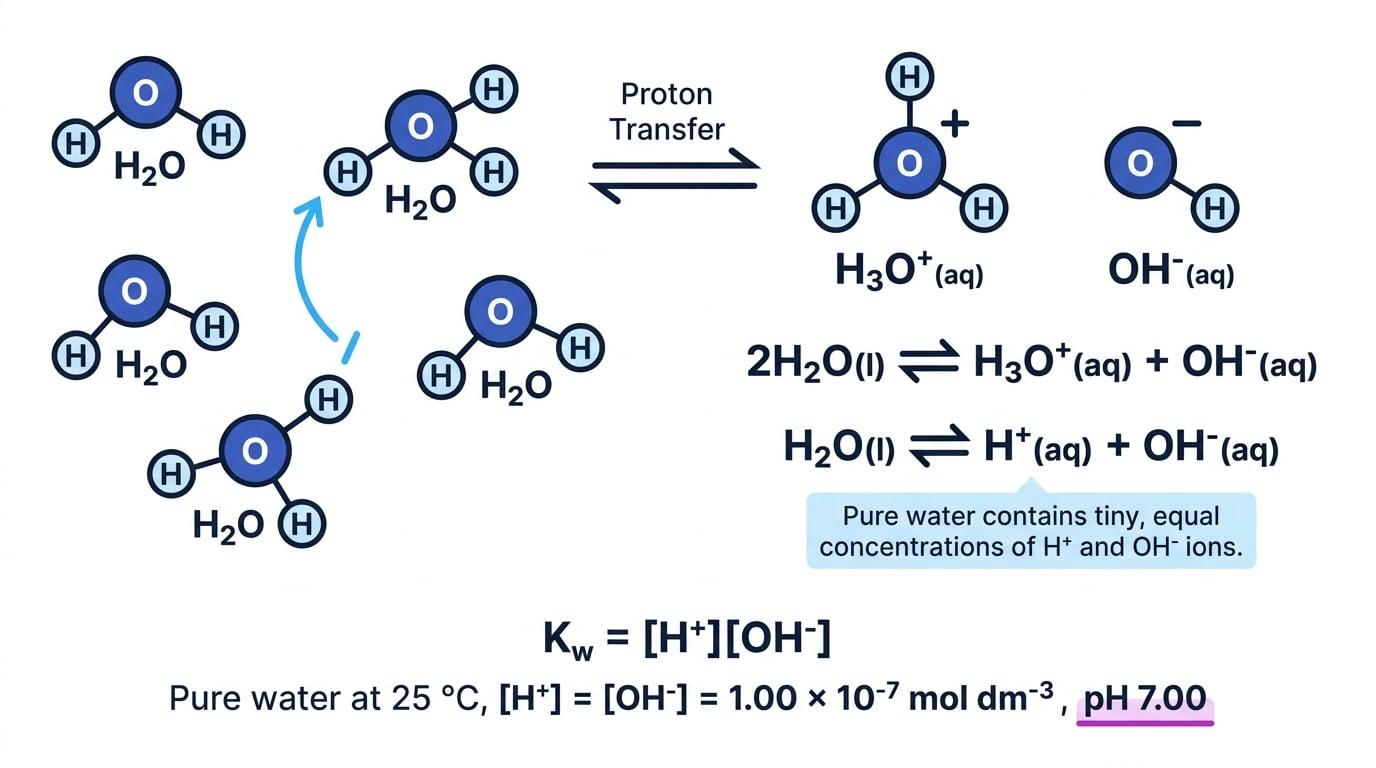
- Why pure water contains tiny amounts of both hydrogen ions and hydroxide ions.
- How KwK_wKw comes from the equilibrium for water dissociation.
- Why the value of KwK_wKw changes with temperature.
- How to calculate the pH of a strong base from its concentration.
Before KwK_wKw: the key symbols
In acid–base calculations, you will often see square brackets around a formula, such as [H+][\text{H}^+][H+] or [OH−][\text{OH}^-][OH−]. These mean concentration.
Concentration brackets
Square brackets mean the concentration of a species in solution, usually in mol dm⁻³. For example, [OH−][\text{OH}^-][OH−] means the concentration of hydroxide ions in mol dm⁻³.
You also need the pH equation from earlier in acids and bases.
pH
The pH of a solution is a logarithmic measure of its hydrogen ion concentration:
pH=−log10[H+]\text{pH} = -\log_{10}[\text{H}^+]pH=−log10[H+]In this equation, [H+][\text{H}^+][H+] must be in mol dm⁻³.
Because pH is logarithmic, a change of 1 pH unit means a factor of 10 change in [H+][\text{H}^+][H+].
Calculating pH from hydrogen ion concentration
A solution has [H+]=2.50×10⁻³ mol dm−3[\text{H}^+] = 2.50 \times 10^{-3}\ \text{mol dm}^{-3}[H+]=2.50×10⁻³ mol dm−3. Calculate its pH.
-
Substitute the hydrogen ion concentration into the pH equation:
pH=−log10(2.50×10⁻³)\text{pH} = -\log_{10}(2.50 \times 10^{-3})pH=−log10(2.50×10⁻³) -
Evaluate the logarithm:
pH=2.602…\text{pH} = 2.602\ldotspH=2.602… -
Round appropriately, usually to 2 decimal places in A-level pH calculations:
pH=2.60\text{pH} = 2.60pH=2.60
Water is slightly dissociated
Pure water is mostly made of neutral water molecules, but a very small number of water molecules transfer protons between themselves. This is called dissociation, meaning splitting into ions.
A more realistic equation is:
2H2O(l)⇌H3O+(aq)+OH−(aq)2\text{H}_2\text{O}(l) \rightleftharpoons \text{H}_3\text{O}^+(aq) + \text{OH}^-(aq)2H2O(l)⇌H3O+(aq)+OH−(aq)At A-level, the hydronium ion, H3O+\text{H}_3\text{O}^+H3O+, is usually simplified and written as H+\text{H}^+H+:
H2O(l)⇌H+(aq)+OH−(aq)\text{H}_2\text{O}(l) \rightleftharpoons \text{H}^+(aq) + \text{OH}^-(aq)H2O(l)⇌H+(aq)+OH−(aq)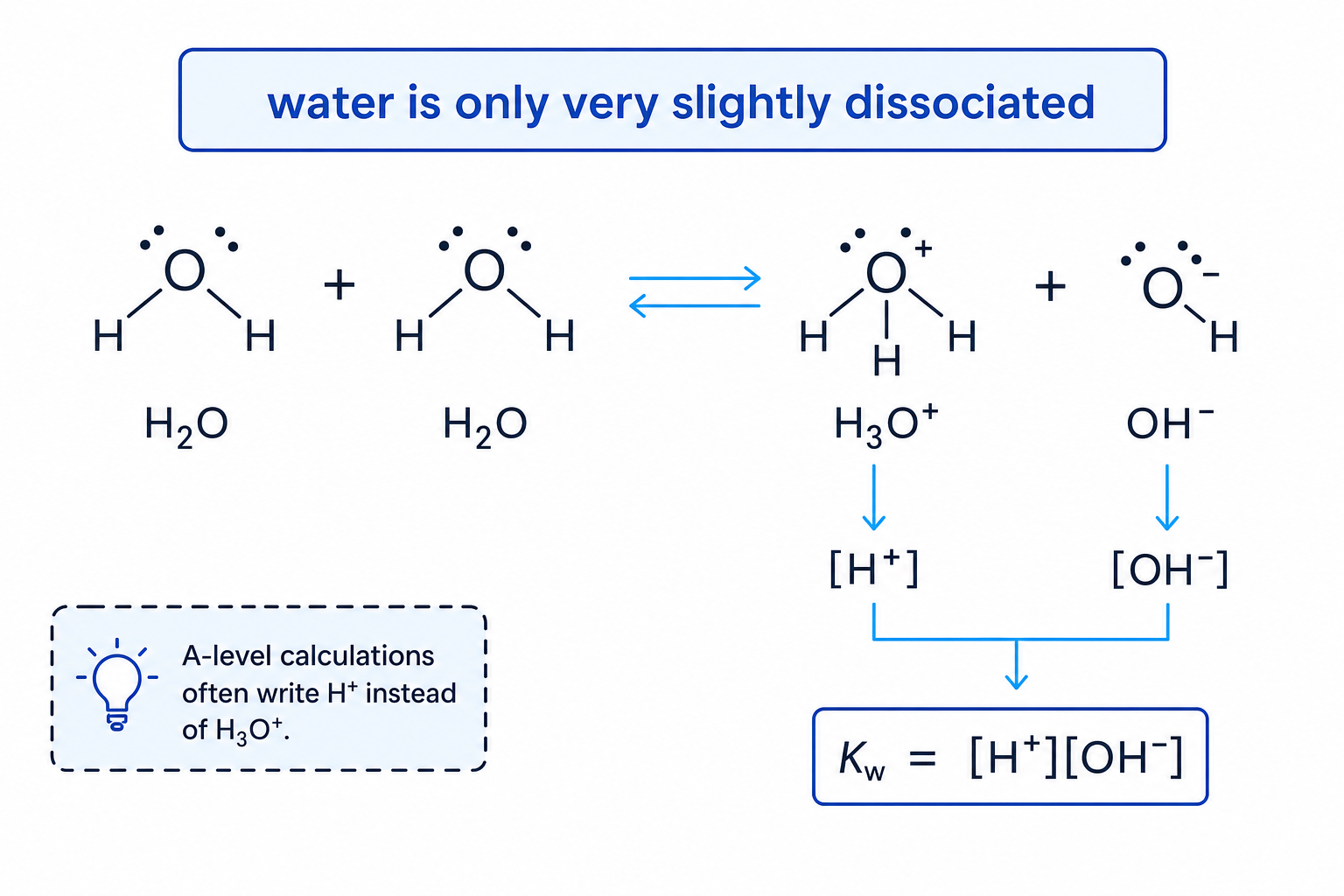
Water contains both ions
Even pure water contains tiny concentrations of both H+\text{H}^+H+ and OH−\text{OH}^-OH− ions. The equilibrium lies very far to the left, so only a very small fraction of water molecules are ionised.
Deriving the ionic product of water
Because the dissociation of water is reversible, it has an equilibrium constant. For the simplified dissociation,
H2O(l)⇌H+(aq)+OH−(aq)\text{H}_2\text{O}(l) \rightleftharpoons \text{H}^+(aq) + \text{OH}^-(aq)H2O(l)⇌H+(aq)+OH−(aq)we can build a special equilibrium expression called the ionic product of water.
Ionic product of water
The ionic product of water, KwK_wKw, is defined as:
Kw=[H+][OH−]K_w = [\text{H}^+][\text{OH}^-]Kw=[H+][OH−]It links the hydrogen ion concentration and hydroxide ion concentration in aqueous solutions.
Deriving the ionic product expression
-
Start with the simplified equilibrium for water dissociation:
H2O(l)⇌H+(aq)+OH−(aq)\text{H}_2\text{O}(l) \rightleftharpoons \text{H}^+(aq) + \text{OH}^-(aq)H2O(l)⇌H+(aq)+OH−(aq) -
Write an equilibrium expression in the usual way:
Kc=[H+][OH−][H2O]K_c = \frac{[\text{H}^+][\text{OH}^-]}{[\text{H}_2\text{O}]}Kc=[H2O][H+][OH−] -
The concentration of liquid water is effectively constant because water is the solvent and is present in a huge excess. This constant is combined with KcK_cKc to give a new constant:
Kw=Kc[H2O]=[H+][OH−]K_w = K_c[\text{H}_2\text{O}] = [\text{H}^+][\text{OH}^-]Kw=Kc[H2O]=[H+][OH−]
The value and units of KwK_wKw
At 25 °C, or 298 K, the value usually used is:
Kw=1.00×10⁻¹⁴ mol2 dm−6K_w = 1.00 \times 10^{-14}\ \text{mol}^2\text{ dm}^{-6}Kw=1.00×10⁻¹⁴ mol2 dm−6The units come from multiplying two concentrations:
(mol dm−3)(mol dm−3)=mol2 dm−6(\text{mol dm}^{-3})(\text{mol dm}^{-3}) = \text{mol}^2\text{ dm}^{-6}(mol dm−3)(mol dm−3)=mol2 dm−6In pure water, each dissociation event produces one H+\text{H}^+H+ ion and one OH−\text{OH}^-OH− ion, so:
[H+]=[OH−][\text{H}^+] = [\text{OH}^-][H+]=[OH−]At 25 °C:
[H+]=[OH−]=1.00×10⁻⁷ mol dm−3[\text{H}^+] = [\text{OH}^-] = 1.00 \times 10^{-7}\ \text{mol dm}^{-3}[H+]=[OH−]=1.00×10⁻⁷ mol dm−3so pure water has pH 7.00 at 25 °C.
Neutral does not always mean pH 7
A solution is neutral when [H+]=[OH−][\text{H}^+] = [\text{OH}^-][H+]=[OH−]. Neutral water has pH 7.00 only at 25 °C, because KwK_wKw changes with temperature.
KwK_wKw changes with temperature
The value of KwK_wKw is not fixed. If the temperature changes, the position of the water dissociation equilibrium changes, so the product [H+][OH−][\text{H}^+][\text{OH}^-][H+][OH−] changes too.
In exam questions, use the value of KwK_wKw given in the question. If no value is given and the temperature is 25 °C, use 1.00×10⁻¹⁴ mol2 dm−61.00 \times 10^{-14}\ \text{mol}^2\text{ dm}^{-6}1.00×10⁻¹⁴ mol2 dm−6.
Finding the neutral pH at a different temperature
At 50 °C, Kw=5.47×10⁻¹⁴ mol2 dm−6K_w = 5.47 \times 10^{-14}\ \text{mol}^2\text{ dm}^{-6}Kw=5.47×10⁻¹⁴ mol2 dm−6. Calculate the pH of pure water at this temperature.
-
In pure water, the concentrations of hydrogen ions and hydroxide ions are equal. Let:
[H+]=[OH−]=x[\text{H}^+] = [\text{OH}^-] = x[H+]=[OH−]=x -
Substitute into the expression for KwK_wKw:
Kw=x2K_w = x^2Kw=x2so:
x=5.47×10−14=2.34×10⁻⁷ mol dm−3x = \sqrt{5.47 \times 10^{-14}} = 2.34 \times 10^{-7}\ \text{mol dm}^{-3}x=5.47×10−14=2.34×10⁻⁷ mol dm−3 -
Calculate the pH:
pH=−log10(2.34×10⁻⁷)=6.63\text{pH} = -\log_{10}(2.34 \times 10^{-7}) = 6.63pH=−log10(2.34×10⁻⁷)=6.63
This water is neutral, even though its pH is below 7, because [H+]=[OH−][\text{H}^+] = [\text{OH}^-][H+]=[OH−].
Calculating the pH of a strong base
This is the main calculation skill for this sub-topic.
Strong base
A strong base fully dissociates in water. This means the concentration of hydroxide ions can be found directly from the concentration and formula of the base.
For example:
NaOH(aq)→Na+(aq)+OH−(aq)\text{NaOH}(aq) \to \text{Na}^+(aq) + \text{OH}^-(aq)NaOH(aq)→Na+(aq)+OH−(aq)One mole of sodium hydroxide produces one mole of hydroxide ions, so for sodium hydroxide:
[OH−]=[NaOH][\text{OH}^-] = [\text{NaOH}][OH−]=[NaOH]But for barium hydroxide:
Ba(OH)2(aq)→Ba2+(aq)+2OH−(aq)\text{Ba(OH)}_2(aq) \to \text{Ba}^{2+}(aq) + 2\text{OH}^-(aq)Ba(OH)2(aq)→Ba2+(aq)+2OH−(aq)one mole of barium hydroxide produces two moles of hydroxide ions, so:
[OH−]=2[Ba(OH)2][\text{OH}^-] = 2[\text{Ba(OH)}_2][OH−]=2[Ba(OH)2]Strong-base pH method
For a strong base, find [OH−][\text{OH}^-][OH−] first, then use KwK_wKw to find [H+][\text{H}^+][H+], then use the pH equation.
The key rearrangement is:
Kw=[H+][OH−]K_w = [\text{H}^+][\text{OH}^-]Kw=[H+][OH−]so:
[H+]=Kw[OH−][\text{H}^+] = \frac{K_w}{[\text{OH}^-]}[H+]=[OH−]KwCalculating the pH of sodium hydroxide
Calculate the pH of 0.0250 mol dm⁻³ sodium hydroxide at 25 °C.
-
Sodium hydroxide is a strong base and produces one hydroxide ion per formula unit:
[OH−]=0.0250 mol dm−3[\text{OH}^-] = 0.0250\ \text{mol dm}^{-3}[OH−]=0.0250 mol dm−3 -
Use Kw=[H+][OH−]K_w = [\text{H}^+][\text{OH}^-]Kw=[H+][OH−] and rearrange:
[H+]=1.00×10−140.0250[\text{H}^+] = \frac{1.00 \times 10^{-14}}{0.0250}[H+]=0.02501.00×10−14 [H+]=4.00×10⁻¹³ mol dm−3[\text{H}^+] = 4.00 \times 10^{-13}\ \text{mol dm}^{-3}[H+]=4.00×10⁻¹³ mol dm−3 -
Convert hydrogen ion concentration into pH:
pH=−log10(4.00×10⁻¹³)=12.40\text{pH} = -\log_{10}(4.00 \times 10^{-13}) = 12.40pH=−log10(4.00×10⁻¹³)=12.40
Using the formula of the base
Calculate the pH of 0.0150 mol dm⁻³ barium hydroxide at 25 °C.
-
Barium hydroxide produces two hydroxide ions per formula unit, so double the base concentration:
[OH−]=2×0.0150=0.0300 mol dm−3[\text{OH}^-] = 2 \times 0.0150 = 0.0300\ \text{mol dm}^{-3}[OH−]=2×0.0150=0.0300 mol dm−3 -
Use KwK_wKw to find [H+][\text{H}^+][H+]:
[H+]=1.00×10−140.0300[\text{H}^+] = \frac{1.00 \times 10^{-14}}{0.0300}[H+]=0.03001.00×10−14 [H+]=3.33×10⁻¹³ mol dm−3[\text{H}^+] = 3.33 \times 10^{-13}\ \text{mol dm}^{-3}[H+]=3.33×10⁻¹³ mol dm−3 -
Convert to pH:
pH=−log10(3.33×10⁻¹³)=12.48\text{pH} = -\log_{10}(3.33 \times 10^{-13}) = 12.48pH=−log10(3.33×10⁻¹³)=12.48
Using the base concentration as hydrogen ion concentration
In a strong base calculation, the given concentration usually tells you [OH−][\text{OH}^-][OH−], not [H+][\text{H}^+][H+]. If you put the base concentration straight into pH=−log10[H+]\text{pH} = -\log_{10}[\text{H}^+]pH=−log10[H+], you will get an acidic pH for an alkaline solution.
The pOH shortcut
You may also see pOH used for alkaline solutions.
pOH
The pOH of a solution is defined as:
pOH=−log10[OH−]\text{pOH} = -\log_{10}[\text{OH}^-]pOH=−log10[OH−]At 25 °C:
pH+pOH=14.00\text{pH} + \text{pOH} = 14.00pH+pOH=14.00This shortcut comes from Kw=1.00×10⁻¹⁴K_w = 1.00 \times 10^{-14}Kw=1.00×10⁻¹⁴ at 25 °C. It is often quicker, but the direct KwK_wKw method is safer because it works at any temperature if you are given the correct value of KwK_wKw.
Rounding pH answers
Carry extra digits during the calculation and round the final pH at the end. Unless the question says otherwise, pH is usually given to 2 decimal places.
In the exam
- Check whether the solution is acidic or alkaline so you know whether the given concentration is likely to be [H+][\text{H}^+][H+] or [OH−][\text{OH}^-][OH−].
- For strong bases, use the formula of the base to find [OH−][\text{OH}^-][OH−], then calculate [H+]=Kw[OH−][\text{H}^+] = \frac{K_w}{[\text{OH}^-]}[H+]=[OH−]Kw.
- Use the value of KwK_wKw for the temperature in the question; only use 1.00×10−141.00 \times 10^{-14}1.00×10⁻¹⁴ automatically at 25 °C.
Check yourself
- Why does pure water contain both H+\text{H}^+H+ ions and OH−\text{OH}^-OH− ions?
- At 25 °C, how would you calculate the pH of 0.0400 mol dm⁻³ sodium hydroxide?
- Why can neutral water at a temperature above 25 °C have a pH below 7?