What you'll learn
- What a reversible reaction is, and what dynamic equilibrium really means.
- How to predict equilibrium shifts when concentration, pressure or temperature changes.
- Why catalysts speed up equilibrium being reached but do not change the final mixture.
- Why industry often uses compromise conditions rather than the “best yield” conditions.
Reversible reactions: the starting point
Many reactions are not simply one-way. In some reactions, the products can react to make the original reactants again.
Reversible reaction
A reversible reaction is a reaction where products can react together to re-form the reactants. The forward reaction goes from reactants to products; the reverse reaction goes from products back to reactants.
Reversible reactions are shown using the reversible arrow ⇌ rather than a one-way arrow. For example:
N₂O₄(g) ⇌ 2NO₂(g)
The left-to-right direction is the forward reaction. The right-to-left direction is the reverse reaction.
Closed systems and dynamic equilibrium
A closed system is a system where no substances enter or leave. Energy can still be transferred to or from the surroundings.
For a reversible reaction to reach equilibrium, it usually needs to be in a closed system. If gases escape or solution is poured away, the reverse reaction may not have the substances it needs.
Rate means how quickly a reaction happens, often measured as a change in concentration per unit time. Concentration means amount of substance per unit volume, usually in mol dm⁻³ for solutions.
Dynamic equilibrium
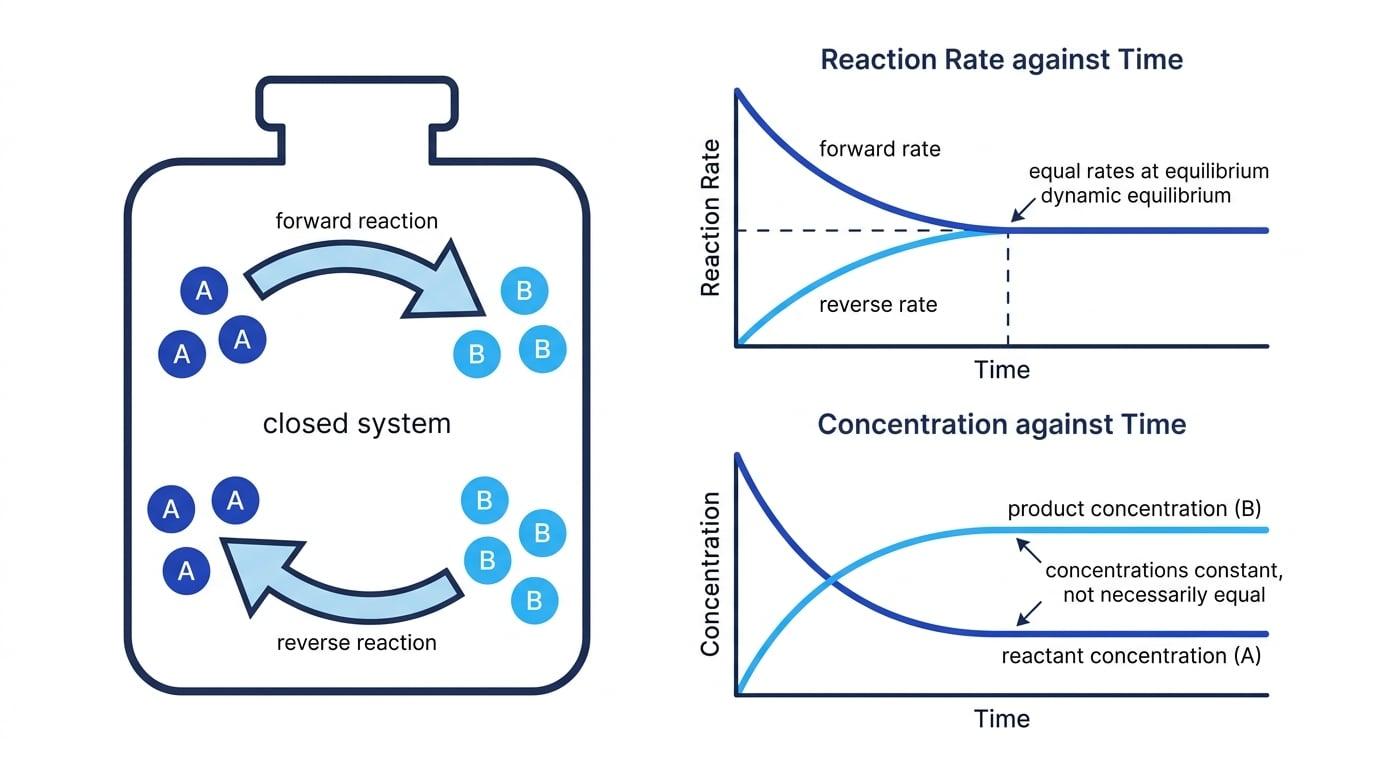
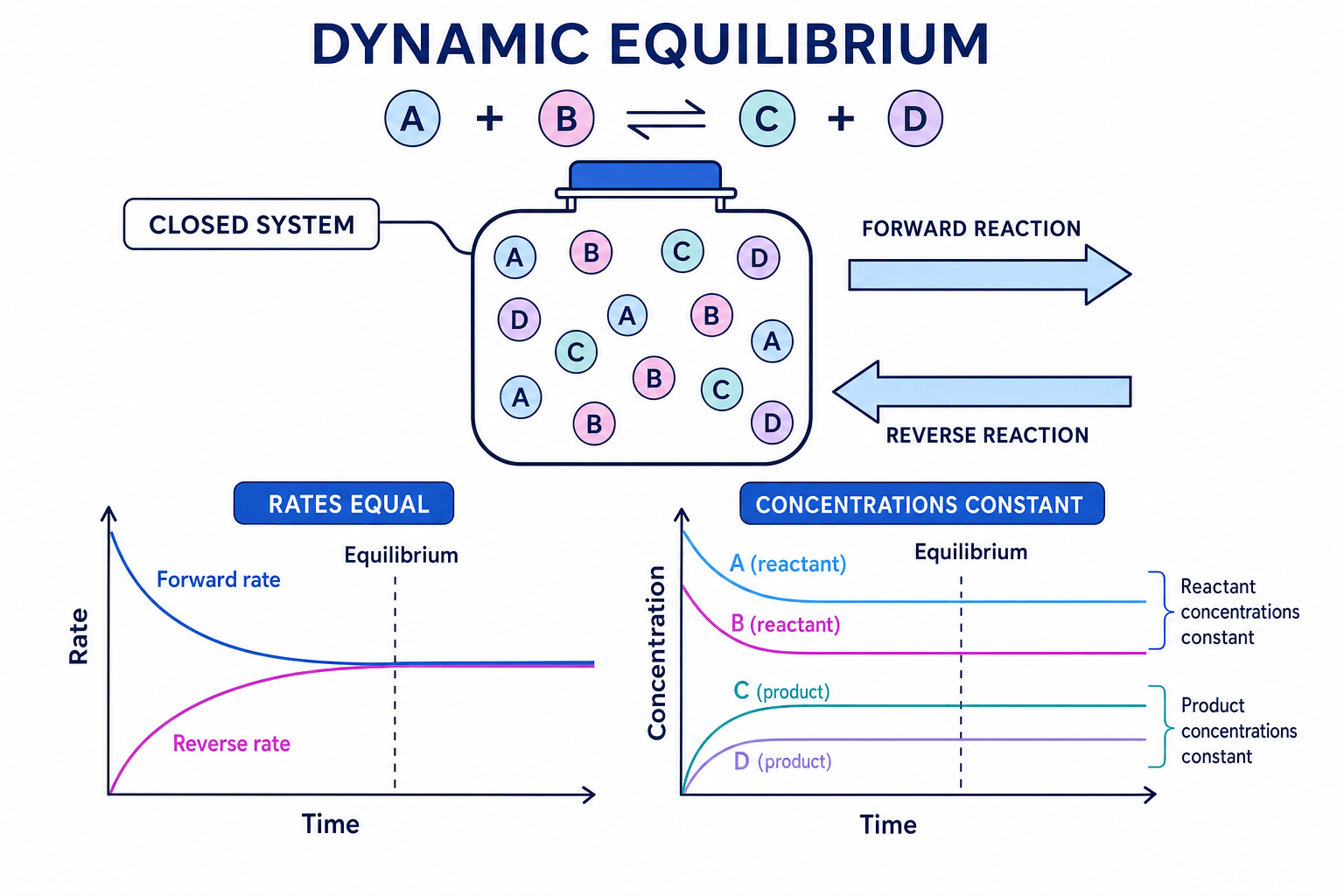
A dynamic equilibrium is reached in a closed system when the forward and reverse reactions continue at equal rates, so the concentrations of reactants and products remain constant.
The word dynamic is important: the reactions have not stopped. They are still happening, but the two directions exactly balance each other.
The diagram shows why equilibrium is dynamic: particles keep reacting, even though the measured concentrations become constant.
Recognising dynamic equilibrium
A sealed flask contains a reversible reaction mixture. The forward rate is 0.18 mol dm⁻³ s⁻¹, the reverse rate is 0.18 mol dm⁻³ s⁻¹, and the concentrations have not changed for several minutes. Decide whether the system is at dynamic equilibrium.
- Compare the two reaction rates: the forward and reverse rates are the same, so neither direction is winning overall.
- Check the system condition: the flask is sealed, so it is a closed system with no substances escaping or entering.
- Use the definition: equal forward and reverse rates, plus constant concentrations in a closed system, means the mixture is at dynamic equilibrium.
Constant does not mean equal
At equilibrium, concentrations are constant, not necessarily equal. You could have more products than reactants, or more reactants than products, as long as their concentrations are no longer changing.
The position of equilibrium
The position of equilibrium describes the relative amounts of reactants and products in the equilibrium mixture.
- If equilibrium lies to the right, the mixture contains a relatively high proportion of products.
- If equilibrium lies to the left, the mixture contains a relatively high proportion of reactants.
A homogeneous reaction is one where the reacting substances are in the same physical state, such as all gases or all aqueous ions. In this section, Le Chatelier’s principle is used to predict shifts in homogeneous equilibria.
Le Chatelier’s principle
A disturbance is a change made to an equilibrium mixture, such as changing concentration, pressure or temperature.
Le Chatelier's principle
If a system at equilibrium is disturbed, the position of equilibrium shifts in the direction that opposes the change.
“Opposes” does not mean the system completely cancels the change. It means the system responds in the direction that partly reduces the effect of the change.
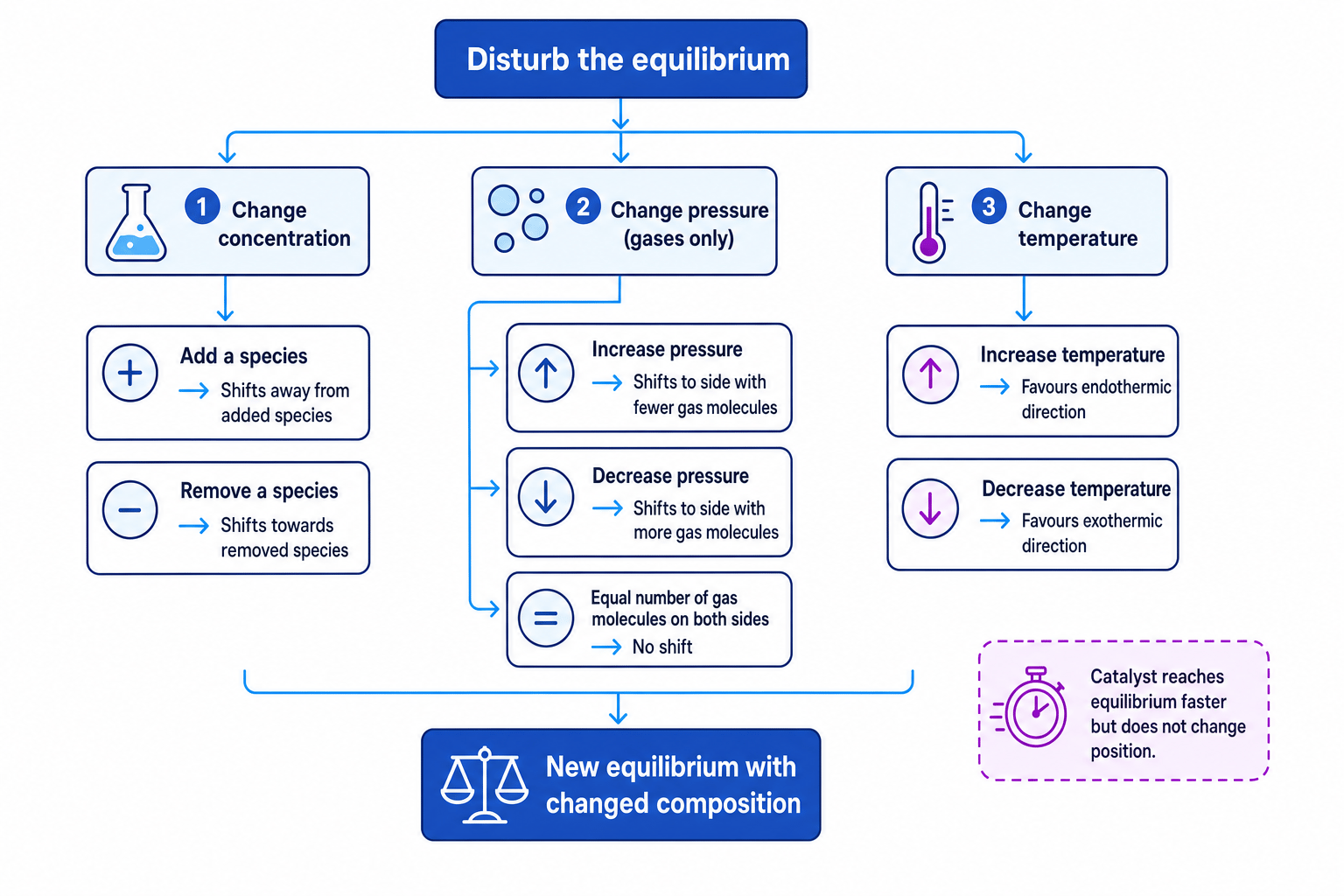
Here is the core decision process for predicting equilibrium shifts.
Changing concentration
Changing concentration matters most in solution equilibria, but the same idea applies to gases if a reactant or product is added or removed.
The system shifts to reduce the change:
- Adding a reactant shifts equilibrium towards products.
- Adding a product shifts equilibrium towards reactants.
- Removing a reactant shifts equilibrium towards reactants.
- Removing a product shifts equilibrium towards products.
Concentration example
Consider this aqueous equilibrium:
Fe³⁺(aq) + SCN⁻(aq) ⇌ [FeSCN]²⁺(aq)
The product ion [FeSCN]²⁺ is red.
Predicting a concentration change
Predict what happens when Fe³⁺ ions are added to the equilibrium mixture.
- Identify the disturbance: the concentration of Fe³⁺ has increased.
- Decide how the system can oppose it: the equilibrium must shift in the direction that uses up Fe³⁺, which is the forward reaction.
- State the result: the position of equilibrium shifts to the right, more [FeSCN]²⁺ forms, and the red colour becomes more intense.
Expecting the original concentrations to return
After you add a substance, the system shifts to reduce the change, but the final equilibrium concentrations are usually not exactly the same as before the disturbance.
Changing pressure
Pressure changes only affect equilibria involving gases.
Increasing pressure makes gas particles more crowded. The system responds by shifting to the side with fewer moles of gas particles, because that reduces the pressure.
Decreasing pressure has the opposite effect: equilibrium shifts to the side with more moles of gas particles.
Pressure example
For the Haber process:
N₂(g) + 3H₂(g) ⇌ 2NH₃(g)
Predicting a pressure change
Predict the effect of increasing pressure on the position of equilibrium.
- Count the gaseous particles on each side using the balancing numbers: the left side has 1+3=41+3=41+3=4 mol of gas, while the right side has 2 mol of gas.
- Apply Le Chatelier’s principle: increasing pressure is opposed by shifting to the side with fewer moles of gas.
- Conclude the shift: equilibrium shifts to the right, so the equilibrium mixture contains a higher proportion of ammonia.
If both sides have the same number of moles of gas, changing pressure does not shift the position of equilibrium.
Counting the wrong particles
For pressure changes, count gases only. Solids, liquids and aqueous species do not contribute to the number of gas particles.
Changing temperature
Temperature changes are slightly different because you need to know whether the forward reaction is exothermic or endothermic.
An exothermic reaction releases heat, so for that direction, ΔH<0\Delta H < 0ΔH<0.
An endothermic reaction absorbs heat, so for that direction, ΔH>0\Delta H > 0ΔH>0.
A useful way to think about it is:
- Increasing temperature favours the endothermic direction.
- Decreasing temperature favours the exothermic direction.
Temperature example
N₂O₄(g) is colourless and NO₂(g) is brown:
N₂O₄(g) ⇌ 2NO₂(g), ΔH=+58 kJ mol−1\Delta H = +58\ \text{kJ mol}^{-1}ΔH=+58 kJ mol−1
Predicting a temperature change
Predict the effect of increasing temperature.
- Interpret the enthalpy change: ΔH\Delta HΔH is positive, so the forward reaction is endothermic and absorbs heat.
- Apply Le Chatelier’s principle: increasing temperature is opposed by favouring the direction that uses up heat, which is the endothermic forward reaction.
- State the visible result: equilibrium shifts to the right, producing more brown NO₂, so the mixture becomes darker brown.
Temperature affects rate and equilibrium
Raising temperature usually increases the rate of reaction, but in equilibrium questions you are predicting the final composition after the system has shifted.
Catalysts and equilibrium
A catalyst is a substance that increases the rate of a reaction without being used up. It provides an alternative reaction pathway with a lower activation energy, EaE_aEa.
For a reversible reaction, a catalyst speeds up both the forward and reverse reactions. It does not favour one side of the equilibrium over the other.
Catalysts do not move the equilibrium
A catalyst helps the system reach equilibrium faster, but it does not change the position of equilibrium or the equilibrium yield.
Practical link: visible equilibrium shifts
A common test-tube demonstration uses a copper(II) equilibrium:
[Cu(H₂O)₆]²⁺(aq) + 4Cl⁻(aq) ⇌ [CuCl₄]²⁻(aq) + 6H₂O(l)
The left-hand copper complex is blue, while the chloride complex is yellow-green. Adding concentrated hydrochloric acid increases the concentration of Cl⁻ ions, so equilibrium shifts right. Adding water reduces the chloride ion concentration, so equilibrium shifts left again.
This is useful because the colour change lets you see Le Chatelier’s principle in action.
Industrial compromise conditions
In industry, chemists often want a high yield, meaning a high amount or proportion of desired product. However, the conditions that give the best equilibrium yield may be slow, expensive or unsafe.
The key compromise is usually between:
- equilibrium yield
- rate of reaction
- energy cost
- equipment cost and safety
Industrial example: the Haber process
The Haber process makes ammonia:
N₂(g) + 3H₂(g) ⇌ 2NH₃(g), ΔH=−92 kJ mol−1\Delta H = -92\ \text{kJ mol}^{-1}ΔH=−92 kJ mol−1
Choosing compromise conditions for ammonia manufacture
Explain why a compromise temperature and pressure are used.
- Predict the best equilibrium conditions: the forward reaction is exothermic, so a low temperature favours ammonia; the product side has fewer moles of gas, so high pressure also favours ammonia.
- Consider rate and cost: a very low temperature gives a slow reaction rate, while extremely high pressure is expensive and requires stronger, safer equipment.
- Explain the compromise: industry uses a moderately high temperature, about 450 °C, and a high but manageable pressure, often around 15,000–20,000 kPa, with an iron catalyst to increase rate without changing the equilibrium position.
In the exam
- Always state the disturbance first, then say which direction opposes it, then give the shift left or right.
- For pressure questions, count only moles of gas on each side of the equation.
- For temperature questions, use the sign of ΔH\Delta HΔH and keep equilibrium yield separate from reaction rate.
Check yourself
- What two conditions must be true in a closed system at dynamic equilibrium?
- For PCl₅(g) ⇌ PCl₃(g) + Cl₂(g), what happens to the position of equilibrium when pressure is increased?
- Why might an industrial process not use the temperature that gives the highest equilibrium yield?