What you'll learn
- What KcK_cKc means for a reversible reaction at equilibrium.
- How to construct a KcK_cKc expression from a balanced equation.
- How to calculate KcK_cKc using equilibrium concentrations in mol dm⁻³.
- How concentration, catalysts and temperature affect — or do not affect — KcK_cKc.
Starting point: reversible reactions and equilibrium
A reversible reaction is one that can go in both directions. We show this using the reversible arrow, ⇌\rightleftharpoons⇌.
At dynamic equilibrium, the forward and reverse reactions are still happening, but at the same rate. This means the concentrations of reactants and products stay constant.
Dynamic equilibrium
A dynamic equilibrium exists in a closed system when the forward and reverse reactions occur at equal rates, so the concentrations of reactants and products remain constant.
A closed system means no substances can enter or leave. Equilibrium can only be established properly if matter is not escaping.
Homogeneous systems
A species is any chemical particle involved in a reaction, such as a molecule, ion or atom.
Homogeneous system
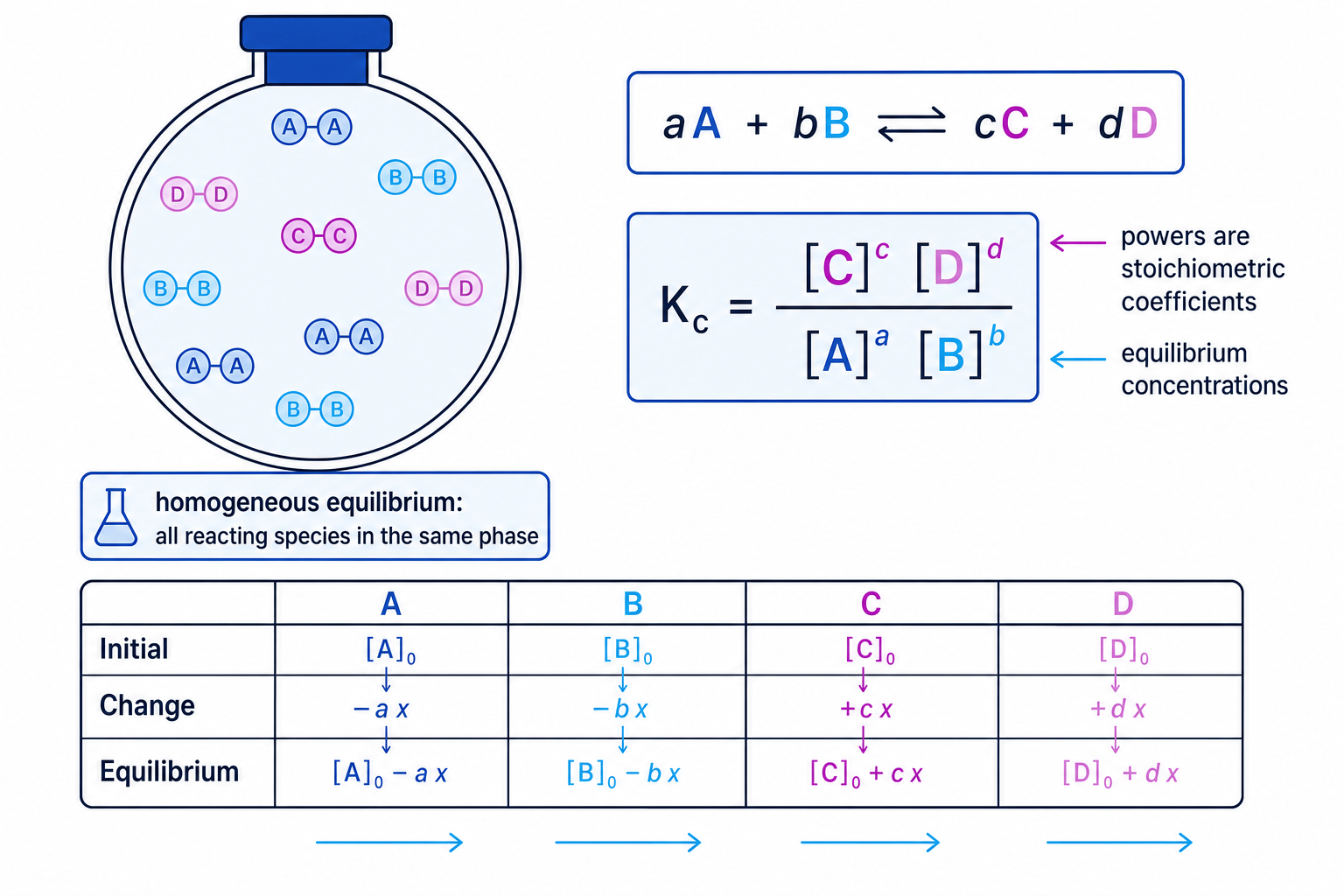
A homogeneous system is a reaction mixture in which all the reacting species are in the same physical phase, for example all gases or all dissolved in solution.
For this topic, all the species in the equilibrium expression are in the same phase. Common examples include gas equilibria and solution equilibria.
Concentration notation: square brackets
The concentration of a species X is written as [X][X][X].
Square bracket notation
[X][X][X] means the concentration of species X, measured in mol dm⁻³. In a KcK_cKc expression, square brackets always mean equilibrium concentration, not initial concentration.
For example, [H2][\text{H}_2][H2] means the equilibrium concentration of hydrogen.
Using initial concentrations
The most common KcK_cKc error is substituting the starting concentrations into the expression. KcK_cKc uses concentrations at equilibrium only.
Building the KcK_cKc expression
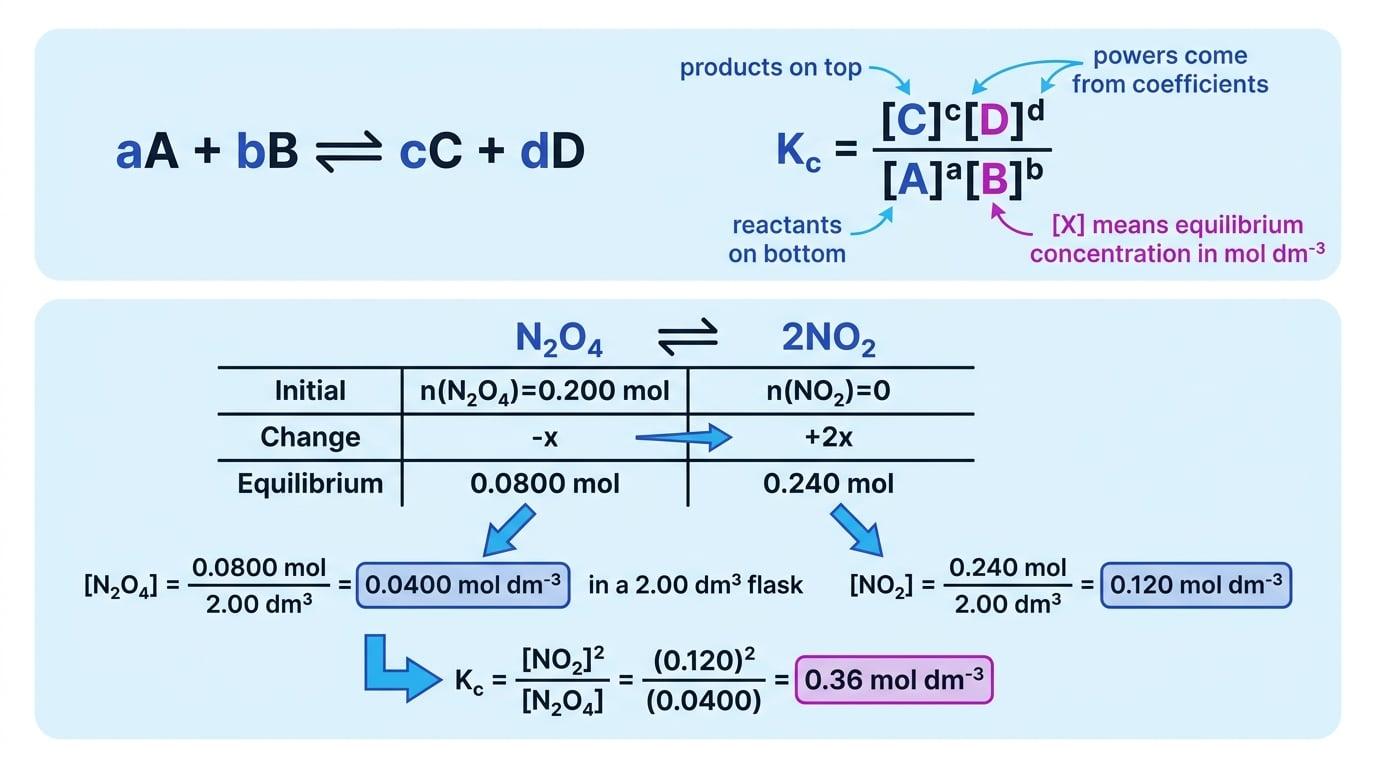
For a general reversible reaction:
aA+bB⇌cC+dDaA + bB \rightleftharpoons cC + dDaA+bB⇌cC+dDthe equilibrium constant is:
Kc=[C]c[D]d[A]a[B]bK_c = \frac{[C]^c[D]^d}{[A]^a[B]^b}Kc=[A]a[B]b[C]c[D]dThe products go on the top, reactants go on the bottom, and the powers come from the balanced equation.
The structure of Kc
KcK_cKc is built directly from the balanced reversible equation: products over reactants, with each concentration raised to the power of its coefficient.
Writing a Kc expression
For the equilibrium:
N2(g)+3H2(g)⇌2NH3(g)\text{N}_2(g) + 3\text{H}_2(g) \rightleftharpoons 2\text{NH}_3(g)N2(g)+3H2(g)⇌2NH3(g)write the expression for KcK_cKc.
-
Identify the products and reactants. The product is NH3\text{NH}_3NH3; the reactants are N2\text{N}_2N2 and H2\text{H}_2H2.
-
Put products over reactants:
Kc=[NH3][N2][H2]K_c = \frac{[\text{NH}_3]}{[\text{N}_2][\text{H}_2]}Kc=[N2][H2][NH3] -
Apply the powers from the balanced equation. The coefficient of NH3\text{NH}_3NH3 is two, and the coefficient of H2\text{H}_2H2 is three:
Kc=[NH3]2[N2][H2]3K_c = \frac{[\text{NH}_3]^2}{[\text{N}_2][\text{H}_2]^3}Kc=[N2][H2]3[NH3]2
Forgetting the powers
If the equation contains 2NH32\text{NH}_32NH3, the expression contains [NH3]2[\text{NH}_3]^2[NH3]2, not 2[NH3]2[\text{NH}_3]2[NH3].
What the value of Kc tells you
The size of KcK_cKc tells you about the position of equilibrium.
- If KcK_cKc is large, the numerator is relatively large, so the equilibrium mixture contains a high proportion of products.
- If KcK_cKc is small, the denominator is relatively large, so the equilibrium mixture contains a high proportion of reactants.
- If KcK_cKc is close to one, there are significant amounts of both reactants and products.
This does not mean the reaction has stopped. It only describes the equilibrium composition at a particular temperature.
Units of Kc
The units of KcK_cKc depend on the expression. You work them out by substituting the unit mol dm⁻³ into the KcK_cKc expression and simplifying.
Sometimes the concentration units cancel completely. In that case, KcK_cKc has no units, often described as dimensionless.
Finding the units of Kc
For:
N2(g)+3H2(g)⇌2NH3(g)\text{N}_2(g) + 3\text{H}_2(g) \rightleftharpoons 2\text{NH}_3(g)N2(g)+3H2(g)⇌2NH3(g)the expression is:
Kc=[NH3]2[N2][H2]3K_c = \frac{[\text{NH}_3]^2}{[\text{N}_2][\text{H}_2]^3}Kc=[N2][H2]3[NH3]2-
Replace each concentration with mol dm⁻³:
(mol dm−3)2(mol dm−3)(mol dm−3)3\frac{(\text{mol dm}^{-3})^2}{(\text{mol dm}^{-3})(\text{mol dm}^{-3})^3}(mol dm−3)(mol dm−3)3(mol dm−3)2 -
Combine the powers in the denominator:
(mol dm−3)2(mol dm−3)4\frac{(\text{mol dm}^{-3})^2}{(\text{mol dm}^{-3})^4}(mol dm−3)4(mol dm−3)2 -
Subtract the powers:
(mol dm−3)−2(\text{mol dm}^{-3})^{-2}(mol dm−3)−2 -
Rewrite with positive powers:
dm6 mol−2\text{dm}^6\ \text{mol}^{-2}dm6 mol−2
Unit shortcut
Compare the total powers on the top and bottom of the KcK_cKc expression. If they are the same, the units cancel.
Calculating Kc from equilibrium concentrations
If you are given equilibrium concentrations, the calculation is usually direct:
- Write the balanced equation.
- Write the KcK_cKc expression.
- Substitute equilibrium concentrations.
- Calculate the value and units.
Calculating Kc from equilibrium concentrations
For:
N2(g)+3H2(g)⇌2NH3(g)\text{N}_2(g) + 3\text{H}_2(g) \rightleftharpoons 2\text{NH}_3(g)N2(g)+3H2(g)⇌2NH3(g)at equilibrium:
- [N2]=0.250 mol dm−3[\text{N}_2] = 0.250\ \text{mol dm}^{-3}[N2]=0.250 mol dm−3
- [H2]=0.150 mol dm−3[\text{H}_2] = 0.150\ \text{mol dm}^{-3}[H2]=0.150 mol dm−3
- [NH3]=0.300 mol dm−3[\text{NH}_3] = 0.300\ \text{mol dm}^{-3}[NH3]=0.300 mol dm−3
Calculate KcK_cKc.
-
Write the expression from the balanced equation:
Kc=[NH3]2[N2][H2]3K_c = \frac{[\text{NH}_3]^2}{[\text{N}_2][\text{H}_2]^3}Kc=[N2][H2]3[NH3]2 -
Substitute the equilibrium concentrations:
Kc=(0.300)2(0.250)(0.150)3K_c = \frac{(0.300)^2}{(0.250)(0.150)^3}Kc=(0.250)(0.150)3(0.300)2 -
Calculate the numerator and denominator:
Kc=0.09000.00084375K_c = \frac{0.0900}{0.00084375}Kc=0.000843750.0900 -
Evaluate and give appropriate units:
Kc=107 dm6 mol−2K_c = 107\ \text{dm}^6\ \text{mol}^{-2}Kc=107 dm6 mol−2
Significant figures
Give your final answer to a sensible number of significant figures, usually matching the least precise data given in the question.
When you are given amounts instead of concentrations
Often, you are given amounts in mol and a volume in dm³. Convert amount to concentration using:
concentration=amount in molvolume in dm3\text{concentration} = \frac{\text{amount in mol}}{\text{volume in dm}^3}concentration=volume in dm3amount in molYou may need to work out the equilibrium amounts first using the stoichiometry of the balanced equation. This is often called an ICE method: Initial, Change, Equilibrium.
Using equilibrium amounts to calculate Kc
Dinitrogen tetroxide decomposes in a sealed flask:
N2O4(g)⇌2NO2(g)\text{N}_2\text{O}_4(g) \rightleftharpoons 2\text{NO}_2(g)N2O4(g)⇌2NO2(g)Initially, 0.200 mol of N2O4\text{N}_2\text{O}_4N2O4 is placed in a 2.00 dm³ flask. At equilibrium, 0.0800 mol of N2O4\text{N}_2\text{O}_4N2O4 remains. Calculate KcK_cKc.
-
Work out the amount of N2O4\text{N}_2\text{O}_4N2O4 that reacted:
0.200−0.0800=0.120 mol0.200 - 0.0800 = 0.120\ \text{mol}0.200−0.0800=0.120 mol -
Use the mole ratio. For every one mol of N2O4\text{N}_2\text{O}_4N2O4 that reacts, two mol of NO2\text{NO}_2NO2 form:
amount of NO2=2×0.120=0.240 mol\text{amount of NO}_2 = 2 \times 0.120 = 0.240\ \text{mol}amount of NO2=2×0.120=0.240 mol -
Convert equilibrium amounts to concentrations using the 2.00 dm³ volume:
[N2O4]=0.08002.00=0.0400 mol dm−3[\text{N}_2\text{O}_4] = \frac{0.0800}{2.00} = 0.0400\ \text{mol dm}^{-3}[N2O4]=2.000.0800=0.0400 mol dm−3 [NO2]=0.2402.00=0.120 mol dm−3[\text{NO}_2] = \frac{0.240}{2.00} = 0.120\ \text{mol dm}^{-3}[NO2]=2.000.240=0.120 mol dm−3 -
Substitute into the expression:
Kc=[NO2]2[N2O4]K_c = \frac{[\text{NO}_2]^2}{[\text{N}_2\text{O}_4]}Kc=[N2O4][NO2]2 Kc=(0.120)20.0400=0.360 mol dm−3K_c = \frac{(0.120)^2}{0.0400} = 0.360\ \text{mol dm}^{-3}Kc=0.0400(0.120)2=0.360 mol dm−3
Same volume does not always mean ignore volume
For some KcK_cKc expressions, volume cancels out, but for others it does not. The safest method is to convert equilibrium amounts into concentrations before substituting.
Changes in concentration and catalysts
At a constant temperature, changing concentration does not change the value of KcK_cKc.
If you add more reactant or product, the equilibrium position shifts to reduce the change, according to Le Chatelier’s principle. However, once equilibrium is re-established at the same temperature, the ratio in the KcK_cKc expression returns to the same value.
A catalyst also does not change KcK_cKc. It speeds up both the forward and reverse reactions, so equilibrium is reached faster, but the equilibrium composition is unchanged.
What can change Kc?
For a given reaction, only temperature changes the value of KcK_cKc. Concentration changes and catalysts do not change KcK_cKc.
Predicting the effect of adding a reactant
For:
H2(g)+I2(g)⇌2HI(g)\text{H}_2(g) + \text{I}_2(g) \rightleftharpoons 2\text{HI}(g)H2(g)+I2(g)⇌2HI(g)extra hydrogen is added at constant temperature. Explain what happens to KcK_cKc.
- Adding H2\text{H}_2H2 increases the denominator of the reaction quotient temporarily, so the mixture is no longer at equilibrium.
- The equilibrium shifts to the right, using up some H2\text{H}_2H2 and I2\text{I}_2I2 and forming more HI.
- Because the temperature has not changed, the system settles at a new equilibrium mixture with the same value of KcK_cKc.
Temperature and Kc
Temperature is different: it changes the value of KcK_cKc.
Use the enthalpy change of the forward reaction to decide what happens.
- If the forward reaction is exothermic, increasing temperature favours the reverse reaction, so KcK_cKc decreases.
- If the forward reaction is endothermic, increasing temperature favours the forward reaction, so KcK_cKc increases.
The opposite happens when temperature is decreased.
Predicting the effect of temperature on Kc
For the Haber equilibrium:
N2(g)+3H2(g)⇌2NH3(g)\text{N}_2(g) + 3\text{H}_2(g) \rightleftharpoons 2\text{NH}_3(g)N2(g)+3H2(g)⇌2NH3(g)the forward reaction is exothermic. Predict the effect on KcK_cKc when temperature is increased.
-
Since the forward reaction is exothermic, the reverse reaction is endothermic.
-
Increasing temperature favours the endothermic direction, so equilibrium shifts to the left.
-
This decreases [NH3][\text{NH}_3][NH3] and increases [N2][\text{N}_2][N2] and [H2][\text{H}_2][H2].
-
In the expression
Kc=[NH3]2[N2][H2]3K_c = \frac{[\text{NH}_3]^2}{[\text{N}_2][\text{H}_2]^3}Kc=[N2][H2]3[NH3]2the numerator decreases and the denominator increases, so KcK_cKc decreases.
Practical link: esterification
A common equilibrium used to determine KcK_cKc is the reaction between ethanol and ethanoic acid to form ethyl ethanoate and water:
CH3COOH+C2H5OH⇌CH3COOC2H5+H2O\text{CH}_3\text{COOH} + \text{C}_2\text{H}_5\text{OH} \rightleftharpoons \text{CH}_3\text{COOC}_2\text{H}_5 + \text{H}_2\text{O}CH3COOH+C2H5OH⇌CH3COOC2H5+H2OThe expression is:
Kc=[CH3COOC2H5][H2O][CH3COOH][C2H5OH]K_c = \frac{[\text{CH}_3\text{COOC}_2\text{H}_5][\text{H}_2\text{O}]}{[\text{CH}_3\text{COOH}][\text{C}_2\text{H}_5\text{OH}]}Kc=[CH3COOH][C2H5OH][CH3COOC2H5][H2O]A strong acid catalyst may be used to help the mixture reach equilibrium faster. It does not change the value of KcK_cKc at the same temperature.
In the exam
- Always start by writing the balanced equation and the correct KcK_cKc expression before substituting numbers.
- Check that you are using equilibrium concentrations in mol dm⁻³, not initial amounts in mol.
- For temperature questions, identify whether the forward reaction is exothermic or endothermic, then decide whether products or reactants are favoured.
Check yourself
- For 2SO2(g)+O2(g)⇌2SO3(g)2\text{SO}_2(g) + \text{O}_2(g) \rightleftharpoons 2\text{SO}_3(g)2SO2(g)+O2(g)⇌2SO3(g), can you write the expression for KcK_cKc?
- If all concentrations in a KcK_cKc expression are doubled at the same temperature, does KcK_cKc change?
- For an endothermic forward reaction, what happens to KcK_cKc when temperature is increased?