

What you'll learn
- What a catalyst is — and what it is not.
- How catalysts increase reaction rate by providing an alternative route with lower activation energy.
- How to use a Maxwell–Boltzmann distribution to explain catalysis in gas reactions.
- Common exam mistakes to avoid when writing catalyst explanations.
The starting point: rate and successful collisions
A chemical reaction only happens when reacting particles collide in the right way. Not every collision leads to reaction.
For a collision to be successful, the particles must:
- collide with enough energy
- have a suitable orientation, meaning the particles meet in a way that allows bonds to break and form
Activation energy
The activation energy, EaE_aEa, is the minimum energy that reacting particles must have for a collision to lead to a reaction.
If more particles have energy greater than or equal to EaE_aEa, more collisions are successful per second, so the reaction rate increases.
What is a catalyst?
Catalyst
A catalyst is a substance that increases the rate of a chemical reaction without being changed in chemical composition or amount.
This means a catalyst is not used up overall. It may take part in some steps of the reaction, but it is regenerated by the end.
For example, manganese(IV) oxide, MnO₂, catalyses the decomposition of hydrogen peroxide:
2H2O2(aq)→2H2O(l)+O2(g)2\text{H}_2\text{O}_2(aq) \to 2\text{H}_2\text{O}(l) + \text{O}_2(g)2H2O2(aq)→2H2O(l)+O2(g)The MnO₂ speeds up oxygen production, but the MnO₂ can be recovered at the end.
Catalysts are regenerated
A catalyst can appear to “take part” during the reaction, but it must be present again at the end in the same chemical composition and amount.
Recognising a catalyst
A black solid is added to hydrogen peroxide. Oxygen is produced much faster. At the end, the same mass of black solid is filtered off, and tests show it is still manganese(IV) oxide. Explain why the black solid is acting as a catalyst.
-
The black solid increases the reaction rate because oxygen is produced faster than before it was added.
-
The same mass of solid is recovered at the end, so it has not been used up in amount.
-
The solid is still manganese(IV) oxide, so its chemical composition has not changed overall. Therefore, it fits the definition of a catalyst.
How catalysts work: an alternative route
A catalyst works by providing an alternative reaction route. This means the reaction follows a different pathway from reactants to products.
The important point is that this alternative route has a lower activation energy.
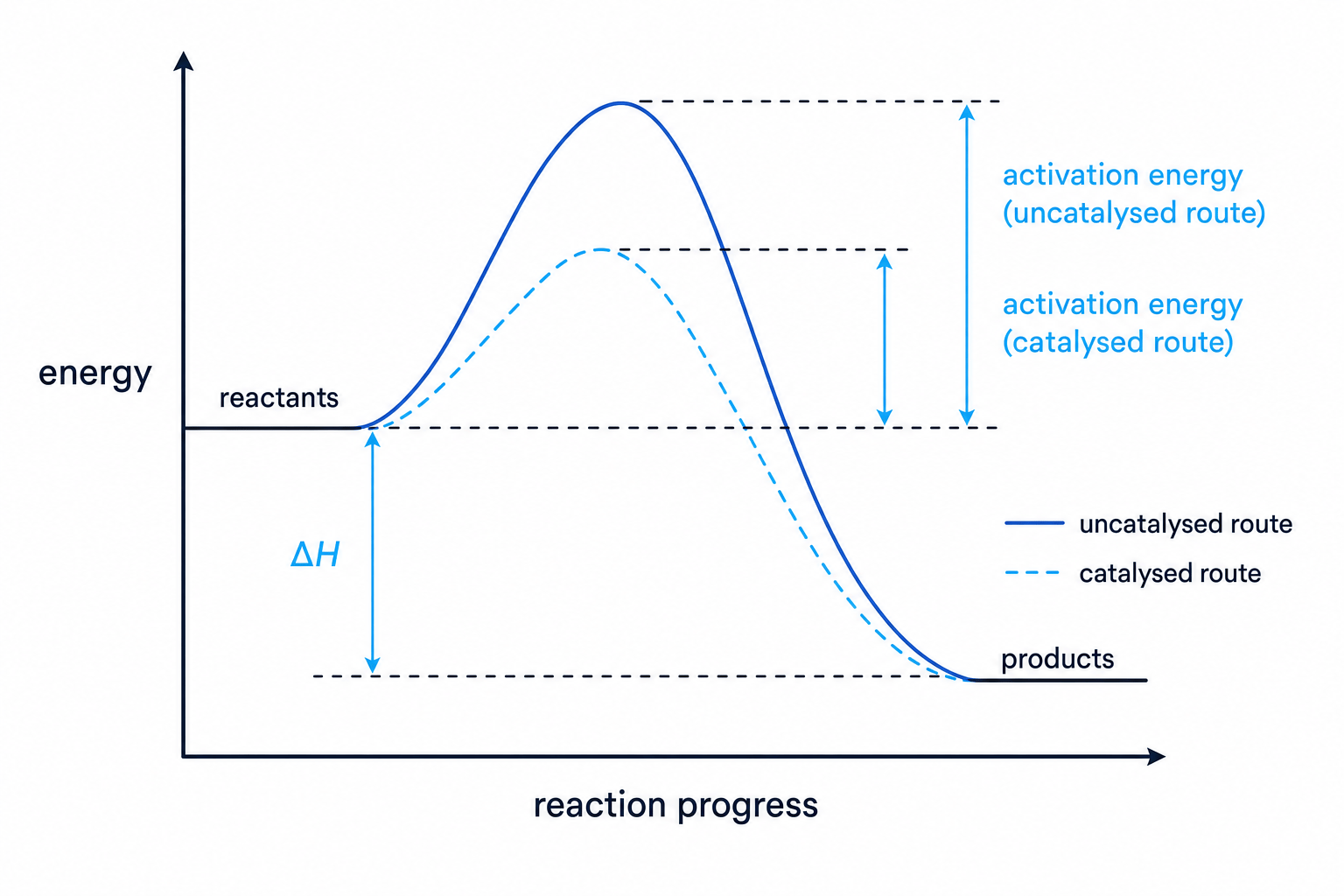
On a reaction profile diagram, the catalysed route has a lower peak. The peak represents the energy barrier that reacting particles must overcome.
Catalysts lower the barrier
A catalyst increases rate by lowering EaE_aEa, not by giving particles extra energy.
The enthalpy change, ΔH\Delta HΔH, is unchanged because the reactants and products are still the same. Only the route between them changes.
Lowering enthalpy change
Do not say that a catalyst lowers ΔH\Delta HΔH. A catalyst lowers EaE_aEa. The overall energy difference between reactants and products stays the same.
Reading an energy profile
A reaction has an uncatalysed activation energy of 85 kJ mol⁻¹. With a catalyst, the activation energy is 42 kJ mol⁻¹. The reactants are at 120 kJ mol⁻¹ and the products are at 40 kJ mol⁻¹. What changes when the catalyst is used?
-
Compare the activation energies: the catalyst reduces EaE_aEa from 85 kJ mol⁻¹ to 42 kJ mol⁻¹, so the energy barrier is lower.
-
Calculate the enthalpy change using products minus reactants:
ΔH=40−120=−80 kJ mol−1\Delta H = 40 - 120 = -80\ \text{kJ mol}^{-1}ΔH=40−120=−80 kJ mol−1The reaction is exothermic because ΔH\Delta HΔH is negative.
-
The catalyst does not change the reactants or products, so ΔH\Delta HΔH remains −80 kJ mol⁻¹. The rate increases, but the overall enthalpy change is unchanged.
Why a lower activation energy increases rate
At a fixed temperature, particles have a range of energies. Some have very low energy, some have moderate energy, and a small number have very high energy.
If the activation energy is high, only a small fraction of particles have enough energy to react.
If a catalyst lowers the activation energy, a larger fraction of particles now have enough energy for successful collisions. So the reaction is faster.
Comparing successful collisions
In a gas reaction, suppose there are 4.0×1054.0 \times 10^54.0×10⁵ collisions per second. Without a catalyst, 2.0% of collisions have enough energy to react. With a catalyst, 15.0% have enough energy to react. Compare the number of successful collisions per second.
-
Without a catalyst, calculate 2.0% of the total collisions:
0.020×4.0×105=8.0×10³ successful collisions s−10.020 \times 4.0 \times 10^5 = 8.0 \times 10^3\ \text{successful collisions s}^{-1}0.020×4.0×105=8.0×10³ successful collisions s−1 -
With a catalyst, calculate 15.0% of the total collisions:
0.150×4.0×105=6.0×10⁴ successful collisions s−10.150 \times 4.0 \times 10^5 = 6.0 \times 10^4\ \text{successful collisions s}^{-1}0.150×4.0×105=6.0×10⁴ successful collisions s−1 -
Compare the two values:
6.0×1048.0×103=7.5\frac{6.0 \times 10^4}{8.0 \times 10^3} = 7.58.0×1036.0×104=7.5The catalysed reaction has 7.5 times as many successful collisions per second.
Catalysts and Maxwell–Boltzmann distributions
A Maxwell–Boltzmann distribution is a graph showing how the energies of particles are distributed in a gas at a fixed temperature.
The graph has:
- energy on the horizontal axis
- number of particles on the vertical axis
- a curve showing that most particles have intermediate energies
- a long tail showing that a small number of particles have very high energies
The total area under the curve represents the total number of particles.
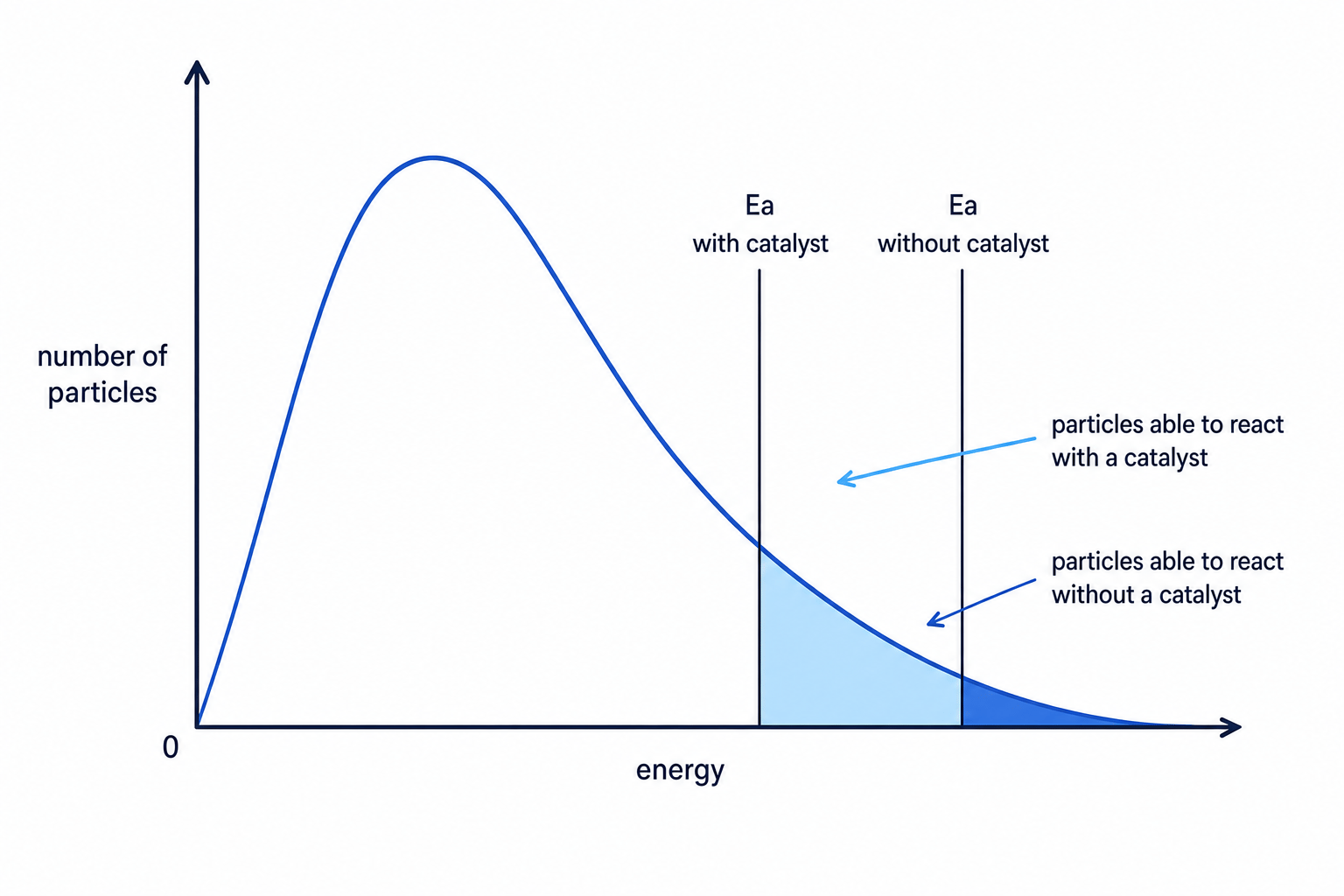
On this graph, particles to the right of the activation energy line have enough energy to react.
When a catalyst is used, EaE_aEa is lower, so the activation energy line moves to the left. The area to the right of the line becomes larger. This means a greater proportion of particles have enough energy for successful collisions.
Changing the curve
At the same temperature, a catalyst does not change the shape of the Maxwell–Boltzmann distribution. The curve stays the same; the EaE_aEa line moves left.
Using a Maxwell–Boltzmann curve
Explain, using a Maxwell–Boltzmann distribution, why a catalyst increases the rate of a gas reaction.
-
At a fixed temperature, the gas particles have the same Maxwell–Boltzmann distribution of energies, so the curve itself does not change.
-
The catalyst provides an alternative reaction route with a lower activation energy, so the EaE_aEa line is shifted to a lower energy.
-
A larger area under the curve lies to the right of EaE_aEa, so a greater fraction of particles have energy greater than or equal to EaE_aEa. Therefore, there are more successful collisions per second and the rate increases.
What catalysts do not change
Catalysts are powerful, but they do not change everything.
A catalyst does not:
- change the enthalpy change, ΔH\Delta HΔH
- change the energy of the reactants or products
- get used up overall
- increase the energy of the particles
- change the Maxwell–Boltzmann distribution at the same temperature
For reversible reactions, a catalyst speeds up both the forward and reverse reactions. This means equilibrium is reached faster, but the equilibrium position is not changed.
A concise exam phrase
A strong catalyst explanation is: “The catalyst provides an alternative reaction route with lower activation energy, so a greater proportion of particles have energy greater than or equal to EaE_aEa, leading to more successful collisions per second.”
Temporary intermediates
A catalyst may form temporary intermediates during a reaction mechanism. That is allowed, as long as the catalyst is regenerated by the end and is not consumed overall.
In the exam
-
Always state that a catalyst provides an alternative reaction route with lower activation energy.
-
If using a Maxwell–Boltzmann distribution, say that the curve is unchanged at the same temperature, but the EaE_aEa line moves to the left.
-
Avoid vague phrases like “the catalyst gives particles more energy”. Instead, link lower EaE_aEa to a greater proportion of successful collisions.
Check yourself
- Why does a catalyst increase the rate of reaction without being used up?
- On a Maxwell–Boltzmann distribution, what does the area to the right of EaE_aEa represent?
- Which quantity changes when a catalyst is used: EaE_aEa, ΔH\Delta HΔH, or the energy of the products?
