The graph below shows the changes in membrane potential during the propagation of an action potential along an axon.
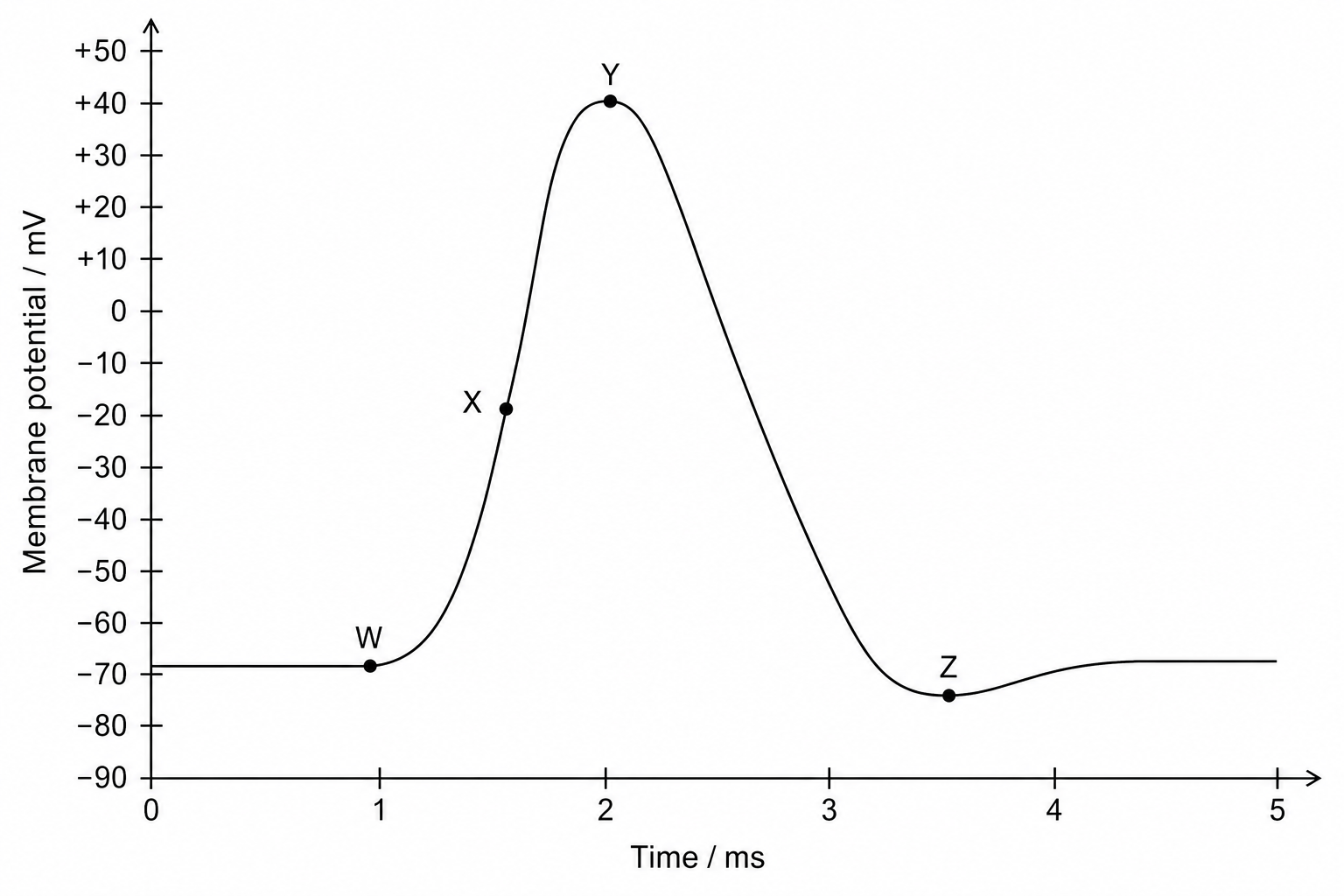
Which of the following statements regarding the movement of ions and the state of membrane channels at points W, X, Y, or Z is not correct?
At point W, the resting membrane potential is maintained primarily by the active transport of 3 Na+3\ \text{Na}^+3 Na+ ions out of the axon for every 2 K+2\ \text{K}^+2 K+ ions transported in, alongside the passive leakage of K+\text{K}^+K+ ions.
At point X, voltage-gated Na+\text{Na}^+Na+ channels are open, allowing a rapid influx of Na+\text{Na}^+Na+ ions into the axoplasm down their electrochemical gradient by facilitated diffusion.
At point Y, the voltage-gated Na+\text{Na}^+Na+ channels close and voltage-gated K+\text{K}^+K+ channels open, initiating the repolarisation of the membrane as K+\text{K}^+K+ ions diffuse out of the axon.
At point Z, the membrane is hyperpolarised because the sodium-potassium pump actively transports excess K+\text{K}^+K+ ions out of the axon, making the inside more negative relative to the outside.