Skip to content
MathsGenie logo
Open app

Course home

  1. A Level
  2. Biology OCR A
  3. Question bank

Analysis

EasyMedium
123456789101112131415161718192021222324252627282930313233343536373839404142434445464748
Question 48

Biologists studied the shell diameters of two species of land snails living in different microhabitats: Cepaea hortensis and Cepaea nemoralis. Shell diameter is a highly heritable phenotypic trait linked to thermoregulation and hydration.

Some of the results are shown in the chart below.

The recorded shell diameters represented by each bar in the dataset are:
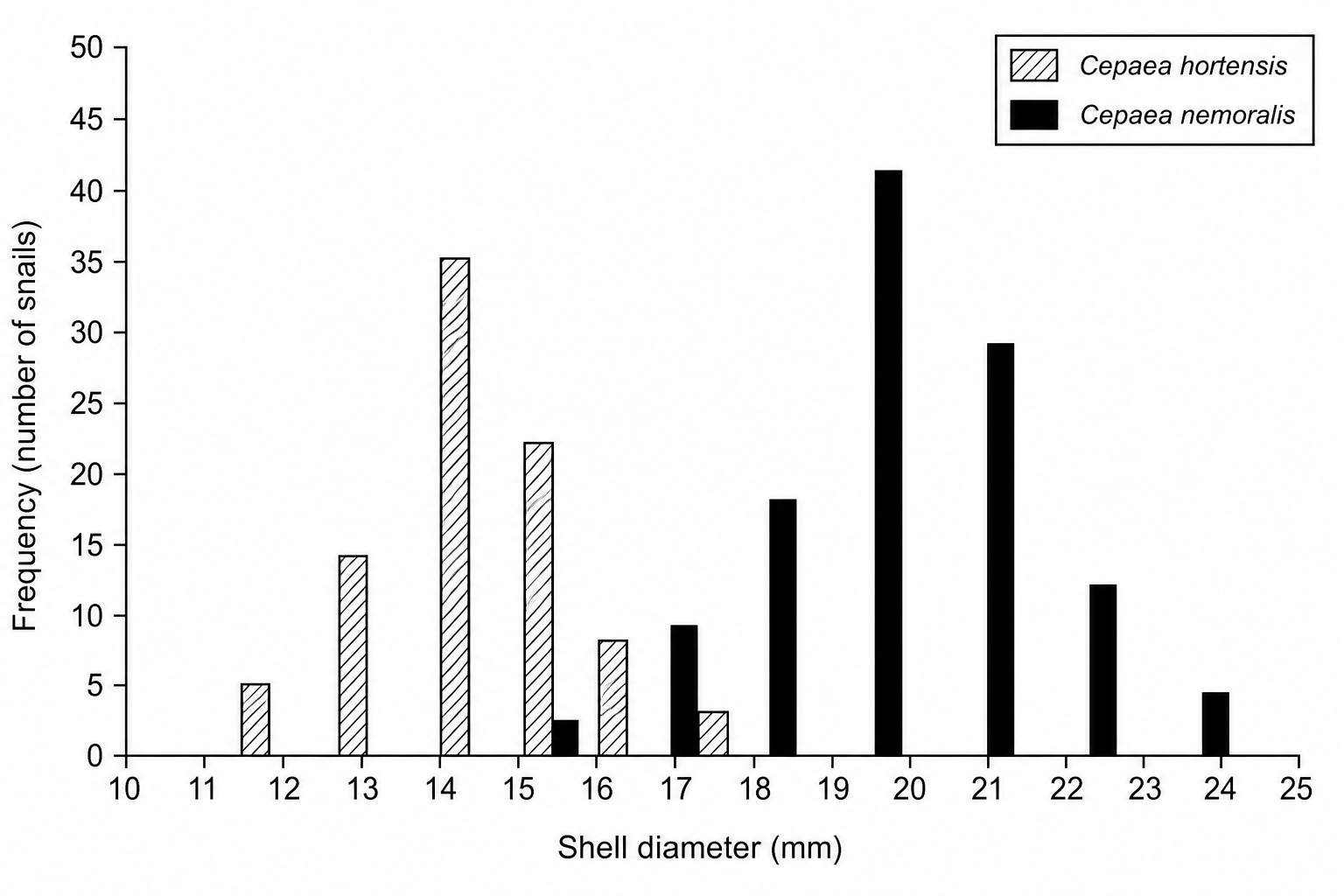
  • Cepaea hortensis (patterned bars): 11.7 mm11.7\text{ mm}11.7 mm, 12.8 mm12.8\text{ mm}12.8 mm, 14.1 mm14.1\text{ mm}14.1 mm, 15.2 mm15.2\text{ mm}15.2 mm, 16.3 mm16.3\text{ mm}16.3 mm, and 17.5 mm17.5\text{ mm}17.5 mm.
  • Cepaea nemoralis (solid bars): 15.5 mm15.5\text{ mm}15.5 mm, 17.1 mm17.1\text{ mm}17.1 mm, 18.3 mm18.3\text{ mm}18.3 mm, 19.7 mm19.7\text{ mm}19.7 mm, 21.1 mm21.1\text{ mm}21.1 mm, 22.4 mm22.4\text{ mm}22.4 mm, and 24.0 mm24.0\text{ mm}24.0 mm.

A scientific bar chart showing the frequency distribution of shell diameters for two land snail species: Cepaea hortensis (patterned bars) and Cepaea nemoralis (solid bars).

a.

Identify the modal shell diameter of Cepaea hortensis.

[1]
b.

Calculate the range of Cepaea hortensis shell diameter as a proportion of the range of Cepaea nemoralis shell diameter.

Give your answer to 2 significant figures.

[3]

Analysis Questions

  1. A Level
  2. /Biology
  3. /Analysis
