What you'll learn
- How the light-dependent reaction produces ATP, reduced NADP and oxygen.
- How chemiosmosis works in chloroplast thylakoid membranes.
- How the Calvin cycle uses ATP and reduced NADP to make triose phosphate.
- How to explain limiting factors and the two required practicals for this topic.
The big picture: what photosynthesis does
Photosynthesis
Photosynthesis is the process by which plants, algae and some bacteria use light energy to make organic molecules from carbon dioxide and water.
The overall equation is:
6CO2+6H2O→C6H12O6+6O26\text{CO}_2 + 6\text{H}_2\text{O} \to \text{C}_6\text{H}_{12}\text{O}_6 + 6\text{O}_26CO2+6H2O→C6H12O6+6O2At A-level, you need the mechanism: photosynthesis is split into the light-dependent reaction and the light-independent reaction. The light-dependent reaction makes ATP and reduced NADP. The light-independent reaction uses them to make carbohydrate.
Energy transfer
Photosynthesis does not create energy. It transfers light energy into chemical energy stored in organic molecules such as glucose, starch and lipids.
Chloroplasts: the reaction site
Photosynthesis happens in chloroplasts, organelles found in plant cells and algal cells.
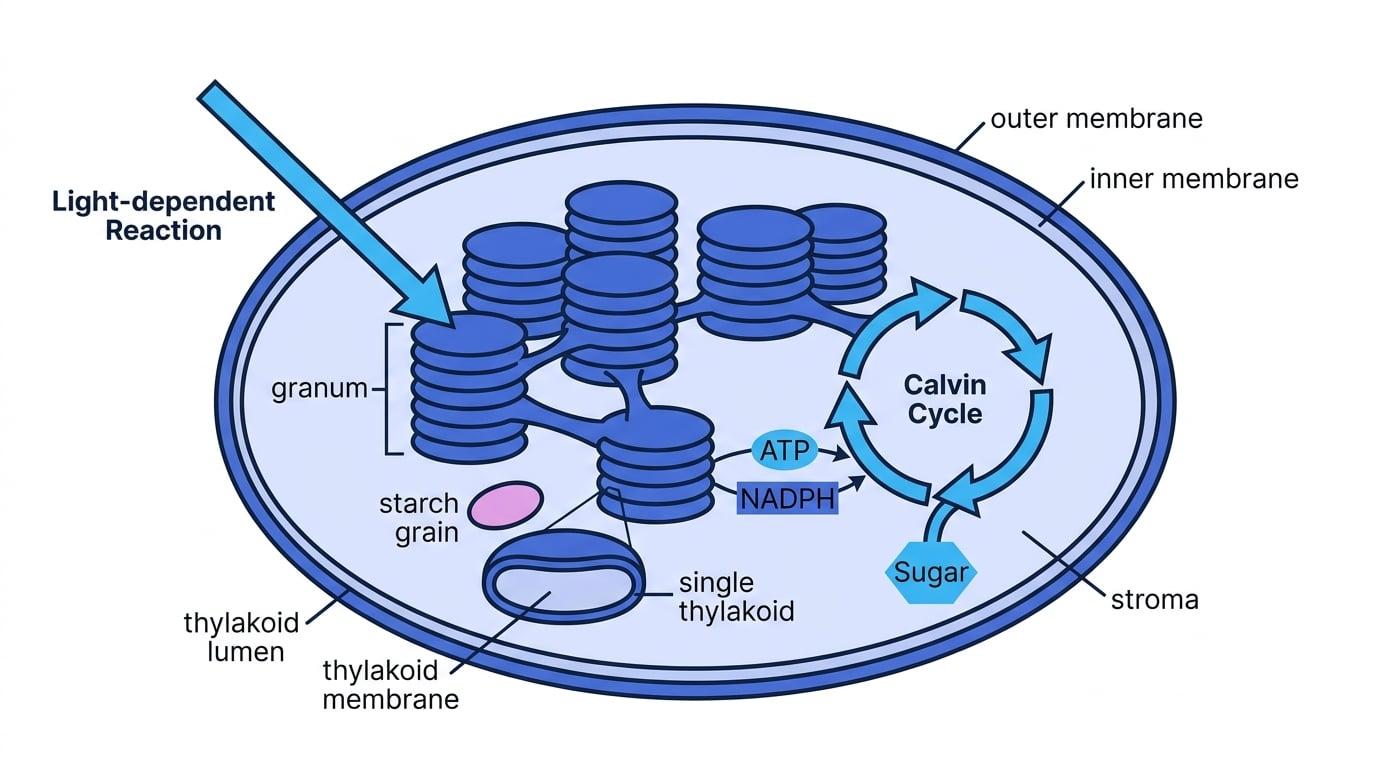
A chloroplast contains flattened membrane sacs called thylakoids. Stacks of thylakoids are called grana. The fluid-filled space around the thylakoids is the stroma.
The light-dependent reaction happens in the thylakoid membranes. The light-independent reaction happens in the stroma.
Key molecules
Chlorophyll is a photosynthetic pigment that absorbs light. ATP is an immediate energy source for reactions. NADP is a coenzyme that accepts electrons and hydrogen ions to become reduced NADP, which carries reducing power to the Calvin cycle.
The light-dependent reaction
The light-dependent reaction needs light and happens in the thylakoid membranes. Its main jobs are to make ATP, make reduced NADP, and split water to release oxygen.
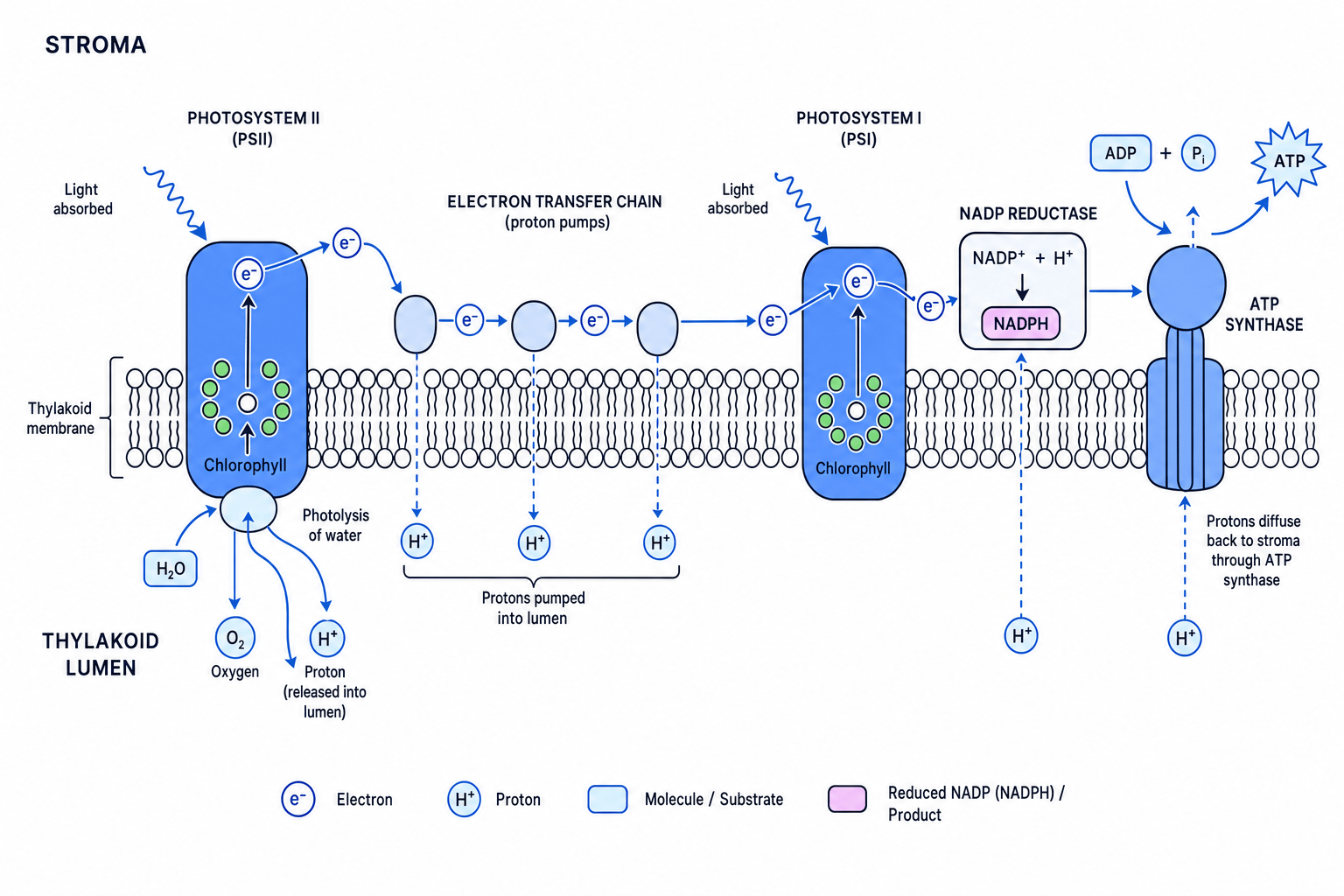
The diagram below shows the flow of electrons and protons across the thylakoid membrane.
1. Chlorophyll absorbs light
Chlorophyll molecules are arranged in photosystems, which are groups of pigments and proteins embedded in the thylakoid membrane.
When chlorophyll absorbs light, electrons gain energy and are released from the chlorophyll molecule. This is called photoionisation.
Photoionisation
Photoionisation is the loss of electrons from chlorophyll after chlorophyll absorbs light energy.
2. Water is split by photolysis
The electrons lost from chlorophyll need to be replaced. This is done by splitting water.
Photolysis
Photolysis is the splitting of water using light energy.
The reaction is:
2H2O→4H++4e−+O22\text{H}_2\text{O} \to 4\text{H}^+ + 4e^- + \text{O}_22H2O→4H++4e−+O2Photolysis produces:
- electrons, which replace those lost from chlorophyll
- protons, also called hydrogen ions
- oxygen, which is released as a waste product
Where oxygen comes from
The oxygen released in photosynthesis comes from water, not carbon dioxide.
3. Electrons pass along an electron transfer chain
The excited electrons pass along an electron transfer chain, a series of electron carrier proteins in the thylakoid membrane.
As electrons move down the chain, some of their energy is used to pump protons from the stroma into the thylakoid lumen. The lumen is the space inside the thylakoid.
This creates a high concentration of protons inside the thylakoid lumen.
4. ATP is made by chemiosmosis
Chemiosmosis
Chemiosmosis is the movement of protons down their concentration gradient through ATP synthase, releasing energy used to make ATP.
Protons diffuse back from the thylakoid lumen into the stroma through ATP synthase, an enzyme embedded in the thylakoid membrane. ATP synthase catalyses the formation of ATP from ADP and inorganic phosphate.
This is called photophosphorylation because light energy is used indirectly to add phosphate to ADP.
5. Reduced NADP is formed
Electrons are re-energised by light at another photosystem. They then combine with NADP and protons to form reduced NADP.
Reduced NADP carries electrons and hydrogen to the light-independent reaction.
Predicting the effect of inhibited photolysis
-
If photolysis stops, water is no longer split, so electrons are not supplied to replace those lost from chlorophyll.
-
Electron flow through the electron transfer chain decreases, so less energy is available to pump protons into the thylakoid lumen.
-
The proton gradient becomes smaller, so less ATP is produced by ATP synthase. Less reduced NADP is also made, so the Calvin cycle slows down.
The light-independent reaction: the Calvin cycle
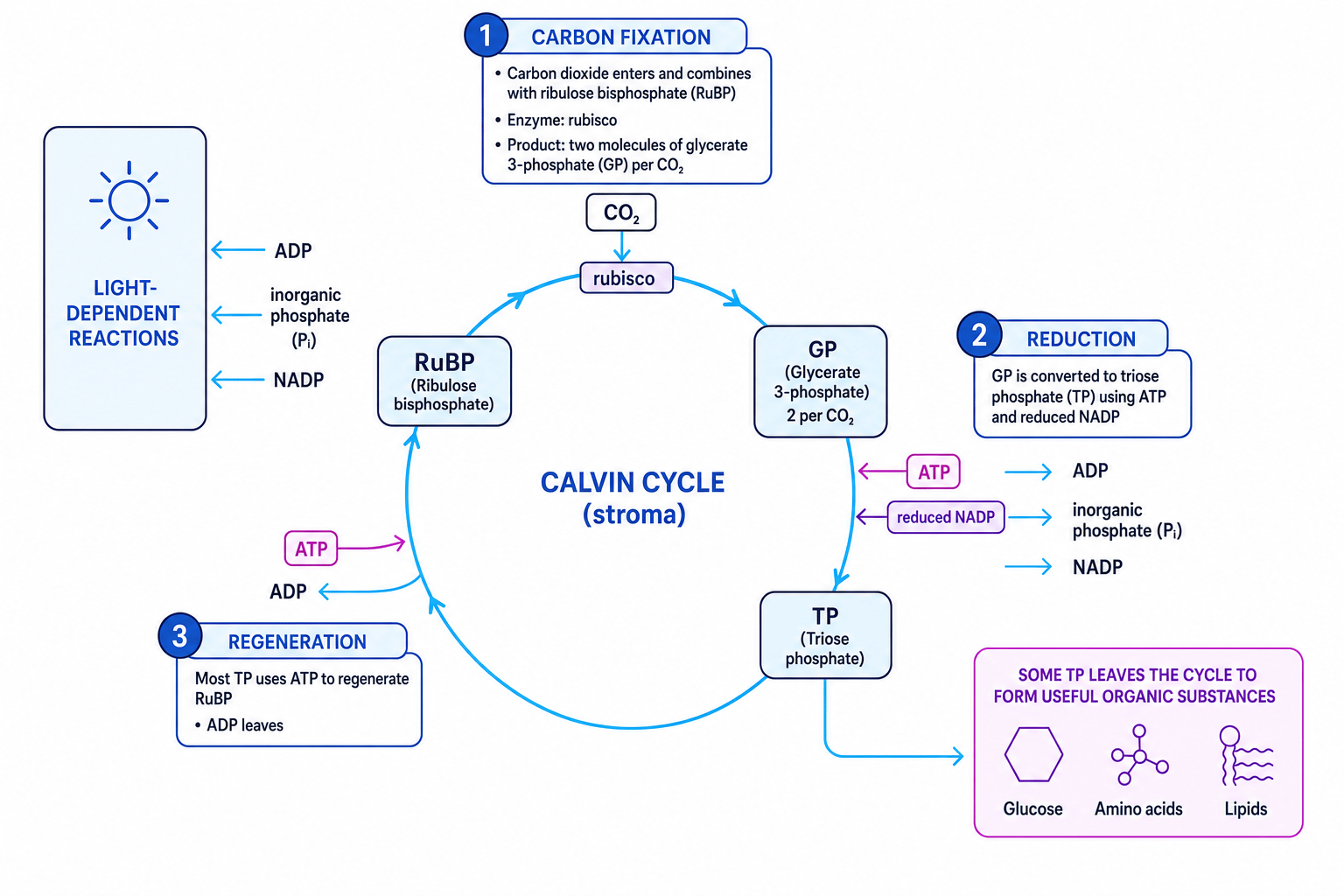
The light-independent reaction does not use light directly, but it depends on ATP and reduced NADP from the light-dependent reaction. It happens in the stroma and is also called the Calvin cycle.
1. Carbon dioxide is fixed
Carbon fixation
Carbon fixation is the incorporation of carbon dioxide into an organic molecule.
Carbon dioxide combines with ribulose bisphosphate, usually shortened to RuBP. RuBP is a five-carbon compound.
This reaction is catalysed by rubisco, an enzyme in the stroma. The six-carbon compound formed is unstable, so it immediately splits into two molecules of glycerate 3-phosphate, or GP.
GP is a three-carbon compound.
2. GP is reduced to triose phosphate
GP is converted into triose phosphate, or TP. TP is also a three-carbon compound.
This reduction needs:
- ATP, which provides energy by hydrolysis
- reduced NADP, which provides hydrogen and electrons
After this, ADP, inorganic phosphate and NADP return to the light-dependent reaction.
3. RuBP is regenerated
Some TP is used to regenerate RuBP. This means the cycle can continue fixing more carbon dioxide.
Regeneration of RuBP also requires ATP.
4. Some TP becomes useful organic substances
Some TP leaves the Calvin cycle and is used to make useful organic substances, including:
- glucose and other hexose sugars
- starch for storage
- cellulose for cell walls
- lipids
- amino acids, if nitrate ions are also available
Why it is a cycle
The Calvin cycle is a cycle because RuBP is regenerated. TP is the important product that can leave the cycle to form other organic molecules.
Predicting the effect of low ATP supply
-
If the light-dependent reaction produces less ATP, GP cannot be reduced to TP as quickly because ATP hydrolysis supplies energy for this step.
-
RuBP regeneration also slows because ATP is needed to convert TP back into RuBP.
-
With less RuBP available, carbon dioxide fixation decreases, so the overall rate of photosynthesis falls.
Limiting factors of photosynthesis
Limiting factor
A limiting factor is the factor in shortest supply that prevents the rate of a process from increasing.
The main environmental limiting factors for photosynthesis are:
- light intensity — affects the light-dependent reaction
- carbon dioxide concentration — affects carbon fixation in the Calvin cycle
- temperature — affects enzyme-controlled reactions, including rubisco activity
At low light intensity, increasing light usually increases the rate of photosynthesis. Eventually the graph plateaus because another factor, such as carbon dioxide concentration or temperature, becomes limiting.
Temperature has an optimum. If temperature is too low, enzymes work slowly. If temperature is too high, enzymes may denature and stomata may close, reducing carbon dioxide entry.
Identifying the limiting factor
An aquatic plant produces oxygen at 6.0 micromoles per minute at low light, whether the dissolved carbon dioxide concentration is 0.40 millimoles per cubic decimetre or 0.80 millimoles per cubic decimetre. At high light, increasing carbon dioxide from 0.40 to 0.80 millimoles per cubic decimetre increases oxygen production from 12.0 to 20.0 micromoles per minute.
-
At low light, increasing carbon dioxide has no effect on oxygen production, so carbon dioxide is not limiting. Light intensity is the limiting factor.
-
At high light, increasing carbon dioxide increases oxygen production, so carbon dioxide was limiting at the lower carbon dioxide concentration.
-
The percentage increase at high light is:
So carbon dioxide enrichment would be useful only if light intensity is also high enough.
Agricultural practices
In greenhouses, growers can manipulate limiting factors to increase yield. Common practices include:
- using artificial lighting to increase light intensity or day length
- adding carbon dioxide to increase carbon fixation
- heating to keep enzymes near their optimum temperature
- ventilating to prevent overheating
- supplying water and mineral ions to prevent indirect limitation
When evaluating data, always consider whether the yield increase is large enough to justify the extra cost.
Evaluating greenhouse data
If a graph has already plateaued, increasing the factor on the x-axis further will not improve yield unless another limiting factor is also changed.
Required practical 7: chromatography of leaf pigments
Chromatography
Chromatography is a technique used to separate substances in a mixture because they have different solubilities in the solvent and different affinities for the stationary phase.
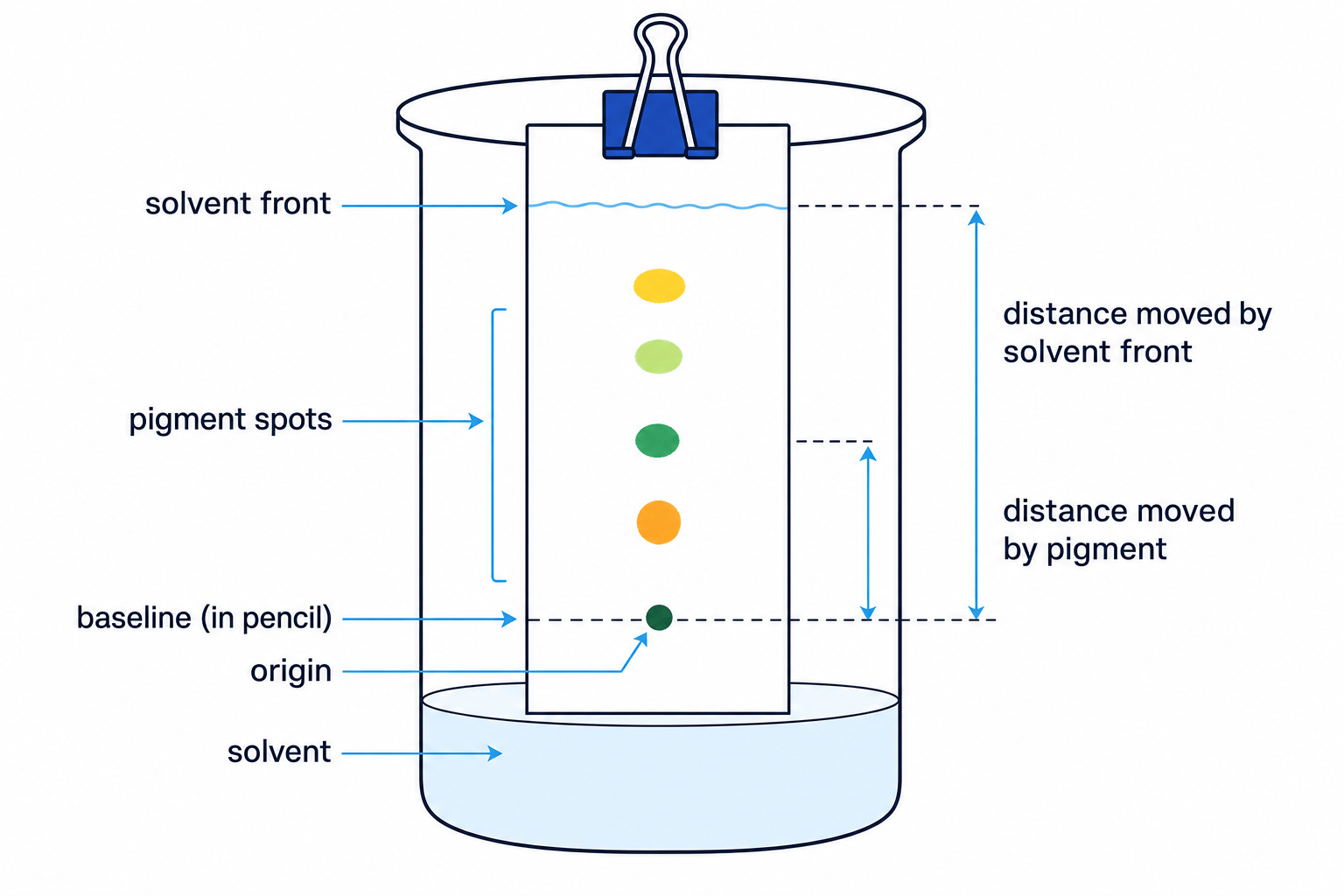
In leaf chromatography, the mobile phase is the solvent and the stationary phase is the paper or thin-layer chromatography plate. Different pigments move different distances.
Basic method:
- Grind leaf tissue with a suitable solvent to extract pigments.
- Draw a pencil baseline near the bottom of the chromatography paper.
- Add a small spot of pigment extract to the baseline and let it dry. Repeat to concentrate the spot.
- Place the paper in solvent, making sure the solvent level is below the baseline.
- Remove the paper before the solvent reaches the top and mark the solvent front immediately.
- Calculate Rf values and compare pigments from different leaves.
The Rf value is:
Rf=distance moved by pigment from origindistance moved by solvent front from originR_f = \frac{\text{distance moved by pigment from origin}}{\text{distance moved by solvent front from origin}}Rf=distance moved by solvent front from origindistance moved by pigment from originCalculating Rf values
A pigment spot moves 42 millimetres from the origin. The solvent front moves 70 millimetres from the origin.
- Use the Rf formula:
- Substitute the measured distances:
- Calculate and cancel the units:
The Rf value has no units.
Baseline errors
Use pencil for the baseline because ink may dissolve in the solvent. Also keep the baseline above the solvent, or the pigment spot may wash into the solvent.
Required practical 8: dehydrogenase activity in chloroplast extracts
Dehydrogenase
A dehydrogenase is an enzyme that removes hydrogen atoms from a substrate. In chloroplast investigations, this is linked to electron transfer in the light-dependent reaction.
This practical often uses DCPIP, a blue dye that becomes colourless when reduced. DCPIP acts as an artificial electron acceptor, replacing NADP.
A typical investigation into the effect of light intensity would involve:
- Preparing a chloroplast extract and keeping it cold.
- Mixing chloroplast extract with buffer and DCPIP.
- Exposing samples to different light intensities, for example by changing lamp distance.
- Keeping other variables constant, such as temperature, pH, DCPIP concentration and chloroplast extract volume.
- Measuring the time taken for DCPIP to decolourise, or using a colorimeter to measure absorbance over time.
- Repeating and calculating a mean.
You should include a control, such as a tube kept in the dark or a tube with boiled chloroplast extract.
Calculating relative dehydrogenase activity
A DCPIP sample decolourises in 80 seconds in bright light and 200 seconds in dim light. Relative activity can be estimated using:
relative activity=1time\text{relative activity} = \frac{1}{\text{time}}relative activity=time1- Calculate the bright-light activity:
- Calculate the dim-light activity:
- Compare the two rates:
So the dehydrogenase activity is 2.5 times higher in bright light.
What DCPIP measures
DCPIP is a proxy for light-dependent electron transfer. It does not directly measure the Calvin cycle or glucose production.
In the exam
-
Use precise reaction locations: light-dependent reaction in the thylakoid membranes, Calvin cycle in the stroma.
-
Link limiting factors to the correct stage: light affects ATP and reduced NADP production; carbon dioxide affects RuBP carboxylation; temperature affects enzyme-controlled reactions.
-
In practical questions, name the independent variable, dependent variable, controlled variables, repeats, and a suitable control.
Check yourself
- Why does stopping photolysis reduce both ATP production and reduced NADP production?
- In the Calvin cycle, what are the roles of RuBP, GP and TP?
- How would you decide from a graph whether light intensity or carbon dioxide concentration is limiting?