What you'll learn
- How genotype, phenotype, alleles and loci fit together.
- How to build fully labelled genetic diagrams for monohybrid and dihybrid crosses.
- How inheritance changes with codominance, sex linkage, autosomal linkage, multiple alleles and epistasis.
- How to use the chi-squared test to compare observed and expected genetic ratios.
The core vocabulary
Inheritance is about how genetic information is passed from parents to offspring.
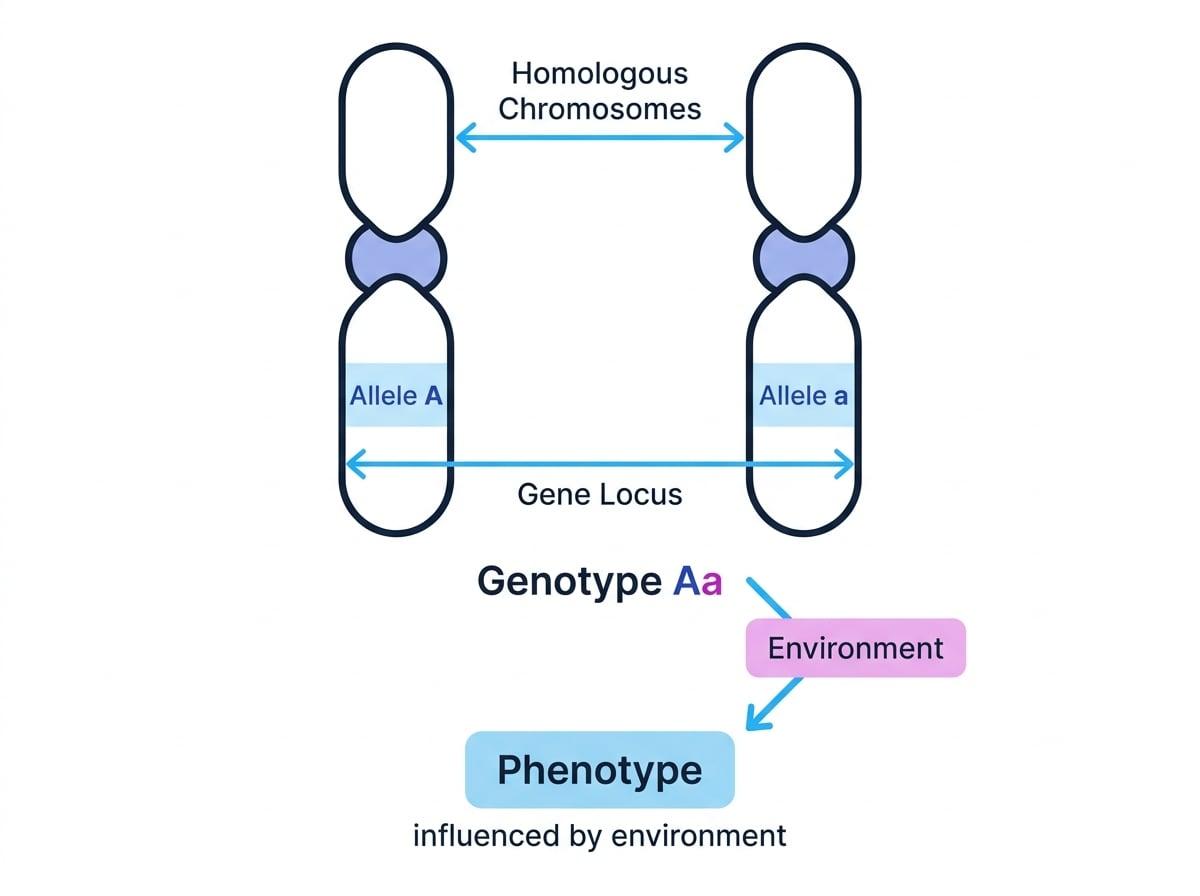
A gene is a length of DNA that codes for a polypeptide or functional RNA. In diploid organisms, such as humans, chromosomes are found in homologous pairs: one chromosome inherited from each parent. The same gene is found at the same position on each homologous chromosome.
Core inheritance terms
- An allele is an alternative form of a gene.
- A locus is the fixed position of a gene on a chromosome.
- The genotype is the genetic constitution of an organism.
- The phenotype is the expression of the genotype, together with its interaction with the environment.
- A diploid organism has two sets of chromosomes, so it usually has two alleles at each gene locus.
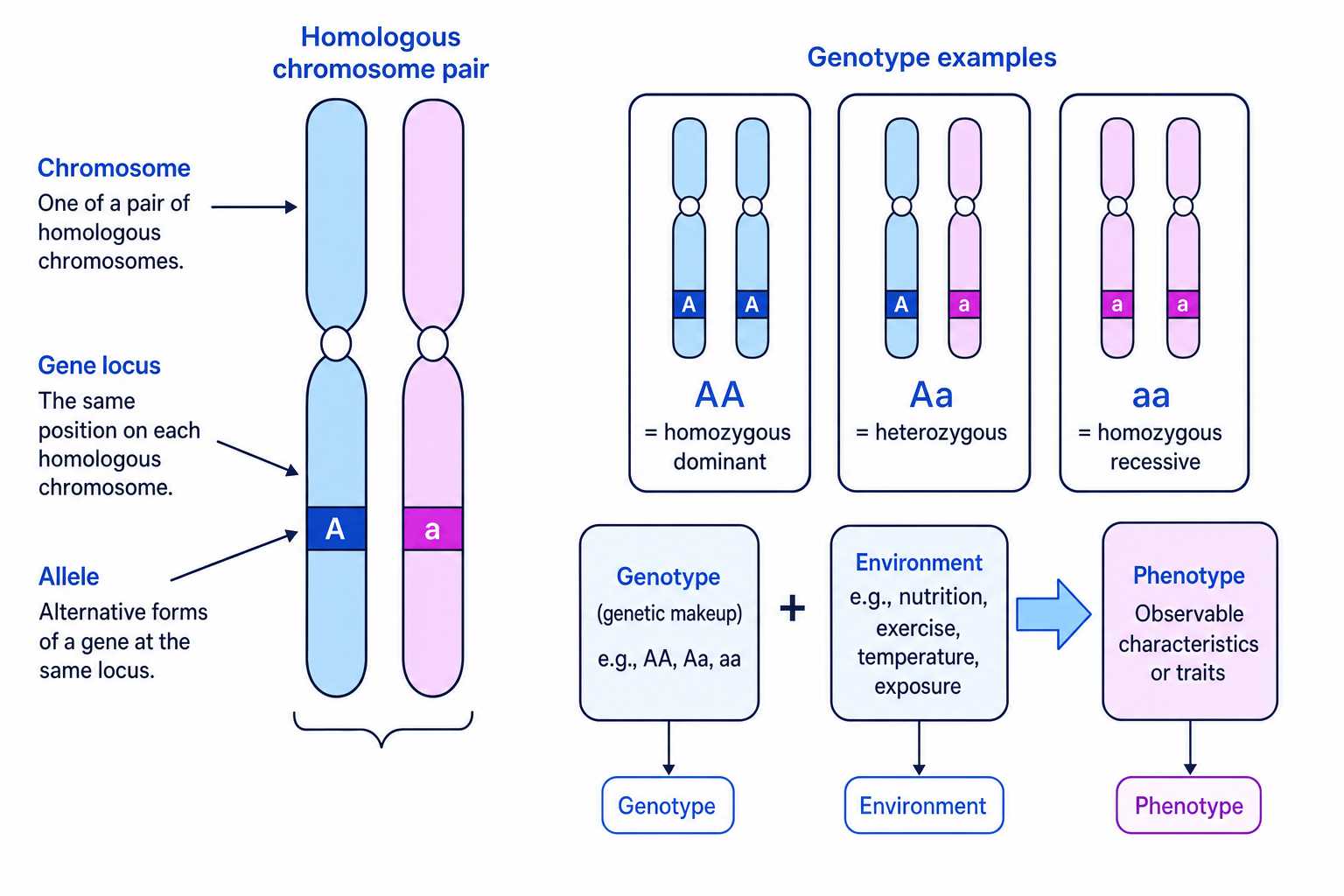
A phenotype is not always “just the genes”. For example, plant height may depend on alleles affecting growth, but also on light intensity, mineral ions and water availability.
Alleles: dominant, recessive and codominant
A dominant allele is expressed in the phenotype if at least one copy is present. A recessive allele is expressed only when no dominant allele is present at that locus.
A codominant allele is expressed alongside another allele in a heterozygote, so both alleles affect the phenotype.
Homozygous and heterozygous
At a specific locus, an organism is homozygous if both alleles are the same, such as AA or aa. It is heterozygous if the two alleles are different, such as Aa.
Dominant does not mean common
A dominant allele is not automatically the most frequent allele in a population, and a recessive allele is not automatically harmful. Dominance describes expression in a heterozygote, not how common or useful the allele is.
There may be many alleles of a single gene in a population, but a diploid individual normally carries only two alleles for that gene.
Fully labelled genetic diagrams
This bit is A-Level-only inheritance work: you need to interpret and predict crosses using complete genetic diagrams, not just memorise ratios.
A good genetic diagram should show:
- the parental phenotypes and genotypes
- the possible gametes from each parent
- the offspring genotypes
- the offspring phenotypes
- the expected phenotypic ratio or probability
The genetic diagram routine
Choose allele symbols carefully, work out gametes, combine gametes, then translate offspring genotypes into phenotypes.
Monohybrid crosses
A monohybrid cross follows the inheritance of one gene.
Predicting a monohybrid ratio
In pea plants, tall is dominant to short. Predict the offspring from two heterozygous tall plants.
-
Use T for the dominant tall allele and t for the recessive short allele. A heterozygous tall plant has genotype Tt, so the cross is Tt crossed with Tt.
-
Each parent can produce gametes carrying T or t. Combining the gametes gives the offspring genotypes TT, Tt, Tt and tt.
-
TT and Tt are tall, while tt is short. The expected phenotypic ratio is 3 tall : 1 short, so the probability of a short offspring is 25%.
Always label the phenotype
Examiners often want the final answer as a phenotypic ratio, not just genotypes. Do not stop at TT : Tt : tt.
Dihybrid crosses
A dihybrid cross follows the inheritance of two genes. If the genes are not linked, their alleles show independent assortment during meiosis, meaning the inheritance of one gene does not affect the inheritance of the other.
For a typical heterozygous dihybrid cross, AaBb crossed with AaBb, each parent can make four gamete types: AB, Ab, aB and ab.
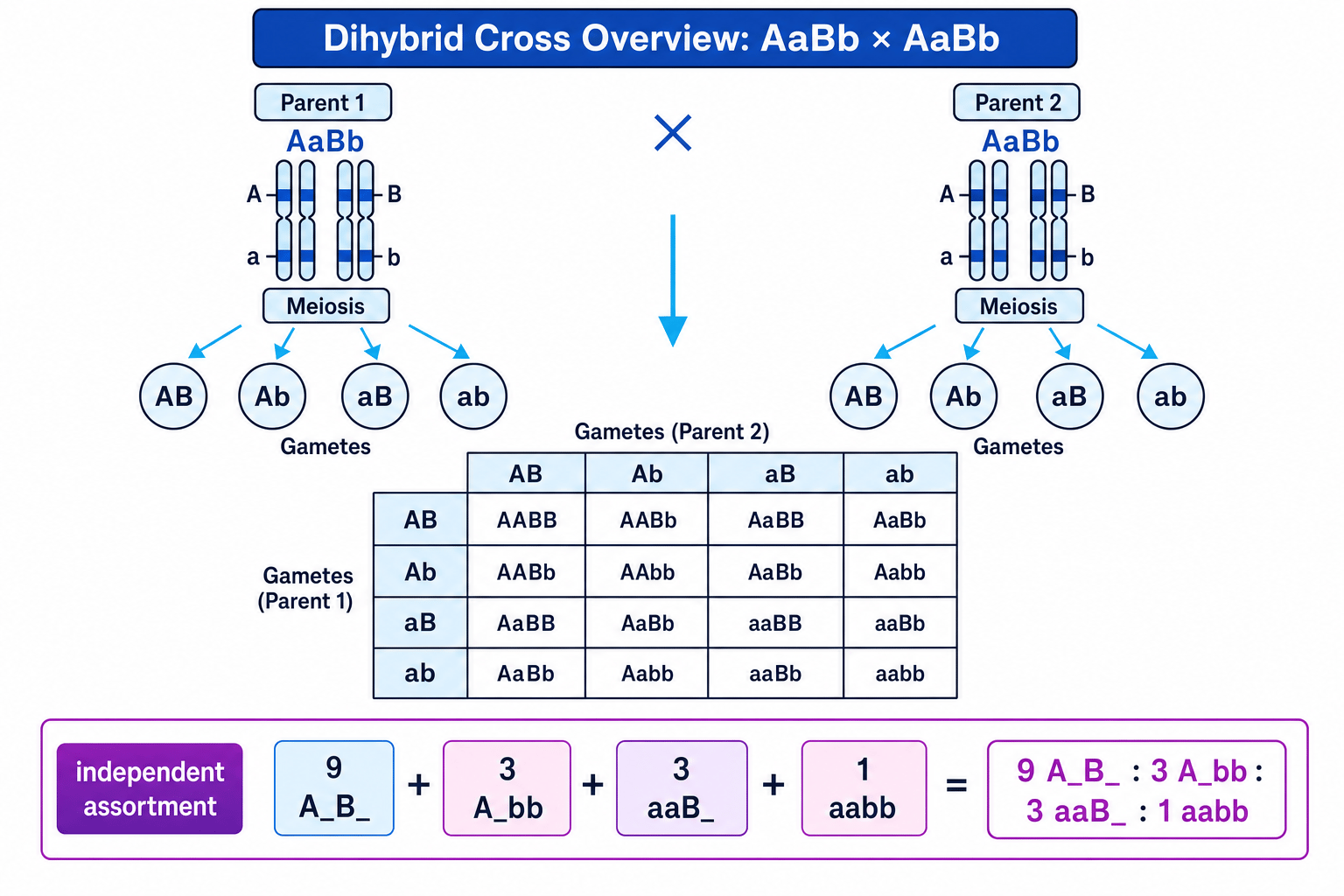
When both genes show complete dominance and assort independently, the classic phenotypic ratio is:
9 with both dominant phenotypes : 3 with only the first dominant phenotype : 3 with only the second dominant phenotype : 1 with both recessive phenotypes.
Calculating expected dihybrid numbers
A dihybrid cross gives an expected 9:3:3:1 ratio. There are 320 offspring in total. Find the expected number in each phenotype class.
-
Add the ratio parts: 9 + 3 + 3 + 1 = 16 parts.
-
Find one part: 32016=20\frac{320}{16}=2016320=20 offspring.
-
Multiply each ratio part by 20, giving 180, 60, 60 and 20 offspring.
Using 9:3:3:1 when genes are not independent
The 9:3:3:1 ratio only applies when the two genes assort independently and there is complete dominance at both loci. It may not apply with linkage or epistasis.
Multiple alleles and codominance
A gene can have more than two alleles in the population. Human ABO blood group is a useful example.
The alleles IAI^\text{A}IA and IBI^\text{B}IB are codominant. The allele i is recessive to both.
Predicting ABO blood groups
A parent with genotype IAiI^\text{A}iIAi has blood group A. A parent with genotype IBiI^\text{B}iIBi has blood group B. Predict their possible children.
-
The first parent can produce gametes carrying IAI^\text{A}IA or i. The second parent can produce gametes carrying IBI^\text{B}IB or i.
-
The possible offspring genotypes are IAIBI^\text{A}I^\text{B}IAIB, IAiI^\text{A}iIAi, IBiI^\text{B}iIBi and ii.
-
These give blood groups AB, A, B and O, so the expected phenotypic ratio is 1 AB : 1 A : 1 B : 1 O.
Sex linkage
A sex-linked gene is found on a sex chromosome. In humans, females usually have XX and males usually have XY. Many sex-linked conditions are X-linked because the Y chromosome carries fewer genes.
A male has only one X chromosome, so for an X-linked gene he has only one allele. This is called being hemizygous. Recessive X-linked alleles are therefore more likely to be expressed in males.
Predicting an X-linked recessive condition
A carrier female is crossed with an unaffected male. Use H for the normal allele and h for the recessive condition allele.
-
The carrier female is XHXhX^\text{H}X^\text{h}XHXh. The unaffected male is XHYX^\text{H}YXHY.
-
The female produces XHX^\text{H}XH and XhX^\text{h}Xh gametes. The male produces XHX^\text{H}XH and Y gametes.
-
The possible offspring are XHXHX^\text{H}X^\text{H}XHXH, XHXhX^\text{H}X^\text{h}XHXh, XHYX^\text{H}YXHY and XhYX^\text{h}YXhY. Only XhYX^\text{h}YXhY is affected, so 25% of all children are expected to be affected, or 50% of sons.
Forgetting the Y chromosome
In sex-linked crosses, do not write male genotypes as if they had two X-linked alleles. A male is written with X and Y, for example XhYX^\text{h}YXhY.
Autosomal linkage
An autosome is any chromosome that is not a sex chromosome. Autosomal linkage occurs when two genes are on the same autosome. Linked genes tend to be inherited together because they are on the same chromosome.
Crossing over during meiosis can separate linked alleles, producing recombinant offspring, but recombinant phenotypes are usually less frequent than parental phenotypes.
Recognising autosomal linkage
A heterozygote with linked alleles AB on one chromosome and ab on the homologous chromosome is test-crossed with aabb. The offspring are 42 AB phenotype, 8 Ab phenotype, 9 aB phenotype and 41 ab phenotype.
-
In a test cross with aabb, the offspring phenotypes reveal the gametes made by the heterozygous parent.
-
If the genes assorted independently, the four phenotypes would be expected in roughly equal numbers.
-
The AB and ab phenotypes are much more common than Ab and aB, so AB and ab are parental combinations. The low-frequency Ab and aB classes are recombinants caused by crossing over.
Epistasis
Epistasis occurs when an allele at one gene locus masks or modifies the expression of alleles at another gene locus. This changes the expected dihybrid ratio.
Combining phenotype classes in epistasis
In a coat-colour example, B gives black pigment, b gives brown pigment, but ee prevents pigment being deposited. A BbEe cross with another BbEe individual is considered.
-
Without epistasis, the dihybrid classes would be 9 B_E_, 3 bbE_, 3 B_ee and 1 bbee.
-
Because ee prevents pigment deposition, both B_ee and bbee produce the same masked phenotype.
-
The phenotypic ratio becomes 9 black : 3 brown : 4 masked, not 9:3:3:1.
Chi-squared test for genetic ratios
The chi-squared test compares observed frequencies with expected frequencies. In inheritance, it is used to test whether differences between observed and expected phenotypic ratios are likely to be due to chance.
The null hypothesis is usually: there is no significant difference between the observed and expected results; any difference is due to chance.
The formula is:
χ2=∑(O−E)2E\chi^2=\sum \frac{(O-E)^2}{E}χ2=∑E(O−E)2where O is the observed frequency and E is the expected frequency.
Testing a 3:1 monohybrid ratio
A plant cross gives 78 tall offspring and 22 short offspring. The expected ratio is 3 tall : 1 short. Test whether the data fit the expected ratio.
-
There are 100 offspring. For a 3:1 ratio, the expected numbers are 75 tall and 25 short.
-
Substitute into the chi-squared formula:
So:
χ2=975+925=0.12+0.36=0.48\chi^2=\frac{9}{75}+\frac{9}{25}=0.12+0.36=0.48χ2=759+259=0.12+0.36=0.48The statistic has no units because it is calculated from frequencies.
- There are two phenotype categories, so degrees of freedom = 2 - 1 = 1. At p = 0.05, the critical value is 3.84. Since 0.48 is less than 3.84, the difference is not significant, so the data fit the expected 3:1 ratio.
Small expected values
The chi-squared test is unreliable if expected values are very small. At A-Level, be cautious if any expected category is below 5.
In the exam
-
For genetic diagrams, always show parental genotypes, gametes, offspring genotypes and offspring phenotypes.
-
Choose notation that matches the inheritance pattern: use X and Y for sex linkage, and avoid uppercase/lowercase notation for codominant alleles unless the question defines it.
-
For chi-squared questions, calculate expected numbers from the proposed ratio before substituting into the formula, then compare your value with the critical value.
Check yourself
- Why can a recessive X-linked allele be expressed more often in males than females?
- When would a dihybrid cross fail to produce a 9:3:3:1 ratio?
- What does it mean if a calculated chi-squared value is greater than the critical value?