Fibroblasts are cells involved in tissue repair and wound healing. Fibroblasts secrete a hormone called pro-healing peptide (pro-HP) in an inactive form. pro-HP is a protein. The active form of HP binds to a receptor on T-lymphocytes, stimulating them to release the signaling protein Interleukin-H (IL-H). Fibroblasts have receptors for IL-H. The figure shows how the production of pro-HP by fibroblasts is controlled by positive feedback. 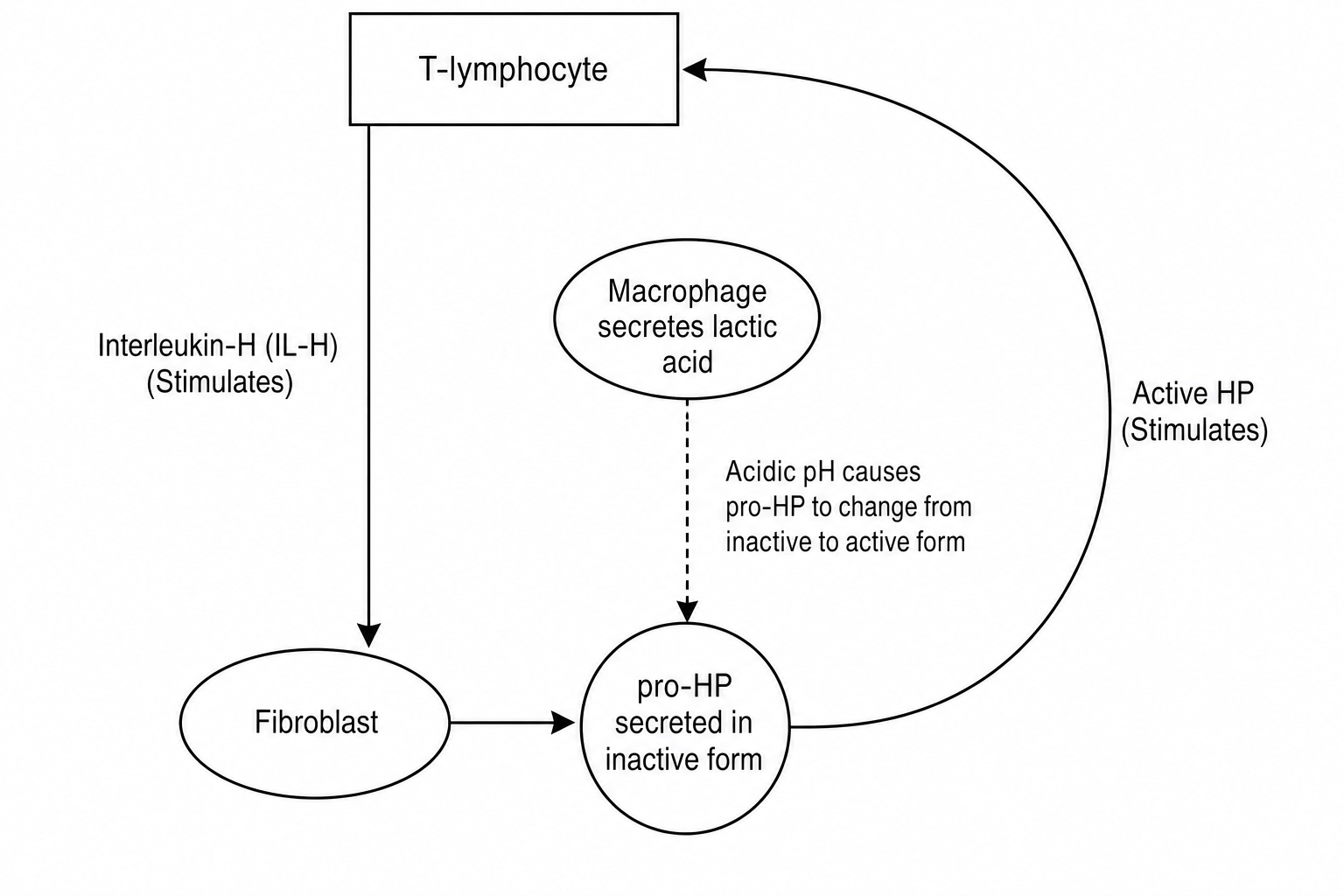
The secretion of pro-HP (in an inactive form) by fibroblasts is controlled by positive feedback. Use information from the figure to explain why this is positive feedback.
The acidic conditions created by macrophages cause the inactive form of the protein pro-HP to change into the active form HP. Suggest how.
Binding of Interleukin-H (IL-H) leads to an increase in the rate of aerobic respiration in cells such as fibroblasts. Explain how.
Practise AQA A Level Biology Homeostasis is the maintenance of a stable internal environment (A-level only) with exam-style questions for A Level Biology. 21 questions covering Principles of homeostasis and negative feedback (A-level only), Control of blood glucose concentration (A-level only), and Control of blood water potential (A-level only), matched to the AQA A Level Biology (7402) specification and written in Paper 1, Paper 2 and Paper 3 style. Every question includes a full worked solution and mark scheme, so you can see where marks are awarded rather than just whether you got the answer right.

