What you'll learn
- What the genome and proteome are, and why different cells can make different proteins.
- How mRNA and tRNA are structured for their roles in protein synthesis.
- How transcription produces RNA from DNA, including splicing in eukaryotes.
- How translation uses codons, ribosomes, tRNA and ATP to build a polypeptide.
Big picture: from gene to protein
A nucleic acid is a polymer made from nucleotides. DNA and RNA are nucleic acids. Each nucleotide contains a phosphate group, a sugar and a nitrogen-containing base.
DNA stores genetic information in the order of its bases. RNA helps use that information to make proteins. A polypeptide is a chain of amino acids joined by peptide bonds; a protein is one or more polypeptides folded into a specific 3D shape.
Gene, genome and proteome
A gene is a length of DNA that codes for a polypeptide or functional RNA. The genome is the complete set of genes in a cell. The proteome is the full range of proteins that a cell is able to produce.
Different specialised cells usually have the same genome, but they do not express all genes equally. For example, a pancreatic β cell expresses genes needed to produce insulin, while a muscle cell expresses many genes needed for contraction. This means their proteomes differ.
Gene expression
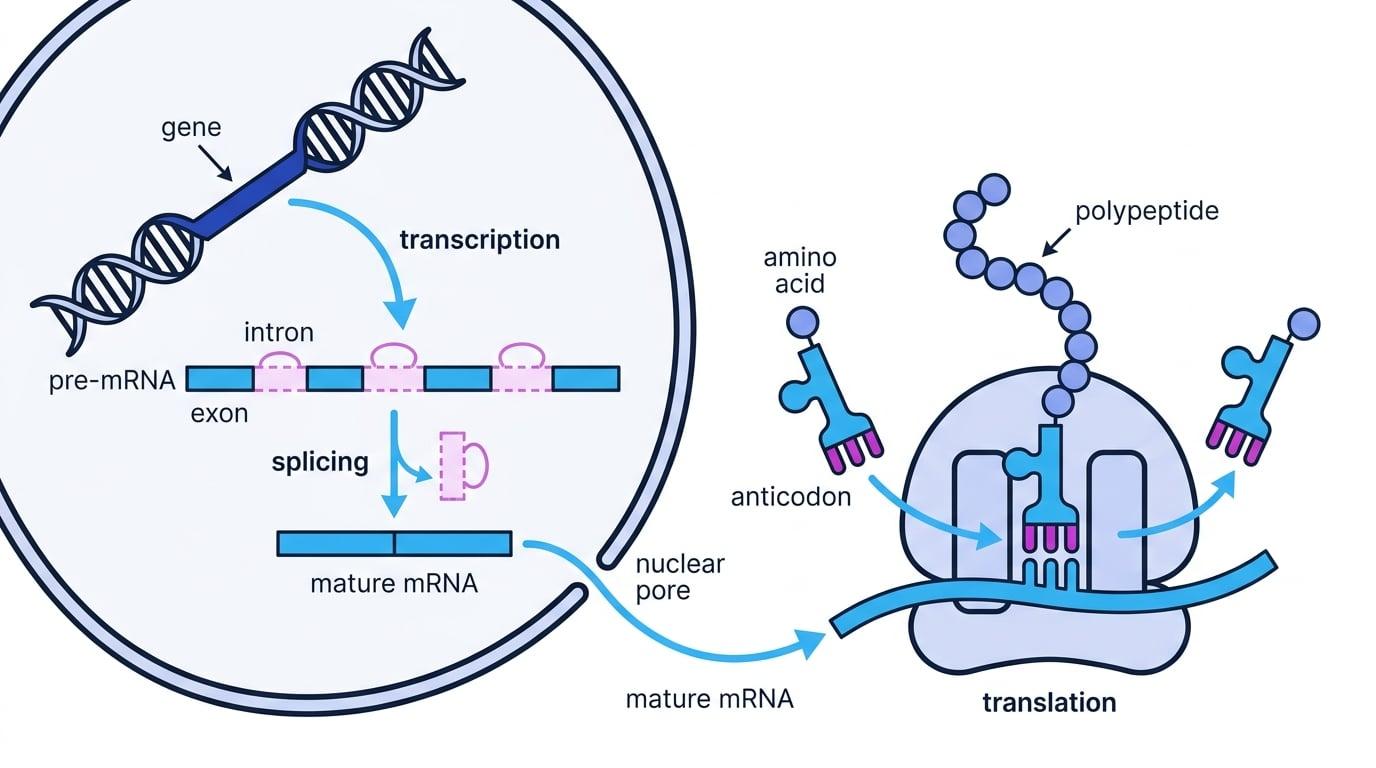
Gene expression means using the information in a gene to make a functional product. For protein-coding genes, this happens in two main stages: transcription makes RNA, then translation makes a polypeptide.
RNA: similar to DNA, but with key differences
RNA is usually single-stranded, whereas DNA is usually double-stranded. RNA contains the sugar ribose, while DNA contains deoxyribose. RNA also contains the base uracil instead of thymine.
The RNA bases are:
- adenine, A
- uracil, U
- cytosine, C
- guanine, G
In RNA base pairing, A pairs with U, and C pairs with G.
Messenger RNA, mRNA
Messenger RNA, shortened to mRNA, is a single-stranded molecule that carries a copy of the genetic code from DNA to a ribosome.
mRNA is organised into codons. A codon is a sequence of three bases on mRNA that codes for one amino acid, or acts as a start or stop signal during translation.
Transfer RNA, tRNA
Transfer RNA, shortened to tRNA, is a single-stranded RNA molecule folded into a cloverleaf shape by hydrogen bonds between complementary bases.
Each tRNA has:
- an anticodon: a sequence of three bases complementary to a codon on mRNA
- an amino acid attachment site: where a specific amino acid is carried
Codon versus anticodon
A codon is on mRNA. An anticodon is on tRNA. Both are made of RNA bases, so use U rather than T.
Transcription: making RNA from DNA
Transcription is the production of RNA from a DNA template. For protein synthesis, transcription produces mRNA in prokaryotes and pre-mRNA in eukaryotes.
The DNA strand used to make RNA is called the template strand. The RNA molecule made is complementary to this strand.
RNA polymerase is an enzyme, meaning a biological catalyst, that joins RNA nucleotides together by forming phosphodiester bonds in the sugar-phosphate backbone.
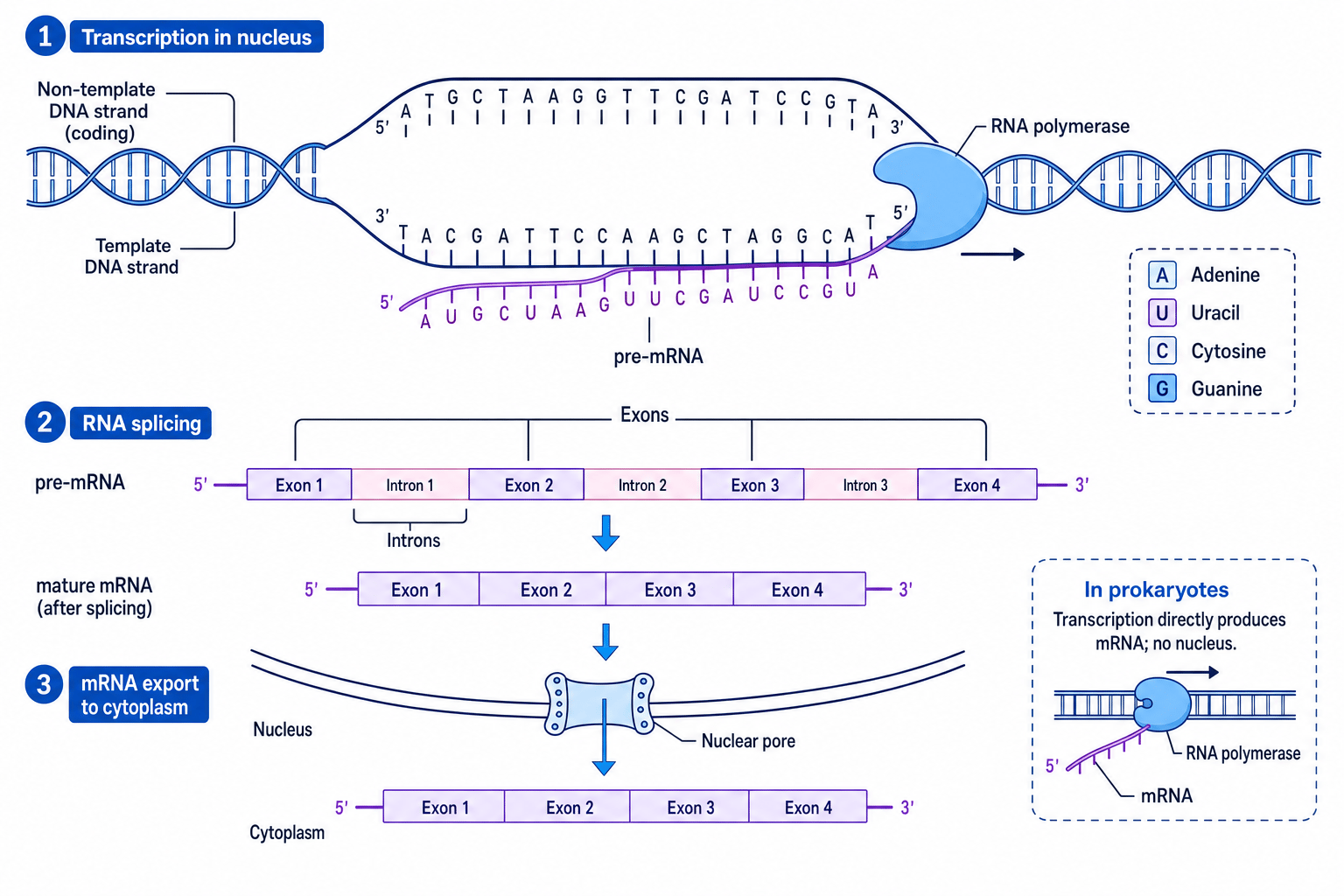
The diagram shows transcription and, in eukaryotes, the extra processing step needed before mRNA leaves the nucleus.
What happens during transcription?
- RNA polymerase attaches to the DNA at the start of a gene.
- The hydrogen bonds between DNA bases break, so the DNA strands separate.
- Free RNA nucleotides line up next to exposed bases on the template strand by complementary base pairing.
- RNA polymerase joins the RNA nucleotides together.
- The RNA molecule separates from the DNA, and the DNA strands rejoin.
Template strand shortcut
The mRNA sequence is complementary to the DNA template strand. It has the same base sequence as the non-template, or coding, strand except that U replaces T.
Transcribing a DNA template strand
A DNA template strand has the sequence 3′-TAC AAA CGT ATT-5′. Find the mRNA sequence.
- Use complementary RNA base pairing: DNA T pairs with RNA A, DNA A pairs with RNA U, DNA C pairs with RNA G, and DNA G pairs with RNA C.
- Convert each DNA triplet into an mRNA codon: TAC becomes AUG, AAA becomes UUU, CGT becomes GCA, and ATT becomes UAA.
- Write the mRNA in the direction it is made and read by ribosomes: 5′-AUG UUU GCA UAA-3′.
Prokaryotes and eukaryotes differ after transcription
A prokaryote is an organism whose cells do not contain a nucleus, such as a bacterium. In prokaryotes, transcription directly produces mRNA from DNA. Because there is no nucleus, translation can begin very soon after transcription.
A eukaryote is an organism whose cells contain a nucleus, such as an animal, plant or fungus. In eukaryotes, transcription produces pre-mRNA first.
Pre-mRNA contains:
- exons: sections that remain in the final mRNA
- introns: sections removed before translation
Splicing is the process where introns are removed and exons are joined together to form mature mRNA. The mature mRNA then leaves the nucleus through a nuclear pore and moves to a ribosome in the cytoplasm.
Introns and exons
Do not say introns code for amino acids in the final polypeptide. Introns are removed during splicing; exons remain in the mature mRNA.
Translation: making a polypeptide
Translation is the production of a polypeptide from the sequence of codons carried by mRNA.
It takes place at a ribosome, a structure made from ribosomal RNA and protein. The ribosome holds mRNA and tRNA molecules in the correct positions so amino acids can be joined in the correct order.
ATP is an energy-carrying molecule. ATP is needed to attach amino acids to their specific tRNA molecules before they are used in translation.
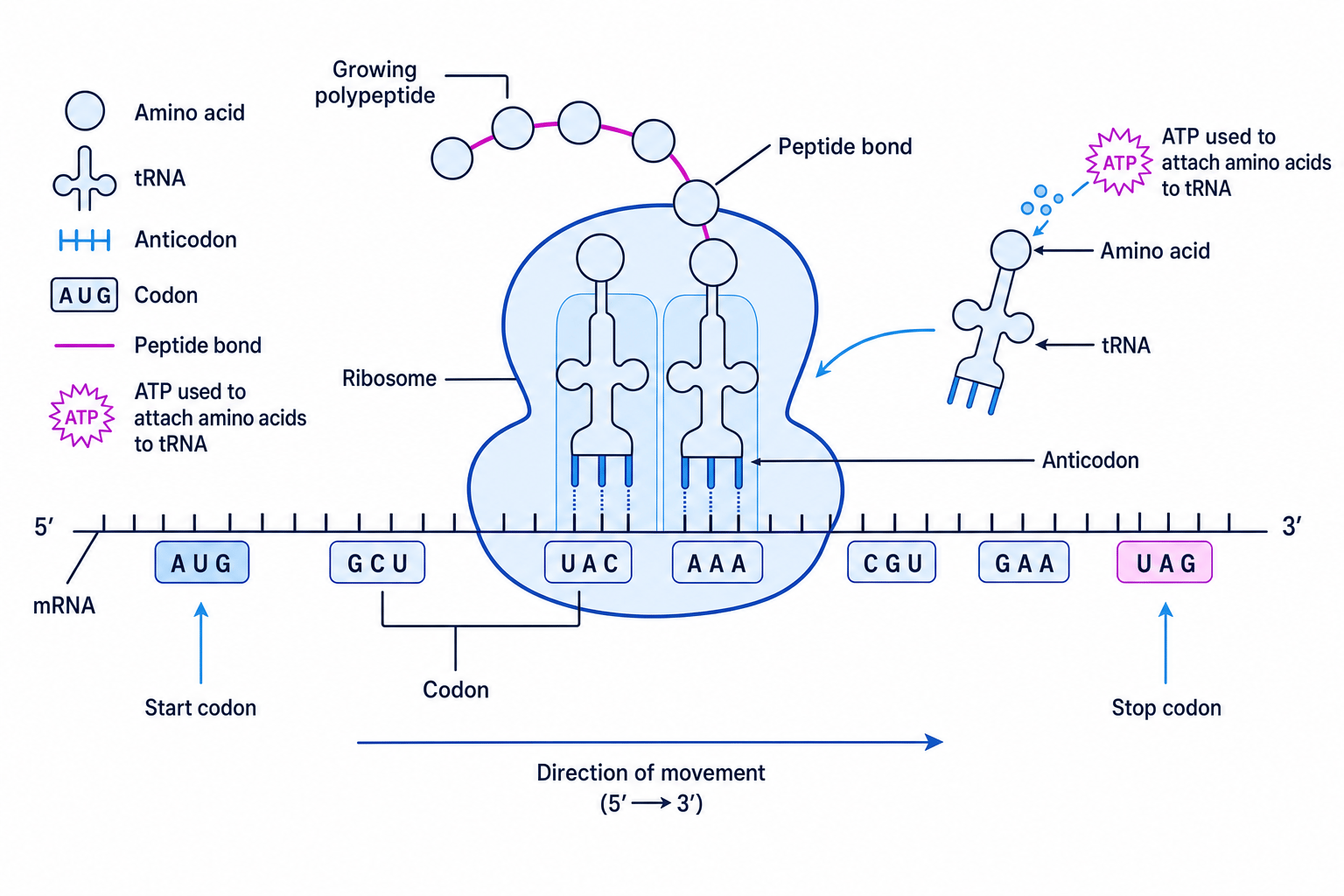
The diagram shows how mRNA codons, tRNA anticodons and amino acids work together at a ribosome.
What happens during translation?
- The ribosome attaches to the mRNA at a start codon.
- A tRNA molecule with a complementary anticodon binds to the first mRNA codon.
- Another tRNA binds to the next codon, carrying its specific amino acid.
- The ribosome catalyses formation of a peptide bond between the amino acids.
- The ribosome moves along the mRNA one codon at a time.
- This continues until a stop codon is reached, when the polypeptide is released.
The order of codons in mRNA determines the order of amino acids in the polypeptide. This amino acid sequence affects how the polypeptide folds, so it affects the final protein’s shape and function.
Relating a DNA sequence to amino acids
A DNA template strand is 3′-TAC AAA CGT ATT-5′. You are given this genetic code information: AUG codes for methionine and is a start codon, UUU codes for phenylalanine, GCA codes for alanine, and UAA is a stop codon. Find the amino acid sequence.
- Transcribe the DNA template into mRNA using complementary RNA bases: 3′-TAC AAA CGT ATT-5′ gives 5′-AUG UUU GCA UAA-3′.
- Split the mRNA into codons from the start codon: AUG, UUU, GCA, UAA.
- Use the provided genetic code data: AUG gives methionine, UUU gives phenylalanine, and GCA gives alanine.
- Stop at UAA because it is a stop codon and does not add an amino acid. The polypeptide sequence is methionine, phenylalanine, alanine.
You do not memorise the codon table
In written papers, you are not expected to recall which codons code for which amino acids. If codon meanings are needed, the question will provide suitable data.
Interpreting experimental data about nucleic acids
You may be asked to interpret evidence showing the role of nucleic acids. Focus on what molecule has been labelled, tracked or changed, and what happens to the product.
For example, DNA contains phosphate groups, so radioactive phosphorus can be used to track DNA. Some proteins contain sulfur, so radioactive sulfur can be used to track protein.
Interpreting labelled molecule data
Viruses are grown in two batches. In batch 1, their DNA is labelled with radioactive phosphorus. In batch 2, their protein coats are labelled with radioactive sulfur. The viruses infect bacteria. After separation, most phosphorus is found inside the bacterial cells, while most sulfur remains outside with empty virus coats.
- Identify what each label tracks: radioactive phosphorus tracks DNA, while radioactive sulfur tracks protein coats.
- Compare where the labels end up after infection: phosphorus is inside the bacterial cells, but sulfur is mainly outside the cells.
- Link the location to the role: the material entering the bacteria is the DNA, so the genetic instructions used during infection are carried by nucleic acid, not by the protein coat.
Bringing it together
Protein synthesis depends on accurate base pairing and correct reading of codons.
- DNA stores the gene sequence.
- Transcription makes an RNA copy.
- In eukaryotes, pre-mRNA is spliced to make mature mRNA.
- Translation reads mRNA codons at a ribosome.
- tRNA molecules bring specific amino acids.
- Peptide bonds join amino acids into a polypeptide.
In the exam
- If given a DNA sequence, check whether it is the template strand or coding strand before writing mRNA.
- Use RNA bases in mRNA and tRNA answers: U replaces T.
- Read mRNA in codons of three bases, use the genetic code data provided, and stop translating at a stop codon.
Check yourself
- Why can two specialised cells have the same genome but different proteomes?
- How does RNA polymerase help produce mRNA during transcription?
- What are the roles of mRNA, tRNA, ribosomes and ATP in translation?