What you'll learn
- How DNA is organised differently in prokaryotic cells, eukaryotic nuclei, mitochondria and chloroplasts.
- What chromosomes, genes and loci are.
- How DNA triplets relate to amino acids and the genetic code.
- Why much eukaryotic nuclear DNA is non-coding, including introns, exons and repeated sequences.
Starting point: DNA as stored information
DNA stands for deoxyribonucleic acid. It is a biological polymer: a large molecule made from many repeating smaller units called nucleotides. Each DNA nucleotide contains a phosphate group, a deoxyribose sugar and one nitrogen-containing base.
The four DNA bases are adenine (A), thymine (T), cytosine (C) and guanine (G). The base sequence means the order of these bases along the DNA molecule.
DNA
DNA is a molecule that carries genetic information in the sequence of its bases: A, T, C and G.
The key idea for this topic is that DNA is not just “floating information”. It is physically organised in different ways depending on the cell type and where it is found.
DNA in different types of cells
A prokaryotic cell is a cell without a nucleus, such as a bacterial cell. A eukaryotic cell is a cell with a nucleus and membrane-bound organelles, such as an animal, plant or fungal cell.
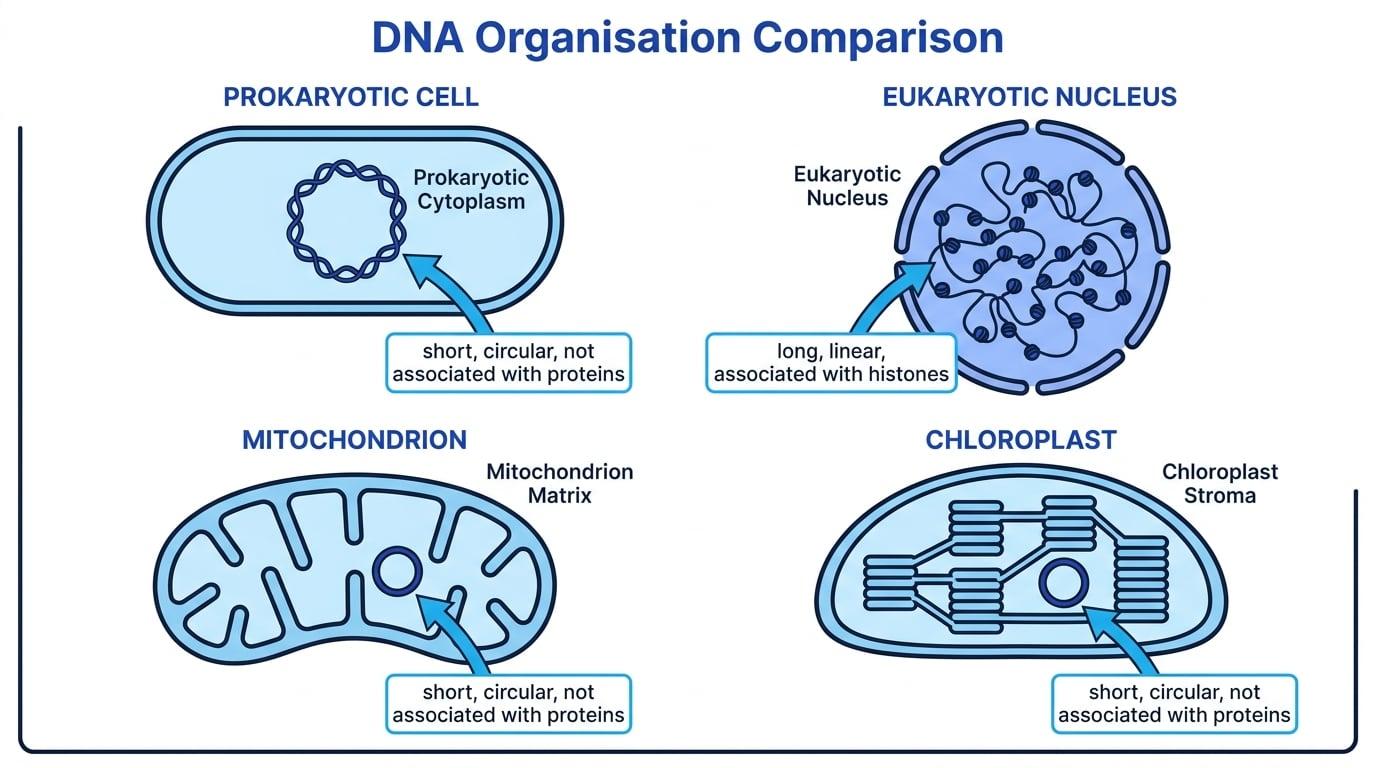
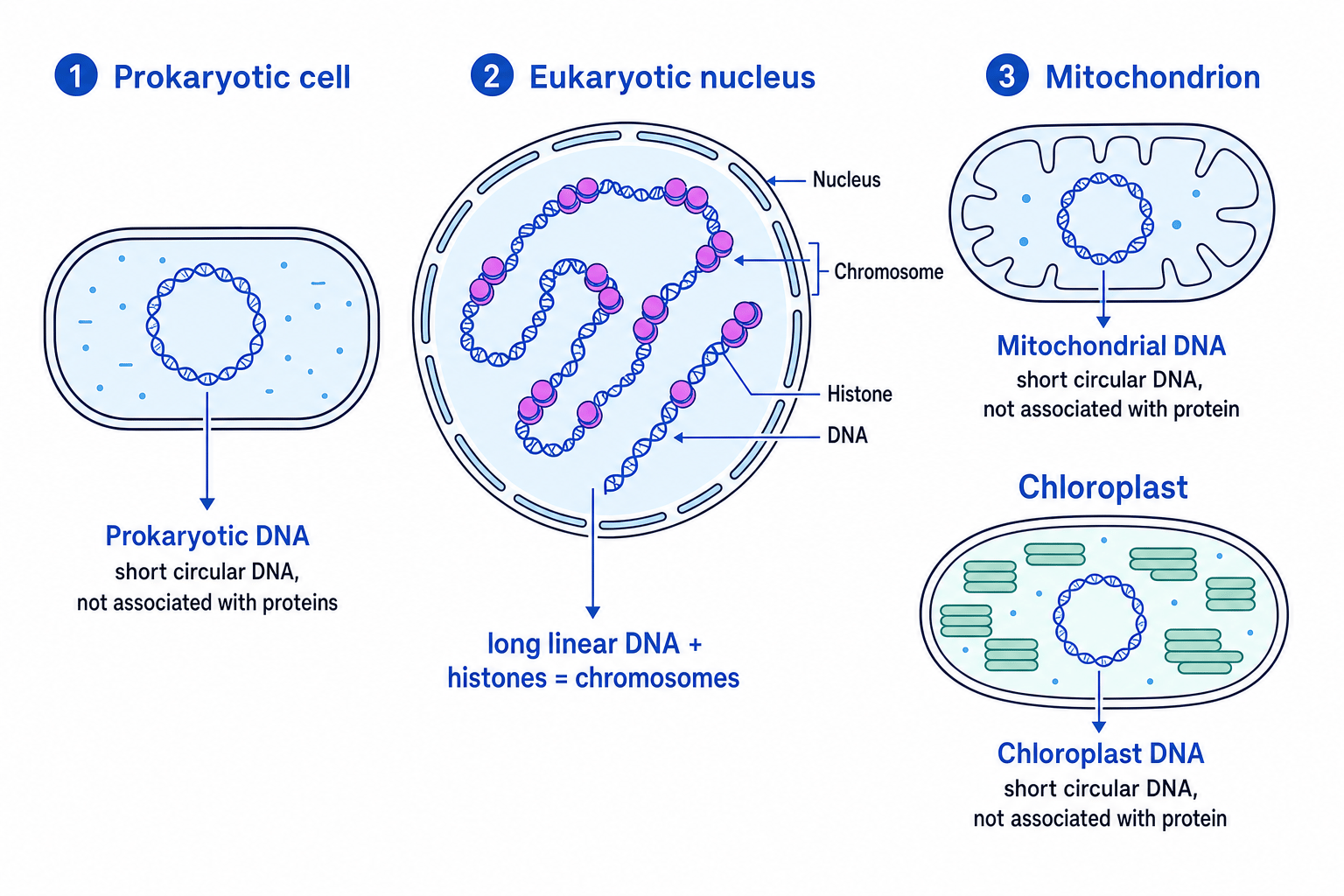
This diagram summarises the DNA organisation you need for this section: prokaryotic DNA, eukaryotic nuclear DNA, and the DNA found in mitochondria and chloroplasts.
Prokaryotic DNA
In prokaryotic cells, DNA molecules are:
- short compared with eukaryotic nuclear DNA
- circular, meaning the DNA molecule forms a loop
- not associated with proteins in the AQA specification wording
Prokaryotic cells do not have a nucleus, so their main DNA is in the cytoplasm.
Eukaryotic nuclear DNA
In the nucleus of eukaryotic cells, DNA molecules are:
- very long
- linear, meaning each DNA molecule has two ends
- associated with proteins called histones
Histones are proteins that help package and organise eukaryotic nuclear DNA. Together, one DNA molecule and its associated proteins form a chromosome.
Chromosome
A chromosome is a DNA molecule together with its associated proteins. In eukaryotic nuclei, these proteins include histones.
Do not rely only on the familiar “X-shaped” chromosome diagram. That is one condensed form often shown during cell division. For this topic, the exam definition is more important: DNA + associated proteins = chromosome.
Mitochondrial and chloroplast DNA
Mitochondria are organelles involved in aerobic respiration. Chloroplasts are organelles found in plant and algal cells where photosynthesis occurs.
Mitochondria and chloroplasts contain their own DNA. This DNA is like prokaryotic DNA because it is:
- short
- circular
- not associated with protein
Not all eukaryotic DNA is nuclear DNA
Do not write “eukaryotic DNA is long, linear and associated with histones” as a blanket statement. That describes DNA in the nucleus. DNA in mitochondria and chloroplasts is short, circular and not associated with protein.
Inferring where a DNA molecule is found
A cell sample contains one DNA molecule that is long, linear and associated with histones. It also contains another DNA molecule that is short, circular and not associated with protein.
- The long, linear molecule associated with histones matches eukaryotic nuclear DNA, so it is part of a chromosome in the nucleus.
- The short, circular molecule not associated with protein does not match eukaryotic nuclear DNA.
- If the sample is from a eukaryotic cell, the short circular DNA could be from a mitochondrion or, in a plant/algal cell, a chloroplast. More information would be needed to distinguish between those two organelles.
From chromosomes to genes
A chromosome contains many sections of DNA. Some of these sections are genes.
Gene
A gene is a base sequence of DNA that codes for either the amino acid sequence of a polypeptide or a functional RNA molecule, including ribosomal RNA and transfer RNA.
An amino acid is a small molecule that can be joined to others. A polypeptide is a chain of amino acids. Polypeptides fold to form proteins, or parts of proteins.
RNA, or ribonucleic acid, is another nucleic acid involved in gene expression. A functional RNA is an RNA molecule that has a job itself rather than being translated into a polypeptide. Ribosomal RNA (rRNA) forms part of ribosomes, and transfer RNA (tRNA) carries amino acids during protein synthesis.
Genes do not always code for proteins
A gene can code for a polypeptide, but it can also code for a functional RNA such as rRNA or tRNA. So “all genes code for proteins” is too simplistic.
Locus: the gene’s position
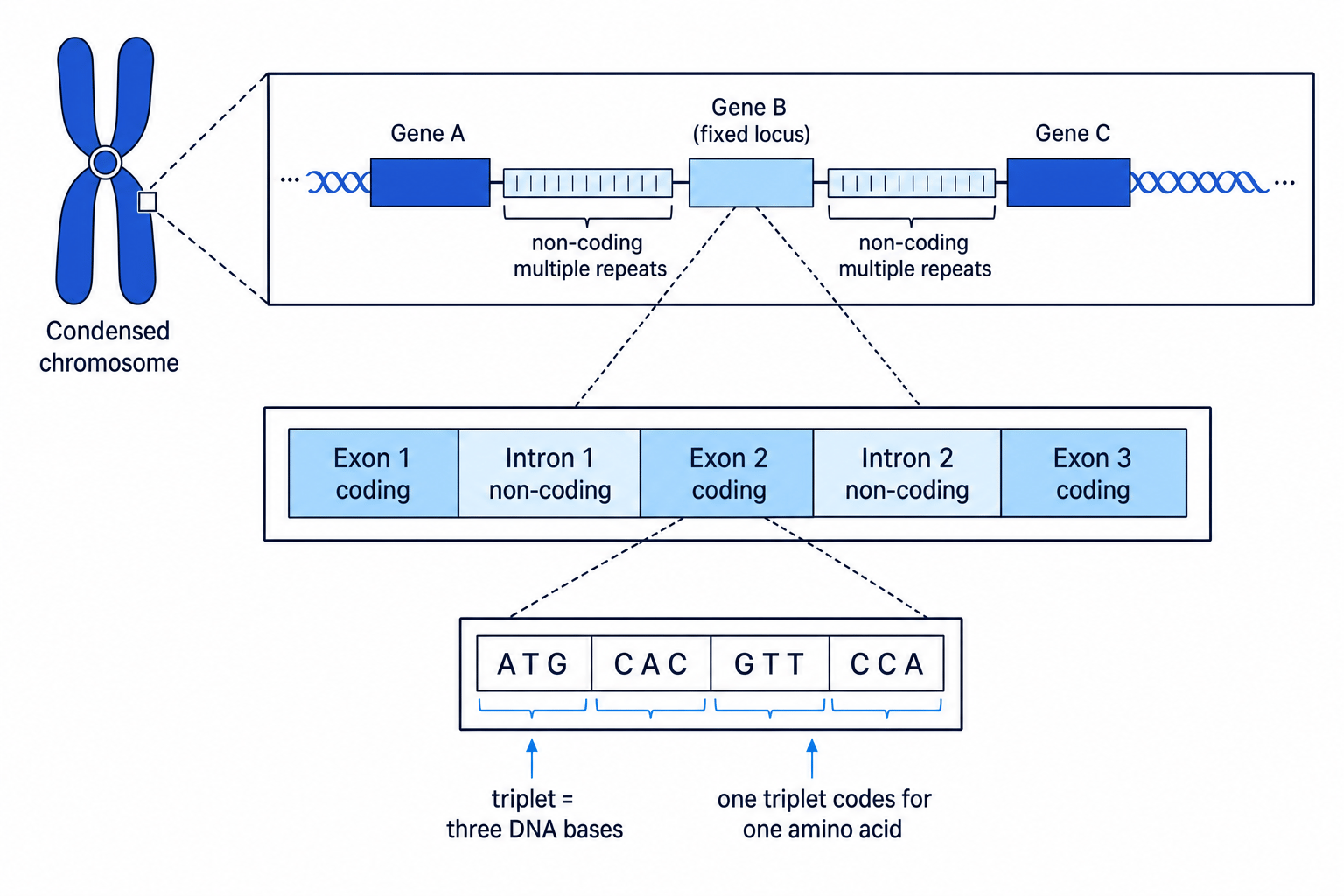
A locus is the fixed position of a gene on a particular DNA molecule. Think of it as the gene’s address on a chromosome or other DNA molecule.
The diagram shows how a gene sits at a fixed locus, how exons and introns are arranged within a eukaryotic gene, and how bases are grouped into triplets.
Triplets and the genetic code
A triplet is a sequence of three DNA bases. Each triplet codes for a specific amino acid.
Genetic code
The genetic code is the relationship between DNA base triplets and the amino acids they code for. It is universal, non-overlapping and degenerate.
Universal
The genetic code is described as universal because the same triplet codes for the same amino acid in almost all organisms. At A-Level, treat this as a major reason why genes can be compared between different species.
Non-overlapping
The code is non-overlapping because bases are read in separate groups of three. Each base is part of only one triplet.
For example, a sequence of 12 bases would be read as four triplets, not as a sliding set of overlapping groups.
Counting triplets in a coding sequence
A simplified coding DNA sequence contains 18 bases. How many amino acids could it code for, assuming every triplet codes for an amino acid?
- Because the code is non-overlapping, split the sequence into consecutive groups of three bases.
- Calculate the number of triplets: 18 bases3 bases per triplet=6 triplets\frac{18\ \text{bases}}{3\ \text{bases per triplet}} = 6\ \text{triplets}3 bases per triplet18 bases=6 triplets.
- If each triplet codes for one amino acid, the sequence could code for 6 amino acids.
Degenerate
The genetic code is degenerate because most amino acids are coded for by more than one triplet. This does not mean the code is vague.
Degenerate does not mean ambiguous
A degenerate code means one amino acid may have several possible triplets. It does not mean one triplet codes for several different amino acids.
Coding and non-coding DNA in eukaryotes
In eukaryotes, much of the nuclear DNA does not code for polypeptides. This is a big difference from the simple idea that “DNA is just genes”.
There are non-coding regions between genes, including multiple repeats of base sequences. These are repeated DNA sequences that do not code for amino acid sequences.
There are also non-coding regions within genes. In eukaryotic protein-coding genes:
- exons are sequences that code for amino acid sequences
- introns are non-coding sequences within the gene
- exons are separated by one or more introns
Calculating amino acids from exons
A eukaryotic gene has three exons of 120 bases, 90 bases and 150 bases. It also has two introns of 300 bases and 600 bases. Assuming the exon bases are all coding bases, how many amino acids are coded for?
- Introns are non-coding, so exclude the 300-base and 600-base introns from the calculation.
- Add only the exon bases: 120+90+150=360 coding bases120 + 90 + 150 = 360\ \text{coding bases}120+90+150=360 coding bases.
- Convert coding bases into triplets: 360 coding bases3 bases per triplet=120 triplets\frac{360\ \text{coding bases}}{3\ \text{bases per triplet}} = 120\ \text{triplets}3 bases per triplet360 coding bases=120 triplets, so the exons code for 120 amino acids.
Introns are not between genes
Introns are non-coding sequences within a gene. Non-coding multiple repeats are found between genes. Exons are the coding parts within a gene.
Pulling the hierarchy together
The order of ideas is:
- DNA is the molecule carrying genetic information.
- A chromosome is a DNA molecule with associated proteins.
- A gene is a base sequence of DNA that codes for a polypeptide or functional RNA.
- A locus is the fixed position of a gene on a DNA molecule.
- A triplet is three DNA bases coding for one amino acid.
In the exam
- When comparing DNA locations, use the exact contrasts: short circular no protein for prokaryotic, mitochondrial and chloroplast DNA; long linear with histones for eukaryotic nuclear DNA.
- Define a gene broadly: it can code for a polypeptide or a functional RNA such as rRNA or tRNA.
- For eukaryotic genes, keep the locations straight: repeated non-coding DNA is between genes, while introns and exons are within genes.
Check yourself
- Why is a eukaryotic nuclear chromosome more than just “a piece of DNA”?
- A DNA sequence codes for a tRNA molecule. Why is it still a gene?
- What is the difference between an intron and a non-coding multiple repeat between genes?