

What you'll learn
- How gene mutations change the base sequence of DNA.
- Why some mutations change proteins, while others have no effect on the amino acid sequence.
- How meiosis produces genetically different haploid cells.
- How independent segregation, crossing over and random fertilisation increase genetic variation.
The big idea: genetic diversity
Genetic diversity
Genetic diversity is the variety of alleles within a population of a species. An allele is a different version of the same gene.
Genetic diversity matters because it gives natural selection variation to act on. New variation can arise by mutation, and existing variation can be reshuffled during meiosis and fertilisation.
A gene is a length of DNA that codes for a polypeptide or functional RNA. A chromosome is a long, coiled DNA molecule associated with proteins. In humans, body cells are usually diploid, meaning they contain two sets of chromosomes.
Gene mutations
Gene mutation
A gene mutation is a change in the base sequence of DNA in a chromosome.
DNA is made from four bases: adenine, thymine, cytosine and guanine. Their order forms a base sequence. During DNA replication, the DNA molecule is copied. Errors can happen spontaneously, so mutations can occur without an obvious external cause.
Mutagenic agents are factors that increase the rate of mutation. Examples include ionising radiation, ultraviolet radiation and some chemicals.
Base substitution
A base substitution is when one base in the DNA sequence is replaced by another.
Because DNA is read in triplets of three bases, a substitution may change one triplet. This may or may not change the amino acid coded for.
Degenerate genetic code
The genetic code is degenerate because most amino acids are coded for by more than one triplet/codon.
So, a base substitution can be:
- silent, if the new triplet still codes for the same amino acid;
- missense, if it codes for a different amino acid;
- nonsense, if it creates a stop signal early, shortening the polypeptide.
Base deletion
A base deletion is when one base is removed from the DNA sequence. This is often more serious because it can cause a frameshift, where every triplet after the deletion is regrouped differently.
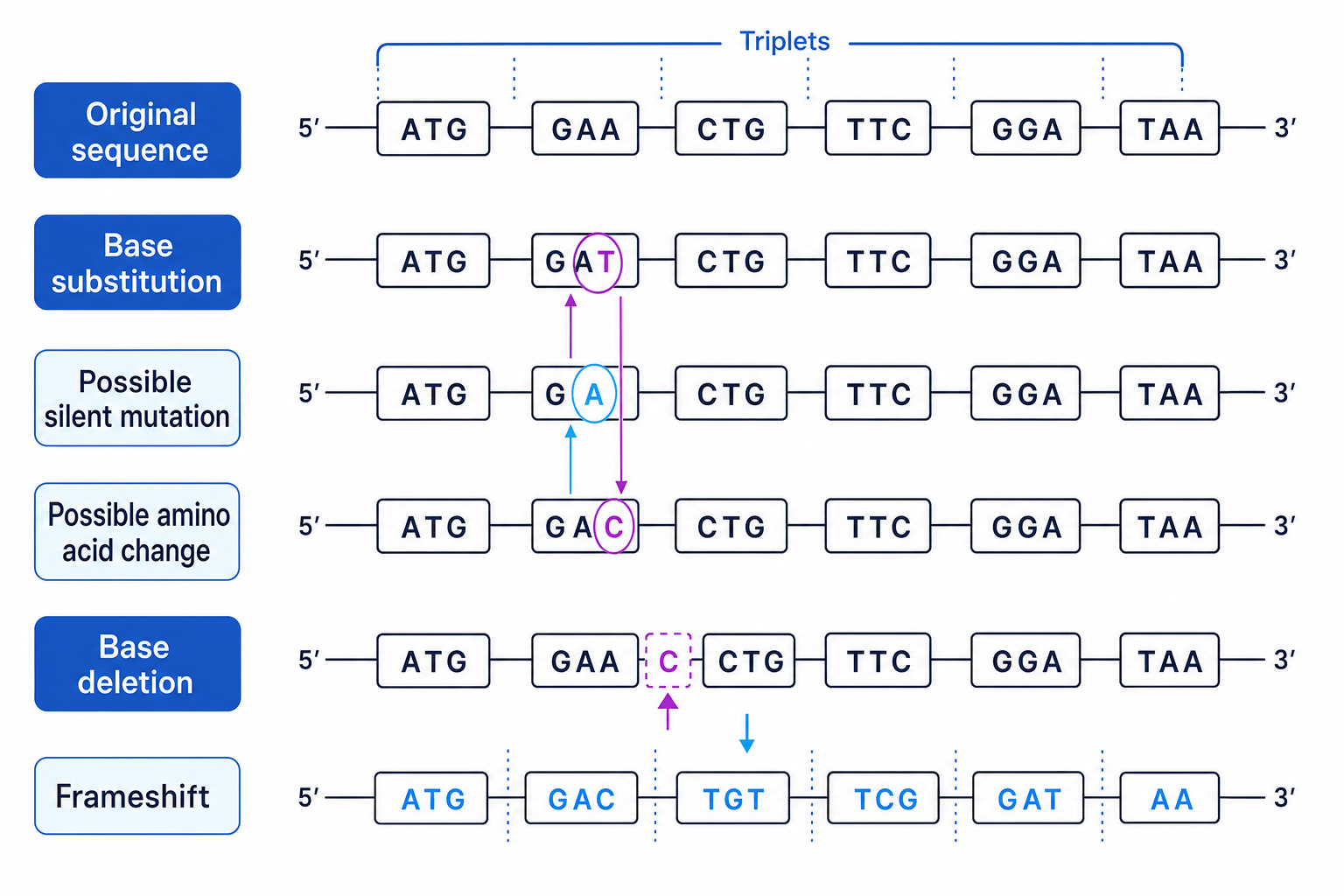
Predicting mutation effects
A coding DNA sequence begins ATG GAA CTT GGA. A substitution changes GAA to GAG. A deletion removes the third base of GAA.
- Treat the sequence as triplets from the start:
ATG | GAA | CTT | GGA. - For the substitution, only one triplet changes:
GAAbecomesGAG. If both triplets code for the same amino acid, the amino acid sequence is unchanged, so this is a silent mutation. - For the deletion, the sequence becomes regrouped after the missing base:
ATG | GAC | TTG | .... The reading frame has shifted, so many amino acids after the deletion may change.
Assuming every mutation affects the protein
Not every gene mutation changes the amino acid sequence. A base substitution can be silent because the genetic code is degenerate.
Mutations in chromosome number: non-disjunction
A mutation can also involve the number of chromosomes, not just the base sequence of a gene.
Non-disjunction is when chromosomes fail to separate properly during meiosis. This can produce gametes with too many or too few chromosomes.
If a gamete with an abnormal chromosome number fuses with a normal gamete at fertilisation, the zygote may have an abnormal chromosome number.
Working out chromosome number after non-disjunction
A species has a normal haploid number of 3. During meiosis, one homologous pair fails to separate, producing gametes with abnormal chromosome numbers. A normal gamete then fuses with one abnormal gamete.
- A normal gamete has 3 chromosomes, so an abnormal gamete may have one extra chromosome or one missing chromosome.
- The possible abnormal gametes are therefore n+1=4n + 1 = 4n+1=4 chromosomes or n−1=2n - 1 = 2n−1=2 chromosomes.
- After fertilisation with a normal gamete containing 3 chromosomes, the zygotes could have 4+3=74 + 3 = 74+3=7 chromosomes or 2+3=52 + 3 = 52+3=5 chromosomes.
Meiosis: making genetically different haploid cells
Meiosis
Meiosis is a type of nuclear division that usually produces four genetically different haploid daughter cells from one diploid parent cell.
A haploid cell contains one set of chromosomes. Gametes are haploid in animals.
Before meiosis starts, DNA replication occurs. Each chromosome is copied into two identical sister chromatids, joined at a centromere.
Meiosis then has two nuclear divisions:
Meiosis I
In meiosis I, homologous chromosomes separate.
Homologous chromosomes
Homologous chromosomes are a matching pair of chromosomes, one inherited from each parent. They have the same genes at the same loci, but may carry different alleles.
After meiosis I, the cells are haploid because each cell has one chromosome from each homologous pair. However, each chromosome is still made of two sister chromatids.
Meiosis II
In meiosis II, sister chromatids separate. This produces four haploid daughter cells.
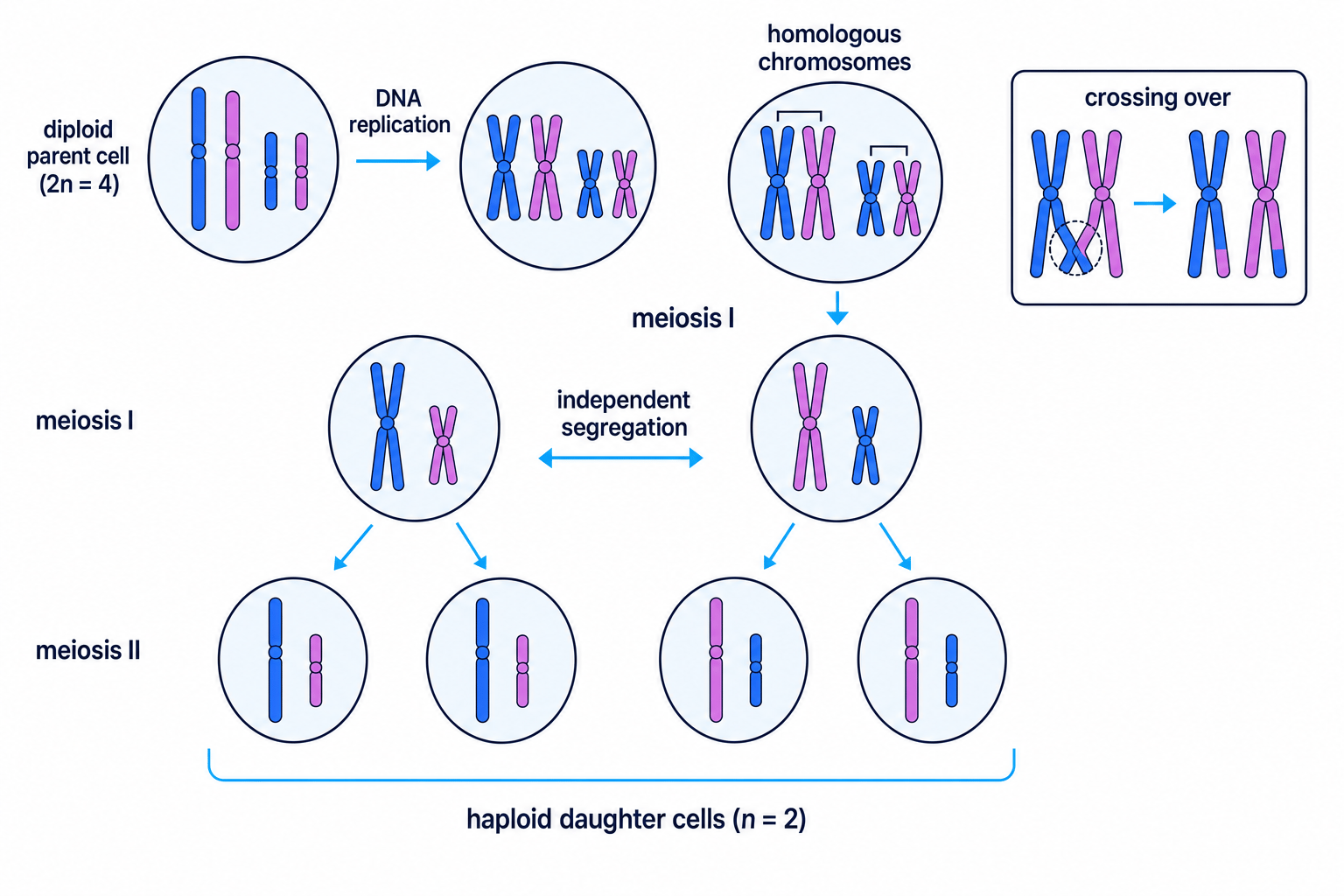
Tracing chromosome content through meiosis
A diploid parent cell has 6 chromosomes.
- Work out the number of homologous pairs: 6 chromosomes means 3 homologous pairs.
- After meiosis I, homologous chromosomes have separated, so each cell has 3 chromosomes. Each chromosome is still made of two sister chromatids.
- After meiosis II, sister chromatids have separated, so there are four haploid cells. Each has 3 chromosomes, now as single chromatids.
How meiosis creates genetic variation
Independent segregation
During meiosis I, each homologous pair lines up independently of the others. This is called independent segregation.
For each homologous pair, either the maternal chromosome or the paternal chromosome can go into a particular daughter cell. With several homologous pairs, there are many possible chromosome combinations.
If a diploid cell has nnn homologous chromosome pairs, the number of possible chromosome combinations in gametes, ignoring crossing over, is:
2n2^n2nIn this formula, nnn means the number of homologous chromosome pairs.
Calculating chromosome combinations
A species has a diploid chromosome number of 8. Calculate the number of possible gamete chromosome combinations from independent segregation, ignoring crossing over, and the number of possible zygote combinations after random fertilisation.
- A diploid number of 8 means there are 4 homologous chromosome pairs, so n=4n = 4n=4.
- The number of possible gametes is 2n=24=162^n = 2^4 = 162n=24=16.
- Random fertilisation combines two gametes, so the number of possible zygote combinations is 16×16=25616 \times 16 = 25616×16=256. Equivalently, 22n=28=2562^{2n} = 2^8 = 25622n=28=256.
Using the diploid number in the formula
If the diploid chromosome number is 8, use 4 in 2n2^n2n, not 8. The formula uses the number of homologous pairs.
Crossing over
Crossing over happens during meiosis I when non-sister chromatids of homologous chromosomes break and rejoin, exchanging sections of DNA.
This creates new combinations of alleles on a chromosome. The points where chromatids cross over are called chiasmata.
Why meiosis makes cells different
Meiosis creates genetic variation because homologous chromosomes segregate independently and crossing over produces new allele combinations.
Random fertilisation
Fertilisation is the fusion of two haploid gametes to form a diploid zygote.
Because each gamete is genetically different, random fertilisation greatly increases genetic variation within a species. The formula 22n2^{2n}22n only counts variation from independent segregation in both parents; crossing over makes the real number of possible zygotes much larger.
Mitosis and meiosis: different outcomes
Mitosis and meiosis are both types of nuclear division, but they have different roles.
| Feature | Mitosis | Meiosis |
|---|---|---|
| Number of divisions | One | Two |
| Daughter cells produced | Two | Usually four |
| Chromosome number | Maintained | Halved |
| Genetic similarity | Genetically identical | Genetically different |
| Main role | Growth, repair, asexual reproduction | Production of haploid gametes or spores |
Spotting meiosis in an unfamiliar life cycle
In animals, meiosis produces gametes in reproductive organs such as testes and ovaries.
In plants and some other organisms, meiosis may produce haploid spores rather than gametes. So in an unfamiliar life cycle, do not just look for the word “gamete”.
Finding meiosis in a life cycle
Look for the point where chromosome number is reduced from diploid to haploid. That reduction division is meiosis.
Observing meiosis on prepared slides
You may examine prepared slides of tissues where meiosis is occurring, such as plant anthers or animal reproductive tissue. Cells undergoing meiosis often show condensed chromosomes, making stages easier to identify.
You do not need to memorise every microscopic appearance in detail for this sub-topic, but you should link what you see to the key events: homologous chromosomes separating in meiosis I and sister chromatids separating in meiosis II.
In the exam
- When asked about mutation, state that it is a change in the base sequence, then link it to possible changes in amino acid sequence.
- For meiosis diagrams, track homologous chromosomes in meiosis I and sister chromatids in meiosis II.
- For variation questions, mention independent segregation, crossing over and random fertilisation as separate sources of genetic variation.
Check yourself
- Why might a base substitution have no effect on the amino acid sequence?
- In meiosis, what separates in meiosis I and what separates in meiosis II?
- A species has 5 homologous chromosome pairs. How many gamete chromosome combinations are possible from independent segregation alone?
