What you'll learn
- What ATP is made from, and why it is called a nucleotide derivative.
- How ATP hydrolysis transfers energy to processes inside cells.
- How phosphorylation can make other molecules more reactive.
- How ATP is continually resynthesised from ADP and inorganic phosphate.
Why cells need ATP
Cells constantly need energy for processes such as active transport, muscle contraction, protein synthesis, DNA replication and secretion. However, cells do not usually use glucose directly to power these reactions.
Instead, they use adenosine triphosphate, usually shortened to ATP. ATP acts as an immediate energy-transfer molecule: it is made, used, and remade very quickly.
ATP
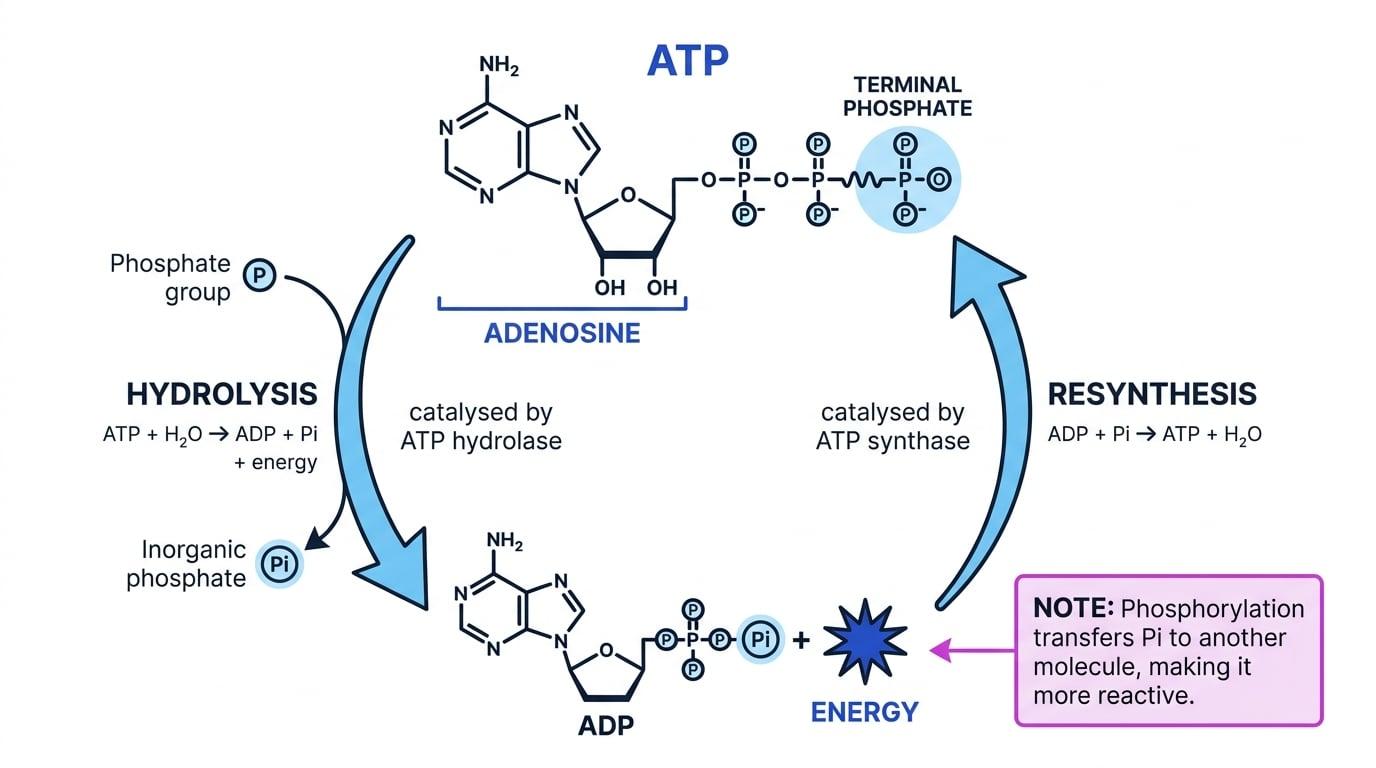
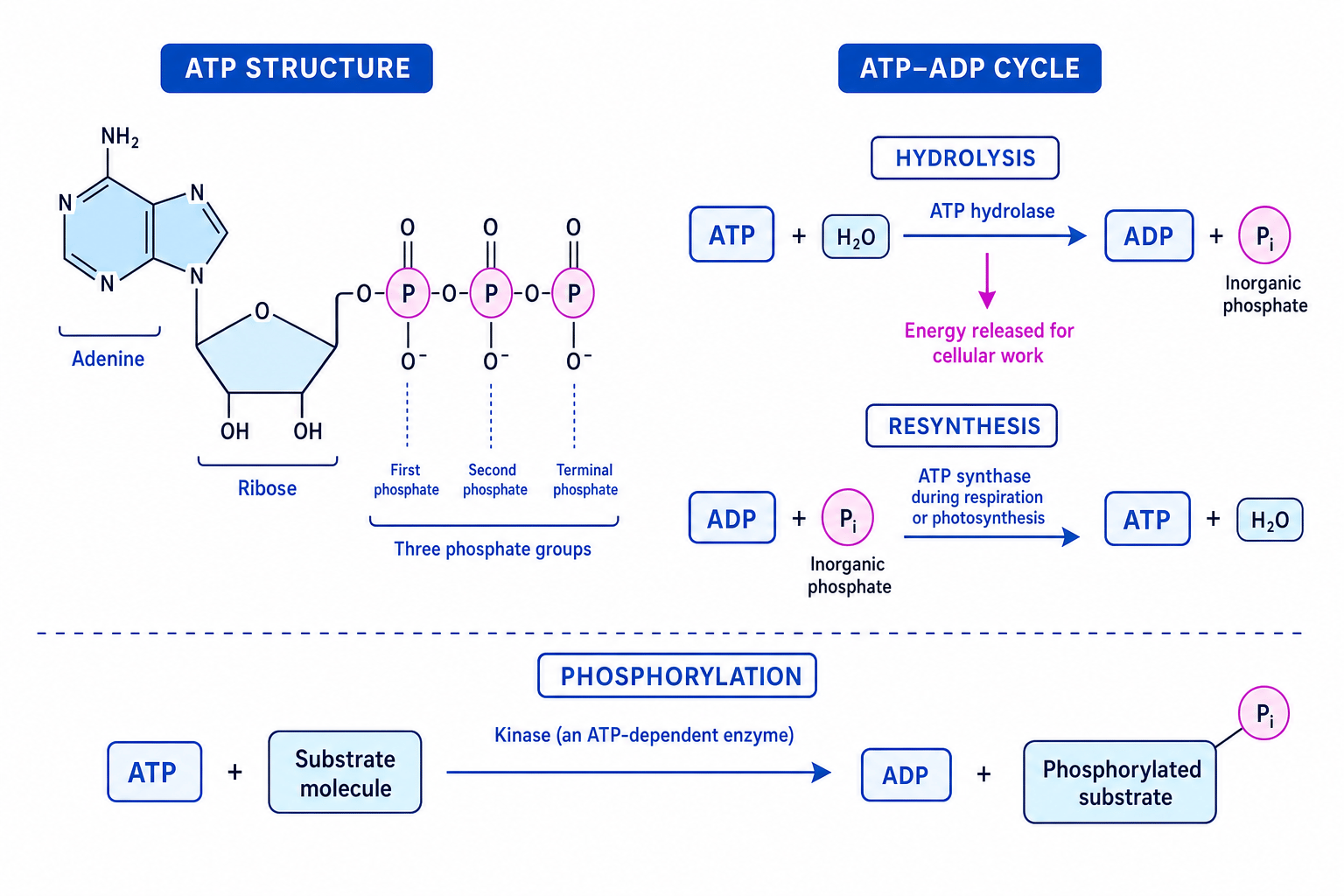
Adenosine triphosphate (ATP) is a nucleotide derivative made from one molecule of adenine, one molecule of ribose and three phosphate groups.
The structure of ATP
To understand ATP, start with a nucleotide. A nucleotide is a molecule made from:
- a pentose sugar, which is a five-carbon sugar
- a nitrogen-containing organic base, which contains nitrogen and acts as a base
- one or more phosphate groups
ATP is described as a nucleotide derivative because it is based on the same basic nucleotide pattern, but it has three phosphate groups rather than just one.
In ATP:
- the nitrogen-containing base is adenine
- the pentose sugar is ribose
- adenine plus ribose forms adenosine
- three phosphate groups are attached to the ribose
The final phosphate group is often called the terminal phosphate group. This is the phosphate group removed when ATP is hydrolysed.
Big picture
ATP is useful because it links energy-releasing processes, such as respiration, to energy-requiring processes, such as active transport and biosynthesis.
Hydrolysis of ATP
Hydrolysis means breaking a chemical bond using water. In cells, ATP is hydrolysed to form adenosine diphosphate, shortened to ADP, and inorganic phosphate, written as PiP_iPi.
ATP hydrolysis
ATP hydrolysis is the enzyme-catalysed reaction in which ATP reacts with water to form ADP and inorganic phosphate, transferring energy for cellular processes.
The reaction is:
ATP+H2O→ADP+Pi+energy\text{ATP} + \text{H}_2\text{O} \to \text{ADP} + P_i + \text{energy}ATP+H2O→ADP+Pi+energyThis reaction is catalysed by the enzyme ATP hydrolase.
The energy transferred from ATP hydrolysis can be used for processes such as:
- moving substances against a concentration gradient in active transport
- changing the shape of carrier proteins
- allowing muscle proteins to move relative to each other
- building larger molecules from smaller molecules
Do not say ATP stores lots of energy
ATP is not a long-term energy store like glycogen or lipids. It is an immediate energy-transfer molecule, and cells only keep a small supply because ATP is constantly being hydrolysed and resynthesised.
Coupling ATP hydrolysis to active transport
A cell pumps mineral ions from a region of lower concentration to a region of higher concentration. Explain how ATP is involved.
-
Moving ions from a lower concentration to a higher concentration is movement against the concentration gradient, so it requires energy.
-
ATP is hydrolysed to ADP and PiP_iPi, catalysed by ATP hydrolase, and energy is transferred to the transport protein.
-
The phosphate group can phosphorylate the transport protein, changing its shape so the ions are moved across the membrane.
Energy coupling
A reaction that needs energy is called an energy-requiring reaction. ATP hydrolysis can be coupled to these reactions, meaning the energy transferred by ATP hydrolysis is used directly to drive another process.
This matters because cells need energy to be released in small, controlled amounts. If all the energy from glucose were released at once, much of it would be wasted as heat and it would be difficult for the cell to use safely.
Coupled reaction
A coupled reaction is one in which the energy transferred from one reaction, such as ATP hydrolysis, is used to drive another reaction that would not otherwise happen easily.
A good exam phrase
Use wording like: “ATP hydrolysis is coupled to the energy-requiring reaction.” This is usually more precise than saying “ATP gives energy to the cell”.
Phosphorylation
When ATP is hydrolysed, the inorganic phosphate group released can be transferred to another molecule. This is called phosphorylation.
Phosphorylation
Phosphorylation is the addition of a phosphate group to a molecule.
Phosphorylation often makes a molecule:
- more reactive, because the phosphate group can make it less stable
- more likely to take part in the next reaction
- able to change shape or behaviour, especially if it is a protein
For example, in respiration, glucose is phosphorylated early in glycolysis. This helps make glucose more reactive so it can be broken down in later reactions.
Phosphorylating glucose
Explain why adding phosphate to glucose can help a cell start breaking it down in respiration.
-
ATP transfers a phosphate group to glucose, forming a phosphorylated glucose molecule and ADP.
-
The added phosphate group makes the molecule less stable and more reactive, so it is more likely to undergo the next enzyme-controlled reaction.
-
This helps the cell control the start of glucose breakdown, because phosphorylation links the reaction to ATP hydrolysis.
Resynthesis of ATP
ATP cannot simply be used up and thrown away. Cells need to resynthesise it continuously.
Resynthesis means making ATP again. It happens when ADP and inorganic phosphate join together in a condensation reaction.
Condensation reaction
A condensation reaction joins two molecules together and releases water.
ATP is resynthesised by this reaction:
ADP+Pi→ATP+H2O\text{ADP} + P_i \to \text{ATP} + \text{H}_2\text{O}ADP+Pi→ATP+H2OThis reaction is catalysed by the enzyme ATP synthase. ATP synthase is important during:
- respiration, where energy from respiratory substrates is used to make ATP
- photosynthesis, where energy from light is used to make ATP
You will meet the detailed mechanisms later, especially in respiration and photosynthesis. For now, the key point is that ATP is part of a cycle: hydrolysis releases energy for cellular work, and condensation resynthesises ATP.
ATP is recycled
ATP is not made once and kept forever. It is continuously hydrolysed to ADP and PiP_iPi, then resynthesised from ADP and PiP_iPi.
Why ATP is well suited to its role
ATP is a good immediate energy source because:
- it is small and soluble, so it can move around the cell
- hydrolysis is a single enzyme-controlled reaction
- it releases a manageable amount of energy, reducing waste as heat
- it can transfer a phosphate group to other molecules
- it can be rapidly resynthesised from ADP and PiP_iPi
Breaking bonds wording
Avoid saying “energy is released when the phosphate bond breaks”. Breaking bonds requires energy. The overall hydrolysis reaction transfers energy because the products, ADP and PiP_iPi, are more stable than ATP.
In the exam
-
If asked for ATP structure, name all three parts: adenine, ribose and three phosphate groups.
-
If asked about ATP hydrolysis, include: water is used, ATP hydrolase catalyses the reaction, and ADP plus inorganic phosphate are formed.
-
If asked how ATP helps another reaction, say that ATP hydrolysis is coupled to the process and that PiP_iPi may phosphorylate another compound, making it more reactive.
Check yourself
- What three components make up one molecule of ATP?
- What is the difference between ATP hydrolysis and ATP resynthesis?
- Why can phosphorylation make a molecule more reactive?