

What you'll learn
- What triglycerides and phospholipids are made from.
- How condensation reactions form ester bonds in triglycerides.
- How saturated and unsaturated fatty acids differ.
- Why lipid structure explains properties such as insolubility, energy storage, and membrane formation.
- How to carry out and interpret the emulsion test for lipids.
The starting point: what are lipids?
Lipids are a group of biological molecules that include triglycerides and phospholipids. They contain mainly carbon, hydrogen and oxygen; phospholipids also contain phosphorus.
Unlike carbohydrates and proteins, lipids are not polymers made from repeating monomers. Instead, they are built from smaller molecules such as glycerol and fatty acids.
Lipid
A lipid is a biological molecule that is insoluble in water but soluble in organic solvents such as ethanol, because much of its structure is non-polar.
Polar and non-polar molecules
A polar molecule has an uneven distribution of charge, so it can interact with water. A non-polar molecule has no significant charge separation, so it does not mix well with water.
Water is polar. Most lipid tails are non-polar hydrocarbon chains, meaning they are made mainly from carbon and hydrogen.
Why lipids do not dissolve in water
Most lipid molecules contain long non-polar hydrocarbon chains, so they are hydrophobic, meaning they repel water or do not mix with it.
Triglycerides
A triglyceride is a lipid made from one molecule of glycerol joined to three fatty acid molecules.
Glycerol and fatty acids
Glycerol is a three-carbon molecule with three hydroxyl groups. A fatty acid has a carboxyl group, written as RCOOH, attached to a hydrocarbon chain called the R group.
Each fatty acid joins to glycerol by a condensation reaction. A condensation reaction joins two molecules together and releases a molecule of water.
In a triglyceride, one glycerol molecule reacts with three fatty acid molecules, forming three ester bonds and releasing three water molecules.
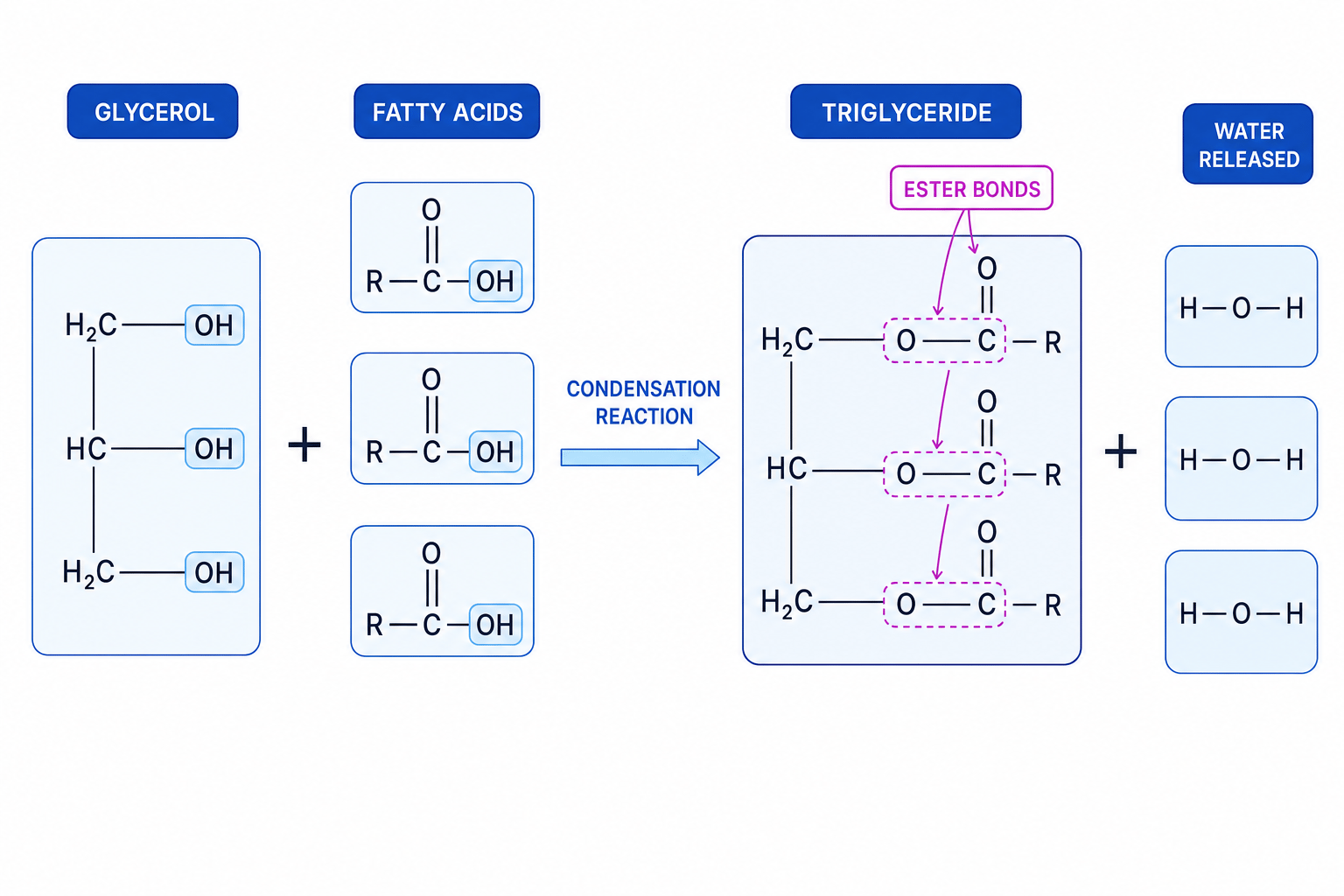
Ester bond
An ester bond is the chemical bond formed between the hydroxyl group of glycerol and the carboxyl group of a fatty acid during a condensation reaction.
Hydrolysis reverses condensation
A hydrolysis reaction breaks a bond using water. So triglycerides can be broken down into glycerol and fatty acids by hydrolysis of ester bonds.
Water in condensation and hydrolysis
Condensation releases water when a bond forms. Hydrolysis uses water when a bond breaks.
Saturated and unsaturated fatty acids
The R group of a fatty acid may be saturated or unsaturated.
A saturated fatty acid has no carbon-carbon double bonds in its hydrocarbon chain. It is “saturated” with hydrogen atoms because each carbon has the maximum possible number of hydrogens.
An unsaturated fatty acid has at least one carbon-carbon double bond in its hydrocarbon chain. This usually creates a kink in the chain.
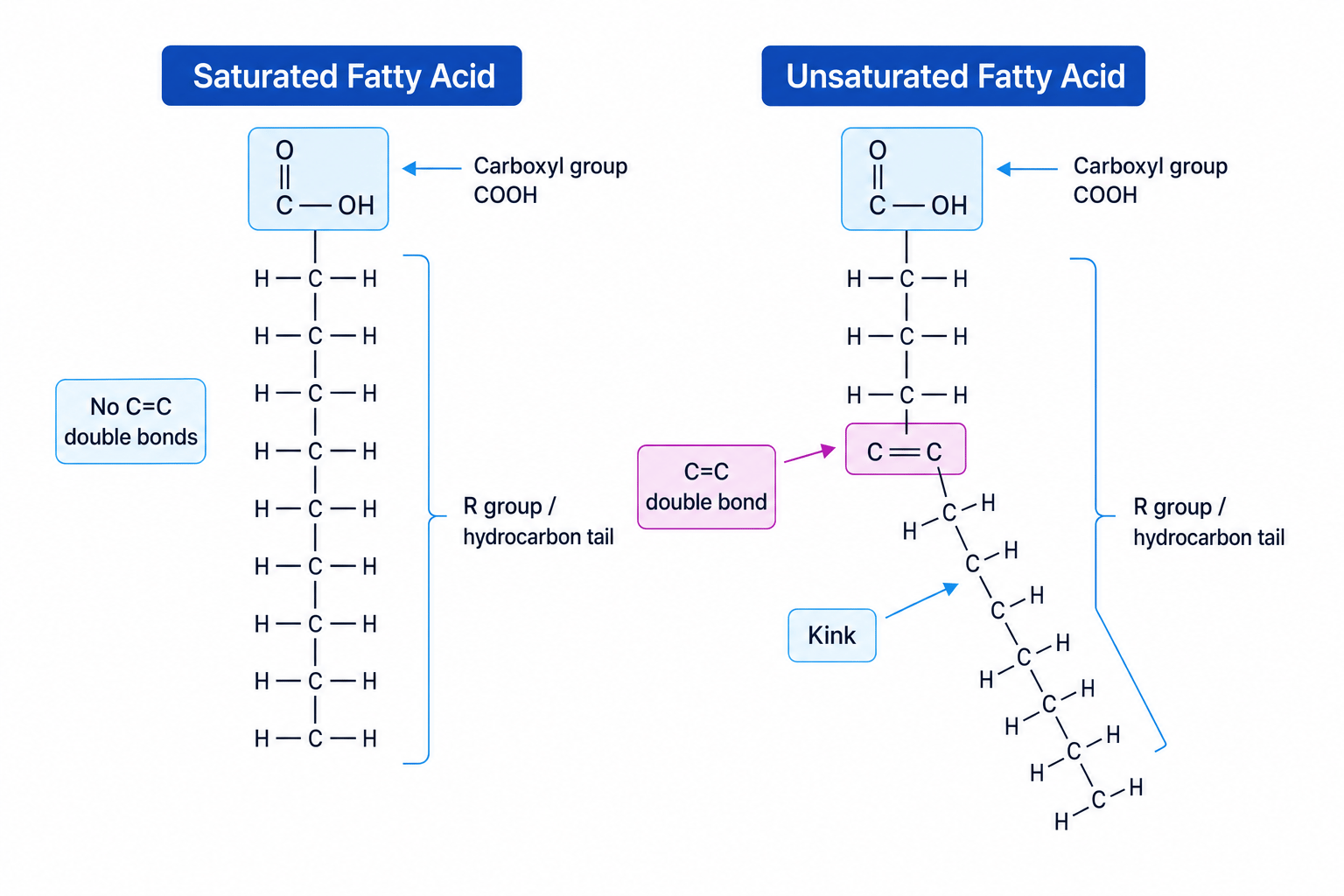
Why the double bond matters
Straight saturated fatty acid chains can pack closely together. This makes many saturated fats solid at room temperature.
Unsaturated fatty acids have kinks, so they cannot pack as closely. This often makes unsaturated lipids more fluid and gives them lower melting points.
Classifying a fatty acid
A diagram shows a fatty acid with a carboxyl group at one end and one carbon-carbon double bond in the hydrocarbon tail.
- Focus on the hydrocarbon tail, because saturation depends on carbon-carbon bonds in the R group.
- Identify the carbon-carbon double bond in the tail. The carboxyl group contains a carbon-oxygen double bond, but that does not make the fatty acid unsaturated.
- Since there is one carbon-carbon double bond, the fatty acid is unsaturated. More specifically, it is monounsaturated.
Counting the wrong double bond
Do not count the carbon-oxygen double bond in the carboxyl group. Saturation depends on carbon-carbon double bonds in the fatty acid chain.
Properties of triglycerides
Triglycerides are useful energy-storage molecules.
Their structure explains this:
- They contain many carbon-hydrogen bonds, which can release lots of energy during respiration.
- They are insoluble in water, so they do not affect the water potential of cells.
- They are large and non-polar, so they do not easily diffuse out of cells.
- They are compact energy stores, useful in seeds and adipose tissue.
- They can provide insulation and cushioning in animals.
Explaining why triglycerides are good storage molecules
A seed stores triglyceride rather than glucose as its main energy reserve. Explain why this is useful.
- Triglycerides have many carbon-hydrogen bonds, so they release a large amount of energy when respired.
- Triglycerides are insoluble in water, so storing them does not greatly affect the water potential of the seed cells.
- Triglycerides are compact and non-polar, so they can be stored efficiently without diffusing away easily.
Phospholipids
A phospholipid is similar to a triglyceride, but one of the three fatty acids is replaced by a phosphate-containing group.
So a phospholipid has:
- one glycerol molecule
- two fatty acid tails
- one phosphate-containing head
The phosphate-containing head is hydrophilic, meaning it interacts with water. The fatty acid tails are hydrophobic.
Amphipathic
An amphipathic molecule has both a hydrophilic part and a hydrophobic part. Phospholipids are amphipathic because they have a hydrophilic phosphate-containing head and hydrophobic fatty acid tails.
Phospholipids form bilayers in water. The hydrophilic heads face the water, while the hydrophobic tails point inwards, away from water. This is the basic structure of cell-surface membranes and membranes around organelles.
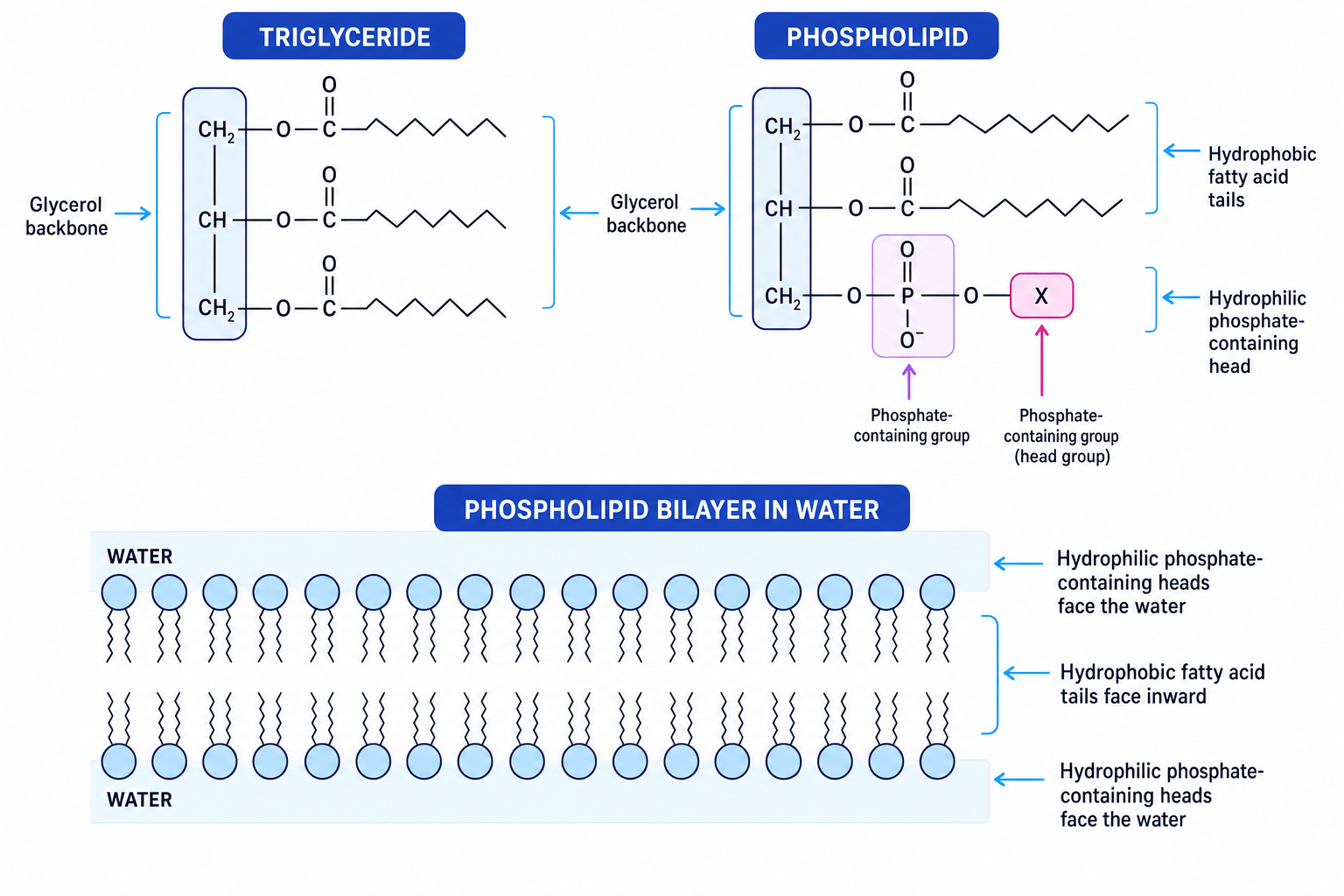
Structure explains function
Triglycerides are mainly hydrophobic energy stores. Phospholipids are amphipathic, so they naturally form bilayers that act as barriers in membranes.
Comparing triglycerides and phospholipids
| Feature | Triglyceride | Phospholipid |
|---|---|---|
| Main structure | Glycerol plus three fatty acids | Glycerol plus two fatty acids plus a phosphate-containing group |
| Interaction with water | Hydrophobic and insoluble | Amphipathic: hydrophilic head and hydrophobic tails |
| Main biological role | Energy storage, insulation and protection | Formation of cell membranes |
| Key structural reason | Long non-polar fatty acid chains | Polar phosphate-containing head plus non-polar tails |
The emulsion test for lipids
The emulsion test is a biochemical test used to detect lipids. An emulsion is a cloudy mixture formed when tiny droplets of one liquid are dispersed through another liquid.
This is a practical technique you should be able to carry out and interpret.
Method
- Add the sample to a clean test tube.
- Add ethanol and shake to dissolve any lipid present.
- Add distilled water.
- Shake gently and observe.
A positive result is a cloudy white or milky emulsion. A negative result remains clear.
Why the test works
Lipids dissolve in ethanol, but they do not dissolve in water. When water is added, the lipid comes out of solution as tiny droplets. These droplets scatter light, producing a white cloudy emulsion.
Interpreting an emulsion test
A student tests two food samples. After ethanol is added and shaken, water is added. Sample A stays clear. Sample B forms a cloudy white emulsion.
- A cloudy white emulsion shows that tiny lipid droplets have formed after water was added.
- Sample B therefore contains lipid, because lipid dissolved in ethanol but became dispersed as droplets in water.
- Sample A gives a negative result because it remains clear, so there is no evidence of lipid in that sample.
Improving reliability
Use a known lipid as a positive control and distilled water as a negative control. This helps you check that the test procedure and reagents are working properly.
Ethanol safety
Ethanol is flammable, so keep it away from flames and wear eye protection during practical work.
In the exam
- When asked about triglyceride formation, name the molecules: one glycerol plus three fatty acids, forming three ester bonds and three water molecules.
- For saturated versus unsaturated fatty acids, look for carbon-carbon double bonds in the hydrocarbon tail, not the carboxyl group.
- When explaining properties, always link structure to function: non-polar tails explain insolubility; phosphate heads explain bilayer formation.
- For the emulsion test, state both the reagent sequence and the positive result: ethanol, then water, then cloudy white emulsion.
Check yourself
- How many ester bonds are present in one triglyceride molecule?
- Why do phospholipids form bilayers in water?
- What result would you expect from the emulsion test if a food sample contains lipid?
