What you'll learn
- Why water molecules are polar and form hydrogen bonds.
- How water acts as a metabolite in condensation and hydrolysis reactions.
- Why water is such an important solvent for life.
- How hydrogen bonding explains water’s high heat capacity, high latent heat of vaporisation, cohesion, and surface tension.
Why water matters in cells
Water is a major component of cells. Cytoplasm, blood plasma, tissue fluid, sap in plants, and many other biological fluids are mostly water.
That matters because most enzyme-controlled reactions happen in an aqueous environment, meaning an environment based on water.
To understand water’s biological importance, you need to start with the structure of a water molecule.
The structure of water
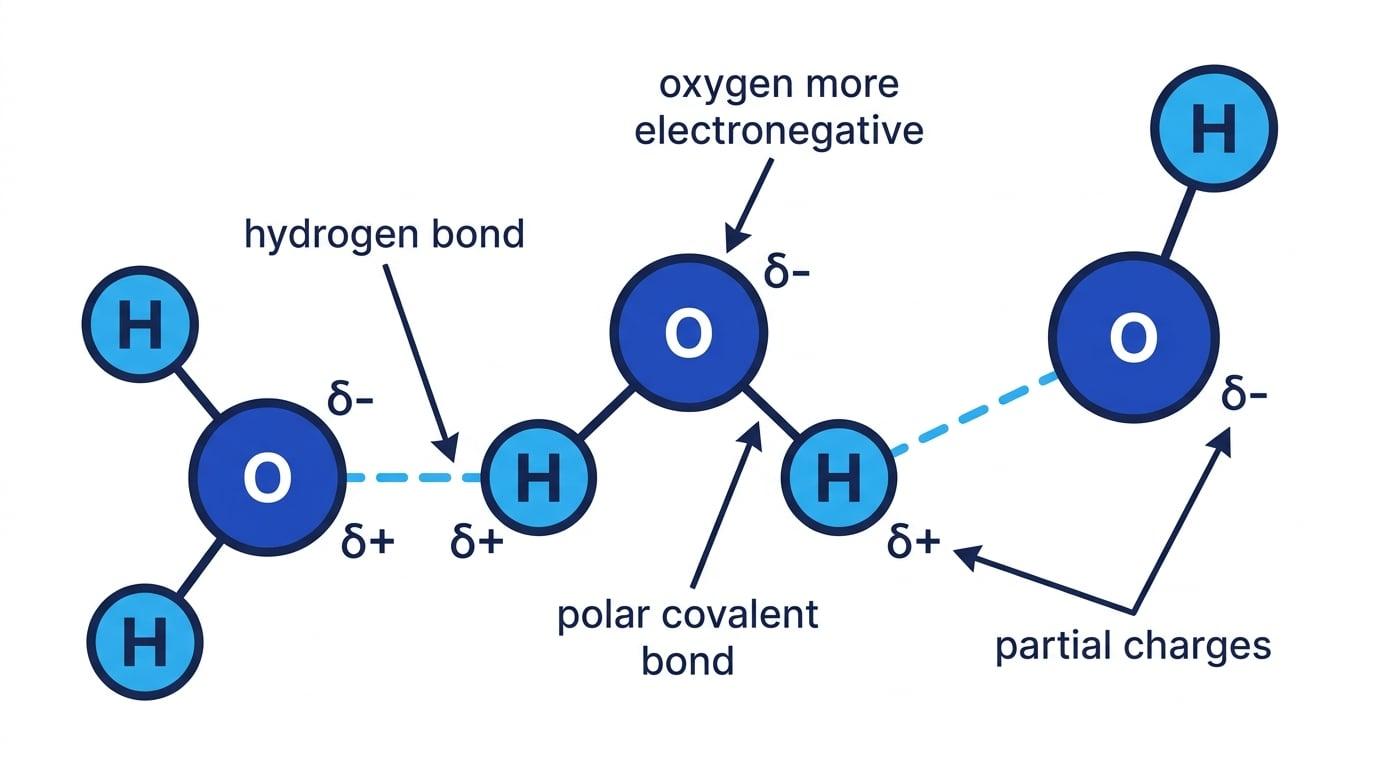
A water molecule, H₂O, contains one oxygen atom covalently bonded to two hydrogen atoms. A covalent bond is a bond in which atoms share a pair of electrons.
Oxygen is more electronegative than hydrogen. Electronegativity means the ability of an atom to attract shared electrons in a covalent bond. Oxygen pulls the shared electrons closer to itself, so the oxygen side of the molecule becomes slightly negative, while the hydrogen sides become slightly positive.
Polar molecule
A polar molecule has an uneven distribution of charge, so different parts of the molecule have slight opposite charges.
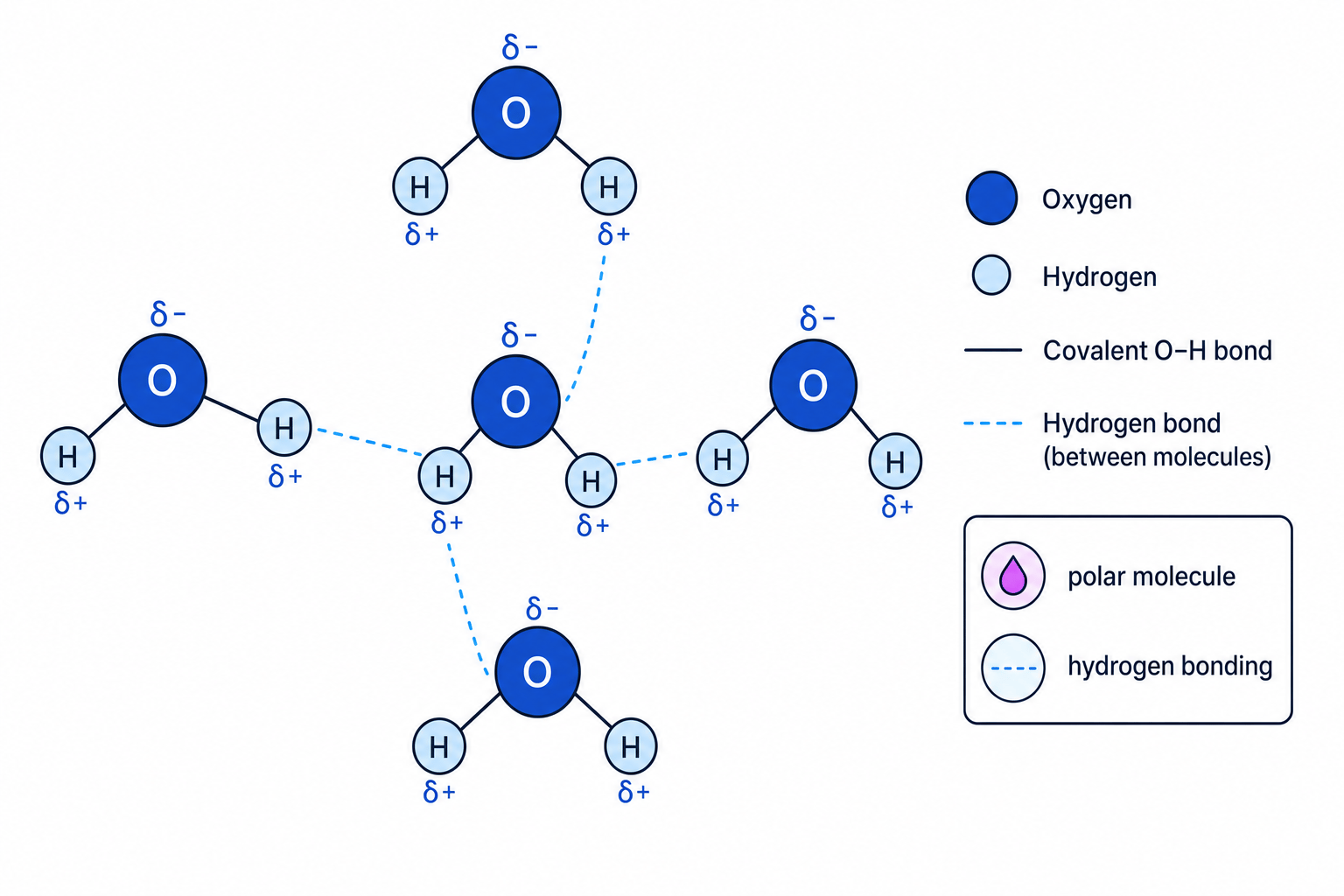
Because water is polar, neighbouring water molecules attract each other. The slightly positive hydrogen of one water molecule is attracted to the slightly negative oxygen of another water molecule. This attraction is called a hydrogen bond.
Hydrogen bond
A hydrogen bond is a weak attraction between a slightly positive hydrogen atom in one molecule and a slightly negative atom, often oxygen or nitrogen, in another molecule or another part of the same molecule.
The key point is that individual hydrogen bonds are weak, but there are huge numbers of them in water, so together they have major effects.
Structure explains properties
Most of water’s biological properties come from two linked ideas: water is polar, and water molecules form hydrogen bonds with each other.
Linking polarity to hydrogen bonding
- Oxygen attracts the shared electrons in each O–H bond more strongly than hydrogen does, so oxygen becomes slightly negative and the hydrogens become slightly positive.
- Opposite charges attract, so the slightly positive hydrogen of one water molecule is attracted to the slightly negative oxygen of a nearby water molecule.
- This attraction is a hydrogen bond. Many hydrogen bonds between water molecules explain properties such as cohesion, high heat capacity, and high latent heat of vaporisation.
Water as a metabolite
A metabolite is a substance that is used or produced in a metabolic reaction. Metabolism is the sum of all the chemical reactions happening in a cell or organism.
Water is not just a background liquid. It is directly involved in many biochemical reactions.
Condensation reactions
A condensation reaction joins two molecules together and produces water.
For example, when two amino acids join, a peptide bond forms between them and water is released. Condensation reactions are also used to build carbohydrates, proteins, and nucleic acids from smaller monomers.
Hydrolysis reactions
A hydrolysis reaction breaks a chemical bond using water.
For example, during digestion, large biological molecules are broken down into smaller soluble molecules by hydrolysis. Water is added across the bond that is being broken.
Condensation and hydrolysis
Do not mix these up: condensation produces water when molecules join; hydrolysis uses water when molecules are broken apart.
Identifying condensation and hydrolysis
- If two amino acids join to form a dipeptide, a new peptide bond is formed between them. Forming a bond between biological monomers is usually a condensation reaction.
- In condensation, atoms are removed from the reacting molecules and combine to form water, so water is produced.
- If the dipeptide is later split back into two amino acids, water is added across the peptide bond. That reverse reaction is hydrolysis.
Water as a solvent
A solvent is a liquid that dissolves other substances. A solute is the substance that dissolves. A solution is formed when a solute is dissolved in a solvent.
Water is an excellent solvent for many ionic and polar substances. An ion is a charged particle. Because water is polar, its slightly charged ends can attract ions and other polar molecules.
For example, the slightly negative oxygen end of water is attracted to positive ions, while the slightly positive hydrogen ends are attracted to negative ions. This helps separate ions and keep them dissolved.
This is vital in biology because metabolic reactions usually happen in solution. Dissolved reactants can move around, collide, and bind to enzyme active sites.
Water also helps transport substances, such as glucose, amino acids, mineral ions, and urea, in organisms.
Hydrophilic and hydrophobic
A hydrophilic substance interacts with water and tends to dissolve in it. A hydrophobic substance does not interact well with water and tends not to dissolve.
Non-polar substances, such as many lipids, are generally hydrophobic. This is important for membranes, because phospholipid tails avoid water and help form the membrane bilayer.
Predicting whether a substance dissolves in water
- Sodium chloride contains charged sodium ions and chloride ions. Polar water molecules can orientate around these ions: oxygen ends face positive ions, and hydrogen ends face negative ions.
- These attractions help separate and stabilise the ions in solution, so sodium chloride dissolves readily in water.
- A triglyceride has long non-polar hydrocarbon tails. Water cannot form strong attractions with these tails, so triglycerides are much less soluble in water.
High heat capacity
Water has a relatively high heat capacity. In biology, this is often discussed as specific heat capacity.
Specific heat capacity
Specific heat capacity is the energy required to raise the temperature of 1 kg of a substance by 1 °C, or by 1 K.
Water’s heat capacity is high because a lot of energy is needed to disrupt the hydrogen bonds between water molecules. As a result, water changes temperature relatively slowly.
This is very useful in living organisms. Cells rely on enzymes, and enzymes are sensitive to temperature. Since cells contain a lot of water, water helps buffer changes in temperature.
It also stabilises aquatic habitats. Large bodies of water warm up and cool down slowly, so organisms living in them are less exposed to rapid temperature changes.
Explaining temperature stability in a pond
- Sunlight transfers energy to the pond water, but much of this energy is used to disrupt hydrogen bonds between water molecules.
- Because less of the energy immediately increases the movement of the water molecules, the temperature rises slowly.
- A slow temperature change helps aquatic organisms maintain enzyme activity and reduces the risk of sudden temperature stress.
High latent heat of vaporisation
Water has a relatively large latent heat of vaporisation.
Latent heat of vaporisation
Latent heat of vaporisation is the energy needed for a liquid to change into a gas without a rise in temperature.
For water molecules to evaporate, hydrogen bonds between water molecules must be broken. This requires a lot of energy.
Evaporation therefore removes a lot of heat energy from a surface. This produces a cooling effect with relatively little loss of water.
This is important in sweating in mammals and transpiration in plants. When sweat evaporates from skin, or water evaporates from leaf surfaces, heat energy is taken away.
Heat capacity vs latent heat
High heat capacity is about resisting a temperature increase. High latent heat of vaporisation is about needing lots of energy for evaporation. Both involve hydrogen bonds, but they answer different questions.
Explaining cooling by sweating
- The water in sweat absorbs energy from the skin to break hydrogen bonds between water molecules.
- The fastest-moving water molecules escape as water vapour, taking energy away from the skin surface.
- The average kinetic energy of the remaining molecules is lower, so the skin cools while only a relatively small amount of water is lost.
Cohesion, adhesion and surface tension
Water molecules are strongly cohesive because they form hydrogen bonds with each other.
Cohesion
Cohesion is attraction between molecules of the same substance. In water, cohesion is caused mainly by hydrogen bonds between water molecules.
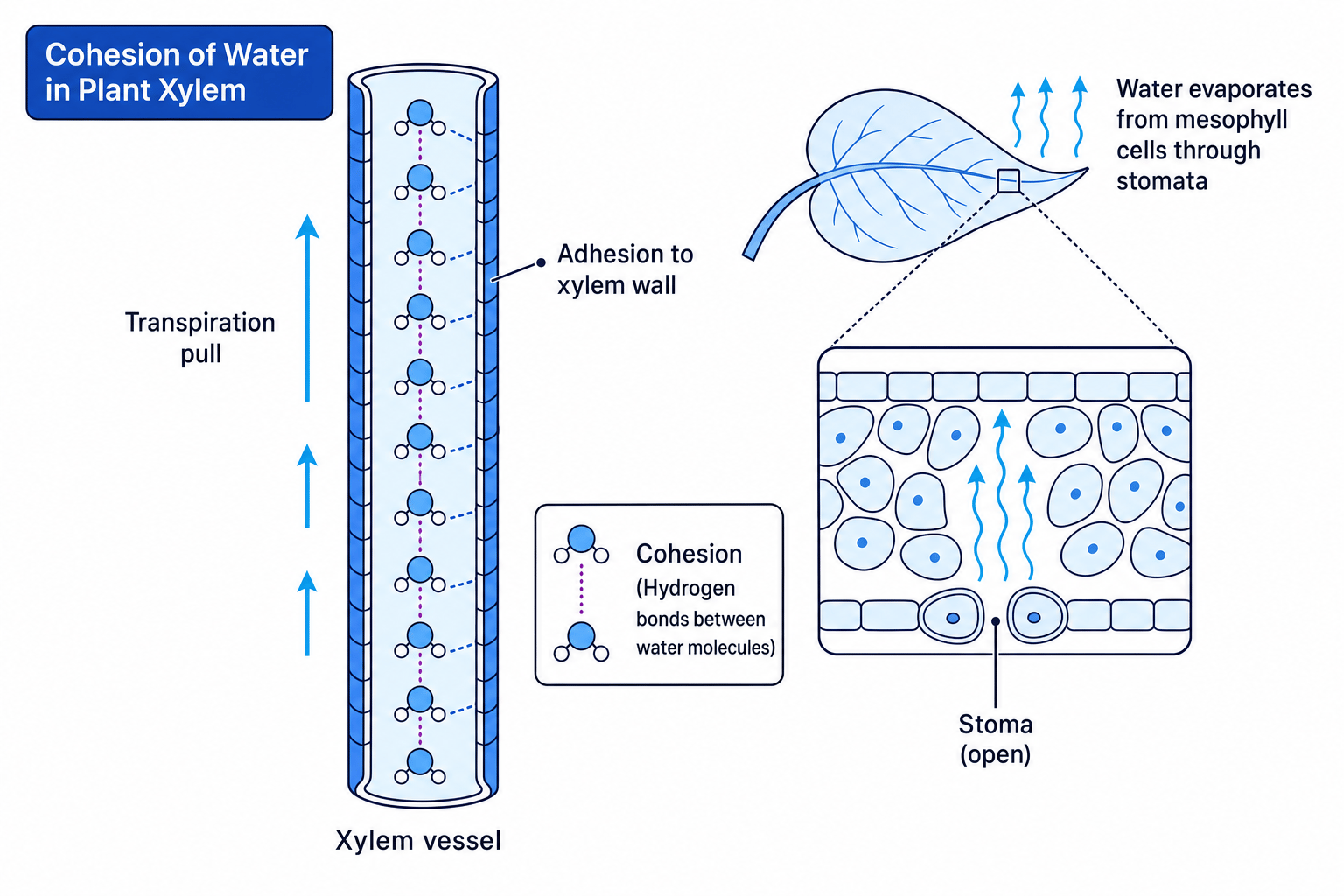
Cohesion helps water form continuous columns in the tube-like transport cells of plants, called xylem vessels. When water evaporates from leaves, it creates a pulling force. Because water molecules stick together, this pull is transmitted down the column of water in the xylem.
Adhesion is attraction between molecules of different substances. In xylem, water also adheres to the xylem walls, helping maintain the continuous column.
Water also has surface tension where it meets air. Surface tension is the tension at the surface of a liquid caused by cohesive forces between molecules. In water, hydrogen bonding pulls surface molecules together, making the surface behave slightly like a stretched film.
Explaining water movement in xylem
- Water evaporates from mesophyll cell surfaces in the leaf, producing a pulling force at the top of the xylem.
- Cohesion means water molecules pull on neighbouring water molecules, so the pull is transmitted down the continuous water column.
- Adhesion between water and the xylem walls helps resist the column breaking, allowing water to move upwards through the plant.
The big picture
Water’s importance is not a list of random facts. It is a chain of reasoning:
- Water molecules are polar.
- Polar water molecules form hydrogen bonds.
- Hydrogen bonding gives water unusual properties.
- Those properties make water essential for cells, organisms, and ecosystems.
In the exam
- For “explain” questions, link structure → property → biological importance. For example: polar water forms hydrogen bonds, giving cohesion, which helps maintain water columns in xylem.
- Use the correct reaction language: condensation produces water; hydrolysis uses water.
- Keep heat capacity and latent heat separate. Heat capacity buffers temperature change; latent heat of vaporisation allows cooling by evaporation.
- If asked about solvent properties, mention water’s polarity and its ability to dissolve ions and polar molecules so metabolic reactions can occur in solution.
Check yourself
- Why does the polarity of water lead to hydrogen bonding between water molecules?
- A disaccharide is broken into two monosaccharides by adding water. What type of reaction is this, and why?
- How do hydrogen bonds explain both cohesion in xylem and cooling by evaporation?