

What you'll learn
- How electricity is generated from wind, water, geothermal resources, solar heating, solar cells, fossil fuels and nuclear power.
- The difference between renewable and non-renewable energy resources.
- How to compare resources for large-scale electricity production.
- How to write clear energy-transfer chains in Edexcel IGCSE answers.
These specification points, 4.18P and 4.19P, are Paper 2 only, but they are very useful because they connect energy transfers with real-world choices.
1. Electricity generation is an energy transfer
When people say electricity is “generated”, they do not mean energy is created from nothing. Energy is transferred from one store to another. The useful final output is electrical energy.
Energy resource
An energy resource is a store or source of energy that can be used to provide useful energy transfers, such as heating, transport or electricity generation.
Electricity generation
Electricity generation is the process of transferring energy from an energy resource into electrical energy, usually using a generator.
A turbine is a set of blades that spins when pushed by a moving fluid. A fluid means a liquid or a gas. In many power stations, moving steam, water or air spins a turbine.
A generator transfers the kinetic energy of the spinning turbine into electrical energy. You will study the detailed physics of generators later, but for this topic the key idea is simple: spinning turbine to generator to electrical energy.
The common pattern
Many electricity-generation methods use the same final steps: a turbine has kinetic energy, the turbine drives a generator, and the generator transfers energy electrically.
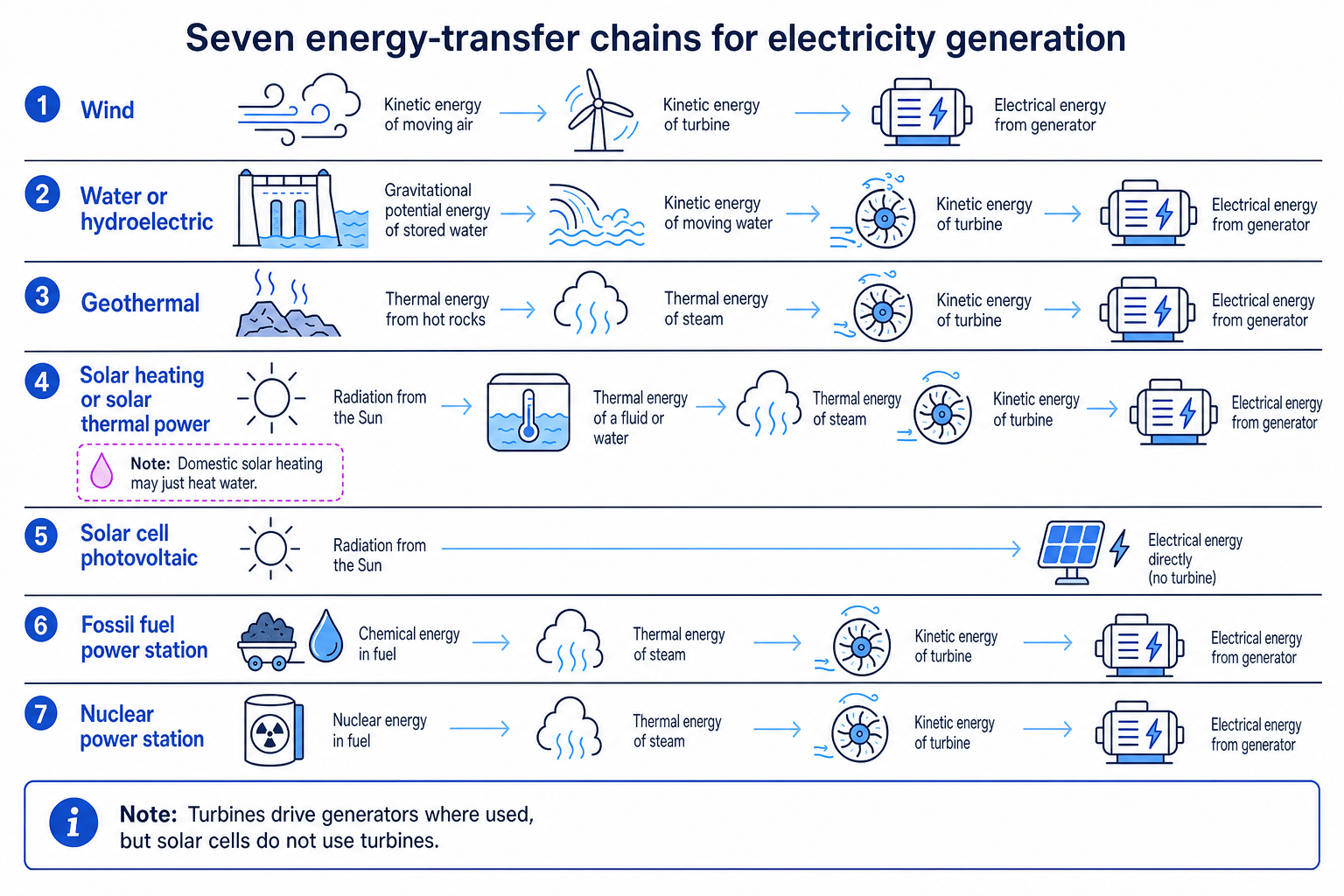
The diagram below summarises the main energy-transfer chains you need for this specification point.
Writing an energy-transfer chain
A gas-fired power station burns natural gas to produce electricity.
- Choose the starting store: natural gas is a fossil fuel, so the initial store is chemical energy in the fuel.
- Apply the thermal power-station pattern: burning transfers energy by heating water, producing high-pressure steam with thermal energy.
- Link the steam to motion: the moving steam transfers energy to the turbine, increasing the turbine’s kinetic energy.
- Finish with the generator: the generator transfers the turbine’s kinetic energy into electrical energy, with some energy dissipated to the surroundings.
So the chain is: chemical energy in fuel → thermal energy of steam → kinetic energy of turbine → electrical energy from the generator.
2. Renewable and non-renewable resources
Renewable and non-renewable resources
A renewable energy resource is replenished naturally on a human timescale. A non-renewable energy resource is used up faster than it is replaced, so it is finite.
Renewable resources include wind, water, geothermal energy and solar energy. Non-renewable resources include fossil fuels and nuclear fuels such as uranium.
Be careful: renewable does not automatically mean “perfect”. A renewable resource may still be expensive, unreliable, visually intrusive or damaging to habitats.
Renewable does not mean continuous
Wind and solar energy are renewable, but they are also intermittent. Intermittent means the output changes depending on conditions, such as wind speed, cloud cover or day and night.
3. Energy transfers for each method
Wind
Wind has kinetic energy because the air is moving. The moving air turns turbine blades. The turbine drives a generator.
Energy transfer chain:
kinetic energy of moving air → kinetic energy of turbine → electrical energy from generator
Wind power is renewable and produces no greenhouse gases while generating electricity. Greenhouse gases, such as carbon dioxide, trap thermal radiation in the atmosphere and contribute to climate change.
Water
For hydroelectric power, water stored high up behind a dam has gravitational potential energy. When released, the water moves downhill and turns turbines.
Energy transfer chain:
gravitational potential energy of stored water → kinetic energy of moving water → kinetic energy of turbine → electrical energy from generator
Other water-based systems, such as tidal power, also use moving water to turn turbines. Tidal power is more predictable than wind because tides follow regular patterns, but suitable sites are limited.
Geothermal resources
Geothermal energy comes from thermal energy stored in hot rocks underground. Water is pumped down, heated by the rocks, and returns as hot water or steam. The steam can turn a turbine.
Energy transfer chain:
thermal energy from hot rocks → thermal energy of steam → kinetic energy of turbine → electrical energy from generator
Geothermal power can provide a steady supply, but it only works well in places with suitable hot rocks close enough to the surface.
Solar heating systems
A solar heating system uses radiation from the Sun to heat water or another fluid. In domestic systems, the useful output may simply be hot water.
For large-scale solar thermal electricity generation, mirrors can concentrate sunlight to heat a fluid and produce steam. The steam turns a turbine connected to a generator.
Energy transfer chain for solar thermal electricity:
radiation from the Sun → thermal energy of fluid or water → thermal energy of steam → kinetic energy of turbine → electrical energy from generator
Solar cells
A solar cell, also called a photovoltaic cell, transfers energy from sunlight directly into electrical energy. It does not need steam, a turbine or a generator.
Energy transfer chain:
radiation from the Sun → electrical energy
Solar cells vs solar heating
Solar cells produce electrical energy directly. Solar heating systems first transfer energy to a thermal store, usually heating water or another fluid.
Fossil fuels
Fossil fuels include coal, oil and natural gas. They formed from ancient living material over millions of years, so they are non-renewable.
In a fossil fuel power station, fuel is burned. The energy released heats water, producing steam. The steam turns a turbine, and the turbine drives a generator.
Energy transfer chain:
chemical energy in fuel → thermal energy of steam → kinetic energy of turbine → electrical energy from generator
Fossil fuel stations can produce large amounts of electricity reliably, but they release carbon dioxide and other pollutants.
Nuclear power
In a nuclear power station, energy is released from nuclear fuel, usually uranium, by nuclear fission. Nuclear fission is the splitting of large unstable nuclei, releasing energy. This energy is used to heat water and produce steam.
Energy transfer chain:
nuclear energy in fuel → thermal energy of steam → kinetic energy of turbine → electrical energy from generator
Nuclear power does not release carbon dioxide during generation, but it produces radioactive waste, which gives out ionising radiation and must be stored safely for a long time.
Spot the repeated power-station pattern
Fossil fuel, nuclear, geothermal and solar thermal stations all commonly use steam to turn a turbine. The starting energy store is different, but the final steps are very similar.
4. Comparing large-scale electricity production
Large-scale electricity production
Large-scale electricity production means producing enough electrical energy to supply many homes, businesses or industry, usually through the National Grid.
When comparing methods, think about:
- Reliability: can it produce electricity when needed?
- Cost: building cost, running cost and fuel cost.
- Environmental impact: pollution, greenhouse gases, land use and habitat damage.
- Site suitability: whether the local conditions are suitable.
- Power output: whether it can provide enough electricity for demand.
| Resource | Main advantages | Main disadvantages |
|---|---|---|
| Wind | Renewable; no fuel cost; no greenhouse gases during generation | Intermittent; visual and noise concerns; needs windy sites |
| Water | Renewable; hydroelectric power can respond quickly to demand; tidal power is predictable | Expensive to build; limited suitable sites; can flood land or affect habitats |
| Geothermal | Renewable if managed well; reliable steady output; low emissions during operation | Only suitable in some regions; drilling is expensive; may release underground gases |
| Solar heating or solar thermal | Renewable; low running cost; useful in sunny regions | Intermittent; needs large sunny areas for high output; weaker at night or in cloudy weather |
| Solar cells | Renewable; no moving parts; useful in remote places; no emissions during operation | Intermittent; large areas needed for high output; manufacturing has environmental costs |
| Fossil fuels | Reliable; high power output; existing technology and infrastructure | Non-renewable; releases carbon dioxide; can release pollutants; mining and drilling damage environments |
| Nuclear | Very high power output; reliable base-load supply; no carbon dioxide during generation | Radioactive waste; expensive to build and decommission; nuclear fuel is non-renewable |
Base-load supply means electricity produced steadily for long periods. Nuclear and some fossil fuel stations are often used for this because they can run continuously. Wind and solar are less suitable for base-load on their own because their output depends on the weather.
Choosing a large-scale resource mix
A coastal region has strong winds, a large tidal estuary, no high mountains, and wants low carbon dioxide emissions with reliable electricity.
- Remove unsuitable choices: no high mountains means a conventional hydroelectric reservoir is unlikely, and there is no evidence of geothermal hot rocks.
- Match resources to the location: strong coastal winds support wind turbines, and the tidal estuary could support tidal turbines or a tidal barrage.
- Test reliability: wind is intermittent, while tides are predictable but not constant, so using both is more reliable than wind alone.
- Balance benefits and drawbacks: wind and tidal power have no fuel cost and low emissions during operation, but both need high construction costs and may affect local habitats or views.
A strong recommendation is wind plus tidal power, supported by storage, a grid connection or another controllable source for periods of low output.
5. How to write strong comparison answers
For “describe advantages and disadvantages” questions, avoid one-sided answers. A good response usually compares at least two factors, such as reliability and environmental impact.
For example, “wind is renewable” is true, but it is not enough on its own. A stronger answer is: “Wind is renewable and has no fuel cost, but its output is intermittent, so another source may be needed when wind speeds are too low.”
There is no perfect resource
The best electricity-generation method depends on the location, required output, reliability needed, cost and environmental priorities.
In the exam
- For energy-transfer questions, start with the resource’s initial energy store and end with electrical energy.
- If a turbine is used, include kinetic energy of the turbine before the generator.
- For comparison questions, always give both an advantage and a disadvantage, and link them to reliability, cost, environmental impact or site suitability.
Check yourself
- How is a solar cell different from a solar heating system?
- Why do fossil fuel and nuclear power stations have similar final energy-transfer steps?
- Give one advantage and one disadvantage of using wind power for large-scale electricity production.

