

What you'll learn
- What a physical quantity and a unit mean in physics.
- The wave-topic units in Edexcel IGCSE Physics 3.1: degree (°), hertz (Hz), metre (m), metre/second (m/s) and second (s).
- How to choose the correct unit for wavelength, frequency, time, speed and angles.
- How to avoid common unit mistakes in wave calculations and ray diagrams.
Why units matter
A number on its own is not enough in physics. If you write “5”, that could mean 5 metres, 5 seconds, 5 hertz, or something else entirely. The unit tells the reader what kind of measurement the number represents.
In the Waves topic, the same diagram might involve distances, times, rates and angles, so units help you stay organised.
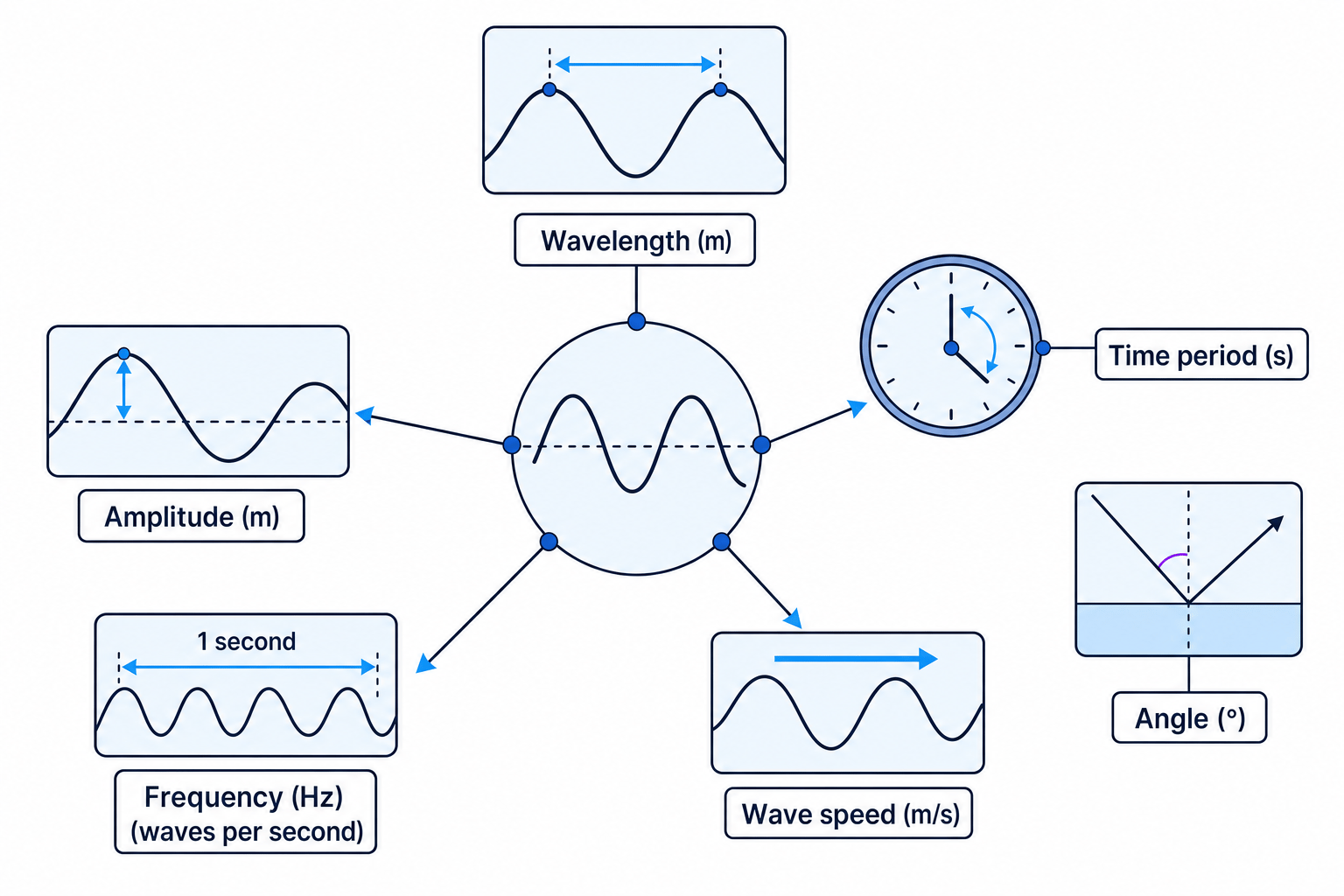
Physical quantity and unit
A physical quantity is something that can be measured, such as length, time, speed, frequency or angle. A unit is the agreed standard used to measure that quantity, such as metre, second or hertz.
A value needs a unit
In physics, a measurement is only complete when it has both a number and a unit, for example 0.50 m, 2.0 s or 440 Hz.
Quantity symbols and unit symbols
Physics often uses letter symbols for quantities. These are different from unit symbols.
For example:
| Quantity | Common symbol | Unit |
|---|---|---|
| wavelength | lambda | metre (m) |
| time period | T | second (s) |
| frequency | f | hertz (Hz) |
| wave speed | v | metre/second (m/s) |
| angle | theta | degree (°) |
You will often see wavelength written as λ\lambdaλ and angle written as θ\thetaθ. These are Greek letters used as quantity symbols, not units.
The letter s can mean two different things
In equations, sss can be used as a symbol for distance moved, but plain s is also the unit symbol for seconds. Read the context carefully.
Metre (m): measuring lengths in waves
The metre (m) is the SI unit of length. SI means the International System of Units, the standard set of units used in science.
In waves, you use metres for distances such as:
- wavelength: the distance from one point on a wave to the same point on the next wave, such as crest to crest;
- amplitude: the maximum displacement from the undisturbed position;
- distance travelled by a wave.
Metre (m)
The metre, symbol m, is the unit used for length and distance in this topic.
Sometimes a question gives a length in centimetres or millimetres. For Edexcel IGCSE calculations, it is usually safest to convert to metres before using wave equations.
Converting a wavelength to metres
A ripple has a wavelength of 12 cm. Convert this to metres.
-
Use the conversion 100 cm = 1 m, so centimetres are converted to metres by dividing by 100.
-
Calculate the wavelength in metres:
- The wavelength you should use in calculations is therefore 0.12 m.
Quick length conversions
For wave calculations: divide by 100 to change cm to m, and divide by 1000 to change mm to m.
Second (s): measuring time
The second (s) is the SI unit of time.
In waves, seconds are used for:
- the time taken for a wave to travel a distance;
- the time taken for several waves to pass a point;
- the time period of a wave.
Time period
The time period, usually symbol TTT, is the time taken for one complete oscillation or one complete wave cycle. Its unit is the second (s).
An oscillation is one complete repeated movement, such as moving from the middle to the top, down to the bottom, and back to the middle again.
Finding the time period
A vibrating source completes 5 complete oscillations in 2.0 s. Find the time period.
- The time period is the time for one oscillation, so divide the total time by the number of oscillations:
- Substitute the values with units:
- Calculate the result:
Writing sec instead of s
The correct unit symbol for second is s, not sec or secs. Unit symbols do not take plurals, so write 5 s, not 5 secs.
Hertz (Hz): measuring frequency
The hertz (Hz) is the unit of frequency.
Frequency and hertz
Frequency, usually symbol fff, is the number of complete waves or oscillations each second. A frequency of 1 Hz means 1 complete wave or oscillation per second.
So:
- 2 Hz means 2 complete oscillations each second;
- 50 Hz means 50 complete oscillations each second;
- a higher frequency means more oscillations every second.
Frequency and time period are linked because they describe the same repeating motion in different ways:
frequency = 1 ÷ time period
f=1T f = \frac{1}{T} f=T1and rearranging:
time period = 1 ÷ frequency
T=1f T = \frac{1}{f} T=f1Calculating frequency from time period
A wave has a time period of 0.25 s. Find its frequency.
- Choose the relationship between frequency and time period:
- Substitute the time period:
- Calculate the frequency. Since hertz means “per second”, the unit is Hz:
Sense-checking frequency
If the time period is small, the frequency should be large. If each cycle takes only a short time, lots of cycles can happen every second.
Metre/second (m/s): measuring speed
The unit metre/second (m/s) means metres travelled per second. It is used for speed.
In the Waves topic, wave speed tells you how quickly the wave disturbance or wave energy travels through space.
Metre/second (m/s)
The unit metre/second, written m/s, is the unit for speed. It means the number of metres travelled in each second.
From the Motion topic, the speed equation is:
average speed = distance moved ÷ time taken
v=st v = \frac{s}{t} v=tsHere, vvv is speed, sss is distance moved and ttt is time taken.
Calculating wave speed from distance and time
A water wave travels 6.0 m across a tank in 3.0 s. Calculate its speed.
- Use the speed equation:
- Substitute the distance and time, keeping the units:
- Divide the numbers and the units:
Confusing m/s and m/s²
m/s is a unit of speed. m/s² is a unit of acceleration. In this Waves unit point, you need m/s for wave speed, not m/s².
Degree (°): measuring angles
A degree (°) is a unit for measuring angles.
In Waves, degrees are especially important in ray diagrams for reflection and refraction. A ray is a straight line used to show the direction a wave travels. A normal is a line drawn at 90° to a surface.
Degree (°)
The degree, symbol °, is the unit used to measure angles. In ray diagrams, angles are usually measured between the ray and the normal.
This matters because students often measure the angle from the surface instead of from the normal.
Finding an angle to the normal
A ray makes an angle of 35° with the surface. Find the angle it makes with the normal.
-
The normal is at 90° to the surface, so the angle to the ray and the angle to the surface add to 90°.
-
Subtract the given angle from 90°:
- The angle between the ray and the normal is 55°.
Measuring from the surface
In reflection and refraction questions, the angle of incidence, angle of reflection and angle of refraction are measured from the normal, not from the surface.
Keeping units consistent
When a question involves a calculation, use a consistent set of units. In this Waves section, that usually means:
- distance or wavelength in m;
- time or period in s;
- frequency in Hz;
- speed in m/s;
- angles in °.
A useful wave equation you will meet in this topic is:
wave speed = frequency × wavelength
v=f×λ v = f \times \lambda v=f×λThe units fit together:
- frequency is in Hz, meaning per second;
- wavelength is in m;
- so frequency × wavelength gives m/s.
Checking the unit in a wave speed calculation
A wave has frequency 5.0 Hz and wavelength 0.80 m. Calculate its wave speed.
- Use the wave speed equation:
- Substitute the values with their units:
- Since Hz means per second, the final speed unit is m/s:
In the exam
-
Always include the unit with a numerical answer, especially after calculations involving waves.
-
Convert lengths to metres before using them with Hz and m/s, unless the question clearly tells you otherwise.
-
In ray diagrams, measure angles from the normal and give the answer in degrees (°).
-
Check that your unit matches the quantity: frequency in Hz, time in s, length in m, speed in m/s.
Check yourself
-
Which unit would you use for wavelength, frequency, time period, wave speed and angle?
-
A wave has a time period of 0.020 s. What unit should its frequency be given in?
-
In a ray diagram, why is it usually wrong to measure the angle from the surface?
