

What you'll learn
- How to tell the difference between transverse and longitudinal waves.
- The meanings of amplitude, wavefront, frequency, wavelength and time period.
- How to use v=f×λv = f \times \lambdav=f×λ and f=1Tf = \frac{1}{T}f=T1 in sound and electromagnetic wave contexts.
- Why moving sources cause the Doppler effect, and why all waves can be reflected and refracted.
What is a wave?
A wave is a repeating disturbance that transfers energy from one place to another. Many waves travel through a medium, meaning a substance such as air, water or a rope. Sound needs a medium, but electromagnetic waves, such as light and radio waves, can travel through a vacuum.
Wave
A wave transfers energy and often information without transferring matter overall.
For example, a sound wave can carry speech information through air. The air particles vibrate backwards and forwards, but the same air particles do not travel all the way from the speaker to your ear.
Energy without matter
In a wave, the pattern travels and transfers energy; the particles of the medium only oscillate about their rest positions.
Transverse and longitudinal waves
A vibration or oscillation is a repeated movement about a rest position. Waves are classified by comparing the direction of this vibration with the direction in which energy is transferred.
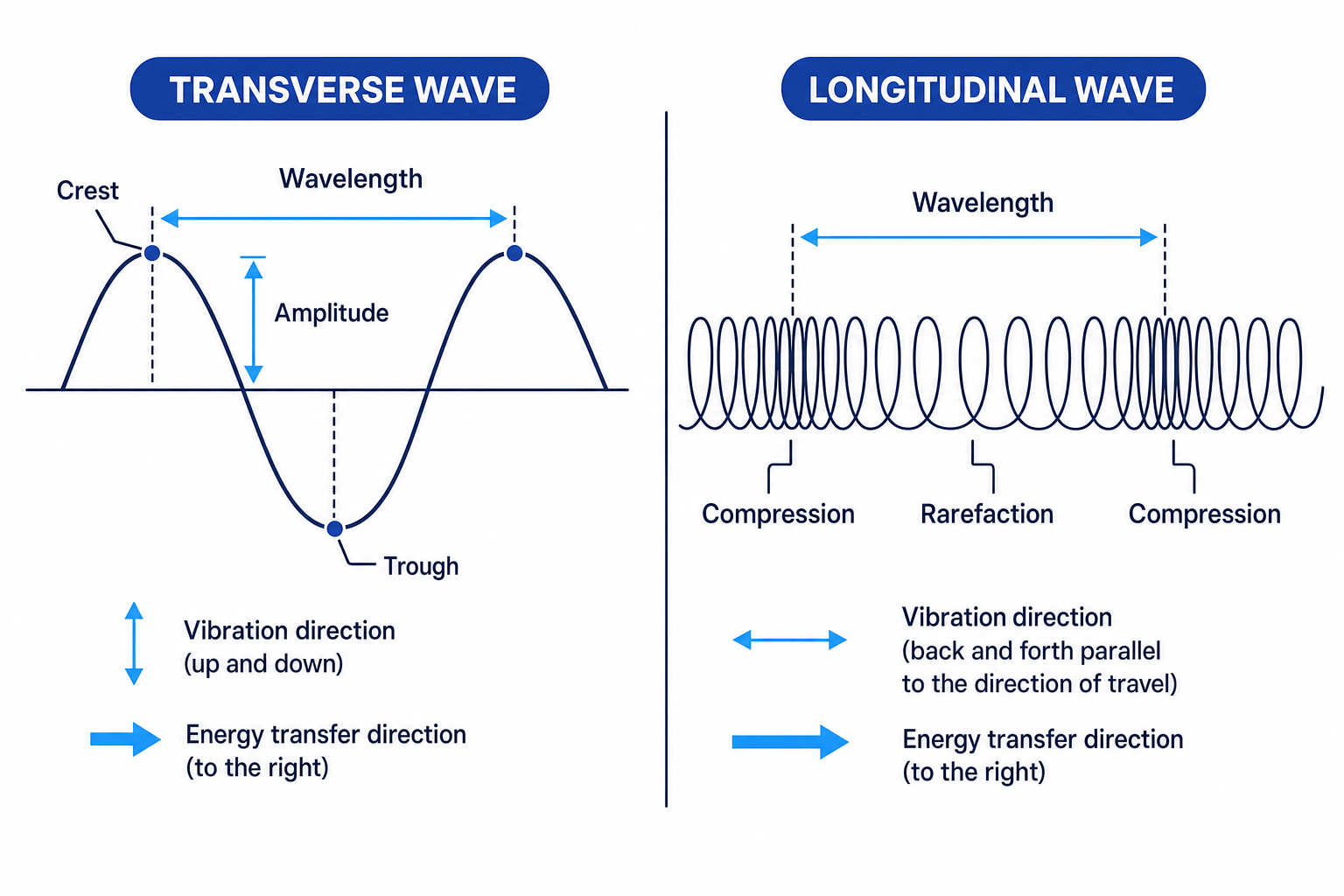
In a transverse wave, the vibrations are at right angles to the direction of energy transfer. Waves on a rope and electromagnetic waves are transverse.
In a longitudinal wave, the vibrations are parallel to the direction of energy transfer. Sound waves in air are longitudinal. They contain compressions, where particles are close together, and rarefactions, where particles are spread further apart.
The diagram below compares the two wave types and labels the key distances you need to recognise.
Direction of travel is not the wave type
A transverse wave does not mean “travelling sideways”. It means the particles vibrate perpendicular to the direction the wave energy travels.
Classifying transverse and longitudinal waves
A wave travels from left to right. In wave A, the particles move up and down. In wave B, the particles move left and right.
- For wave A, compare the vibration direction with the energy transfer direction: up-and-down vibration is perpendicular to left-to-right travel.
- Therefore wave A is transverse.
- For wave B, the particles vibrate left and right, which is parallel to the wave’s left-to-right travel.
- Therefore wave B is longitudinal.
Describing a wave
To do calculations and interpret diagrams, you need the standard wave quantities.
Core wave quantities
- Amplitude is the maximum displacement of a point on a wave from its rest position. For a displacement diagram, it is measured in m.
- Wavelength is the distance from a point on one wave to the same point on the next wave, such as crest to crest or compression to compression. Its symbol is λ\lambdaλ and its unit is m.
- Frequency is the number of complete waves passing a point each second. Its symbol is fff and its unit is Hz.
- Time period is the time taken for one complete wave cycle. Its symbol is TTT and its unit is s.
- A wavefront is a line joining points on a wave that are at the same stage of their cycle, such as a line of crests in water waves.
A crest is the highest point of a transverse wave and a trough is the lowest point. In longitudinal waves, wavelength is usually measured from compression to compression.
Frequency and time period
Frequency and time period are linked because they are reciprocals: one is found by doing 1 divided by the other.
The relationship is frequency = 1/time period, written as:
f=1Tf = \frac{1}{T}f=T1Rearranged:
T=1fT = \frac{1}{f}T=f1Finding frequency from time period
A vibrating source has a time period of 0.0040 s. Find its frequency.
- Use the relationship f=1Tf = \frac{1}{T}f=T1 because the time period is given and frequency is required.
- Substitute the value with its unit: f=10.0040 sf = \frac{1}{0.0040\ \text{s}}f=0.0040 s1.
- Calculate the answer: f=250 Hzf = 250\ \text{Hz}f=250 Hz.
Period and frequency go opposite ways
A shorter time period means a higher frequency. If each vibration takes less time, more vibrations happen every second.
Wave speed, frequency and wavelength
Wave speed is how fast the wave pattern, such as a crest or compression, travels through space. The relationship is:
wave speed = frequency × wavelength
v=f×λv = f \times \lambdav=f×λwhere vvv is wave speed in m/s, fff is frequency in Hz, and λ\lambdaλ is wavelength in m.
Useful rearrangements are:
f=vλλ=vf\begin{aligned} f &= \frac{v}{\lambda} \\ \lambda &= \frac{v}{f} \end{aligned}fλ=λv=fvUnit check
Before using v=f×λv = f \times \lambdav=f×λ, make sure wavelength is in m and frequency is in Hz. If frequency is given in kHz, convert it to Hz first.
Using the wave equation for sound and radio waves
A sound wave has frequency 440 Hz and wavelength 0.75 m. A radio wave in a vacuum has frequency 600 kHz. Find the speed of the sound wave and the wavelength of the radio wave. Use 3×1083 \times 10^83×108 m/s for the speed of electromagnetic waves in a vacuum.
- For the sound wave, use v=f×λv = f \times \lambdav=f×λ because frequency and wavelength are given: v=440 Hz×0.75 mv = 440\ \text{Hz} \times 0.75\ \text{m}v=440 Hz×0.75 m.
- Calculate the sound speed: v=330 m/sv = 330\ \text{m/s}v=330 m/s.
- For the radio wave, convert the frequency: 600 kHz = 6.00×10⁵ Hz6.00 \times 10^5\ \text{Hz}6.00×10⁵ Hz.
- Rearrange the wave equation to find wavelength: λ=vf\lambda = \frac{v}{f}λ=fv.
- Substitute and calculate: λ=3×10⁸ m/s6.00×105 Hz=500 m\lambda = \frac{3 \times 10^8\ \text{m/s}}{6.00 \times 10^5\ \text{Hz}} = 500\ \text{m}λ=6.00×10⁵ Hz3×108 m/s=500 m.
Sound waves are longitudinal waves, usually travelling through air. Electromagnetic waves, including light, microwaves and radio waves, are transverse waves and can travel through a vacuum.
The Doppler effect
The Doppler effect happens when a wave source moves relative to an observer, causing the observed frequency and wavelength to change.
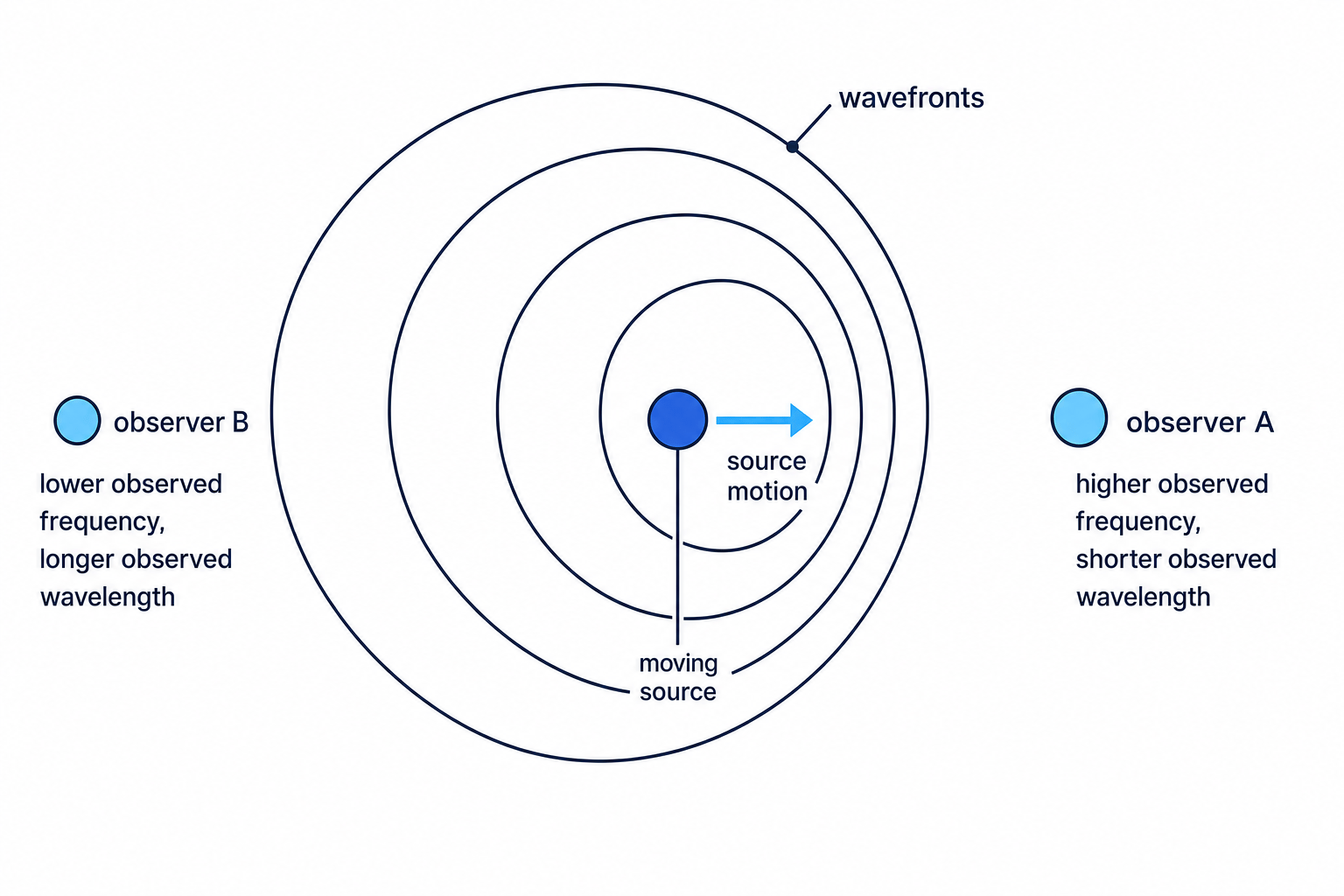
If the source moves towards the observer, wavefronts are closer together in front of the source. The observer detects a shorter wavelength and a higher frequency. For sound, this means a higher pitch.
If the source moves away, wavefronts are further apart. The observer detects a longer wavelength and a lower frequency.
The diagram shows wavefronts bunching up in front of a moving source and spreading out behind it.
Doppler effect
The Doppler effect is the change in observed frequency and wavelength of a wave when the source is moving relative to the observer.
Predicting a Doppler shift
An ambulance with its siren on drives towards you, passes you, then drives away. Describe the pitch you hear.
- As the ambulance moves towards you, it catches up with the wavefronts it emits, so the wavefronts reaching you are closer together.
- Closer wavefronts mean a shorter observed wavelength, so using v=f×λv = f \times \lambdav=f×λ, the observed frequency is higher if the wave speed in air is unchanged.
- After the ambulance passes and moves away, the wavefronts reaching you are spread further apart, so the observed wavelength is longer and the observed frequency is lower.
The source frequency has not changed
In Doppler effect questions, the source may still be producing the same frequency. It is the observed frequency that changes because of relative motion.
Reflection and refraction
All waves can be reflected and refracted. This includes sound waves, water waves and electromagnetic waves.
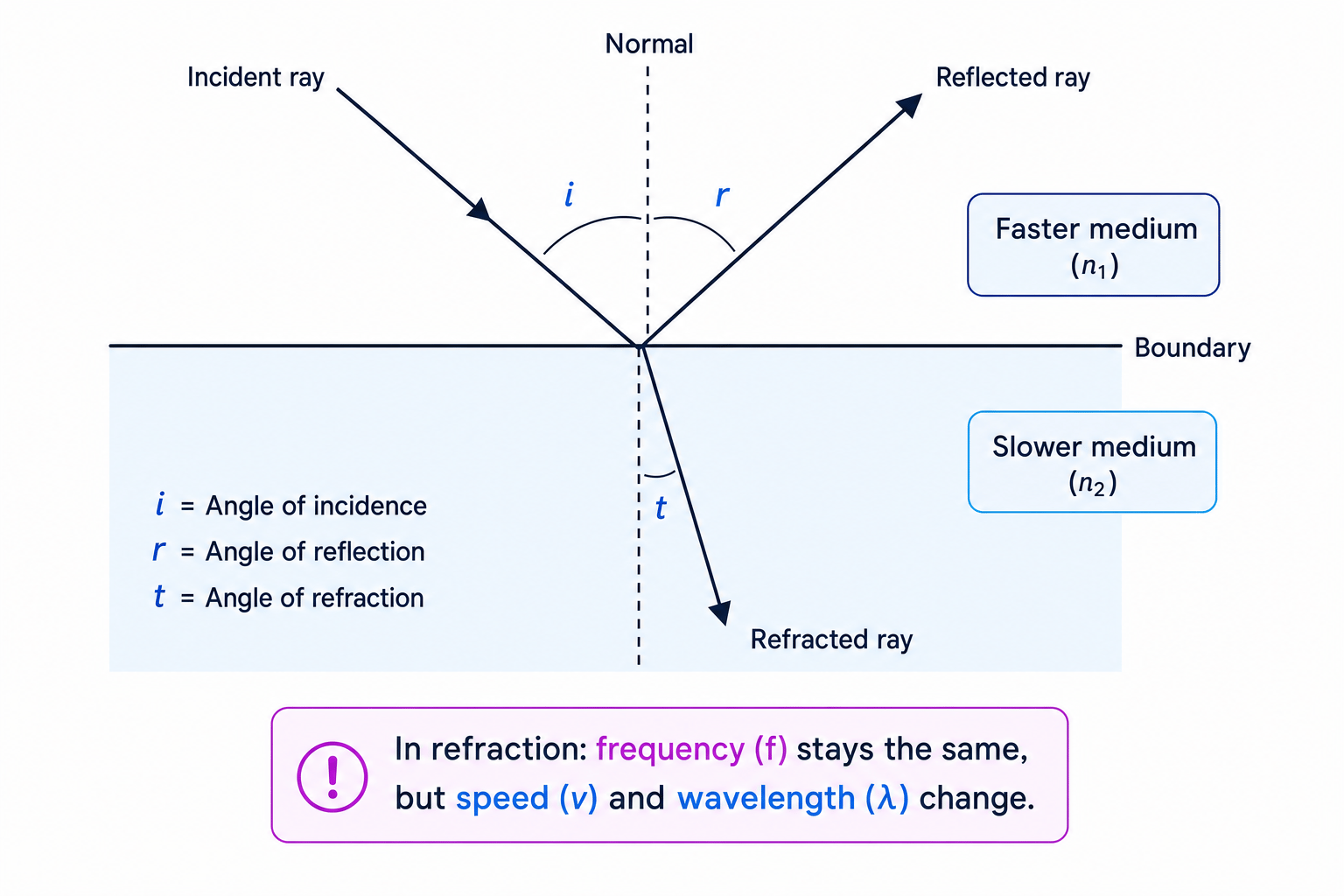
Reflection happens when a wave bounces off a boundary. For ray diagrams, the normal is an imaginary line drawn at 90 degrees to the surface at the point where the wave hits. The angle of incidence equals the angle of reflection, and both angles are measured from the normal.
Refraction happens when a wave changes speed as it enters a different medium. If the wave enters at an angle, this change in speed can make the wave change direction. During refraction, the frequency stays the same because it is set by the source, but the wave speed and wavelength can change.
The diagram below shows reflection and refraction at a boundary, with angles measured from the normal.
Refraction does not always mean bending
If a wave enters a new medium along the normal, its speed and wavelength may still change, but its direction does not change.
Wavelength change during refraction
Water waves move from deep water into shallow water. Their frequency is 5.0 Hz. In deep water their speed is 0.40 m/s, and in shallow water their speed is 0.25 m/s. Find the wavelength in each region.
- The frequency stays the same during refraction, so use f=5.0 Hzf = 5.0\ \text{Hz}f=5.0 Hz for both regions.
- Rearrange v=f×λv = f \times \lambdav=f×λ to make wavelength the subject: λ=vf\lambda = \frac{v}{f}λ=fv.
- In deep water: λ=0.40 m/s5.0 Hz=0.080 m\lambda = \frac{0.40\ \text{m/s}}{5.0\ \text{Hz}} = 0.080\ \text{m}λ=5.0 Hz0.40 m/s=0.080 m.
- In shallow water: λ=0.25 m/s5.0 Hz=0.050 m\lambda = \frac{0.25\ \text{m/s}}{5.0\ \text{Hz}} = 0.050\ \text{m}λ=5.0 Hz0.25 m/s=0.050 m.
- The wave slows down in shallow water, so its wavelength decreases.
In the exam
- For wave type questions, compare vibration direction with energy transfer direction: perpendicular means transverse, parallel means longitudinal.
- For calculations, write the equation first, convert kHz to Hz if needed, then substitute with units.
- For Doppler and refraction explanations, state what changes and what stays the same: Doppler changes observed frequency and wavelength; refraction keeps frequency the same but can change speed and wavelength.
Check yourself
- A wave has frequency 50 Hz and wavelength 0.80 m. What is its wave speed?
- How can you tell from particle motion whether a wave is transverse or longitudinal?
- In refraction, why does the wavelength change when the wave speed changes?
