

What you'll learn
- How to identify common electrical conductors and insulators.
- How insulating materials become charged by friction.
- Why positive and negative charges attract or repel.
- How electrostatic charge can be dangerous, and how it is useful in photocopiers and inkjet printers.
These Edexcel IGCSE points have a P suffix, so they are assessed on Paper 2 only.
1. Electric charge: the starting idea
All matter is made from atoms. Atoms contain:
- protons, which have positive charge
- electrons, which have negative charge
- neutrons, which have no charge
Most objects are normally neutral, meaning the total positive charge balances the total negative charge.
Electric charge
Electric charge is a property of matter that can cause forces of attraction or repulsion. Charge is measured in coulombs, C, and can be positive or negative.
A key point for this topic is that electrons can move between materials, but protons are fixed inside atomic nuclei and do not transfer between objects in ordinary static electricity.
The big rule
When an object becomes charged by rubbing, it is because electrons have moved. Gaining electrons makes an object negative; losing electrons makes it positive.
Moving protons
Do not write that protons move from one object to another when materials are rubbed. In IGCSE electrostatics, explain charging in terms of electron transfer.
2. Conductors and insulators
Some materials allow charge to move easily. Others do not.
Conductors and insulators
- An electrical conductor is a material through which charge can move easily. Common examples include metals such as copper, aluminium and steel.
- An electrical insulator is a material through which charge cannot move easily. Common examples include plastics, rubber, glass and dry wood.
Metals conduct because they contain electrons that are free to move through the material. Plastics are insulators, so extra charge tends to stay where it is put.
This is why static electricity is usually noticed on insulators such as plastic rulers, balloons and synthetic clothing.
Choosing a material for a charged rod
- A rod needs to keep its static charge after rubbing, so electrons must not move away easily.
- Plastic is an insulator, so the transferred electrons stay on or near the rubbed part of the rod.
- Copper is a metal conductor, so charge can flow through the rod, through your hand and away to Earth. The plastic rod is the better choice.
3. Charging insulating materials by friction
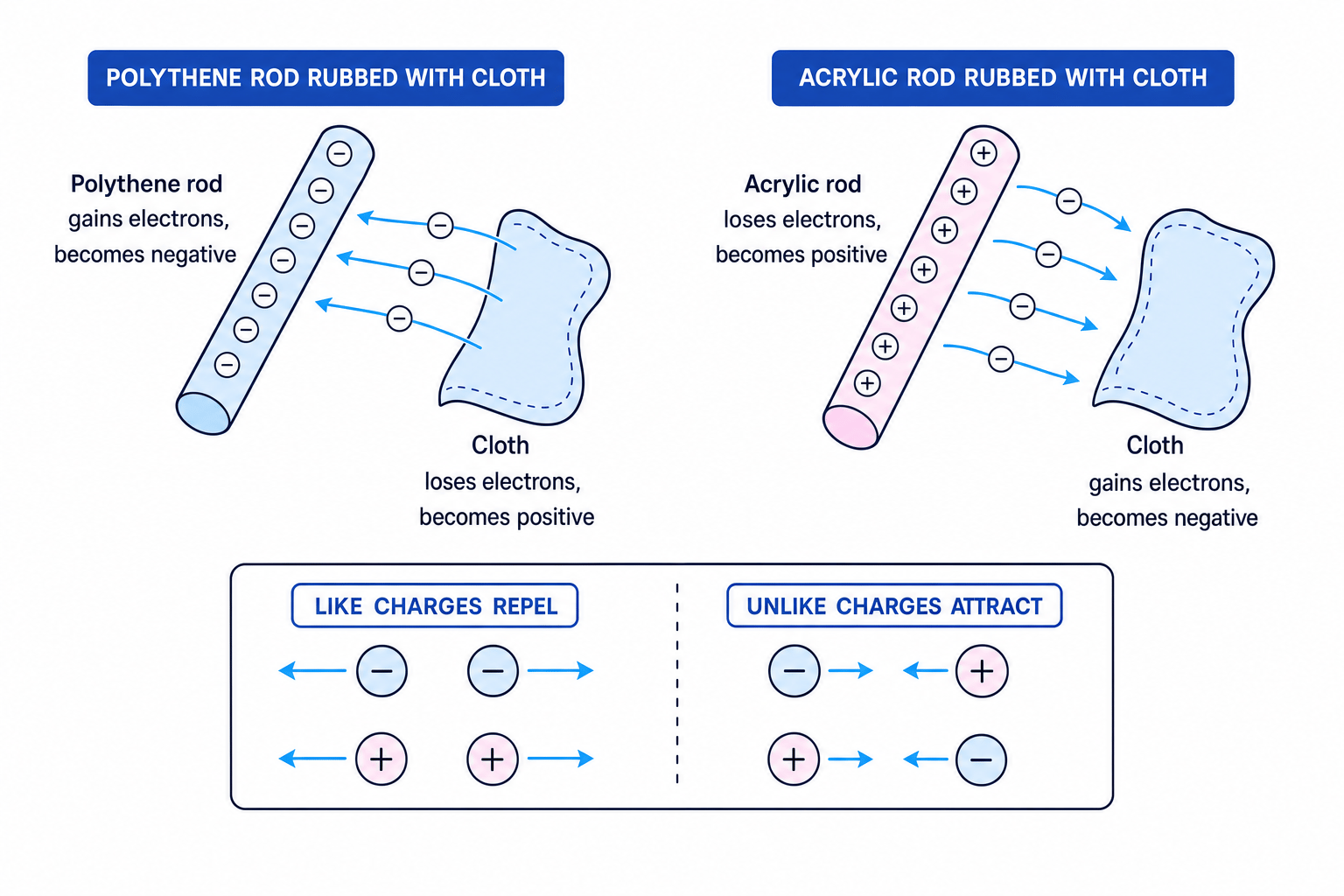
Friction means rubbing two surfaces together. When two insulating materials are rubbed, electrons can transfer from one material to the other.
The material that gains electrons becomes negatively charged. The material that loses electrons becomes positively charged.
Friction does not create charge
Rubbing does not create new charge. It separates charge by transferring electrons from one material to another.
Practical: investigating charging by friction
A typical investigation uses insulating rods, such as polythene and acrylic, rubbed with a dry cloth.
Apparatus
- Insulating rods, for example polythene and acrylic
- Dry cloth, such as wool or fur
- Small pieces of paper, a suspended charged rod, or an electroscope
- Clamp stand and thread if suspending a rod
- Ruler, if measuring distance or deflection
Method
- Dry the rods and cloth, because moisture can let charge leak away.
- Rub one insulating rod with the cloth using the same number of strokes each time.
- Bring the rod close to small pieces of paper, without touching them, and observe whether they are attracted.
- Repeat using a second rod rubbed in the same way.
- Test two charged rods near each other: if they repel, they have the same type of charge; if they attract, they may have opposite charges.
- Repeat readings and compare different materials.
Variables
- Independent variable: material pair used, or the number of rubs.
- Dependent variable: amount of charging, such as number of paper pieces attracted, electroscope leaf deflection, or deflection distance.
- Control variables: distance from paper or electroscope, number of rubs, rubbing force, time spent rubbing, rod size, cloth material and humidity.
Recording and graphing results
For a simple qualitative investigation, record observations such as “attracts paper”, “repels another rubbed polythene rod”, or “no clear effect”.
For a more quantitative investigation, you could plot:
- number of rubs on the x-axis
- number of paper pieces attracted, or deflection distance, on the y-axis
If comparing different materials, a bar chart can be clearer than a line graph.
Repulsion is stronger evidence
A charged object can attract a neutral object, so attraction alone does not prove that both objects are charged. Repulsion is good evidence that both objects are charged with the same type of charge.
Interpreting charging observations
- A rubbed plastic rod attracts small pieces of neutral paper, so the rod is likely to be charged.
- The same rubbed plastic rod repels another plastic rod rubbed in the same way, so the two rods have the same type of charge.
- The rubbed plastic rod attracts a rubbed acrylic rod, so the acrylic rod has the opposite type of charge to the plastic rod.
Poor practical technique
Touching the charged end of a rod, using damp apparatus, or changing the rubbing distance and force can make results unreliable because charge may leak away or the test may not be fair.
4. Forces between charges
Charged objects exert electrostatic forces on each other. These are non-contact forces, meaning the objects do not need to touch.
The rules are simple:
- Like charges repel: positive repels positive, and negative repels negative.
- Unlike charges attract: positive attracts negative.
Charge force rule
Like charges repel. Unlike charges attract.
Predicting signs after rubbing
- A cloth transfers electrons to a polythene rod, so the rod gains electrons.
- Gaining electrons makes the rod negatively charged, while the cloth becomes positively charged.
- If the negative rod is brought near another negative rod, they repel; if it is brought near the positive cloth, they attract.
5. Explaining electrostatic phenomena
An electrostatic phenomenon is an observable effect caused by static charge, such as:
- a balloon sticking to a wall
- a plastic comb attracting small paper pieces
- hair standing up after rubbing a balloon
- a small spark after walking on carpet
To explain these, always focus on electron movement.
If a negatively charged rod is brought near neutral paper, electrons in the paper are repelled slightly, so the side nearer the rod becomes relatively positive. The opposite charges are closer together, so the attraction is stronger than the repulsion from charges further away.
Explaining attraction of neutral paper
- Rubbing a plastic rod can make it negatively charged because it gains electrons.
- When the rod is brought near neutral paper, electrons in the paper are pushed slightly away from the rod.
- The side of the paper nearest the rod becomes relatively positive, so the negative rod attracts it.
Earthing
Earthing means connecting an object to the ground using a conductor, so electrons can flow between the object and Earth and the object becomes neutral.
If an object is negatively charged, electrons can flow from the object to Earth. If an object is positively charged, electrons can flow from Earth onto the object.
6. Dangers of electrostatic charge
Electrostatic charge can be dangerous when fuels are involved.
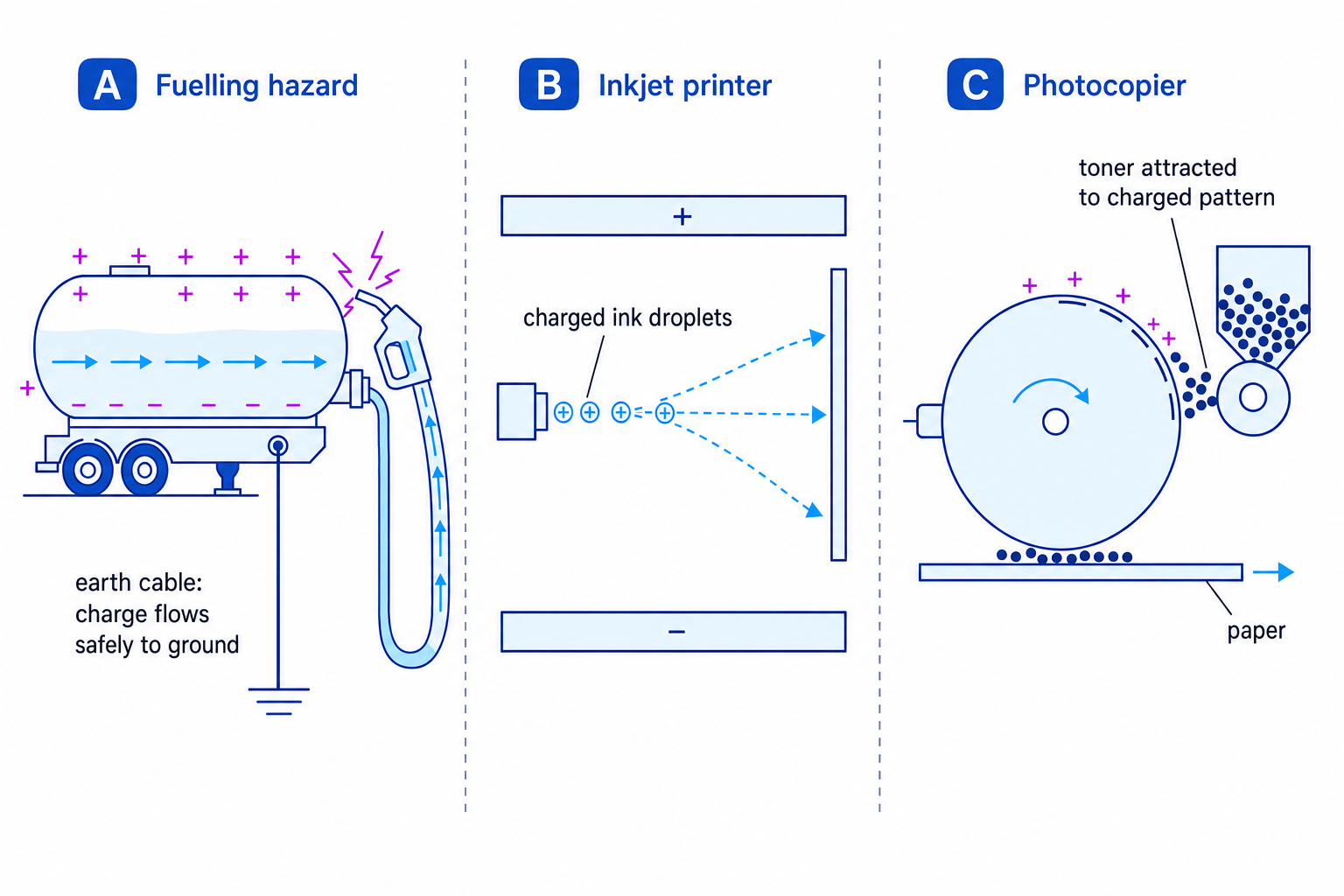
During fuelling, fuel flowing through pipes and hoses can cause charge to build up by friction. If the charge becomes large enough, it can jump across a gap as a spark. A spark could ignite fuel vapour, especially when fuelling aircraft or tankers.
To reduce the danger, aircraft and tankers are connected by a conducting bonding or earthing cable before fuelling begins. This allows charge to flow safely away instead of building up.
Fuel vapour risk
The main danger is usually the fuel vapour, not the liquid fuel itself. Vapour mixed with air can ignite very easily if there is a spark.
7. Uses of electrostatic charge
Electrostatic forces can be useful because charged objects can attract or repel tiny particles very precisely.
Inkjet printers
In an inkjet printer, tiny ink droplets are given an electric charge. Charged plates then attract or repel the droplets, deflecting them so they land in the correct place on the paper.
Deflecting an ink droplet
- Suppose an ink droplet is positively charged.
- A negatively charged plate will attract the droplet, while a positively charged plate will repel it.
- By changing the charges on the plates, the printer controls where the droplet lands on the paper.
Photocopiers
In a photocopier, a charged drum is used to attract toner powder. Toner is a very fine powder that becomes charged.
A simple sequence is:
- A drum is given a pattern of electrostatic charge.
- Charged toner particles are attracted to the charged parts of the drum.
- The toner is transferred to paper.
- Heat fixes the toner to the paper.
Why electrostatics is useful
Electrostatic forces are useful when we need to move or control very small particles, such as ink droplets or toner powder.
In the exam
- When explaining charging, state the direction of electron transfer and then give the resulting signs.
- For force questions, use the exact rule: like charges repel, unlike charges attract.
- For dangers and uses, link the stages clearly: charge builds up, charge causes attraction/repulsion or a spark, then explain the outcome or safety measure.
Check yourself
- Why does gaining electrons make an object negatively charged?
- Why can a charged balloon stick to a neutral wall?
- How does earthing reduce the risk when aircraft or tankers are being fuelled?
