The different regions of the electromagnetic spectrum (such as infrared, visible light, and ultraviolet) all share a fundamental property in a vacuum. In free space, all of these electromagnetic waves must have:
When an LED is correctly biased in a closed circuit and begins emitting light, it indicates that:
An LED requires a minimum potential difference (voltage) to begin conducting and emitting electromagnetic radiation. A student investigates this threshold voltage using the circuit diagram below.
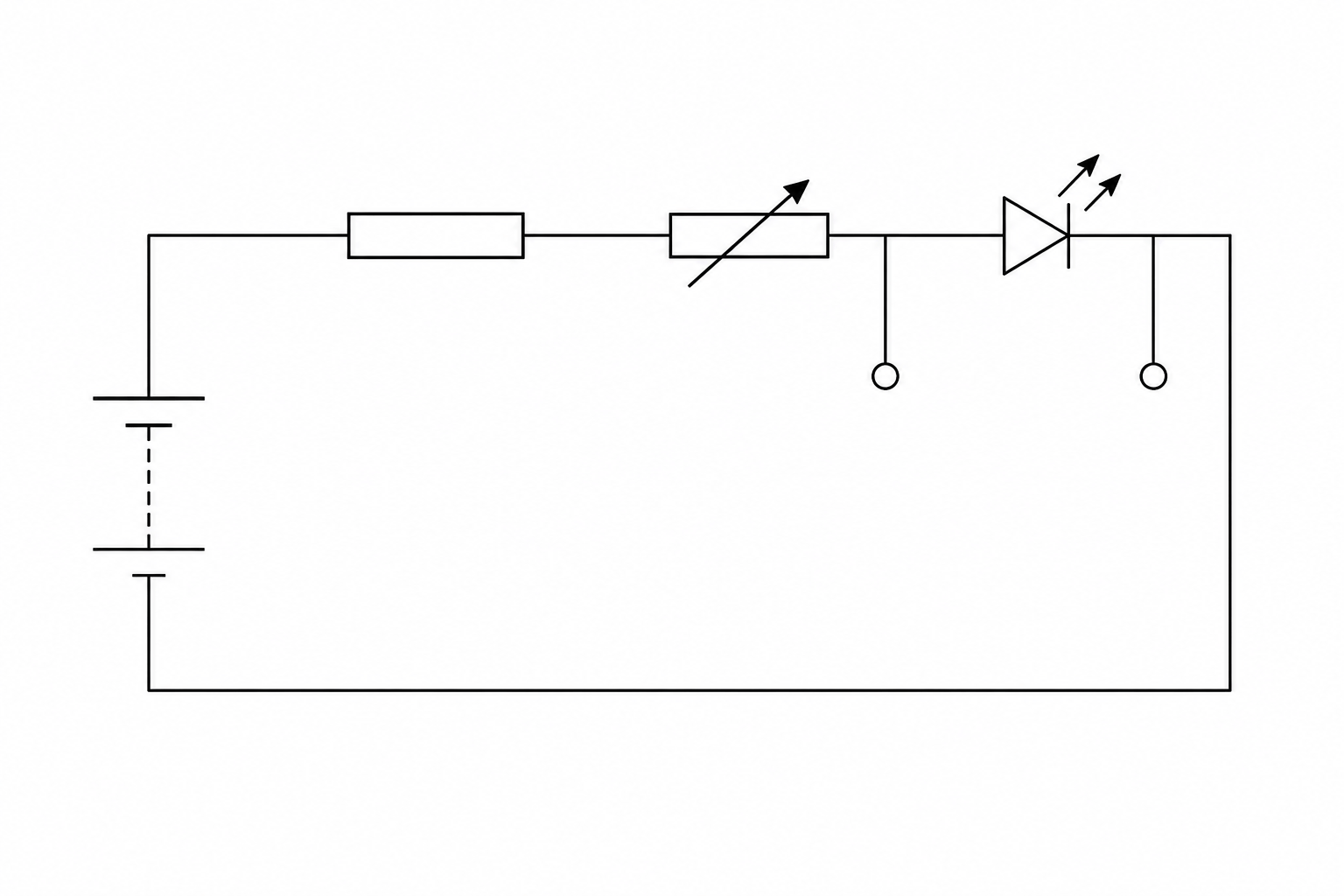
State how a voltmeter must be connected to the terminals shown in the circuit to measure the potential difference across the LED.
The student records the threshold voltage at which five different LEDs, designed for various regions of the electromagnetic spectrum, begin to emit radiation:
| Type of electromagnetic radiation | Threshold voltage in V\text{V}V |
|---|---|
| Far Infrared | 0.5 |
| Near Infrared | 1.2 |
| Orange light | 2.1 |
| Violet light | 3.1 |
| Ultraviolet (UV-A) | 3.8 |
Determine whether a bar chart or a line graph is more appropriate to present these results. State what should be plotted on each axis.
The student proposes the following conclusion:
"The threshold voltage required for emission is inversely proportional to the wavelength of the radiation emitted."
Evaluate this conclusion using the data in the table and your knowledge of the electromagnetic spectrum.

