

What you'll learn
- How a star’s colour classifies it and shows its surface temperature: the temperature of its visible surface.
- How stars similar to the Sun and stars larger than the Sun change as they age.
- What absolute magnitude means: brightness compared at a standard distance (Paper 2 only).
- How to sketch and read a Hertzsprung–Russell diagram, or HR diagram: a graph of star temperature and brightness (Paper 2 only).
The few ideas you need first
Star and nuclear fusion
A star is a huge sphere of hot gas that gives out light because nuclear fusion happens in its core. Nuclear fusion is the joining of light atomic nuclei, releasing energy.
A star is held together by gravity, the attractive force between masses. In the stable part of a star’s life, energy released by fusion produces outward pressure that balances gravity pulling inward.
A main sequence star is a stable star in the long middle stage of its life, where hydrogen fusion in the core releases energy.
The balance in a stable star
During the main sequence stage, inward gravity is balanced by outward pressure from fusion, so the star stays roughly the same size for a long time.
Classifying stars by colour
Stars can be classified according to their colour. In IGCSE Physics, the key link is:
Colour tells you surface temperature
Blue or blue-white stars have the highest surface temperatures. Yellow/orange stars are cooler. Red stars have the lowest surface temperatures.
Star temperatures are usually measured in kelvin, K. A useful order is:
| Colour | Surface temperature idea |
|---|---|
| Blue / blue-white | hottest |
| White / yellow | hot to medium; the Sun is about 5,800 K |
| Orange / red | coolest |
Ordering stars by surface temperature
Three stars are described as red, yellow and blue-white. Put them in order from hottest to coolest.
- Use the colour-temperature rule: blue-white is the hottest colour group, yellow is intermediate, and red is coolest.
- Compare the middle two colours: yellow is hotter than red because red indicates a lower surface temperature.
- So the order from hottest to coolest is blue-white → yellow → red.
Red does not mean hotter
In everyday life, red can suggest “hot”, but for stars it means a cooler surface. Blue stars are hotter than red stars.
How stars evolve
Stellar evolution means the changes a star goes through during its lifetime.
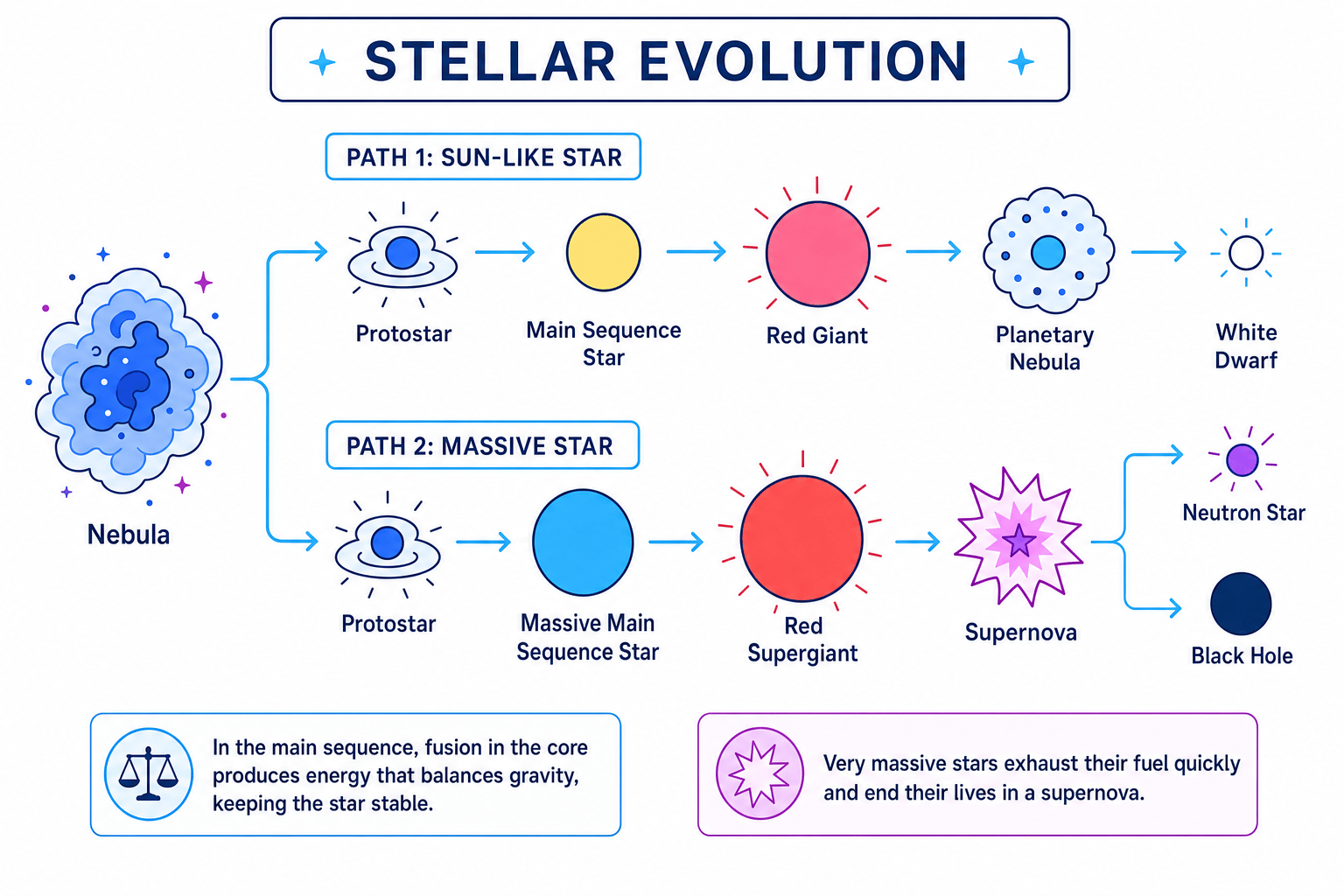
All stars begin in a nebula, a large cloud of gas and dust. Gravity pulls material together into a protostar, which is a hot, contracting object before it becomes a stable main sequence star.
The flow chart shows the two main pathways you need: one for stars similar in mass to the Sun, and one for more massive stars.
Stars with a mass similar to the Sun
A Sun-like star follows this sequence:
- Nebula — gas and dust are pulled together by gravity.
- Main sequence star — the star is stable because fusion pressure balances gravity.
- Red giant — hydrogen in the core runs low, the outer layers expand, and the surface cools, so the star looks redder.
- White dwarf — the outer layers are lost, leaving a small, hot, dense core.
A planetary nebula may form when the outer layers drift away. Despite the name, it has nothing to do with planets.
Stars with a mass larger than the Sun
A more massive star follows a more dramatic pathway:
- Nebula — it forms from gas and dust.
- Massive main sequence star — it is stable, but uses up its fuel much faster than a Sun-like star.
- Red supergiant — it expands into a very large, cool-surfaced star.
- Supernova — the star explodes at the end of its life.
- Neutron star or black hole — the collapsed core remains. A neutron star is extremely dense; a black hole has gravity so strong that light cannot escape.
Mass decides the ending
A Sun-like star ends as a white dwarf. A much more massive star ends with a supernova, leaving a neutron star or black hole.
Choosing the correct stellar pathway
A star has a mass much larger than the Sun. What later stages should you expect?
- Compare its mass with the Sun: much larger mass means it follows the massive-star pathway, not the Sun-like pathway.
- After the main sequence, the star expands into a red supergiant, not just a red giant.
- Its final explosive stage is a supernova, leaving either a neutron star or a black hole.
Absolute magnitude
This is a Paper 2 only idea in the Edexcel IGCSE specification.
A star’s apparent brightness is how bright it looks from Earth. This depends on both the star’s true brightness and its distance from us.
Absolute magnitude
Absolute magnitude represents how bright a star would appear if it were viewed from a standard distance. It lets astronomers compare stars fairly, without distance affecting the result.
The magnitude scale is unusual: lower absolute magnitude numbers mean brighter stars. Very bright stars can even have negative absolute magnitudes.
Comparing stars using absolute magnitude
Star A has absolute magnitude +4. Star B has absolute magnitude -2. Which star is brighter?
- The values are absolute magnitudes, so the stars are being compared as if they are at the same standard distance.
- On the magnitude scale, the smaller number means the brighter star. -2 is smaller than +4.
- Therefore, Star B is brighter than Star A at the standard distance.
Apparent is not absolute
A star that looks bright in the night sky is not automatically the most truly bright star. It may simply be closer to Earth.
The Hertzsprung–Russell diagram
On Paper 2, you need to draw the main components of the Hertzsprung–Russell diagram, usually shortened to HR diagram.
Hertzsprung–Russell diagram
An HR diagram is a graph that plots stars using surface temperature on the horizontal axis and absolute magnitude or brightness on the vertical axis.
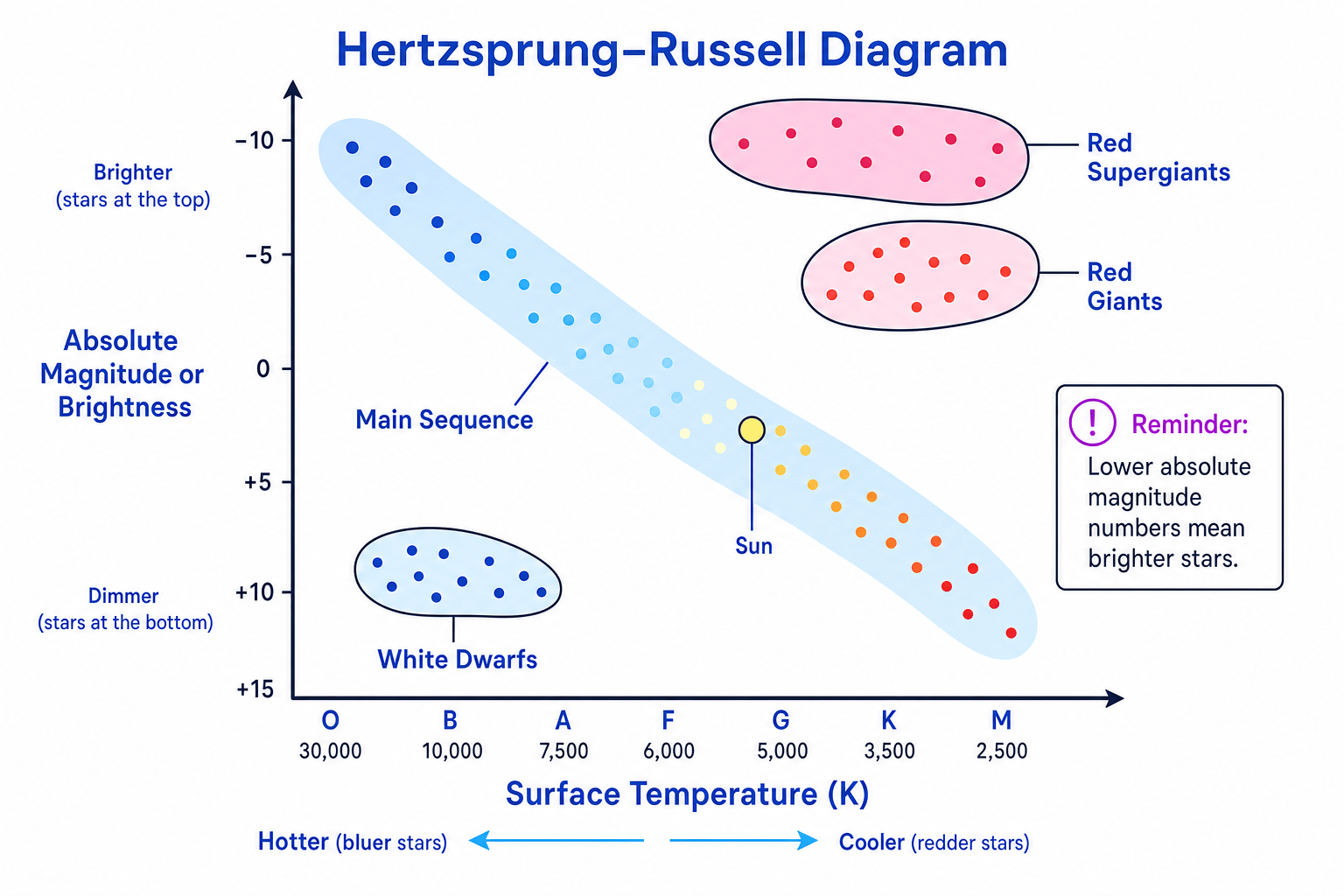
The main sequence runs diagonally from hot, bright blue stars at the top left to cool, dim red stars at the bottom right.
Other key regions are:
- Red giants: upper right — cool surface, but very bright because they are huge.
- Red supergiants: even higher on the upper right — extremely large and bright.
- White dwarfs: lower left — hot surface, but dim because they are small.
- The Sun: on the main sequence, around the middle.
Fast HR sketch
- Put surface temperature / K on the horizontal axis, with hot blue stars on the left and cool red stars on the right.
- Put absolute magnitude or brightness on the vertical axis, with brighter stars at the top and dimmer stars at the bottom.
- Draw the main sequence as a diagonal band from top left to bottom right.
- Add red giants and red supergiants in the upper right, and white dwarfs in the lower left.
Locating a star on an HR diagram
A star has a surface temperature of 9,000 K and absolute magnitude +10. What type of star is it likely to be?
- A surface temperature of 9,000 K puts the star on the hotter side of the horizontal axis, towards the left.
- An absolute magnitude of +10 is dim, so the star should be placed near the lower part of the vertical axis.
- A point in the lower-left region is in the white dwarf area, so the star is likely to be a white dwarf.
In the exam
- For colour questions, remember: blue = hotter, red = cooler.
- For evolution questions, decide the star’s mass first: Sun-like stars end as white dwarfs; massive stars end after a supernova.
- For HR diagrams, check both unusual axes: temperature is often hotter on the left, and lower absolute magnitude means brighter.
Check yourself
- Why can two stars that look equally bright from Earth have different absolute magnitudes?
- What stages does a star similar to the Sun go through after the main sequence?
- Where would you place white dwarfs on an HR diagram, and why?
