

What you'll learn
- How the Universe, galaxies, stars and our Solar System fit together.
- Why gravitational field strength, ggg, is different on different worlds.
- How gravity keeps planets, moons, comets and satellites in orbit.
- How to calculate orbital speed using orbital radius and time period.
The big picture: Universe, galaxies and the Solar System
The Universe is everything that exists: all space, matter and energy. It contains a huge number of galaxies.
A galaxy is a very large collection of billions of stars, held together by gravity. Our galaxy is the Milky Way.
Our Solar System is the Sun and the objects that orbit it, including planets, moons, comets and artificial satellites. It is located inside the Milky Way galaxy.
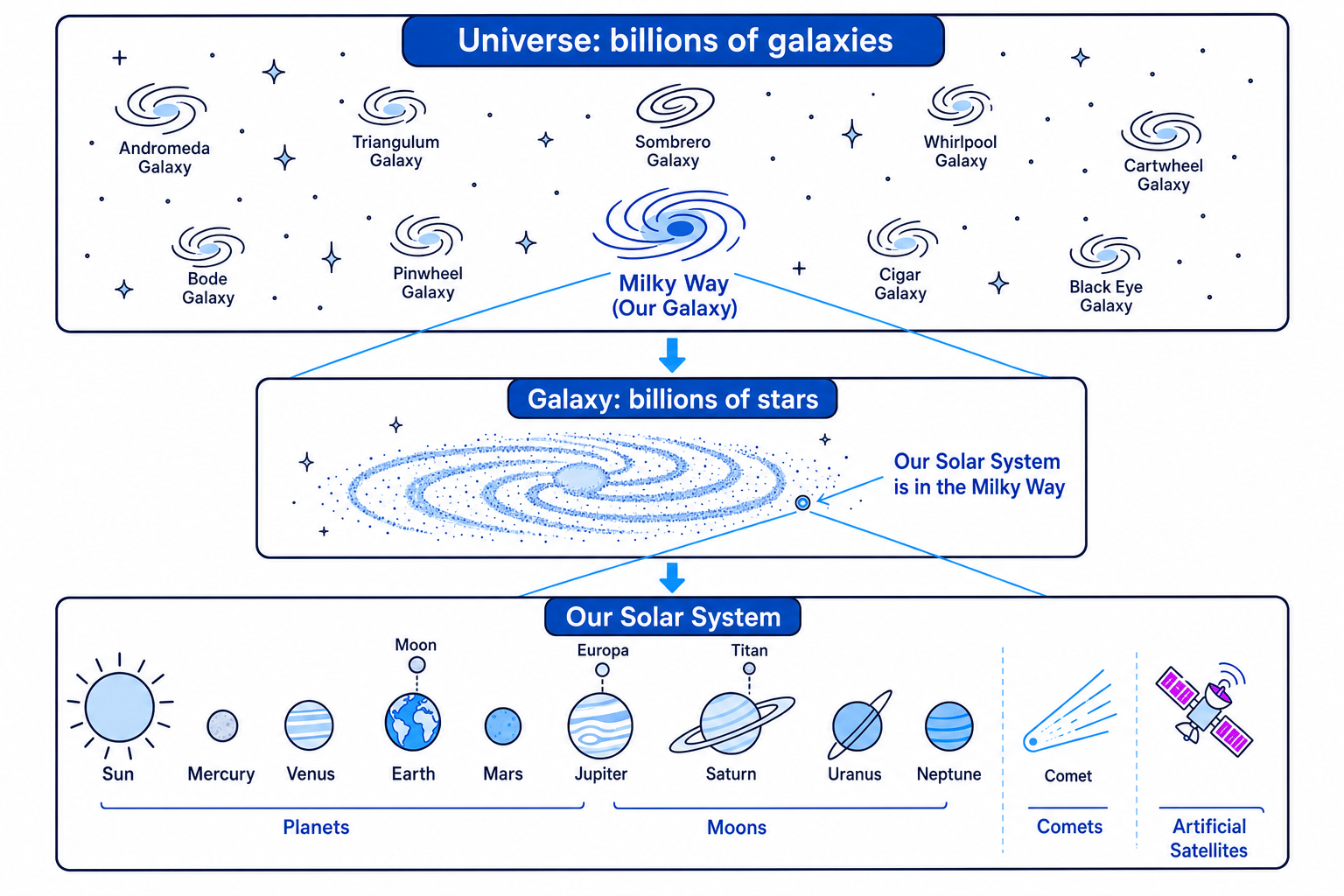
Cosmic address
Universe → galaxies → Milky Way galaxy → Solar System → Earth.
Gravitational field strength, ggg
Gravity is an attractive force between masses. Around any planet, moon or star there is a gravitational field: a region where another mass experiences a gravitational force.
Gravitational field strength
Gravitational field strength, ggg, is the gravitational force on each kilogram of mass. Its unit is N/kg.
On Earth, ggg is about 9.8 N/kg, often rounded to 10 N/kg in IGCSE calculations. On the Moon, ggg is about 1.6 N/kg.
Gravitational field strength varies because different planets and moons have different masses and sizes. In general:
- a more massive body produces a stronger gravitational field
- further from the centre of a body, the gravitational field is weaker
- surface gravity depends on both the body’s mass and its radius
So ggg is not the same on Earth, the Moon, Mars or Jupiter.
You may use the earlier equation:
weight = mass × gravitational field strength
W=m×gW = m \times gW=m×gwhere weight, WWW, is in N, mass, mmm, is in kg, and gravitational field strength, ggg, is in N/kg.
Comparing weight on Earth and the Moon
An astronaut has mass 60 kg. Calculate their weight on Earth, where g=10 N/kgg = 10\ \text{N/kg}g=10 N/kg, and on the Moon, where g=1.6 N/kgg = 1.6\ \text{N/kg}g=1.6 N/kg.
- Use the relationship W=m×gW = m \times gW=m×g. The astronaut’s mass stays 60 kg, but ggg changes from place to place.
- On Earth: W=60 kg×10 N/kg=600 NW = 60\ \text{kg} \times 10\ \text{N/kg} = 600\ \text{N}W=60 kg×10 N/kg=600 N.
- On the Moon: W=60 kg×1.6 N/kg=96 NW = 60\ \text{kg} \times 1.6\ \text{N/kg} = 96\ \text{N}W=60 kg×1.6 N/kg=96 N.
- The astronaut weighs much less on the Moon because the Moon has a weaker gravitational field.
Mass is not weight
Mass is the amount of matter in an object and is measured in kg. Weight is a gravitational force and is measured in N. Your mass stays the same on the Moon; your weight changes.
Gravity and orbits
An orbit is the path followed by an object as it moves around another object in space.
Gravity causes:
- moons to orbit planets
- planets to orbit the Sun
- artificial satellites to orbit the Earth
- comets to orbit the Sun
For an object in orbit, gravity acts towards the body being orbited. For example, Earth’s gravity pulls an artificial satellite towards the centre of the Earth.
The satellite also has sideways motion. Gravity continually changes the satellite’s direction, so instead of travelling in a straight line, it follows a curved path around Earth.
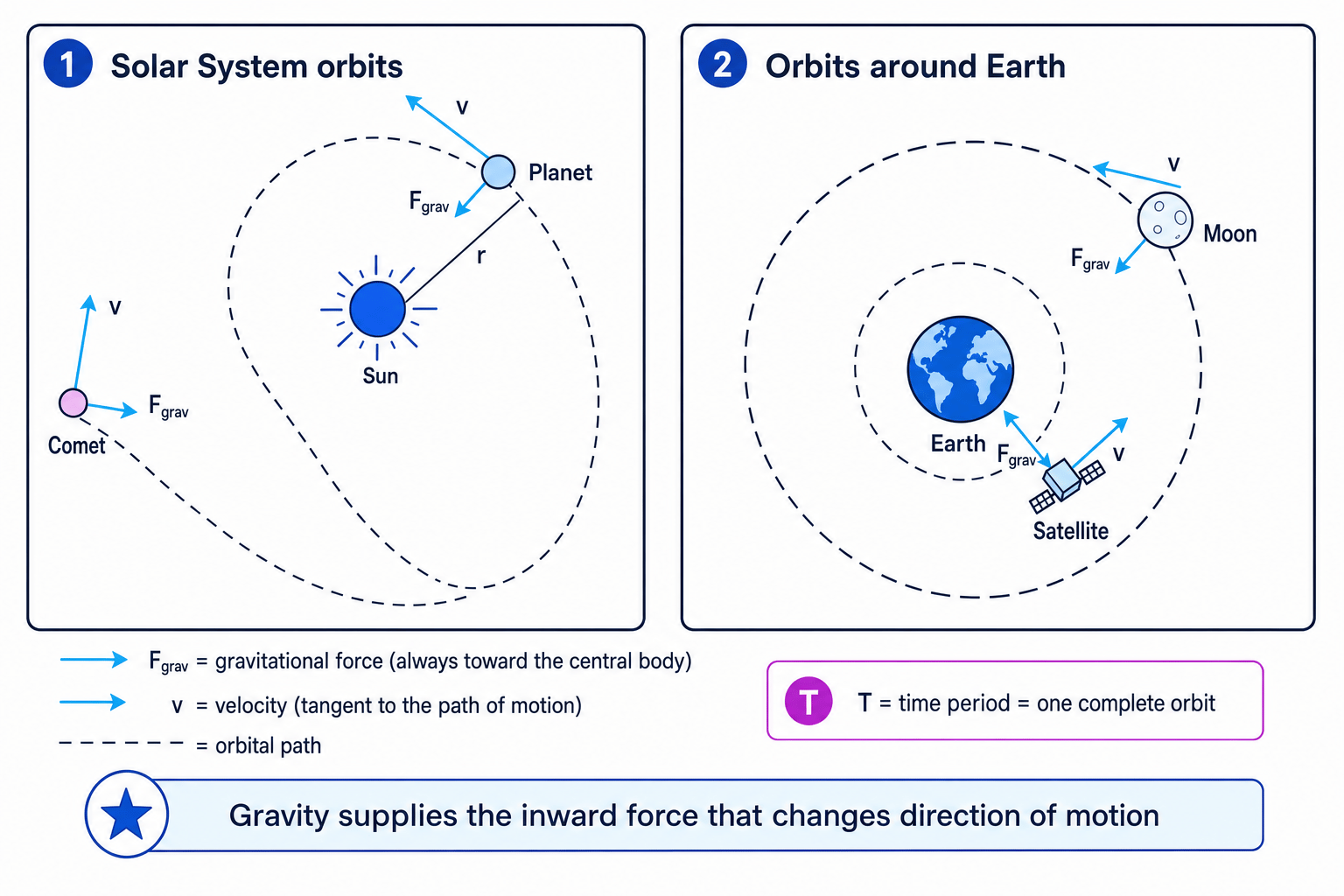
Gravity provides the inward force
In an orbit, the gravitational force acts towards the centre of the object being orbited. The velocity is along the path, at a tangent to the orbit.
Determining force and velocity directions
A satellite is at the top of a circular orbit around Earth and is moving clockwise. State the direction of the gravitational force and the direction of its velocity.
- The central body is Earth, so the gravitational force must act towards the centre of Earth.
- At the top of the orbit, Earth is below the satellite, so the gravitational force is downwards on the diagram.
- The velocity is tangent to the circular path. For clockwise motion at the top of the orbit, the velocity is to the right.
Thinking there is no gravity in space
Objects in orbit are not “outside gravity”. They are still being pulled by gravity. Without gravity, they would travel off in a straight line.
Different types of orbit
Not all objects orbit in the same way.
Elliptical orbit
An elliptical orbit is an oval-shaped orbit. A circle is a special case of an ellipse.
| Object | What it orbits | Typical orbit |
|---|---|---|
| Planet | The Sun | Nearly circular or slightly elliptical |
| Moon | A planet | Usually roughly circular or slightly elliptical |
| Artificial satellite | Earth or another planet | Often circular or slightly elliptical, depending on its purpose |
| Comet | The Sun | Very elongated elliptical orbit |
Planets move around the Sun in paths that are almost circular compared with comets. Comets often travel very far from the Sun, then swing close to the Sun before moving away again. Their speed changes a lot: they are fastest when closest to the Sun.
Moons are natural satellites because they orbit planets naturally. Artificial satellites are human-made objects placed into orbit, for example for communications, weather monitoring or GPS.
Distinguishing a planet and a comet
Two objects orbit the Sun. Object A has a nearly circular orbit. Object B has a very stretched oval orbit and returns close to the Sun only after many years. Identify which is more likely to be a planet and which is more likely to be a comet.
- Both objects orbit the Sun, so either could be a planet or a comet.
- Object A has a nearly circular orbit, which matches the usual orbit of a planet.
- Object B has a very elongated elliptical orbit, which is typical of a comet.
- Therefore, Object A is more likely to be a planet and Object B is more likely to be a comet.
Calculating orbital speed
For a circular orbit, the distance travelled in one complete orbit is the circumference of the circle.
Circumference of orbit = 2×π×r2 \times \pi \times r2×π×r
where rrr is the orbital radius, the distance from the centre of the object being orbited to the orbiting object.
Time period
The time period, TTT, is the time taken for one complete orbit.
The Edexcel relationship is:
orbital speed = 2 × π × orbital radius ÷ time period
v=2×π×rTv = \frac{2 \times \pi \times r}{T}v=T2×π×rwhere:
- vvv = orbital speed in m/s
- rrr = orbital radius in m
- TTT = time period in s
You may need these rearrangements:
v=2×π×rTT=2×π×rvr=v×T2×π\begin{aligned} v &= \frac{2 \times \pi \times r}{T}\\ T &= \frac{2 \times \pi \times r}{v}\\ r &= \frac{v \times T}{2 \times \pi} \end{aligned}vTr=T2×π×r=v2×π×r=2×πv×TCalculating orbital speed
A satellite moves in a circular orbit of radius 7000 km from the centre of Earth. Its time period is 5800 s. Calculate its orbital speed.
- Convert the radius into metres: 7000 km=7.0×10⁶ m7000\ \text{km} = 7.0 \times 10^6\ \text{m}7000 km=7.0×10⁶ m.
- Use v=2×π×rTv = \frac{2 \times \pi \times r}{T}v=T2×π×r with r=7.0×10⁶ mr = 7.0 \times 10^6\ \text{m}r=7.0×10⁶ m and T=5800 sT = 5800\ \text{s}T=5800 s.
- Substitute values: v=2×π×7.0×10⁶ m5800 sv = \frac{2 \times \pi \times 7.0 \times 10^6\ \text{m}}{5800\ \text{s}}v=5800 s2×π×7.0×10⁶ m.
- Calculate: v=7.6×10³ m/sv = 7.6 \times 10^3\ \text{m/s}v=7.6×103 m/s, to 2 significant figures.
Unit check
If rrr is in m and TTT is in s, the answer comes out in m/s. Convert km to m, and convert hours or days to seconds if needed.
Altitude is not always orbital radius
If a question gives the height above Earth’s surface, that is not the orbital radius. The orbital radius is measured from Earth’s centre, so you must add Earth’s radius if it is needed.
Circular orbit assumption
The equation v=2×π×rTv = \frac{2 \times \pi \times r}{T}v=T2×π×r is for circular orbits. For very elliptical orbits, like many comets, the speed changes during the orbit.
In the exam
- Learn the hierarchy clearly: Universe contains galaxies, galaxies contain stars, and our Solar System is in the Milky Way.
- For orbit questions, always show gravity acting towards the central body and velocity tangent to the orbit.
- For orbital speed calculations, convert units first, use the orbital radius not the diameter, and give the final answer with units.
Check yourself
- Why is your weight different on the Moon but your mass is unchanged?
- In what direction does gravity act on a planet orbiting the Sun?
- A satellite’s orbital radius and time period are given. Which equation would you use to calculate its orbital speed?

