

What you'll learn
- How the Big Bang theory describes the past evolution of the universe.
- How moving wave sources change the observed frequency and wavelength.
- How red-shift is measured using spectral lines.
- Why red-shift and cosmic microwave background radiation support an expanding universe.
This section of Edexcel IGCSE Physics 4PH1 is Paper 2 only, but it is still assessed in the normal written exam style: clear descriptions, evidence-based explanations, and unit-carrying calculations.
The Big Bang theory
Cosmology is the study of the universe as a whole: its origin, structure, evolution, and future.
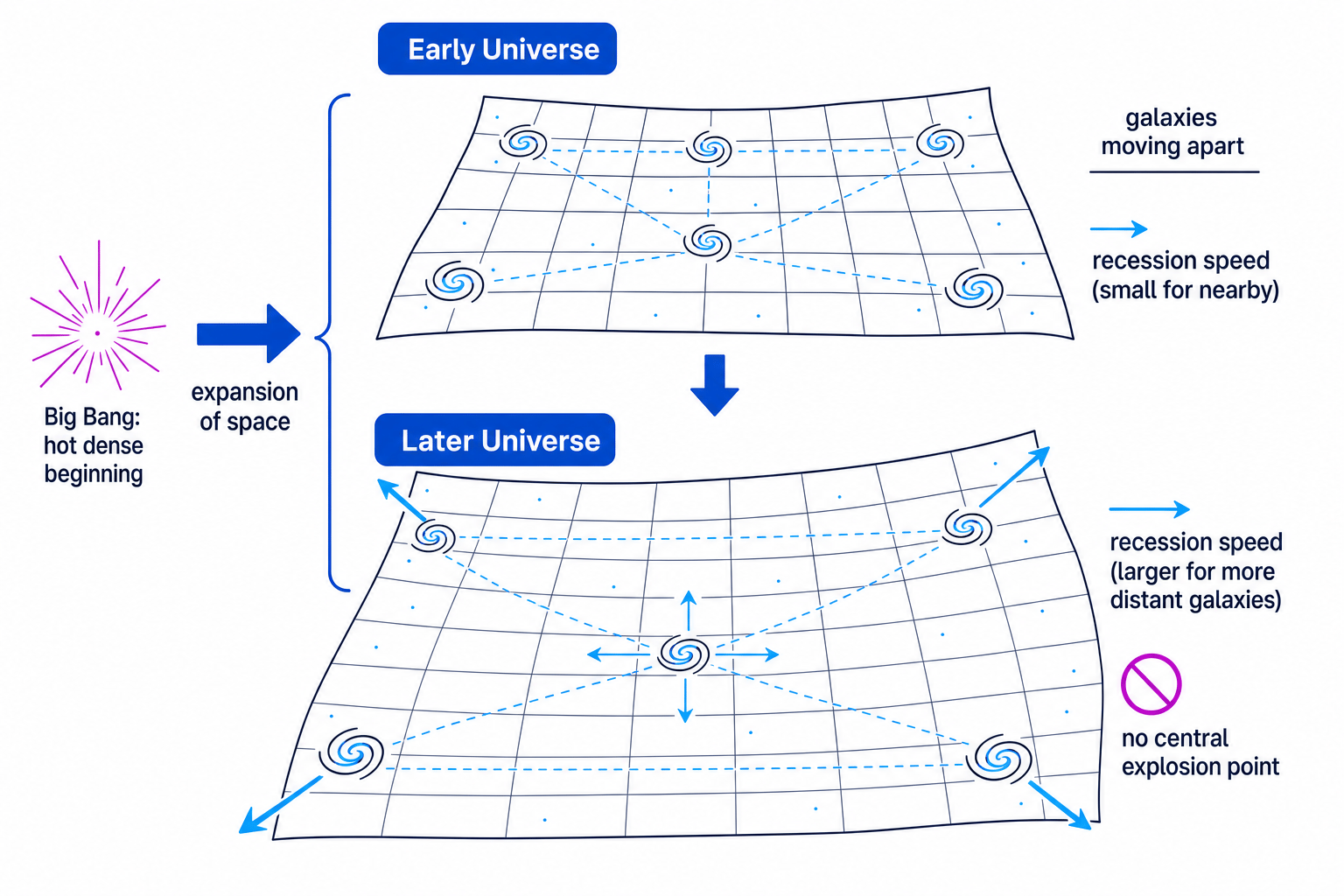
The Big Bang theory says that the universe began in an extremely hot, dense state and has been expanding and cooling ever since. It was not an ordinary explosion from one place into empty space. Instead, the space between galaxies has increased over time.
Big Bang theory
The Big Bang theory is the model that the universe began in a very hot, dense state and has expanded and cooled over time.
The past evolution of the universe
A simple timeline is:
- The early universe was extremely hot and dense.
- As the universe expanded, it cooled.
- Particles and then atoms could form.
- Over much longer times, matter collected into stars and galaxies.
- Today, galaxies are widely separated and the universe is still expanding.
The key reasoning is: if the universe is expanding now, then in the past everything must have been closer together.
Reverse the expansion
If galaxies are moving apart today, then looking backwards in time suggests the universe was once much smaller, hotter, and denser.
Waves from moving sources
Before red-shift makes sense, you need the wave idea.
A wave has a frequency, which is the number of waves passing a point each second, measured in hertz, Hz. A wave also has a wavelength, which is the distance from one point on a wave to the matching point on the next wave, measured in metres, m.
If a wave source moves relative to an observer, the observer detects a different frequency and wavelength from the ones emitted.
Doppler effect
The Doppler effect is the change in observed frequency and wavelength when a wave source moves relative to an observer.
Moving away or moving towards
If the source moves away from you, the waves are spread out:
- observed wavelength increases
- observed frequency decreases
If the source moves towards you, the waves are squashed together:
- observed wavelength decreases
- observed frequency increases
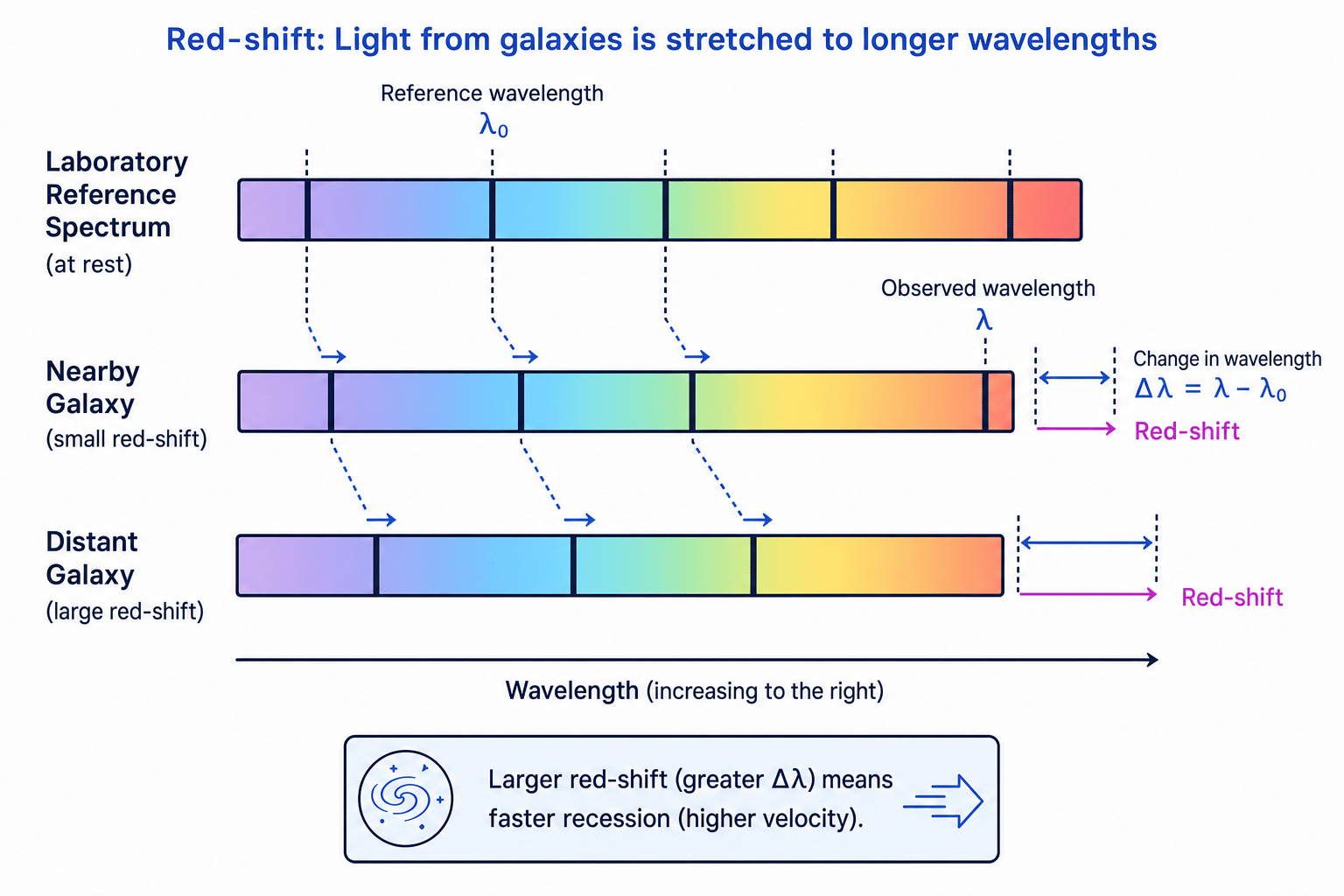
For light, longer wavelengths are towards the red end of the visible spectrum, so light from a source moving away is said to be red-shifted.
Interpreting a wavelength change
A spectral line has a reference wavelength of 6.56×10−76.56 \times 10^{-7}6.56×10⁻⁷ m in the laboratory. The same line from a galaxy is observed at 6.70×10−76.70 \times 10^{-7}6.70×10⁻⁷ m. Decide what this tells you about the galaxy’s motion.
-
Compare the wavelengths: 6.70×10−76.70 \times 10^{-7}6.70×10⁻⁷ m is larger than 6.56×10−76.56 \times 10^{-7}6.56×10⁻⁷ m, so the observed wavelength has increased.
-
An increase in wavelength means the light has shifted towards the red end of the spectrum, so this is red-shift.
-
Red-shift means the source is moving away from the observer, so the galaxy is receding from Earth.
Red-shift does not mean the galaxy looks red
Red-shift means the whole pattern of spectral lines is shifted to longer wavelengths. The galaxy does not necessarily appear red to your eye.
Spectral lines and red-shift
Hot gases, such as hydrogen in stars and galaxies, produce specific patterns of spectral lines. These patterns act like fingerprints for elements.
Astronomers compare:
- the reference wavelength of a spectral line measured in a laboratory on Earth
- the observed wavelength of the same line in light from a galaxy
If the observed wavelength is larger than the reference wavelength, the line has shifted to a longer wavelength. This is red-shift.
Red-shift
Red-shift is the increase in wavelength of light from a source moving away from the observer.
Calculating galaxy velocity from red-shift
For this specification, you need to use the red-shift equation.
In words:
change in wavelengthreference wavelength=velocity of a galaxyspeed of light\frac{\text{change in wavelength}}{\text{reference wavelength}} = \frac{\text{velocity of a galaxy}}{\text{speed of light}}reference wavelengthchange in wavelength=speed of lightvelocity of a galaxyIn symbols:
λ−λ0λ0=Δλλ0=vc\frac{\lambda-\lambda_0}{\lambda_0} = \frac{\Delta\lambda}{\lambda_0} = \frac{v}{c}λ0λ−λ0=λ0Δλ=cvwhere:
- λ0\lambda_0λ0 is the reference wavelength in m
- λ\lambdaλ is the observed wavelength in m
- Δλ\Delta\lambdaΔλ is the change in wavelength in m
- vvv is the velocity of the galaxy in m/s
- ccc is the speed of light, 3.0×1083.0 \times 10^83.0×10⁸ m/s
To find the velocity of the galaxy, rearrange:
v=c×Δλλ0v = c \times \frac{\Delta\lambda}{\lambda_0}v=c×λ0ΔλUse the same wavelength units
The ratio Δλλ0\frac{\Delta\lambda}{\lambda_0}λ0Δλ has no unit, but only if both wavelengths are in the same unit. Using metres for both is safest.
Calculating the velocity of a galaxy
A spectral line has a reference wavelength of 4.86×10−74.86 \times 10^{-7}4.86×10⁻⁷ m. In light from a galaxy, the line is observed at 5.10×10−75.10 \times 10^{-7}5.10×10⁻⁷ m. Calculate the velocity of the galaxy. Use c=3.0×10⁸c = 3.0 \times 10^8c=3.0×10⁸ m/s.
-
Find the change in wavelength:
Δλ=λ−λ0=5.10×10⁻⁷ m−4.86×10⁻⁷ m\Delta\lambda = \lambda - \lambda_0 = 5.10 \times 10^{-7}\,\text{m} - 4.86 \times 10^{-7}\,\text{m}Δλ=λ−λ0=5.10×10⁻⁷m−4.86×10⁻⁷m Δλ=0.24×10⁻⁷ m=2.4×10⁻⁸ m\Delta\lambda = 0.24 \times 10^{-7}\,\text{m} = 2.4 \times 10^{-8}\,\text{m}Δλ=0.24×10⁻⁷m=2.4×10⁻⁸m -
Substitute into the red-shift equation:
Δλλ0=2.4×10⁻⁸ m4.86×10−7 m\frac{\Delta\lambda}{\lambda_0} = \frac{2.4 \times 10^{-8}\,\text{m}}{4.86 \times 10^{-7}\,\text{m}}λ0Δλ=4.86×10⁻⁷m2.4×10−8m Δλλ0≈0.049\frac{\Delta\lambda}{\lambda_0} \approx 0.049λ0Δλ≈0.049 -
Calculate the velocity:
v=c×Δλλ0v = c \times \frac{\Delta\lambda}{\lambda_0}v=c×λ0Δλ v=3.0×10⁸ m/s×0.049v = 3.0 \times 10^8\,\text{m/s} \times 0.049v=3.0×10⁸m/s×0.049 v≈1.5×10⁷ m/sv \approx 1.5 \times 10^7\,\text{m/s}v≈1.5×107m/s
The galaxy is moving away from Earth at about 1.5×1071.5 \times 10^71.5×10⁷ m/s.
Red-shift at different distances
Light received from most distant galaxies is red-shifted. This shows that most galaxies are moving away from Earth.
More distant galaxies generally show a greater red-shift than nearer galaxies. A greater red-shift means a larger increase in wavelength, so the galaxy has a greater recession velocity.
Recession velocity
Recession velocity is the speed at which a galaxy is moving away from an observer.
This does not mean Earth is at the centre of the universe. In an expanding universe, observers in other galaxies would also see distant galaxies moving away from them.
Putting Earth at the centre
Red-shift shows that space is expanding between galaxies. It does not show that Earth is a special central point.
Comparing two galaxy red-shifts
Galaxy A has Δλλ0=0.020\frac{\Delta\lambda}{\lambda_0} = 0.020λ0Δλ=0.020. Galaxy B has Δλλ0=0.070\frac{\Delta\lambda}{\lambda_0} = 0.070λ0Δλ=0.070. Compare their recession velocities.
-
Use the equation Δλλ0=vc\frac{\Delta\lambda}{\lambda_0} = \frac{v}{c}λ0Δλ=cv. A larger red-shift ratio means a larger value of vvv.
-
Calculate Galaxy A’s velocity:
v=3.0×10⁸ m/s×0.020=6.0×106 m/sv = 3.0 \times 10^8\,\text{m/s} \times 0.020 = 6.0 \times 10^6\,\text{m/s}v=3.0×108m/s×0.020=6.0×106m/s -
Calculate Galaxy B’s velocity:
v=3.0×10⁸ m/s×0.070=2.1×107 m/sv = 3.0 \times 10^8\,\text{m/s} \times 0.070 = 2.1 \times 10^7\,\text{m/s}v=3.0×108m/s×0.070=2.1×107m/s -
Galaxy B has the greater recession velocity, so it has the larger red-shift. In the general pattern of the universe, it is likely to be more distant.
Evidence for the Big Bang theory
There are two main pieces of evidence you need for this topic:
- red-shift of distant galaxies
- cosmic microwave background radiation
Red-shift as evidence for expansion
The red-shift evidence works like this:
- Spectral lines from distant galaxies are shifted to longer wavelengths.
- Longer wavelength means red-shift.
- Red-shift means the galaxies are moving away.
- More distant galaxies generally have greater red-shift.
- Therefore, the universe is expanding.
- If the universe is expanding now, it was smaller, hotter, and denser in the past.
That supports the Big Bang theory.
Red-shift evidence
The red-shift of distant galaxies shows that galaxies are moving away from each other, which is evidence that the universe is expanding.
Cosmic microwave background radiation
The second major evidence is the cosmic microwave background, usually shortened to CMB.
Cosmic microwave background radiation
Cosmic microwave background radiation, or CMB radiation, is microwave radiation arriving from all directions in space, thought to be leftover radiation from the early universe.
In the early universe, radiation was very high energy because the universe was extremely hot. As the universe expanded, this radiation was stretched to longer wavelengths. Today it is detected as microwave radiation.
This supports the Big Bang theory because the theory predicts leftover radiation from the hot early universe. The discovery of CMB radiation was therefore strong evidence that the universe really did begin hot and dense.
CMB evidence
CMB radiation is like the cooled-down “afterglow” of the early universe, now stretched into microwaves by the expansion of space.
Pulling the argument together
The Big Bang theory is supported because two independent observations point to the same story.
Red-shift shows that galaxies are moving apart, so the universe is expanding. Reversing that expansion suggests the universe was once much smaller and hotter.
CMB radiation shows that the universe still contains leftover radiation from an early hot stage. This matches the prediction of the Big Bang theory.
In the exam
-
When explaining red-shift, link the ideas in order: longer wavelength → red-shift → galaxy moving away → universe expanding.
-
In calculations, find Δλ\Delta\lambdaΔλ first, keep wavelength units the same, then use v=c×Δλλ0v = c \times \frac{\Delta\lambda}{\lambda_0}v=c×λ0Δλ.
-
For Big Bang evidence, name both red-shift and CMB radiation, then explain how each supports an expanding universe that was once hot and dense.
Check yourself
- What happens to the observed wavelength and frequency when a wave source moves away from an observer?
- Why does greater red-shift suggest a greater recession velocity?
- How does CMB radiation support the Big Bang theory?
