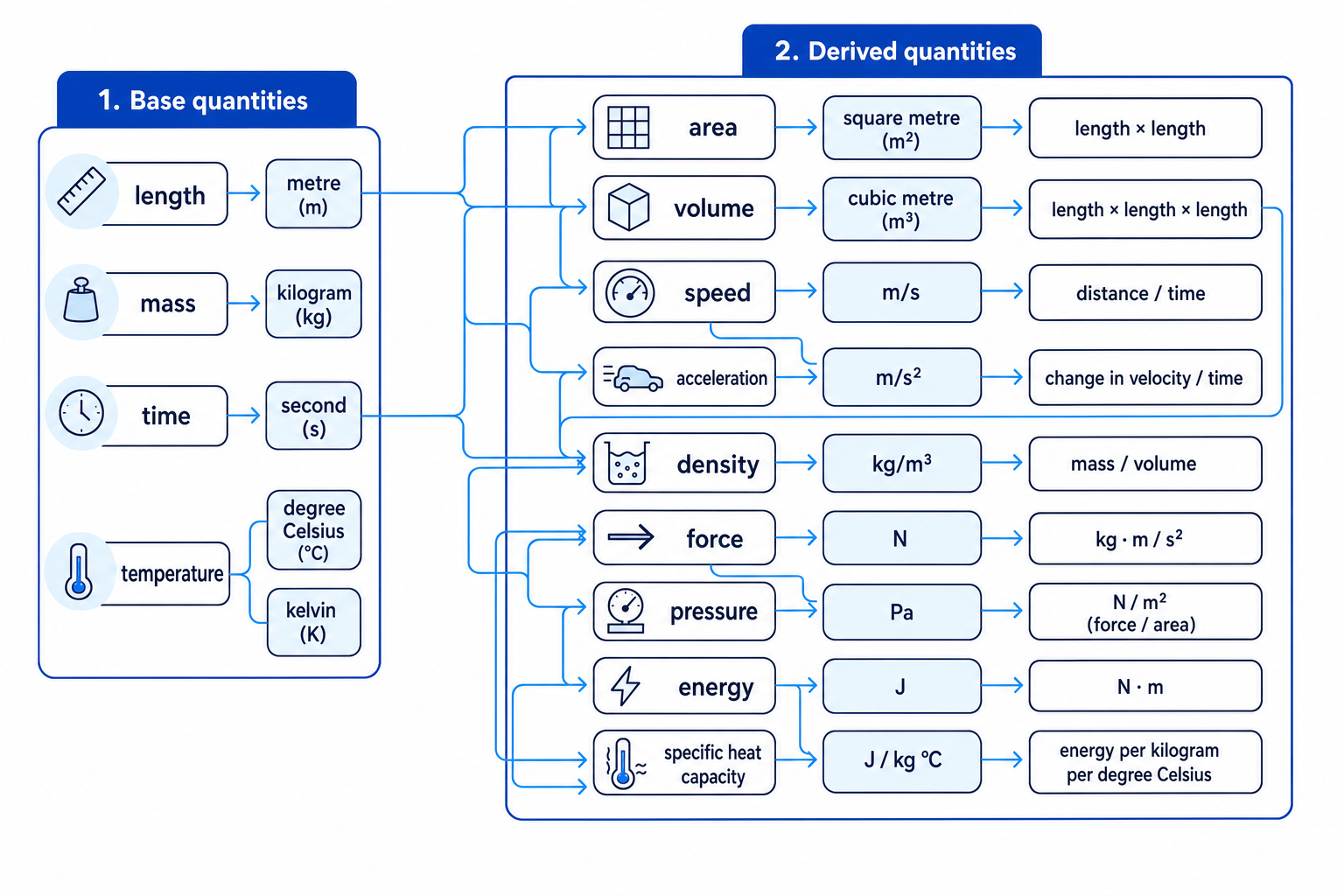
What you'll learn
- What a unit is and why it is part of every physics answer.
- How to use the units in this topic: m, m², m³, kg, kg/m³, N, Pa, J, °C and K.
- How compound units such as m/s² and J/kg °C are built from simpler units.
- How to avoid common conversion mistakes with area, volume and temperature.
Why units matter
Physics is not just about getting a number. A number without a unit is usually meaningless: 5 could mean 5 m, 5 kg, 5 J, 5°C, or many other things.
Physical quantity and unit
A physical quantity is something you can measure, such as mass, volume, pressure or temperature. A unit is the agreed standard used to state that measurement, such as kg for mass or Pa for pressure.
The Edexcel IGCSE specification expects you to use the correct units throughout calculations. In the solids, liquids and gases topic, many units are linked to measurements of matter, temperature, pressure and energy.
Units are part of the answer
In physics, the unit is not decoration. It tells the examiner what quantity your number represents and helps you check whether your calculation makes sense.
Base units and derived units
A base unit is a simple starting unit, such as metre for length or kilogram for mass. A derived unit is made by combining other units. For example, density uses kg/m³ because density compares mass with volume.
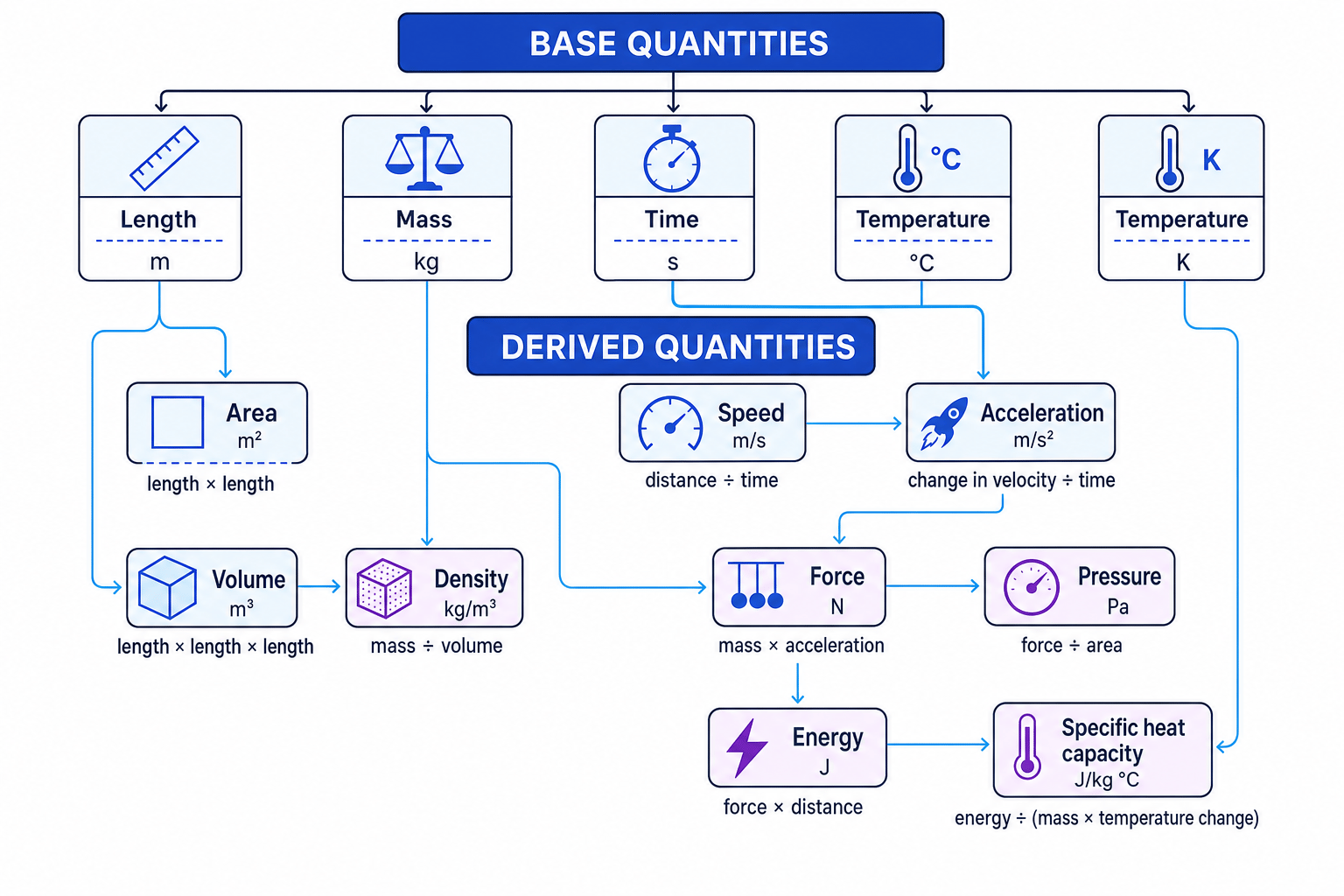
The map below shows how the main units in this section connect.
The units you need to use
| Quantity | Unit name | Unit symbol | Meaning |
|---|---|---|---|
| Temperature | degree Celsius | °C | everyday laboratory temperature scale |
| Temperature | kelvin | K | absolute temperature scale |
| Energy | joule | J | energy transferred or stored |
| Mass | kilogram | kg | amount of matter |
| Length | metre | m | distance in one direction |
| Area | metre squared | m² | surface size |
| Volume | metre cubed | m³ | space occupied |
| Density | kilogram per metre cubed | kg/m³ | mass per unit volume |
| Speed | metre per second | m/s | distance travelled each second |
| Acceleration | metre per second squared | m/s² | change in velocity each second |
| Force | newton | N | push or pull |
| Pressure | pascal | Pa | force per unit area |
| Specific heat capacity | joule per kilogram degree Celsius | J/kg °C | energy needed per kg per °C, Paper 2 only |
Length, area and volume
Length is measured in metres, m. It is a one-dimensional measurement, such as the height of a cylinder.
Area is measured in metres squared, m². Area is two-dimensional, so it comes from multiplying two lengths, such as length times width.
Volume is measured in metres cubed, m³. Volume is three-dimensional, so it comes from multiplying three lengths.
Converting areas and volumes
Do not convert m² or m³ as if they were just metres. Since 1 cm = 0.01 m, then 1 cm² = 0.0001 m² and 1 cm³ = 0.000001 m³.
Mass and density
Mass is measured in kilograms, kg. Mass is the amount of matter in an object. It is not the same as weight, which is a force measured in newtons, N.
Density tells you how much mass there is in a certain volume. Its unit is kg/m³.
The relationship is:
density = mass ÷ volume, ρ=mV\rho = \frac{m}{V}ρ=Vm
where ρ\rhoρ is density, mmm is mass and VVV is volume.
Converting volume before finding density
A metal cube has mass 0.540 kg. Each side is 6.0 cm. Calculate its density in kg/m³.
-
Convert the side length into metres, because the final unit needs m³: 6.0 cm=0.060 m6.0\ \text{cm} = 0.060\ \text{m}6.0 cm=0.060 m.
-
Find the volume of the cube using side cubed: V=(0.060 m)3=2.16×10⁻⁴ m3V = (0.060\ \text{m})^3 = 2.16 \times 10^{-4}\ \text{m}^3V=(0.060 m)3=2.16×10⁻⁴ m3.
-
Substitute into density = mass ÷ volume: ρ=0.540 kg2.16×10−4 m3=2.5×10³ kg/m3\rho = \frac{0.540\ \text{kg}}{2.16 \times 10^{-4}\ \text{m}^3} = 2.5 \times 10^3\ \text{kg/m}^3ρ=2.16×10−4 m30.540 kg=2.5×10³ kg/m3.
Speed and acceleration units
Speed is measured in metres per second, m/s. The equation is:
average speed = distance moved ÷ time taken, v=stv = \frac{s}{t}v=ts
Acceleration is measured in metres per second squared, m/s². Velocity means speed in a stated direction. Acceleration tells you how quickly velocity changes.
acceleration = change in velocity ÷ time taken, a=v−uta = \frac{v - u}{t}a=tv−u
where vvv is final velocity, uuu is initial velocity and ttt is time.
Interpreting acceleration units
A trolley speeds up from 3.0 m/s to 11.0 m/s in 4.0 s. Calculate its acceleration.
-
Find the change in velocity: v−u=11.0 m/s−3.0 m/s=8.0 m/sv - u = 11.0\ \text{m/s} - 3.0\ \text{m/s} = 8.0\ \text{m/s}v−u=11.0 m/s−3.0 m/s=8.0 m/s.
-
Divide by the time taken: a=8.0 m/s4.0 s=2.0 m/s2a = \frac{8.0\ \text{m/s}}{4.0\ \text{s}} = 2.0\ \text{m/s}^2a=4.0 s8.0 m/s=2.0 m/s2.
-
Interpret the unit: 2.0 m/s² means the velocity increases by 2.0 m/s every second.
Force, energy and pressure
A force is a push or pull, measured in newtons, N. The equation is:
force = mass × acceleration, F=m×aF = m \times aF=m×a
This means 1 N is the force needed to give a mass of 1 kg an acceleration of 1 m/s².
Energy is measured in joules, J. In this topic, energy often appears as thermal energy transferred to or from a substance. In mechanics, work done = force × distance moved in the direction of the force, W=F×dW = F \times dW=F×d, so 1 J is also 1 N m.
Pressure is force spread over an area, measured in pascals, Pa.
pressure = force ÷ area, p=FAp = \frac{F}{A}p=AF
One pascal is one newton per square metre, so 1 Pa = 1 N/m².
Calculating pressure
A force of 50 N acts on an area of 25 cm². Calculate the pressure in Pa.
-
Convert the area into m²: 25 cm2=25×10−4 m2=2.5×10⁻³ m225\ \text{cm}^2 = 25 \times 10^{-4}\ \text{m}^2 = 2.5 \times 10^{-3}\ \text{m}^225 cm2=25×10−4 m2=2.5×10⁻³ m2.
-
Substitute into pressure = force ÷ area: p=50 N2.5×10−3 m2p = \frac{50\ \text{N}}{2.5 \times 10^{-3}\ \text{m}^2}p=2.5×10⁻³ m250 N.
-
Calculate the pressure: p=2.0×10⁴ Pap = 2.0 \times 10^4\ \text{Pa}p=2.0×10⁴ Pa.
Celsius and kelvin
Temperature can be measured in degrees Celsius, °C, or kelvin, K.
The Celsius scale is the everyday laboratory scale. The kelvin scale is the absolute temperature scale, where 0 K is called absolute zero. Kelvin temperatures do not use the degree symbol: write 273 K, not 273°K.
For IGCSE calculations, use:
temperature in K = temperature in °C + 273
temperature in °C = temperature in K − 273
Temperature changes
A change of 1°C is the same size as a change of 1 K. So a temperature rise of 20°C is also a temperature rise of 20 K.
Converting between Celsius and kelvin
A gas is warmed from 27°C to 87°C. State both temperatures in K and find the temperature change.
-
Convert the starting temperature: 27∘C+273=300 K27^\circ\text{C} + 273 = 300\ \text{K}27∘C+273=300 K.
-
Convert the final temperature: 87∘C+273=360 K87^\circ\text{C} + 273 = 360\ \text{K}87∘C+273=360 K.
-
Compare the temperatures: the change is 360 K−300 K=60 K360\ \text{K} - 300\ \text{K} = 60\ \text{K}360 K−300 K=60 K, which is the same size as 60°C.
Specific heat capacity unit: J/kg °C
The unit J/kg °C is for specific heat capacity. This part is Paper 2 only, but it is still worth learning carefully.
Specific heat capacity
The specific heat capacity of a substance is the energy needed to raise the temperature of 1 kg of the substance by 1°C.
The related equation is:
change in thermal energy = mass × specific heat capacity × change in temperature, ΔQ=m×c×Δθ\Delta Q = m \times c \times \Delta \thetaΔQ=m×c×Δθ
Rearranging for specific heat capacity:
c=ΔQm×Δθc = \frac{\Delta Q}{m \times \Delta \theta}c=m×ΔθΔQThis gives the unit J/kg °C, meaning joules per kilogram per degree Celsius.
Using J/kg °C
A 0.50 kg block gains 8400 J of thermal energy and its temperature rises by 20°C. Calculate its specific heat capacity.
-
Choose the rearranged equation for specific heat capacity: c=ΔQm×Δθc = \frac{\Delta Q}{m \times \Delta \theta}c=m×ΔθΔQ.
-
Substitute the values with units: c=8400 J0.50 kg×20∘Cc = \frac{8400\ \text{J}}{0.50\ \text{kg} \times 20^\circ\text{C}}c=0.50 kg×20∘C8400 J.
-
Calculate the value: c=840 Jkg ∘Cc = 840\ \frac{\text{J}}{\text{kg}\,^\circ\text{C}}c=840 kg∘CJ, written as 840 J/kg °C.
In the exam
-
Write a unit with every final numerical answer, especially for density, pressure and energy.
-
Convert to SI units before substituting: metres for length, m² for area, m³ for volume and kg for mass.
-
Check compound units carefully: kg/m³ is density, Pa is pressure, and J/kg °C is specific heat capacity.
Check yourself
- Why is 25 cm² not the same as 0.25 m²?
- What is the difference between °C and K when measuring a temperature change?
- A calculation gives force ÷ area. Which unit should the final answer have?