

What you'll learn
- How light fits into the full electromagnetic spectrum.
- The order of electromagnetic waves by wavelength and frequency.
- Common uses of each type of electromagnetic radiation.
- The main health risks of excessive exposure, and simple ways to reduce them.
Starting point: waves and radiation
A wave transfers energy from one place to another without transferring matter overall. In this topic, you are looking at electromagnetic waves: waves that can travel through empty space as well as through some materials.
Visible light is not a special “separate thing” from other electromagnetic waves. It is just the small part of the electromagnetic spectrum that your eyes can detect.
Electromagnetic spectrum
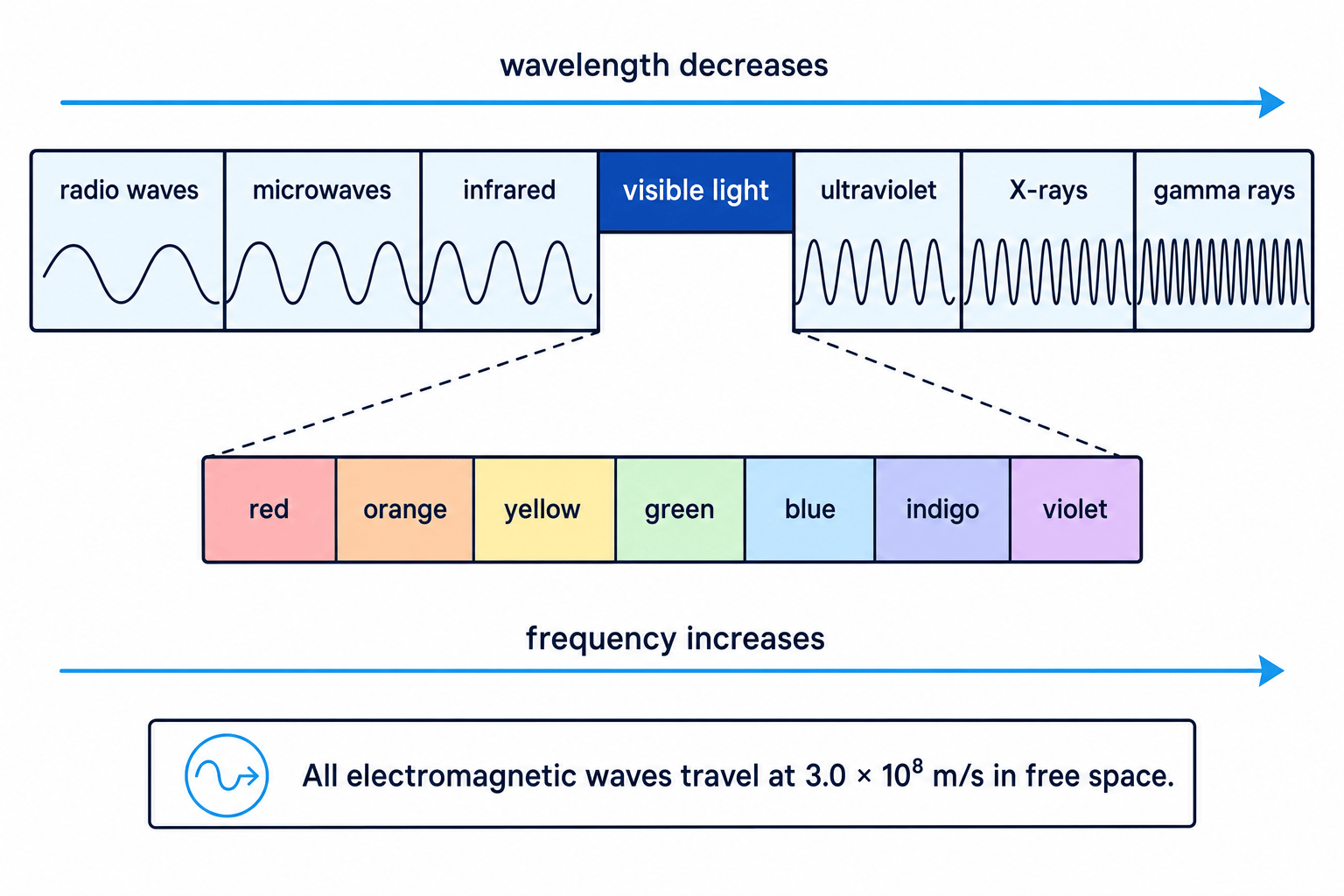
The electromagnetic spectrum is the continuous range of electromagnetic radiations, from radio waves with the longest wavelengths to gamma rays with the shortest wavelengths.
A wavelength is the distance from one point on a wave to the same point on the next wave, such as crest to crest. Its symbol is λ\lambdaλ, and it is measured in metres, m.
A frequency is the number of waves passing a point each second. Its symbol is fff, and it is measured in hertz, Hz.
The wave equation you already use is:
wave speed = frequency × wavelength, v=f×λv=f\times\lambdav=f×λ
where:
- vvv is wave speed in m/s
- fff is frequency in Hz
- λ\lambdaλ is wavelength in m
For electromagnetic waves in free space, meaning a vacuum with no material in the way, the speed is:
c=3.0×10⁸ m/sc=3.0\times10^8 \text{ m/s}c=3.0×108 m/sHere, ccc means the speed of light in free space.
Same speed in free space
All electromagnetic waves travel at the same speed in free space: 3.0×1083.0\times10^83.0×10⁸ m/s. What changes across the spectrum is their wavelength and frequency.
Calculating the frequency of visible light
Red light has a wavelength of 6.0×10−76.0\times10^{-7}6.0×10⁻⁷ m in free space. Calculate its frequency.
-
Use the wave equation and rearrange for frequency:
v=f×λf=vλ\begin{aligned} v&=f\times\lambda \\ f&=\frac{v}{\lambda} \end{aligned}vf=f×λ=λv -
Substitute the speed of electromagnetic waves in free space and the wavelength:
f=3.0×10⁸ m/s6.0×10−7 mf=\frac{3.0\times10^8\text{ m/s}}{6.0\times10^{-7}\text{ m}}f=6.0×10⁻⁷ m3.0×108 m/s -
Calculate the value and units:
f=5.0×10¹⁴ Hzf=5.0\times10^{14}\text{ Hz}f=5.0×10¹⁴ HzSo the frequency of the red light is 5.0×10145.0\times10^{14}5.0×10¹⁴ Hz.
Free space only
The statement “all electromagnetic waves travel at the same speed” applies in free space. In materials such as glass or water, waves can slow down, which is why refraction can happen.
The order of the electromagnetic spectrum
The electromagnetic spectrum is continuous. This means there are no real gaps between the regions; the names are labels for different ranges of wavelength and frequency.
From decreasing wavelength and increasing frequency, the order is:
radio waves → microwaves → infrared → visible light → ultraviolet → X-rays → gamma rays
Within the visible part, the colours go:
red → orange → yellow → green → blue → indigo → violet
Red has the longest wavelength and lowest frequency of visible light. Violet has the shortest wavelength and highest frequency of visible light.
Remembering the order
For the full spectrum, try: Really Must Introduce Very Unusual Xylophones Gradually — radio, microwave, infrared, visible, ultraviolet, X-rays, gamma rays. For visible colours: Richard Of York Gave Battle In Vain.
Reversing wavelength and frequency
As you move from radio waves to gamma rays, wavelength decreases but frequency increases. They go in opposite directions because v=f×λv=f\times\lambdav=f×λ and the speed in free space is constant.
Why different radiations have different uses
Different parts of the electromagnetic spectrum are useful because they interact with materials in different ways. Some pass through materials easily, some are absorbed and heat things up, and some can affect cells.
Radio waves: broadcasting and communications
Radio waves have the longest wavelengths in the electromagnetic spectrum. They are used for broadcasting radio and television signals, and for other forms of communication.
Their long wavelengths make them useful for sending information over large distances.
Microwaves: cooking and satellite transmissions
Microwaves are used in microwave ovens because they are absorbed by water and fat molecules in food, transferring energy and heating the food.
Microwaves are also used for satellite transmissions. They can be sent in narrow beams between a ground station and a satellite dish, and they can pass through the atmosphere well enough for communication.
Infrared: heaters and night vision equipment
Infrared radiation is emitted by warm objects. Infrared heaters transfer energy to people or objects, increasing their temperature.
Night vision equipment can detect infrared radiation from warm bodies, allowing people or animals to be seen in the dark.
Visible light: optical fibres and photography
Visible light is the part of the spectrum detected by the human eye.
It is used in optical fibres, which are thin transparent fibres that guide light signals along them. This is useful for communication and medical viewing devices.
Visible light is also used in photography, where a camera sensor or film records patterns of light from a scene.
Ultraviolet: fluorescent lamps
Ultraviolet radiation, often shortened to UV, has a higher frequency than visible light.
In fluorescent lamps, ultraviolet radiation is absorbed by a coating inside the lamp. The coating then emits visible light. This process is called fluorescence.
X-rays: observing internal structure
X-rays can pass through soft materials but are absorbed more strongly by denser materials, such as bone or metal.
This makes them useful for observing the internal structure of objects and materials, including in medical imaging. For example, bones show up clearly on an X-ray image because they absorb more X-rays than soft tissue.
Gamma rays: sterilising food and medical equipment
Gamma rays have very short wavelengths and very high frequencies. They are highly penetrating and can kill microorganisms.
This makes them useful for sterilising food and medical equipment. Sterilising means killing bacteria, viruses and other microorganisms so that an object is safe to use.
Ionising radiation
Ionising radiation has enough energy to remove electrons from atoms. This can damage living cells and DNA, which is why high-frequency radiations such as X-rays and gamma rays must be carefully controlled.
Choosing a radiation for sterilising equipment
A company wants to sterilise sealed medical syringes without opening the packaging. Choose a suitable electromagnetic radiation and explain why.
-
Identify what the radiation must do: it must pass through the packaging and kill microorganisms on the syringes.
-
Compare possible choices: ultraviolet can kill microorganisms on surfaces, but it does not penetrate packaging well. Gamma rays are more penetrating and can kill microorganisms inside sealed packaging.
-
Choose and justify the radiation: gamma rays are suitable because they can penetrate the packaging and sterilise the equipment, but workers must be protected from exposure.
Radiation does not always mean radioactive
Electromagnetic radiation is energy travelling as waves. Food sterilised using gamma rays does not become radioactive; the gamma rays kill microorganisms, and the radiation source is then removed.
Detrimental effects and protection
A detrimental effect is a harmful effect. Electromagnetic waves are not all equally dangerous, and risk depends on the type of radiation, the intensity, the exposure time, and the protection used.
Microwaves: internal heating of body tissue
Excessive exposure to microwaves can cause internal heating of body tissue. This is because microwaves can transfer energy to water-containing tissues inside the body.
Simple protective measures include:
- using metal shielding around microwave sources
- using safety interlocks on microwave ovens
- keeping a safe distance from powerful transmitters
Infrared: skin burns
Excessive infrared exposure can cause skin burns, because infrared transfers thermal energy to the skin.
Protection includes heat-resistant gloves, protective clothing, screens, and reducing exposure time near very hot sources.
Ultraviolet: surface cell damage and blindness
Excessive ultraviolet exposure can damage surface cells, especially in the skin and eyes. It can also cause blindness if the eyes are exposed to intense UV.
Protection includes:
- sunscreen
- UV-blocking sunglasses
- hats and clothing that cover the skin
- avoiding strong sunlight or UV lamps for long periods
Gamma rays: cancer and mutation
Gamma rays are ionising and can damage DNA inside cells. A mutation is a change in DNA. Mutations can sometimes lead to cancer, where cells divide uncontrollably.
Protection against gamma rays includes:
- thick lead or concrete shielding
- handling sources remotely
- keeping exposure time as short as possible
- staying as far away as practical from the source
X-rays are also ionising, so medical and industrial X-ray exposures are kept as low as possible using shielding and controlled exposure times.
Choosing protection from ultraviolet radiation
A student is using an ultraviolet lamp to make a fluorescent material glow. Suggest protective measures and explain them.
-
Identify the hazard: ultraviolet radiation can damage surface cells and eyes, so both skin and eyes need protection.
-
Match protection to the hazard: UV-blocking goggles protect the eyes, while gloves, sleeves or a screen reduce exposure of the skin.
-
Reduce the dose: switching the lamp off when not needed and limiting exposure time reduce the total energy absorbed by the body.
In the exam
-
If asked for the spectrum order, write it in one direction and label whether wavelength is decreasing or frequency is increasing.
-
For uses, link the property to the job: for example, “X-rays penetrate soft tissue but are absorbed by bone, so they show internal structure.”
-
For hazards, name the specific effect and a practical protection method, not just “it is dangerous.”
Check yourself
-
Can you write the electromagnetic spectrum in order from longest wavelength to shortest wavelength?
-
Why are gamma rays useful for sterilising medical equipment but dangerous to humans?
-
What protective measures would you suggest for someone working near ultraviolet radiation?

