What you'll learn
- How to draw ray diagrams for reflection and refraction.
- How to calculate refractive index and critical angle.
- Why total internal reflection is useful in optical fibres and prisms.
- How sound waves are displayed and measured using microphones and oscilloscopes.
Light as a transverse wave
A transverse wave is a wave where the vibrations are at right angles to the direction the wave transfers energy. Light waves are transverse waves.
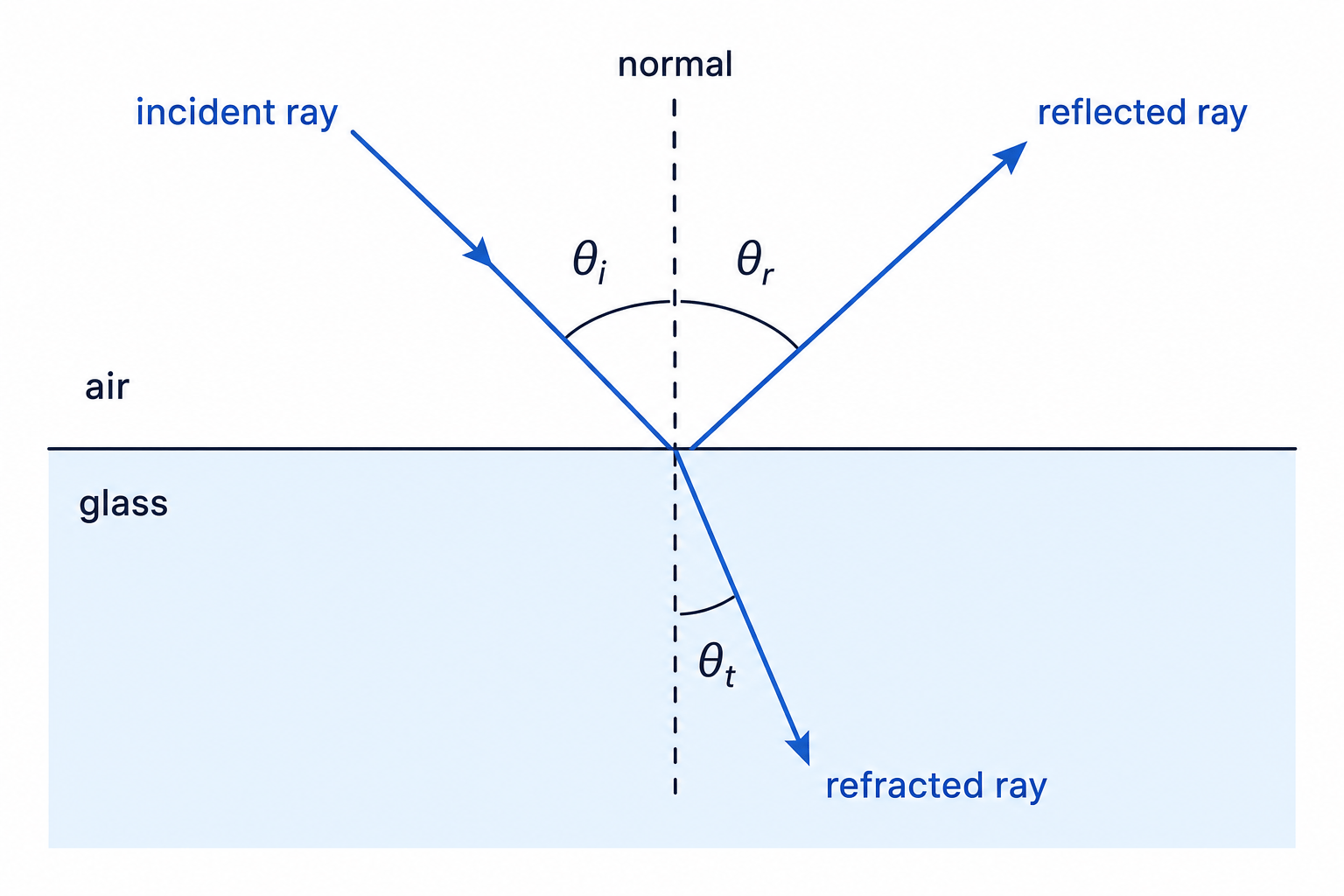
In ray diagrams, a ray is a straight line with an arrow showing the direction light travels. The normal is an imaginary line drawn at 90° to the surface where the ray meets it. Angles in ray diagrams are measured from the normal, not from the surface.
Light can be reflected, meaning it bounces off a surface, and refracted, meaning it changes direction when it passes into a different material because its speed changes.
Reflection
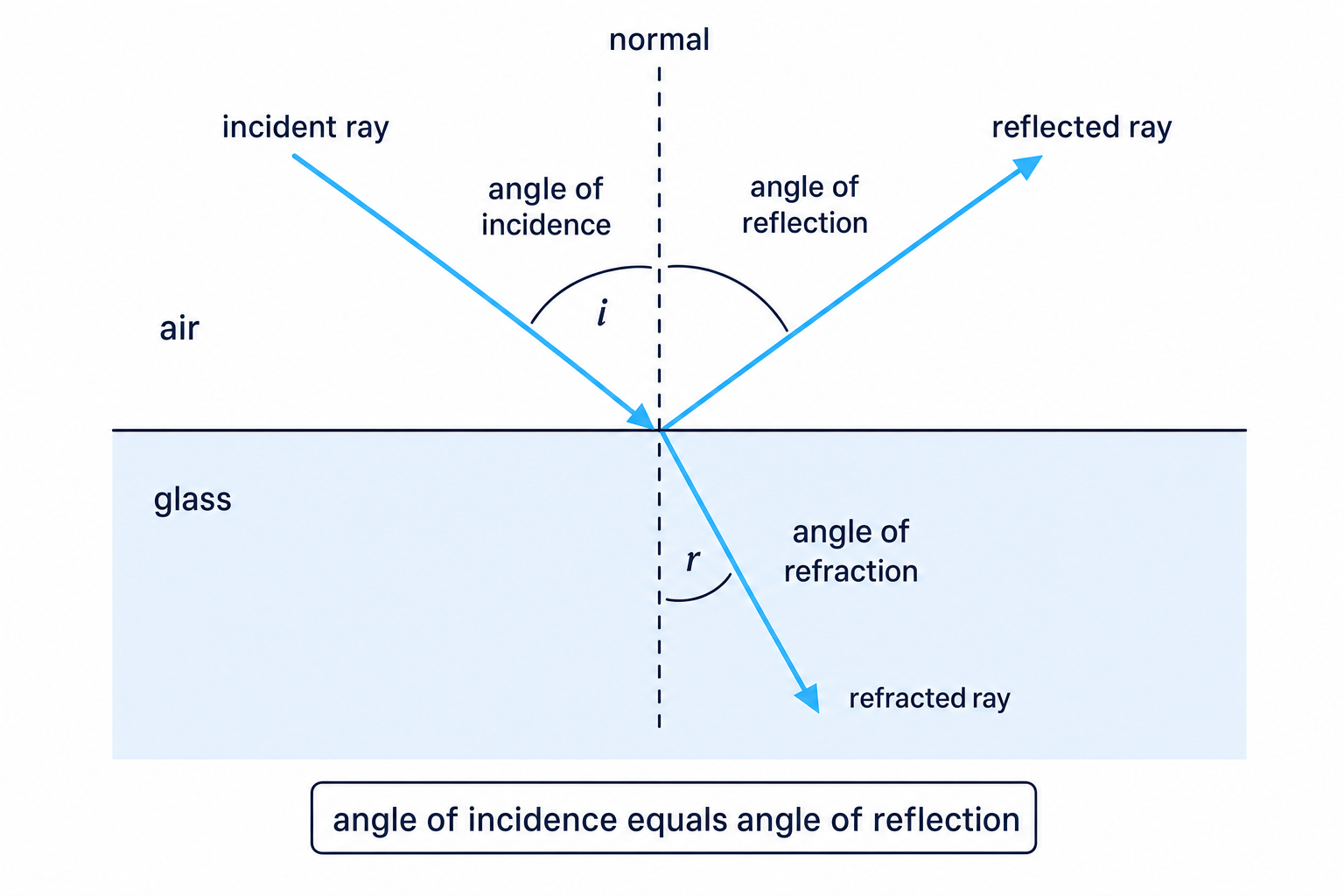
The angle of incidence is the angle between the incident ray and the normal. The angle of reflection is the angle between the reflected ray and the normal.
The law of reflection is:
angle of incidence = angle of reflection, so using symbols for the two angles:
θi=θr\theta_i = \theta_rθi=θr
This works for plane mirrors and for total internal reflection inside materials.
Using the law of reflection
A ray hits a mirror at 30° to the surface. Find the angle of reflection measured from the normal.
- The law uses angles measured from the normal, so convert the given surface angle: 90∘−30∘=60∘90^\circ - 30^\circ = 60^\circ90∘−30∘=60∘.
- Apply the law of reflection: angle of reflection = angle of incidence = 60°.
- If the question asked for the angle to the surface instead, convert back: 90∘−60∘=30∘90^\circ - 60^\circ = 30^\circ90∘−60∘=30∘.
Measuring from the surface
Angles of incidence, reflection and refraction are always measured from the normal. Measuring from the surface gives the complementary angle and usually loses the mark.
Refraction
A medium is a material that a wave travels through, such as air, glass or water. Refraction happens when light crosses a boundary between two media and changes speed, causing a change in direction.
When light goes from air into glass, it slows down and bends towards the normal. When it goes from glass into air, it speeds up and bends away from the normal. If the ray travels along the normal, it does not bend.
Bending rule
Air to glass: towards the normal. Glass to air: away from the normal. Along the normal: no bending.
Refractive index
The refractive index, nnn, tells you how strongly a material refracts light. For light travelling from air into a material:
refractive index = sine of angle of incidence divided by sine of angle of refraction
n=sinisinrn = \frac{\sin i}{\sin r}n=sinrsini
Here, iii is the angle of incidence in air and rrr is the angle of refraction in the material. Refractive index has no unit.
Calculating refractive index
Light enters a glass block from air. The angle of incidence is 35° and the angle of refraction is 22°. Calculate the refractive index of the glass.
- Identify the angles from the normal: i=35∘i = 35^\circi=35∘ and r=22∘r = 22^\circr=22∘.
- Substitute into the refractive index equation: n=sin35∘sin22∘n = \frac{\sin 35^\circ}{\sin 22^\circ}n=sin22∘sin35∘.
- Calculate: n=0.5740.375=1.53n = \frac{0.574}{0.375} = 1.53n=0.3750.574=1.53. The refractive index of the glass is 1.53.
Practical: investigating refraction and refractive index
For these practicals you use a ray box, single slit, paper, pencil, ruler, protractor, and a rectangular glass block, semi-circular glass block or triangular prism.
A typical method is:
- Place the block on paper and draw around it.
- Draw a normal at the point where the ray will enter.
- Shine a narrow ray at a chosen angle of incidence, such as 20°, 30°, 40° and 50°.
- Mark the incoming and outgoing ray positions, remove the block, then join the marks to trace the ray path through the block.
- Measure the angle of incidence and angle of refraction from the normal.
- Repeat and average, or use several different angles.
With a rectangular block, the emergent ray is usually parallel to the incident ray but shifted sideways. With a semi-circular block, aim the ray at the centre of the curved face so it enters without bending, letting you study refraction at the flat face. With a triangular prism, you can trace how the ray is deviated and, at suitable angles, investigate total internal reflection.
For the glass-block refractive index practical, the independent variable is the angle of incidence. The dependent variable is the angle of refraction. Control variables include the material, block position, light colour, and ray width.
Graph for refractive index
To find nnn from results, calculate sini\sin isini and sinr\sin rsinr, then plot sini\sin isini on the vertical axis against sinr\sin rsinr on the horizontal axis. The gradient is the refractive index, because n=sinisinrn = \frac{\sin i}{\sin r}n=sinrsini.
Common practical errors include moving the block after drawing around it, using a ray that is too wide, drawing thick pencil lines, and measuring angles from the surface instead of the normal.
Critical angle and total internal reflection
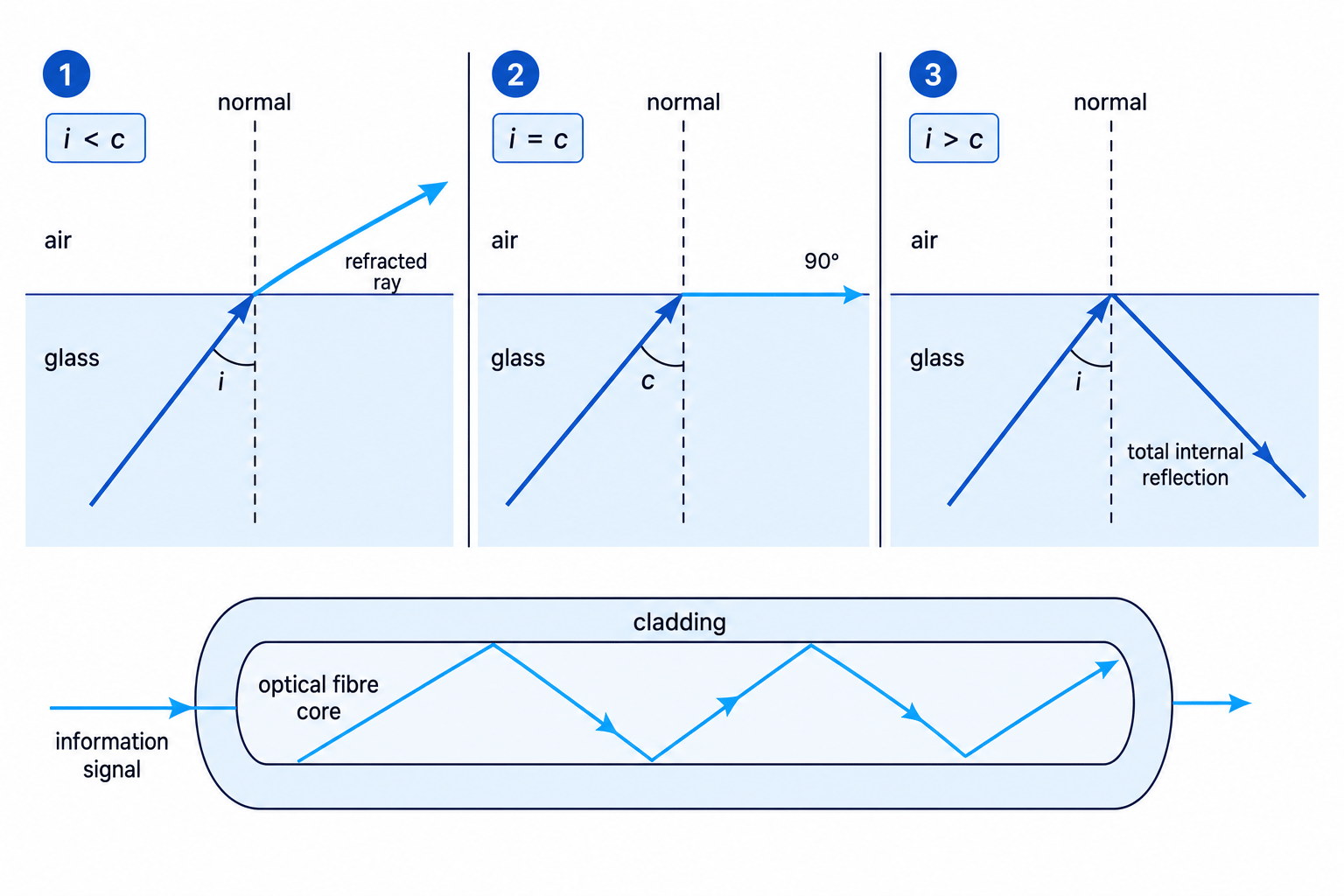
When light travels from glass to air, it bends away from the normal. At one special angle, the refracted ray travels exactly along the boundary. This angle is the critical angle, ccc.
Critical angle
The critical angle, ccc, is the angle of incidence in the denser material for which the angle of refraction is 90°.
If the angle of incidence is greater than the critical angle, no light refracts out. Instead, all the light is reflected back inside the material. This is total internal reflection.
Conditions for total internal reflection
Total internal reflection only happens when light travels from a higher refractive index material to a lower refractive index material, and the angle of incidence is greater than the critical angle.
The relationship is:
sine of critical angle = 1 divided by refractive index
sinc=1n\sin c = \frac{1}{n}sinc=n1
Calculating critical angle
A glass has refractive index 1.50. Calculate the critical angle for a glass-to-air boundary.
- Use the critical angle relationship: sinc=1n\sin c = \frac{1}{n}sinc=n1.
- Substitute n=1.50n = 1.50n=1.50: sinc=11.50=0.667\sin c = \frac{1}{1.50} = 0.667sinc=1.501=0.667.
- Use inverse sine on a calculator in degrees: c=sin−1(0.667)=41.8∘c = \sin^{-1}(0.667) = 41.8^\circc=sin−1(0.667)=41.8∘, so the critical angle is about 42°.
Total internal reflection is used in optical fibres. Light pulses carrying information enter a fibre and repeatedly reflect inside the core, so the signal can travel long distances with little loss. The cladding has a lower refractive index than the core, helping the light stay trapped.
Prisms can also use total internal reflection to turn light through 90° or 180°, for example in periscopes and binoculars.
Sound as a longitudinal wave
A longitudinal wave is a wave where the vibrations are parallel to the direction of energy transfer. Sound waves are longitudinal waves.
In air, sound consists of compressions, where particles are closer together, and rarefactions, where particles are more spread out. Sound waves can be reflected, producing echoes, and refracted when their speed changes, for example through air at different temperatures.
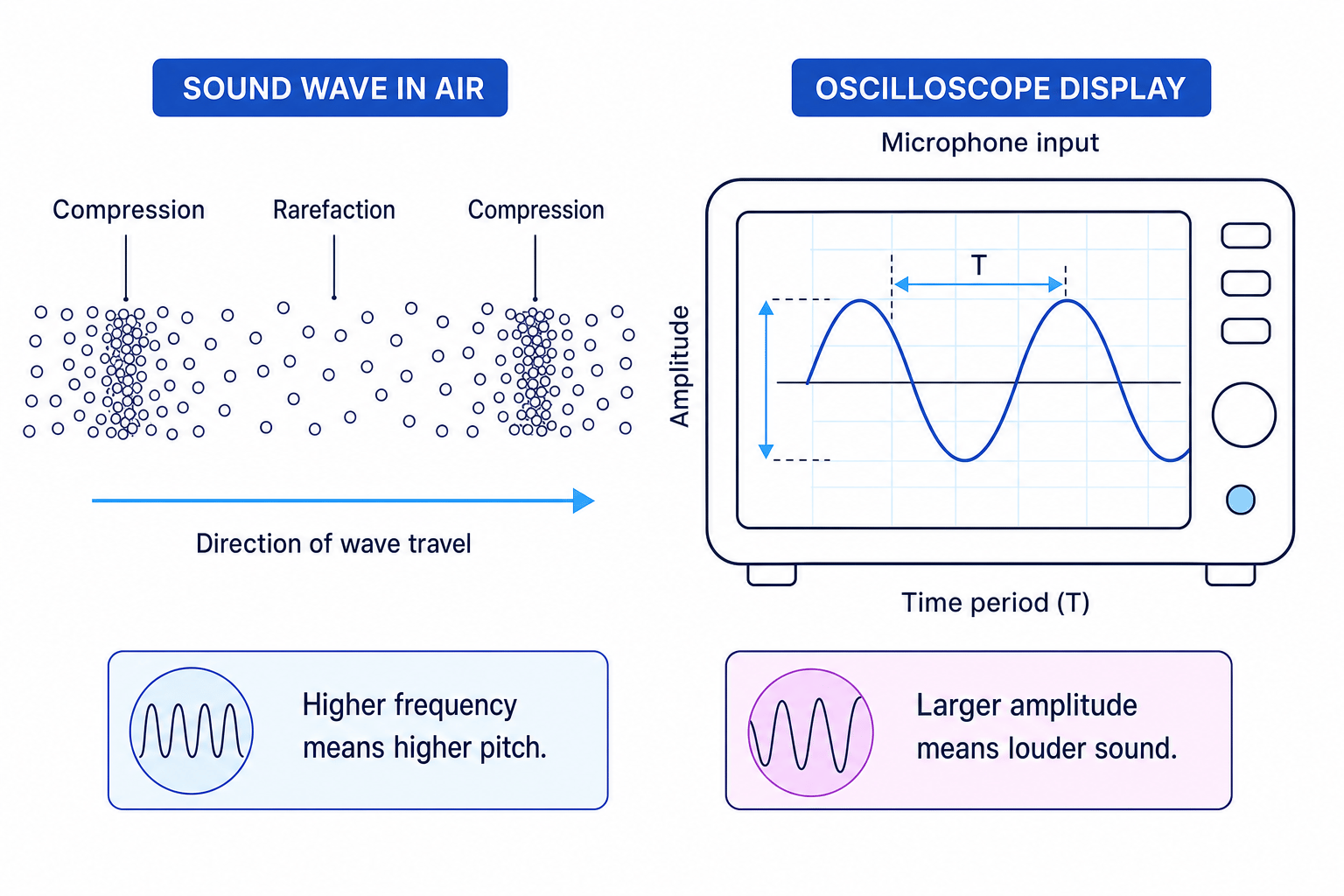
The frequency of a sound is the number of vibrations per second, measured in hertz, Hz. The amplitude is the maximum vibration from the rest position.
For human hearing, the frequency range is 20–20 000 Hz. This point is Paper 2 only.
Pitch and loudness
Higher frequency means higher pitch. Larger amplitude means louder sound.
Practical: investigating the speed of sound in air
This named practical is Paper 2 only. A simple method uses echoes from a large wall.
The equation is:
average speed = distance moved divided by time taken
v=stv = \frac{s}{t}v=ts
Method:
- Measure a large distance from a wall, for example 50 m or more.
- Make a sharp sound, such as clapping two wooden blocks.
- Time several echoes, not just one, to reduce the effect of reaction time.
- The sound travels to the wall and back, so the distance for one echo is twice the distance to the wall.
- Repeat for different distances.
For graphing, plot total distance travelled, sss, on the vertical axis against total time, ttt, on the horizontal axis. The gradient gives the speed of sound in m/s. Control variables include the same wall, same measuring position and similar air conditions. Major errors include reaction time, background noise, wind and difficulty judging exactly when the echo returns.
Finding the speed of sound from echoes
A student stands 85 m from a wall. The total time for 5 echoes is 2.50 s. Calculate the speed of sound.
- For one echo, sound travels to the wall and back: 2×85 m=170 m2 \times 85\ \text{m} = 170\ \text{m}2×85 m=170 m.
- For 5 echoes, the total distance is 5×170 m=850 m5 \times 170\ \text{m} = 850\ \text{m}5×170 m=850 m.
- Use v=stv = \frac{s}{t}v=ts: v=850 m2.50 s=340 m/sv = \frac{850\ \text{m}}{2.50\ \text{s}} = 340\ \text{m/s}v=2.50 s850 m=340 m/s.
Oscilloscopes, microphones and frequency
These oscilloscope ideas are Paper 2 only. A microphone changes sound vibrations into a changing electrical signal. An oscilloscope displays this signal as a voltage-time graph.
The vertical height of the trace shows amplitude. The horizontal spacing for one complete cycle gives the time period, TTT, which is the time for one full vibration.
frequency = 1 divided by time period
f=1Tf = \frac{1}{T}f=T1
To investigate frequency, connect a microphone to an oscilloscope, produce a steady sound using a tuning fork or loudspeaker, adjust the time base until a stable trace is visible, then measure the time for one cycle. For better accuracy, measure several cycles and divide by the number of cycles.
If using a signal generator, you can plot measured frequency against the generator setting. The graph should be a straight line close to gradient 1. Common errors include counting half a cycle, forgetting to convert the time-base scale into seconds, and confusing amplitude with frequency.
Finding frequency from an oscilloscope trace
One complete cycle covers 4.0 divisions on the oscilloscope. The time base is 0.00050 s per division. Calculate the frequency.
- Find the time period from the screen scale: T=4.0×0.00050 s=0.0020 sT = 4.0 \times 0.00050\ \text{s} = 0.0020\ \text{s}T=4.0×0.00050 s=0.0020 s.
- Use the frequency equation: f=1Tf = \frac{1}{T}f=T1.
- Substitute and calculate: f=10.0020 s=500 Hzf = \frac{1}{0.0020\ \text{s}} = 500\ \text{Hz}f=0.0020 s1=500 Hz.
In the exam
- On every ray diagram, draw the normal first, add arrowheads, and measure all angles from the normal.
- For refraction calculations, check whether you need n=sinisinrn = \frac{\sin i}{\sin r}n=sinrsini or sinc=1n\sin c = \frac{1}{n}sinc=n1, and keep your calculator in degrees.
- For sound practicals, reduce timing error by using several echoes or several wave cycles, then carry units through to m/s or Hz.
Check yourself
- A ray enters glass from air at an angle. Should it bend towards or away from the normal?
- How would you use a graph of sini\sin isini against sinr\sin rsinr to find the refractive index of glass?
- On an oscilloscope trace, what changes if a sound becomes both louder and higher pitched?