What you'll learn
- How to use the key SI units in forces and motion.
- How units such as m/s, m/s² and N/kg are built from simpler units.
- How to keep units correct in calculations.
- What the Paper 2 only units Nm and kg m/s mean.
Measurements: numbers need units
In physics, a measurement is not complete unless it has both a number and a unit.
For example, saying a track is “100” long is unclear. Is it 100 m, 100 km, or 100 cm? The unit tells you the scale of the measurement.
Unit
A unit is an agreed standard used to measure a physical quantity. A physical quantity is something that can be measured, such as mass, distance, time, speed or force.
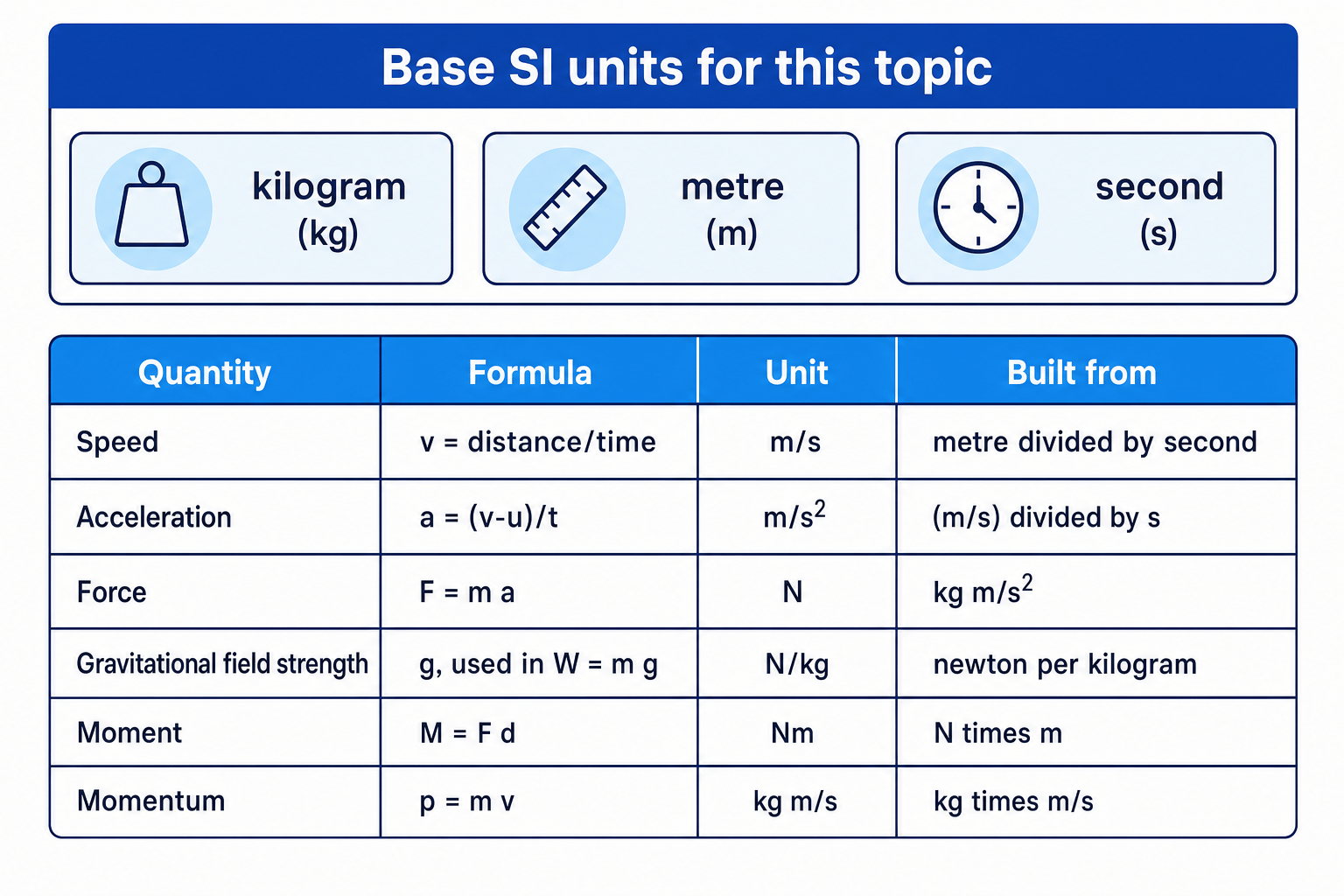
The main system used in science is the SI system, short for the International System of Units. In this topic, the most important starting units are:
| Quantity | Unit name | Unit symbol |
|---|---|---|
| mass | kilogram | kg |
| length or distance | metre | m |
| time | second | s |
Unit symbols are case-sensitive
Write unit symbols exactly: kg, m and s are lower-case, but newton is N because it is named after a person. Do not add plural letters: write 5 kg, not 5 kgs.
Base units and derived units
Some units are base units, meaning they are basic building blocks. The kilogram, metre and second are base units for this topic.
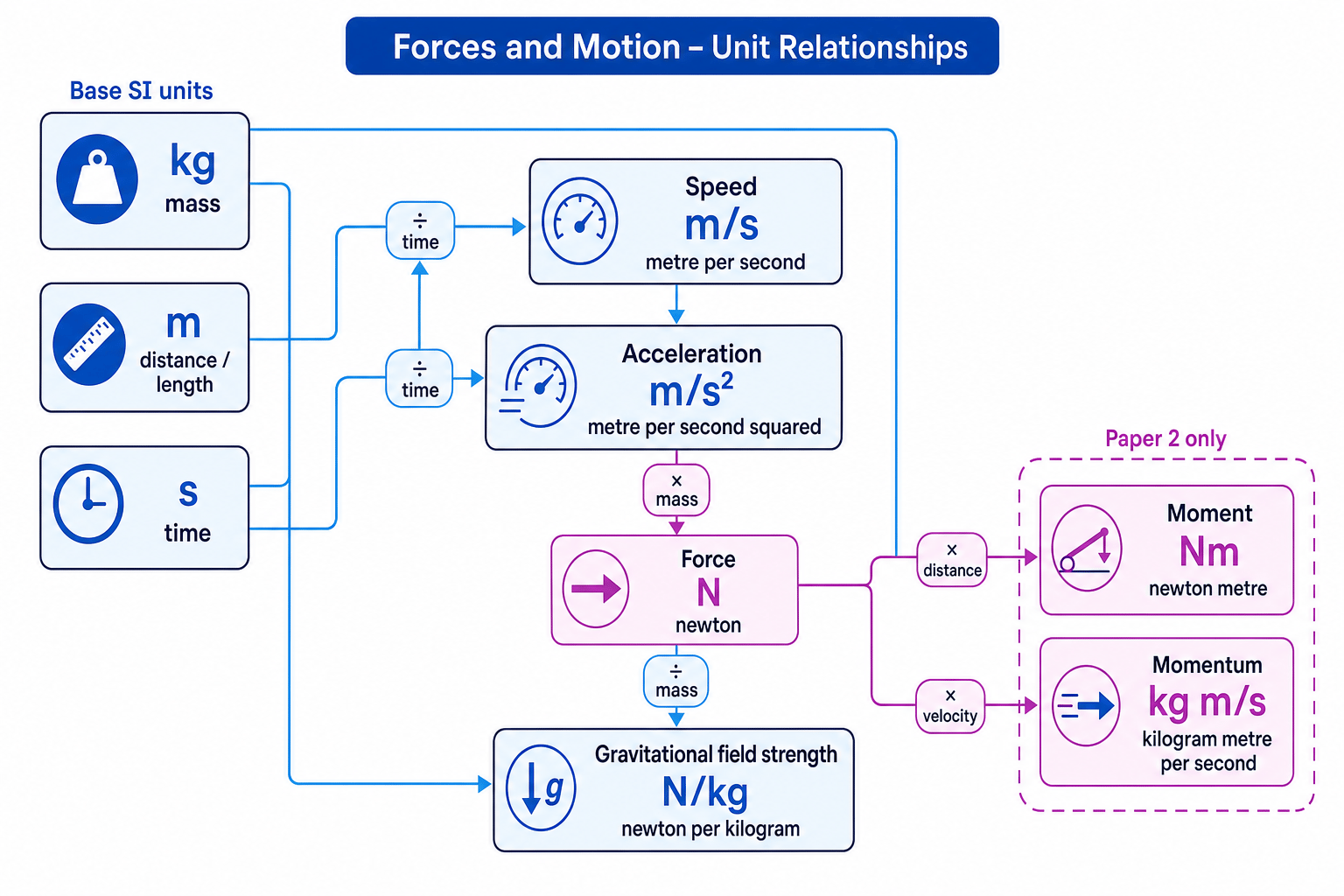
Other units are derived units, meaning they are made by combining base units. For example, speed uses distance and time, so its unit combines metres and seconds.
Units follow the calculation
When quantities are multiplied or divided, their units are multiplied or divided too. That is why units can help you check whether a calculation makes sense.
Metres per second: m/s
Speed tells you how quickly distance is covered.
The equation is:
average speed = distance moved divided by time taken, v=stv = \frac{s}{t}v=ts
If distance is measured in metres and time is measured in seconds, the speed unit is metres per second, written as m/s.
“Per” means “for each”. So 8 m/s means 8 metres for each second.
Calculating average speed
A cyclist travels 120 m in 15 s. Calculate the average speed.
- Use average speed = distance moved divided by time taken, so v=stv = \frac{s}{t}v=ts.
- Substitute the values with units: v=120 m15 sv = \frac{120\ \text{m}}{15\ \text{s}}v=15 s120 m.
- Divide the numbers and the units: v=8.0 m/sv = 8.0\ \text{m/s}v=8.0 m/s.
s can mean seconds or distance
Plain s after a number means seconds, as in 12 s. But italic sss in an equation such as v=stv = \frac{s}{t}v=ts can mean distance or displacement. Use the context carefully.
Metres per second squared: m/s²
Acceleration tells you how quickly velocity changes.
Acceleration
Acceleration is the change in velocity per second. Its unit is metre per second squared, written as m/s².
The equation is:
acceleration = change in velocity divided by time taken, a=v−uta = \frac{v-u}{t}a=tv−u
Here, uuu is the initial velocity and vvv is the final velocity.
An acceleration of 3 m/s² means the velocity changes by 3 m/s every second.
Calculating acceleration
A car’s velocity increases from 4 m/s to 16 m/s in 6 s. Calculate its acceleration.
- Find the change in velocity: v−u=16 m/s−4 m/s=12 m/sv-u = 16\ \text{m/s} - 4\ \text{m/s} = 12\ \text{m/s}v−u=16 m/s−4 m/s=12 m/s.
- Use acceleration = change in velocity divided by time taken: a=v−uta = \frac{v-u}{t}a=tv−u.
- Substitute and calculate: a=12 m/s6 s=2.0 m/s2a = \frac{12\ \text{m/s}}{6\ \text{s}} = 2.0\ \text{m/s}^2a=6 s12 m/s=2.0 m/s2.
Newtons: N
A force is a push or pull that can change an object’s motion, shape or direction. The unit of force is the newton, written N.
The equation connecting force, mass and acceleration is:
force = mass multiplied by acceleration, F=m×aF = m \times aF=m×a
So a newton is linked to kg and m/s². One newton is the force needed to give a 1 kg mass an acceleration of 1 m/s².
Calculating force in newtons
A trolley of mass 0.60 kg accelerates at 2.5 m/s². Calculate the resultant force.
- Use force = mass multiplied by acceleration, so F=m×aF = m \times aF=m×a.
- Substitute the values with units: F=0.60 kg×2.5 m/s2F = 0.60\ \text{kg} \times 2.5\ \text{m/s}^2F=0.60 kg×2.5 m/s2.
- Calculate: F=1.5 kg m/s2F = 1.5\ \text{kg m/s}^2F=1.5 kg m/s2.
- Use the named unit: 1 kg m/s² is 1 N, so F=1.5 NF = 1.5\ \text{N}F=1.5 N.
Newtons per kilogram: N/kg
The unit N/kg means newtons per kilogram.
It is used for gravitational field strength, usually given the symbol ggg.
Gravitational field strength
Gravitational field strength is the force of gravity on each kilogram of mass. Its unit is N/kg.
The equation is:
weight = mass multiplied by gravitational field strength, W=m×gW = m \times gW=m×g
Weight is a force, so it is measured in newtons. Mass is measured in kilograms.
Calculating weight using N/kg
An object has a mass of 7.5 kg. The gravitational field strength is 10 N/kg. Calculate its weight.
- Use weight = mass multiplied by gravitational field strength, so W=m×gW = m \times gW=m×g.
- Substitute the values with units: W=7.5 kg×10 N/kgW = 7.5\ \text{kg} \times 10\ \text{N/kg}W=7.5 kg×10 N/kg.
- The kg cancels with “per kg”, leaving newtons: W=75 NW = 75\ \text{N}W=75 N.
Mass is not weight
Mass is measured in kg. Weight is a force caused by gravity and is measured in N. An astronaut’s mass is the same on Earth and the Moon, but their weight changes because ggg changes.
Converting before you calculate
In Edexcel IGCSE Physics calculations, use the correct SI units unless the question clearly says otherwise.
Common conversions include:
- 1000 g = 1 kg
- 100 cm = 1 m
- 1000 m = 1 km
If you forget to convert, the final answer may be wrong even if your formula is correct.
Converting units before using force
A toy car has mass 500 g and accelerates at 3.0 m/s². Calculate the force.
- Convert the mass into kilograms: 500 g = 0.500 kg.
- Use force = mass multiplied by acceleration: F=m×aF = m \times aF=m×a.
- Substitute and calculate: F=0.500 kg×3.0 m/s2=1.5 NF = 0.500\ \text{kg} \times 3.0\ \text{m/s}^2 = 1.5\ \text{N}F=0.500 kg×3.0 m/s2=1.5 N.
Newton metre and kilogram metre per second
You also need to use two more units: newton metre (Nm) and kilogram metre per second (kg m/s). These are assessed on Paper 2 only.
A moment is the turning effect of a force about a pivot. Its unit is Nm.
The equation is:
moment of a force = force multiplied by perpendicular distance from pivot, M=F×dM = F \times dM=F×d
Momentum is a measure of how much motion an object has. Its unit is kg m/s.
The equation is:
momentum = mass multiplied by velocity, p=m×vp = m \times vp=m×v
Using Nm and kg m/s
A force of 8.0 N acts 0.25 m from a pivot. A separate object has mass 0.20 kg and velocity 15 m/s. Calculate the moment and the momentum.
- For the turning effect, use M=F×dM = F \times dM=F×d with the force and perpendicular distance: M=8.0 N×0.25 mM = 8.0\ \text{N} \times 0.25\ \text{m}M=8.0 N×0.25 m.
- Calculate the moment: M=2.0 NmM = 2.0\ \text{Nm}M=2.0 Nm.
- For the moving object, use p=m×vp = m \times vp=m×v: p=0.20 kg×15 m/sp = 0.20\ \text{kg} \times 15\ \text{m/s}p=0.20 kg×15 m/s.
- Calculate the momentum: p=3.0 kg m/sp = 3.0\ \text{kg m/s}p=3.0 kg m/s.
Nm is not N/m
Nm means newtons multiplied by metres, used for moments. N/m means newtons per metre, a different unit used later for spring stiffness.
In the exam
- Check the units before substituting into an equation: convert g to kg, cm to m, and keep time in s unless told otherwise.
- Write the correct unit on every numerical answer, using exact symbols such as m/s, m/s², N and N/kg.
- For Paper 2 calculations, distinguish carefully between Nm for moments and kg m/s for momentum.
Check yourself
- What is the difference between mass in kg and weight in N?
- A velocity changes from 5 m/s to 17 m/s in 4 s. What unit should the acceleration have?
- Why does a moment use Nm rather than N/m?