A student investigates how the resistance of a negative temperature coefficient (NTC) thermistor changes with temperature.
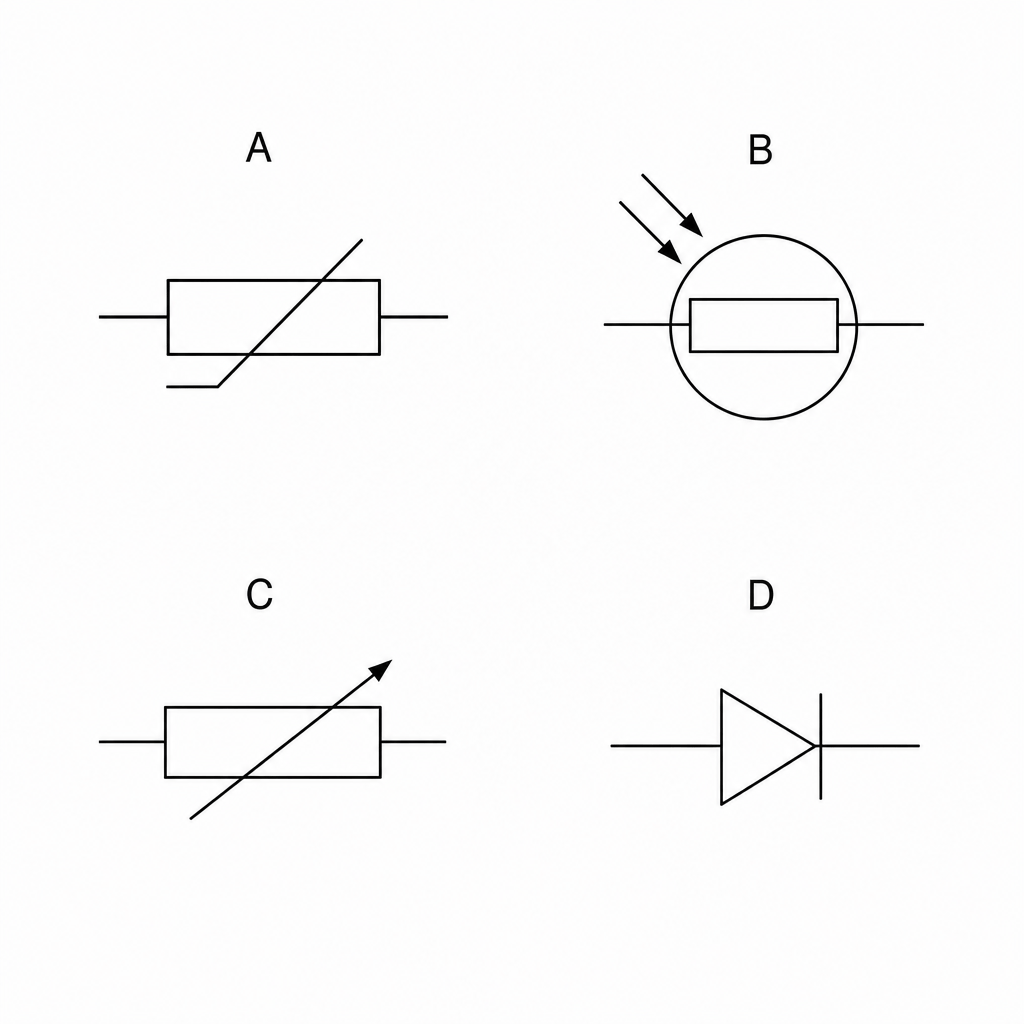
Which of these is the correct circuit symbol for a thermistor?
The student places the thermistor inside a waterproof protective test tube, lowers it into a beaker of water, and heats the water using an electrical hot plate.
Explain why the student must stir the water thoroughly before taking each temperature reading.
To determine the resistance of the thermistor, the student also uses a voltmeter and an ammeter. State how the voltmeter and the ammeter should be connected relative to the thermistor.
The table below shows the student's results.
| Temperature (∘C^{\circ}\text{C}∘C) | Resistance (Ω\OmegaΩ) |
|---|---|
| 10 | 4500 |
| 20 | 3100 |
| 30 | 2200 |
| 40 | 1600 |
| 50 | 2300 |
| 60 | 850 |
| 70 | 600 |
Identify the anomalous reading in the table, giving its temperature and resistance.
State the expected range of resistance at this temperature if it followed the trend shown by the other data points.
Why is it difficult to obtain reliable resistance readings if the water is heated very rapidly?
Suggest one way the student could vary the temperature of the water bath without using the electrical hot plate.

