What you'll learn
- How desertification affects farming, food security and migration.
- How deforestation creates both short-term economic benefits and long-term environmental costs.
- How climate change is already affecting fragile environments and people.
- How to build strong IGCSE explanations using linked chains of impact.
1. Start with the big idea: fragile environments
A fragile environment is a place that is easily damaged and may recover slowly. This is often because soils are thin, rainfall is unreliable, biodiversity is highly specialised, or people depend directly on natural resources for food, fuel and income.
Examples include:
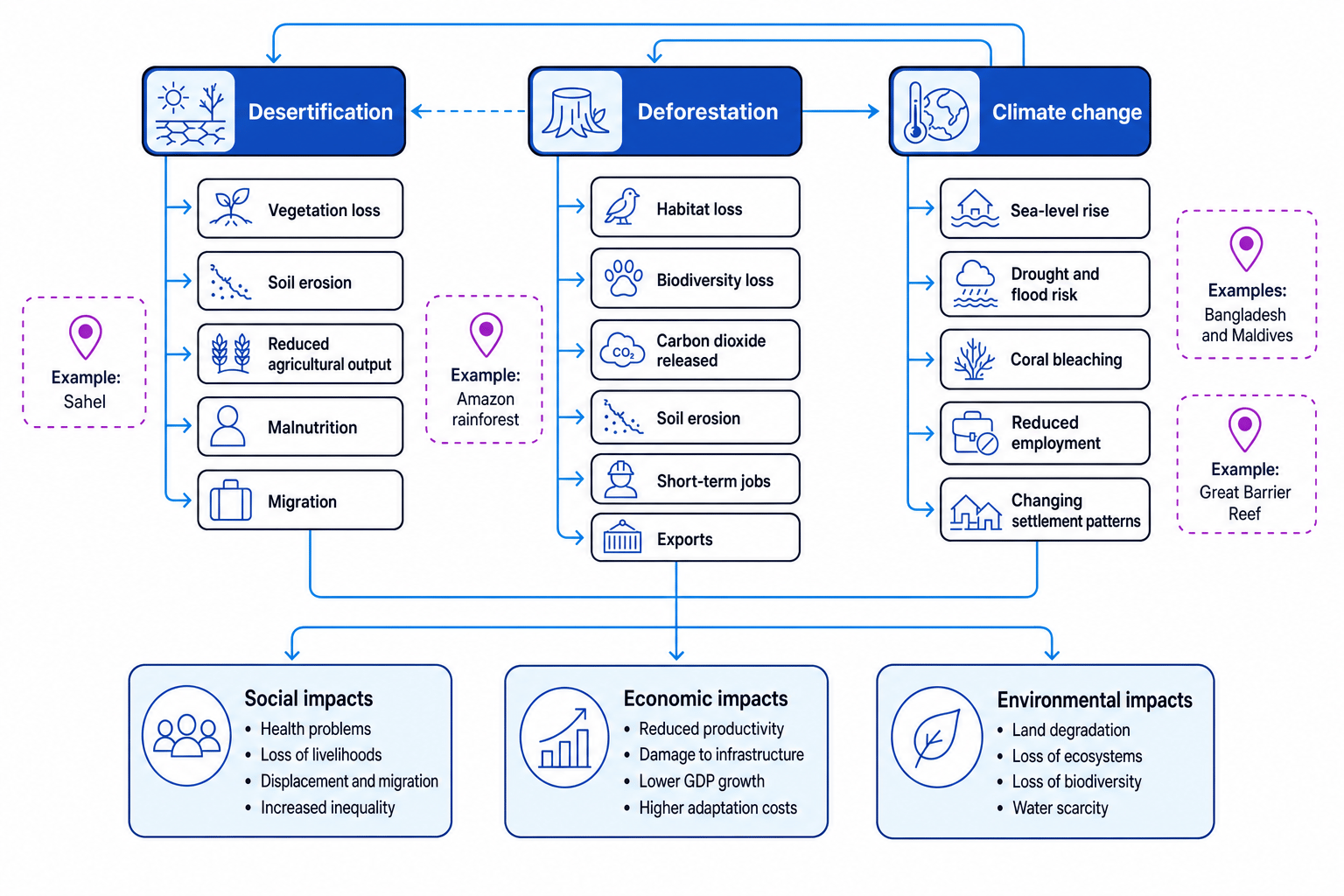
- Semi-arid areas such as the Sahel, south of the Sahara Desert in Africa.
- Tropical rainforests such as the Amazon rainforest in Brazil.
- Low-lying coasts and islands such as Bangladesh and the Maldives.
- Coral reefs such as the Great Barrier Reef in Australia.
Types of impact
A social impact affects people’s lives and wellbeing. An economic impact affects money, jobs, income or production. An environmental impact affects ecosystems, soils, water, climate or biodiversity.
These categories often overlap. For example, crop failure is environmental at first, but it quickly becomes economic because farmers lose income, and social because families may face hunger.
Linked impacts
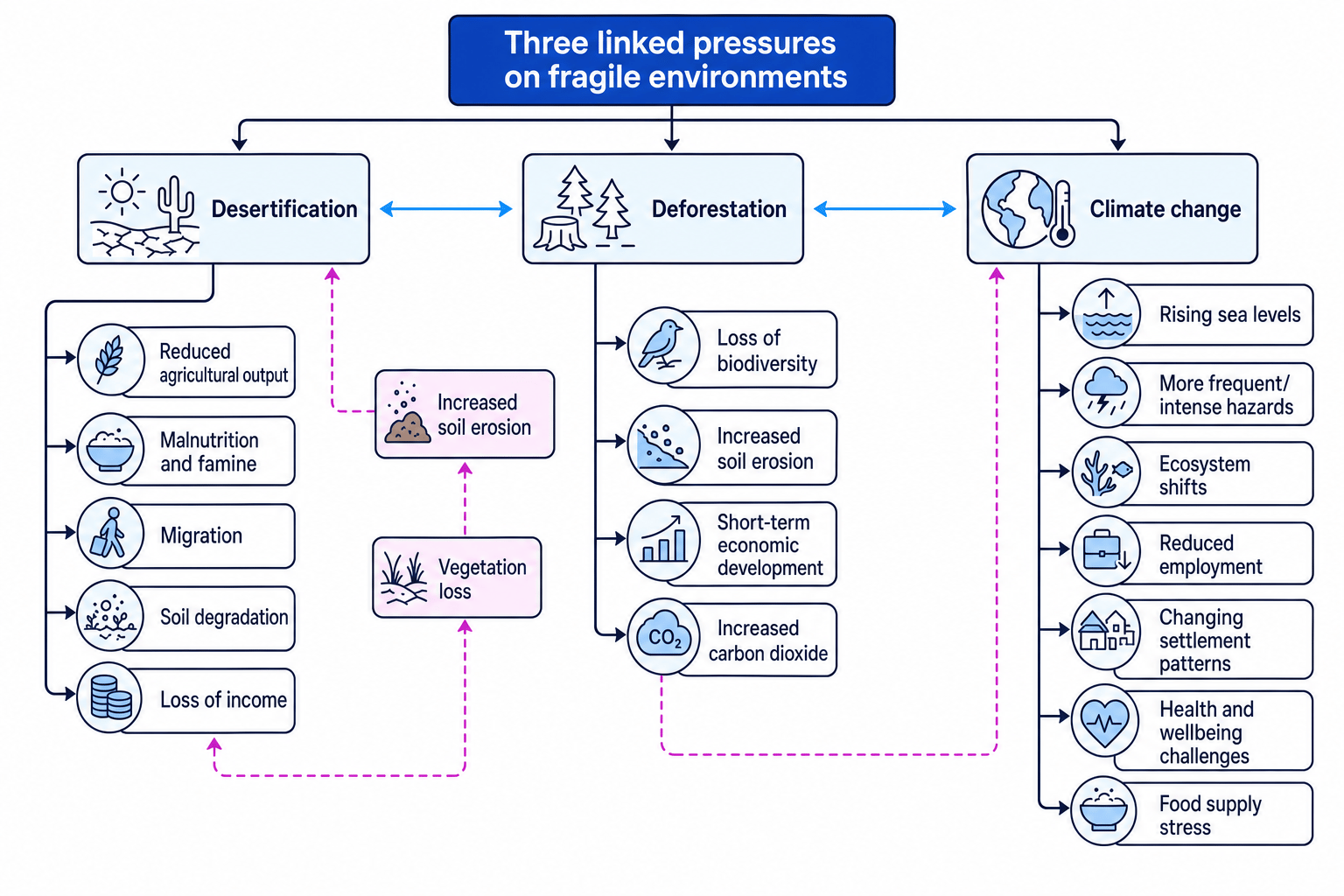
In fragile environments, one impact often triggers another. The best answers explain a chain of consequences, not just a list.
2. Desertification and its impacts
Desertification
Desertification is the process where fertile or semi-fertile land becomes degraded and less productive, often in dryland areas, due to a mix of climate stress and human activity.
Desertification does not always mean a desert physically spreads like a moving wall. More often, it means land loses vegetation, soil fertility and moisture, so it becomes harder to farm or graze animals.
A key located example is the Sahel, a semi-arid belt across Africa including countries such as Niger, Mali, Chad and Sudan. Rainfall is naturally variable, and many people depend on rain-fed farming and livestock. This makes the region vulnerable when drought, overgrazing, fuelwood collection and population pressure combine.
Reduced agricultural output
Agricultural output means the amount of food, crops or livestock produced. Desertification reduces output because:
- Soils become dry, dusty and less fertile.
- Vegetation cover is lost, so animals have less pasture.
- Wind and water remove topsoil, which contains nutrients.
- Drought makes crops fail more often.
This can reduce yields of crops such as millet and sorghum in parts of the Sahel. Exact figures vary by year because rainfall is highly unpredictable.
Malnutrition and famine
Malnutrition and famine
Malnutrition means people do not get enough nutrients for healthy growth and life. Famine is an extreme food crisis where many people face starvation over a wide area.
When farming output falls, food becomes less available and more expensive. Poor households may reduce meal sizes, sell animals or take children out of school to work. In severe drought years, food aid may be needed.
Migration
When land can no longer support families, people may migrate. This can be:
- Temporary migration, such as moving seasonally to find work.
- Rural-to-urban migration, such as moving to cities for jobs.
- International migration, especially if conflict, poverty and drought combine.
Migration can reduce pressure on land in the short term, but it can also create pressure on services, housing and jobs in destination areas.
Explaining a desertification impact chain
- Start with the environmental change: vegetation is removed by drought and overgrazing, leaving soil exposed.
- Link it to farming: exposed soil is more easily eroded, so crops grow less well and agricultural output falls.
- Link it to people: lower output means families have less food and income, increasing the risk of malnutrition.
- Add a wider consequence: if farming becomes unreliable, some people migrate to towns or other regions to find work.
Only writing ‘it becomes a desert’
Avoid vague statements such as “the land turns into desert”. Say what changes: vegetation cover falls, soil fertility declines, crop yields drop, food insecurity increases, and migration may rise.
3. Deforestation and its impacts
Deforestation
Deforestation is the permanent removal of forest, usually so the land can be used for farming, cattle ranching, mining, roads, settlement or timber.
A major located example is the Amazon rainforest in Brazil, a large tropical rainforest in South America. It stores huge amounts of carbon and contains very high biodiversity. Deforestation has occurred for cattle ranching, soya farming, logging, mining, hydroelectric schemes and road building.
Loss of biodiversity
Biodiversity
Biodiversity means the variety of living organisms in an area, including plants, animals, fungi and microorganisms.
Tropical rainforests have many species that are adapted to very specific conditions. When forest is cleared:
- Habitats are destroyed or fragmented.
- Food webs are disrupted.
- Some species cannot move or adapt quickly enough.
- Genetic diversity may be lost before species are even fully studied.
This is an environmental impact, but it can also become economic because forests may contain useful medicines, foods and materials.
Contribution to climate change
Trees absorb carbon dioxide during photosynthesis. When forests are cut and burned, carbon stored in trunks, branches and soils is released into the atmosphere. Fewer trees also means less carbon dioxide is removed in future.
This makes deforestation a contributor to climate change, especially when large areas are burned or converted to cattle pasture.
Economic development
Deforestation can bring economic benefits, especially in the short term:
- Timber can be sold.
- Roads improve access to remote areas.
- Farms, ranches and mines create jobs.
- Exports such as beef, soya and minerals can increase national income.
This is why exam answers should be balanced: deforestation is environmentally damaging, but it may also support development for governments, companies and some local communities.
Increased soil erosion
Rainforest soils are often less fertile than people expect. Many nutrients are stored in the living vegetation rather than deep in the soil. Once trees are removed:
- Rain hits the ground directly.
- Roots no longer bind the soil.
- Surface runoff increases.
- Topsoil is washed into rivers.
This can make farming less productive after only a few years, especially on slopes or where rainfall is intense.
Balancing impacts of Amazon deforestation
- Identify the economic benefit: clearing forest for cattle ranching or soya farming can create jobs, exports and tax income for Brazil.
- Identify the environmental cost: forest clearance destroys habitats, reduces biodiversity and releases carbon dioxide.
- Link the impacts together: if soils are eroded after clearance, farming may become less productive, so the economic benefit may be short-lived.
- Reach a balanced judgement: deforestation can support development, but in fragile rainforest environments it can damage the natural systems that long-term livelihoods depend on.
Use both sides for deforestation
For deforestation, try to include one economic benefit and two environmental costs. This shows the examiner you understand why deforestation happens, not just why it is harmful.
4. Climate change and fragile environments
Climate change
Climate change is a long-term change in average climate conditions, including temperature, rainfall patterns, sea level and the frequency or intensity of some extreme events.
Climate change affects fragile environments because many are already close to their limits. A small change in rainfall, temperature or sea level can have large effects.
Rising sea levels
Global sea level has risen by around 20 cm since the early 20th century, though local impacts vary. Sea-level rise affects low-lying places such as Bangladesh, a densely populated delta country, and the Maldives, an island nation in the Indian Ocean.
Impacts include:
- Coastal flooding and erosion.
- Saltwater entering soils and freshwater supplies.
- Damage to homes, roads and farmland.
- Pressure to move settlements inland or raise buildings.
More hazards
Climate change can increase the risk or intensity of some hazards, such as:
- Heatwaves.
- Droughts.
- Wildfires.
- Intense rainfall and flooding.
- Stronger storm surges in coastal areas.
Do not say every hazard is “caused by climate change”. A safer phrase is that climate change can increase the likelihood or severity of some hazards.
Ecosystem changes
Ecosystems may shift as temperatures and rainfall patterns change. For example:
- Coral reefs suffer bleaching when sea temperatures are too high.
- Mountain species may move uphill to stay in cooler conditions.
- Semi-arid grasslands may become more degraded during drought.
- Forests may face increased wildfire risk.
Coral bleaching
Coral bleaching happens when coral polyps expel the algae that live inside them due to stress, often from warmer water. The coral turns pale and may die if stressful conditions continue.
Reduced employment opportunities
Many jobs depend on stable environmental conditions. Climate change can reduce employment in:
- Farming, if drought or flooding reduces yields.
- Fishing, if fish stocks move or coral reefs decline.
- Tourism, if beaches erode, reefs bleach or heat becomes uncomfortable.
- Forestry, if fires and pests increase.
This is especially serious in poorer communities where people have fewer savings and fewer alternative jobs.
Changing settlement patterns
A settlement pattern is the way homes and communities are distributed. Climate change may cause people to move away from high-risk areas such as eroding coasts, floodplains or drought-prone farming regions.
This can lead to:
- Growth of informal settlements around cities.
- Pressure on water, schools, health care and housing.
- Conflict over land and resources in receiving areas.
- Loss of cultural ties to ancestral land.
Health and wellbeing challenges, including food supply
Climate change can affect health directly and indirectly. Heatwaves can cause dehydration and heat stress. Floods can spread water-borne diseases. Drought can reduce food production and increase food prices.
Food supply is a major issue because climate change affects:
- Crop yields.
- Livestock health.
- Water availability for irrigation.
- Transport routes during floods or storms.
Calculating percentage change in crop output
A semi-arid region produces 800 tonnes of millet in a normal year, but only 560 tonnes during a drought year. Calculate the percentage decrease.
- Find the decrease in output: 800 tonnes − 560 tonnes = 240 tonnes.
- Compare the decrease with the original value using the percentage change formula: changeoriginal×100\frac{\text{change}}{\text{original}} \times 100originalchange×100.
- Substitute the values: 240800×100=30\frac{240}{800} \times 100 = 30800240×100=30.
- Interpret the result: crop output decreased by 30%, which could reduce food supply and farm income.
Avoid overclaiming
Climate change does not affect every place in the same way. In exams, use careful wording such as “may increase”, “can worsen” or “is likely to intensify”, then support it with a named example.
5. Bringing the three processes together
Desertification, deforestation and climate change are separate processes, but they can reinforce each other.
For example, deforestation can increase soil erosion and carbon emissions. More carbon emissions contribute to climate change. Climate change can increase drought risk in some dryland areas, making desertification worse. Desertification then reduces vegetation further, exposing more soil and reducing local livelihoods.
The strongest explanations are connected
A high-quality answer links process → environmental change → human impact → wider consequence. For example: deforestation removes roots, so soil erosion increases, crop yields fall, incomes decline, and migration may increase.
6. Quick comparison
| Process | Main environmental impacts | Main social and economic impacts |
|---|---|---|
| Desertification | Soil degradation, vegetation loss, reduced water availability | Reduced agricultural output, malnutrition, famine risk, migration |
| Deforestation | Biodiversity loss, increased soil erosion, higher carbon emissions | Jobs and exports in the short term, but possible long-term loss of resources |
| Climate change | Sea-level rise, ecosystem change, more intense hazards in some places | Reduced employment, changing settlements, health challenges, food supply stress |
In the exam
- Use named places such as the Sahel, Amazon rainforest, Bangladesh, Maldives or the Great Barrier Reef to anchor your answer.
- Build chains of explanation: do not just list “famine, migration, erosion”; explain how one leads to another.
- Separate social, economic and environmental impacts where possible, but show when they overlap.
- Be balanced for deforestation: include short-term economic development as well as environmental damage.
- Use cautious wording for climate change impacts and support claims with evidence or examples.
Check yourself
- How can desertification lead to both malnutrition and migration?
- Why can deforestation bring economic development while still damaging a fragile environment?
- Choose one fragile environment and explain two ways climate change could affect people living there.