What you'll learn
- How technology can help solve water shortages in dry, fragile environments.
- How rainforests can be managed more sustainably, using the Brazilian Amazon as a named region.
- How responses to climate change differ between a developed country and a developing country.
- Why a country’s level of development affects what responses are realistic.
The big idea: development affects what is possible
A fragile environment is a place where the natural environment is easily damaged and slow to recover. Drylands and tropical rainforests are both fragile, but for different reasons: drylands may have limited water, while rainforests have complex ecosystems that can be quickly disrupted by logging, farming and roads.
A country’s level of development means its general economic and social progress. It is often measured using indicators such as GNI per capita, education, healthcare, infrastructure and the Human Development Index, or HDI.
Key terms for this section
Desertification is the process where land in dry areas becomes less productive, often because of drought, overgrazing, deforestation or poor farming. Deforestation is the large-scale removal of trees. Sustainable management means using resources in a way that meets people’s needs now without damaging the ability of future generations to meet theirs.
Development shapes responses
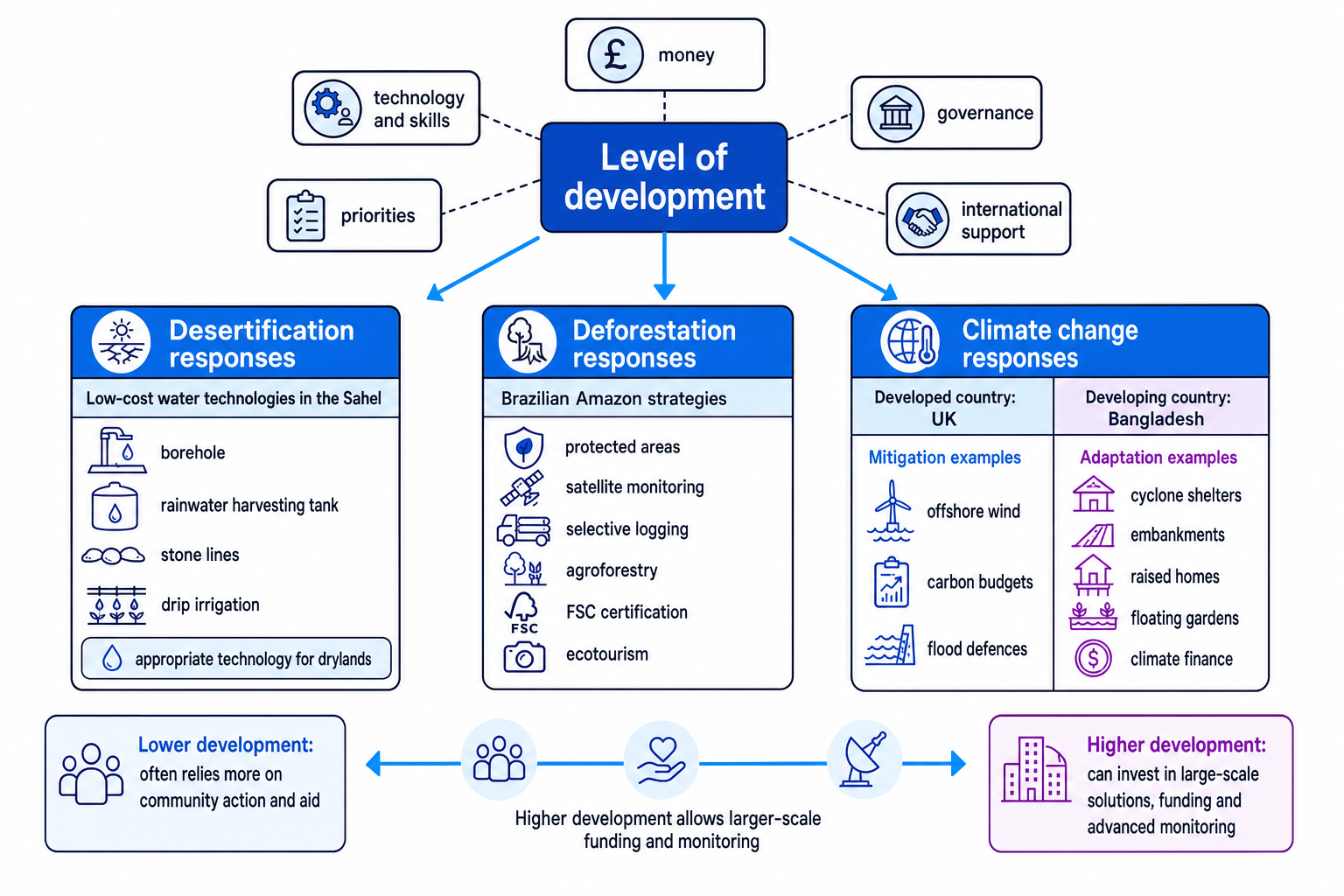
Developed countries usually have more money, technology and government capacity, so they can afford large-scale engineering, strict monitoring and long-term planning. Developing countries may rely more on low-cost, community-based projects, international aid and appropriate technology.
1. Technology and water shortages in areas threatened by desertification
A water-resource shortage happens when demand for water is greater than the available supply of safe, usable water. This can happen because rainfall is low, droughts are frequent, groundwater is overused, or population and farming demand increase.
Dry regions such as the Sahel, south of the Sahara Desert in Africa, are especially vulnerable. Rainfall is highly seasonal and unreliable, and many rural communities depend on farming and livestock. In some Sahel countries, such as Niger, Mali and Burkina Faso, limited income means responses often need to be low-cost and easy to maintain locally.
How technology can help
Technology can reduce water shortages in three main ways:
- Increasing supply: boreholes, wells, solar-powered pumps and small reservoirs help people access or store water.
- Reducing waste: drip irrigation delivers water directly to plant roots, using much less water than flood irrigation.
- Capturing rainfall: rainwater harvesting, stone lines, terraces and small dams slow runoff and allow water to soak into the soil.
Appropriate technology is technology that fits the local level of income, skills, materials and environment. For example, a rainwater harvesting tank or hand pump may be more sustainable than a large dam if a village cannot afford specialist repairs.
Choosing water-resource technology for the Sahel
A village in Niger has unreliable rainfall, limited money and no reliable electricity supply. It wants to improve crop yields without increasing water waste.
-
Compare the physical conditions with the technology. Drip irrigation suits dry areas because it delivers small amounts of water directly to roots, reducing evaporation from the soil surface.
-
Compare the cost and maintenance needs. A large dam or deep motorised borehole may store more water, but it needs major investment, engineering skills and regular maintenance.
-
Choose the most sustainable option. A combination of rainwater harvesting, stone lines and low-cost drip irrigation is likely to be more appropriate because it is cheaper, can be managed locally and directly reduces water loss.
Technology is not a magic fix
Do not write that “technology solves desertification” on its own. It helps most when combined with better land management, such as reducing overgrazing, planting trees and using drought-resistant crops.
2. Sustainable rainforest management in a named region: the Brazilian Amazon
For Edexcel, you need a named rainforest region. A strong example is the Brazilian Amazon, especially states such as Pará and Amazonas. Brazil is an emerging country, meaning it has growing industry, trade and income, but also major inequality and development pressures.
Brazil contains about 60% of the Amazon rainforest. The forest is valuable globally because it stores carbon, supports huge biodiversity and influences rainfall patterns. However, it is also under pressure from cattle ranching, soya farming, road building, mining, logging and hydroelectric power.
Different approaches to sustainable management
Protected areas are zones where forest clearance is restricted or banned. Brazil has national parks, conservation units and Indigenous territories, which can reduce deforestation where laws are enforced.
Selective logging means removing only certain trees rather than clearing the whole forest. This reduces damage compared with clear-felling, but it still needs careful monitoring.
Forest certification is when timber is approved as being produced more sustainably. The Forest Stewardship Council, or FSC, is a well-known certification scheme.
Agroforestry mixes trees with crops or livestock. This allows local people to earn income while keeping more tree cover than full clearance.
Ecotourism is tourism based on natural environments that aims to conserve nature and benefit local communities. It can create income from keeping the forest standing.
Satellite monitoring allows governments and organisations to identify illegal clearance quickly. Brazil has used satellite systems to track deforestation in near-real time, though effectiveness depends on political will and enforcement.
Evaluating rainforest management in Pará
A government wants to reduce deforestation in Pará while still allowing local people to earn a living.
-
Identify the pressures. Cattle ranching and road access make deforestation profitable, so simply banning all use may fail if people have no alternative income.
-
Match responses to pressures. Protected areas and satellite monitoring can limit illegal clearance, while agroforestry and certified timber give legal income from less damaging activities.
-
Judge the likely success. A mixed approach is strongest because it combines enforcement with economic alternatives. However, it depends on funding, corruption control and whether local communities are involved.
Use the word ‘sustainable’ properly
A sustainable rainforest response should balance environmental protection, economic income and social needs. If your answer only says “ban deforestation”, it may ignore people’s livelihoods.
3. Responses to global warming and climate change
Global warming and climate change
Global warming is the long-term rise in Earth’s average temperature, mainly due to greenhouse gases such as carbon dioxide and methane trapping more heat in the atmosphere. Climate change includes wider long-term changes, such as shifting rainfall, rising sea levels and more frequent extreme weather.
There are two main types of response:
- Mitigation means reducing the causes of climate change, for example by cutting greenhouse gas emissions.
- Adaptation means adjusting to the impacts of climate change, for example by building flood defences or changing farming methods.
Developed country example: the UK
The UK is a developed country with high income, strong institutions and advanced technology. This means it can make national laws, invest in renewable energy and fund flood-risk management.
Individuals may reduce home energy use, use public transport, buy electric cars, reduce food waste or choose lower-carbon diets.
Organisations include businesses, charities and local councils. For example, energy companies invest in offshore wind, while environmental organisations campaign for habitat restoration and climate action.
Government responses include the Climate Change Act 2008, legally binding carbon budgets and the target of net zero greenhouse gas emissions by 2050. The UK has also invested heavily in renewable energy, especially offshore wind. For adaptation, the Environment Agency and local authorities manage flood defences, coastal protection and flood-warning systems.
Calculating a percentage fall in emissions
UK greenhouse gas emissions have roughly halved since 1990, depending on the dataset used. If emissions fell from about 800 million tonnes CO₂ equivalent to about 400 million tonnes CO₂ equivalent:
-
Identify the original and new values. The original value is 800, and the new value is 400.
-
Substitute into the percentage change formula:
- Calculate and interpret the result:
The negative sign shows a fall, so emissions decreased by about 50%.
Developing country example: Bangladesh
Bangladesh is a developing country in South Asia. It has a population of over 170 million and much of the country lies on the low-lying Ganges-Brahmaputra-Meghna delta. It contributes a small share of global emissions compared with richer countries, but it is highly vulnerable to sea-level rise, river flooding and tropical cyclones.
Individuals may adapt by raising homes on plinths, storing drinking water, changing crop varieties or using floating gardens in flood-prone areas.
Organisations play a major role. NGOs such as BRAC and the Bangladesh Red Crescent support disaster preparation, community education, microfinance and emergency relief. Some organisations have also promoted solar home systems in rural areas.
Government responses include cyclone warning systems, cyclone shelters, embankments and polders, disaster planning, and long-term strategies such as the Bangladesh Delta Plan 2100. However, funding is more limited, so Bangladesh often needs international climate finance and support.
Why the responses differ
The UK can focus strongly on mitigation because it has money, technology and historic responsibility for high emissions. Bangladesh focuses heavily on adaptation because it is very exposed to climate hazards and has fewer resources, even though its per-person emissions are much lower.
Do not confuse wealth with vulnerability
A developed country is not automatically safe from climate change, and a developing country is not automatically inactive. The key is to compare resources, exposure, governance and priorities.
Bringing it together
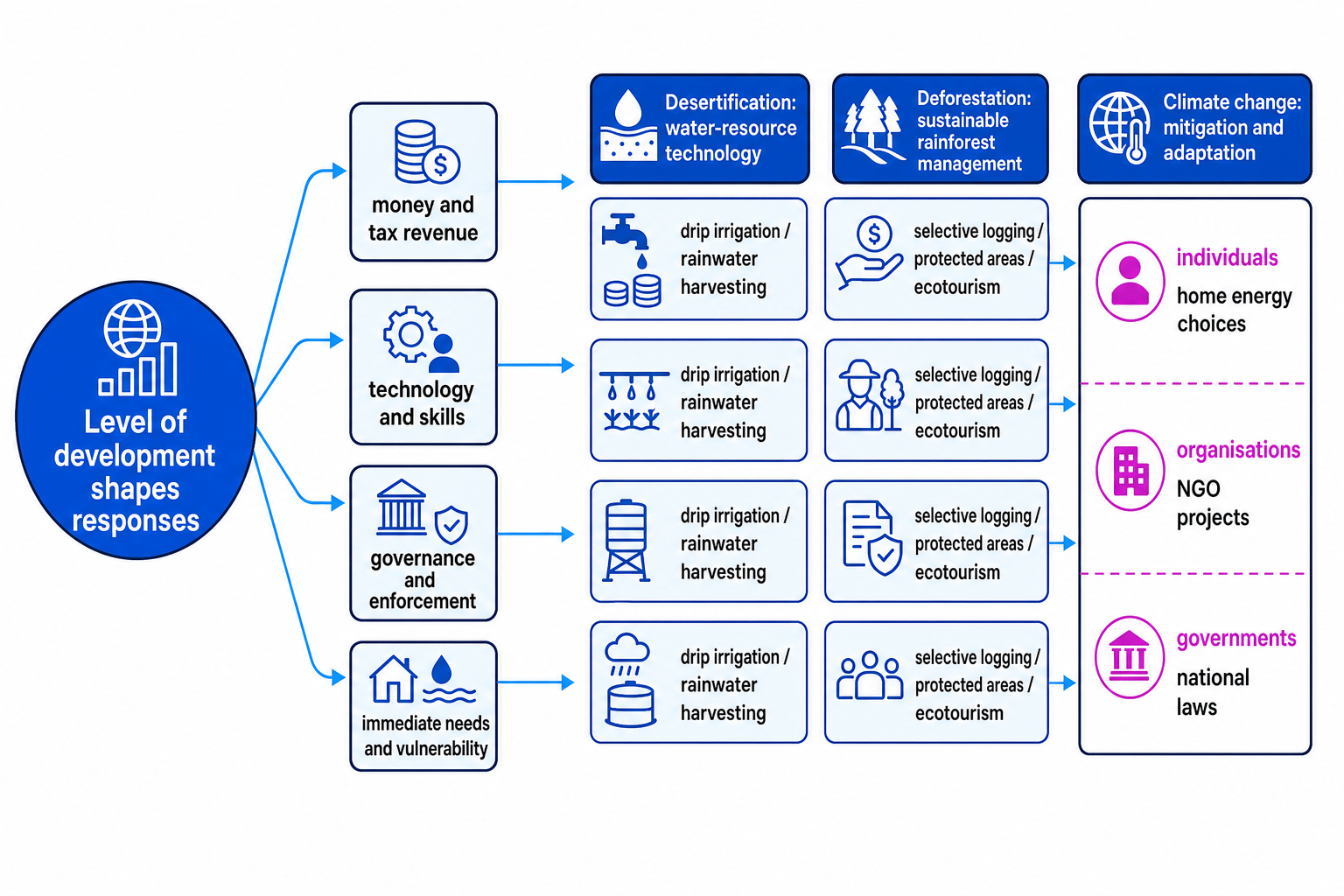
Across all three issues, development affects responses in similar ways:
- Money influences whether countries can afford major engineering, monitoring systems and long-term investment.
- Technology and skills affect whether responses can be built, repaired and improved.
- Governance affects whether laws are enforced, especially for illegal logging or emissions targets.
- Immediate needs matter because poorer communities may prioritise food, water and income over long-term conservation.
- International support can reduce the gap, especially through aid, NGOs and climate finance.
In the exam
-
Name and locate your examples clearly: for example, the Brazilian Amazon, the UK and Bangladesh.
-
Link each response to development: mention money, technology, governance, vulnerability or priorities.
-
For climate change, separate mitigation from adaptation, and include individuals, organisations and governments.
Check yourself
- Why might drip irrigation be more appropriate than a large dam in a Sahel village?
- How can the Brazilian Amazon be managed sustainably without simply banning all economic activity?
- Why does Bangladesh focus more on adaptation than the UK?